Secrets of the Ogham Tree Lore
Celtic Tree Wisdom and the Bnwyfre Spiritual Order inspired by Ogham Tree Lore.
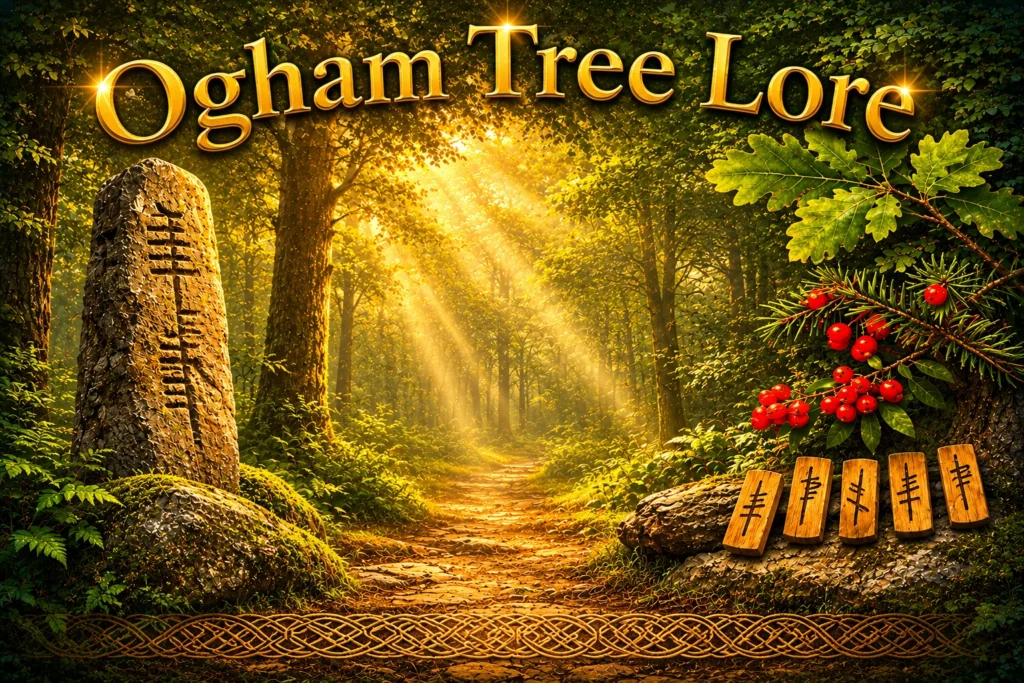
Ogham Tree Lore
The Ogham Tree Lore is a rich and multifaceted tradition that encompasses far more than a simple written language. It is a comprehensive system that serves as a Universal Language, providing a means of symbolic communication rooted in the natural world. It also functions as a Medicinal Log, offering insights into the healing properties and practical applications of trees, plants, animals, vegetables, minerals, the moon phases, the seasons, and the directions, all of which have their part to play.
The Ogham Tree Lore embodies a philosophy, conveying a profound worldview and set of guiding principles. It also represents a theosophy, imparting a deeper understanding of the spiritual realm and the life force energy known as Bnwyfre. This progressive and life-enhancing tradition offers a holistic guide to navigating the complexities of the human experience.
Ogham is often portrayed as the secretive language of the Druids, cloaked in myth and legend. Yet it is far more than a written script. Ogham is a multifaceted expression of medicinal wisdom, philosophy, theosophy, and spiritual belief, preserving an ancient Celtic understanding of the relationship between humanity and the natural world.
Bnwyfre – Breath of Life
This sacred tree alphabet serves as a progressive guide to Bnwyfre, Breath of Life or Life Force Energy that flows through all living things. Ogham transcends the boundaries of conventional language, connecting the physical and spiritual realms through a symbolic system rooted in nature. Its trees, meanings, and associations offer profound insight into the holistic worldview of its Celtic custodians, providing guidance for personal growth, wellbeing, and spiritual understanding. Far beyond a simple coding system, Ogham remains one of the most enduring expressions of Druidic knowledge.
The wisdom and mystical practices of divination, communication, and the expression of intent were preserved and passed through the generations by revered knowledge keepers, Elders, and Druids. Within the Celtic lands, this heritage can be traced back at least 2,500 years, while evidence of comparable symbolic and sacred language systems elsewhere stretches back beyond 3000 BC, suggesting that many of the underlying principles may extend more than 5,000 years into the past.
These traditions represent more than the preservation of ancient knowledge. They reflect humanity’s enduring desire to understand the relationship between the visible and invisible worlds, the natural and spiritual realms, and the life force that flows through all living things. Through Bnwyfre, Ogham offers a path towards greater awareness of the harmony that exists within nature and within ourselves.
Ogham – Gateway to the Trees
1st Aicme –
(Beith)
2nd Aicme – (Huathe)
3rd Aicme –
(Muin)
4th Aicme –
(Ailim)
5th Aicme – (Forfeda)
Holistic
Healing
Explore traditional healing through trees and plants, their properties, preparations and connections with the natural world.
Animal
Spirit
Explore the spiritual correspondences of animals, their folklore, symbolism and relationships with the natural world.
Celtic Totems
& Entities
Explore the beings, spirits and entities that inhabit the Celtic spiritual landscape and connect the physical and spiritual worlds.
Celtic Gods
& Deities
Explore the gods and deities connected with nature, sacred tradition and the deeper correspondences of Ogham.
Secret
Harmonies
Explore the hidden correspondences that connect nature, spirit and human experience through patterns of harmony and relationship.
Celtic Historical Background
This extensive history underscores the profound and enduring significance of these mystical traditions, which have been carefully safeguarded and faithfully transmitted by generations of dedicated custodians. Their continued relevance and transformative power in the modern world speaks to a timeless wisdom and a deep human yearning to commune with the unseen forces that shape our lives and existence. These venerable traditions, having weathered the tides of time, continue to resonate across cultures and centuries, reflecting the universal desire to look beyond the material realm and engage with the mysteries that lie at the heart of creation.
The arrival of the Nordic tribes in Prydain (Britain) brought with it new myths, legends, dialects, and language, which blended with the existing Celtic traditions. It is recognised that the Druids of around 600 BC were already familiar with the language of Socrates and the ancient Greek world. By 400 AD, Latin had become the dominant language amongst the hierarchy of Roman society. Language and dialect also varied considerably between Albion, Prydain, Alba, Erin, and the many regional kingdoms that emerged throughout the British Isles. These names became increasingly familiar following the explorations of Pytheas of Massalia, the Greek geographer who mapped Britain around 325 BC.
Prior to 600 BC, Celtic culture extended across a vast area encompassing much of modern Scandinavia, Germany, France, Spain, Switzerland, Italy, and Greece. The birth of Christ coincided with the rise of the Roman Empire, which accelerated the decline of the Celtic Druid nations and many of their traditions, rites, and rituals. One of the defining features of Druidic culture was the use of a sacred symbolic language that transcended tribal boundaries and regional differences. This language became known as Ogham or Ogam (“ow-em”, “ohm”, or “oh-am”).
The spoken language of these ancient peoples possessed a strongly phonetic character shaped by local dialects and regional influences. The written language likewise reflected these variations through a distinctive script composed of groups of strokes arranged along a central line. Archaeology and the work of dedicated historians have revealed examples carved upon standing stones, boundary markers, and later preserved within manuscripts.
The original Ogham script was not confined to parchment or paper. It was carved into the trunks and branches of trees, inscribed upon standing stones, and marked upon boundary boulders that identified territories associated with Druidic orders and sacred sites. These distinctive markings enabled Druids to recognise one another and identify the sacred Groves under their stewardship. It has also been suggested that the naming of certain Groves may have reflected lunar cycles, with individual Groves associated with one of the thirteen principal trees of the Celtic tree tradition.
Much of our present understanding of ancient Celtic spirituality has emerged through discoveries and reinterpretations made during the 4th, 14th, and 20th centuries. Each period witnessed renewed interest in the traditions of the Druids and contributed fresh perspectives that expanded historical understanding. To explore the Irish fourth-century context and beyond, we rely heavily upon archaeology, surviving manuscripts, folklore, and both direct and circumstantial evidence that illuminate the language, beliefs, and practices of the Celtic Druid.
Tibet – Ogham Tree Lore
Druidic and Monastic Traditions
When examining the expansive plateaus of Tibet, we find communities organised and led by Monks rather than Druids, residing within monastic settlements instead of sacred Groves. Upon closer inspection, we also discover a system of education that mirrors the Druidic tradition, whereby a child is taken into the fold and guided through a series of progressive stages not unlike those of the Druid: Initiate, Novice, Bard, Ovate, Druid, and ultimately Chief Druid or High Priest.
The recording of history through the rhythmic and rhyming mediums of song and oral tradition, carefully handed down from father to son and across generations within the monastic order, is by no means unique. Comparisons with the customs and practices of the Druids reveal striking similarities in the preservation and transmission of historical knowledge and cultural memory.
Within the Druidic tradition, the Bard was responsible for creating comprehensive historical narratives through poetry, prose, and song. Alongside this, the Ovates taught and practised holistic healing formulas, while the Druids themselves sought to understand the principles of local alchemy, philosophy, and spiritual law.
These parallel methods of recording and disseminating knowledge bear a remarkable resemblance to the Tibetan monastic tradition. The distinguishing factor, however, lies in the timeframe of the surviving records. Tibetan monasteries began documenting their history as early as 3000 BCE, preserving their teachings within the revered Vedic scrolls. In contrast, the Roman invasion and occupation of Celtic lands ensured that much tangible evidence of Druidic history was hidden, lost, or destroyed, making the survival of these ancient traditions all the more remarkable.
The Roman invasion ultimately confined the Celtic Druid to the territories of Prydain and its surrounding islands. The Scottish Isles, Ireland, and the Isle of Anglesey became some of the last known strongholds where the culture, traditions, and educational systems of the Prydain Druids continued to thrive despite increasing external pressures and the gradual erosion of their influence.
The survival of these traditions stands as a testament to the resilience of ancient knowledge and the determination of those who preserved it. Though separated by vast distances, the educational structures, oral traditions, and spiritual disciplines of Tibet and the Druids reveal striking echoes of one another, suggesting that the pursuit of wisdom has always followed pathways that transcend geography, language, and time.
Greeks and Druidry
Philosophers, Physicians and Druids
Hippocrates, known today as the founder of Western medicine, was an ancient Greek physician who lived four hundred years before the birth of Christ and whose influence continues to shape modern healthcare. He was among the first to propose that disease was not the result of divine punishment, but a human condition that could be observed, understood, and treated. Living on the remote island of Kos, the father of Western medicine taught students a revolutionary approach to healing that would echo through the centuries.
The rich archaeological evidence found throughout the Northern Hemisphere provides compelling insight into the sophisticated medicinal traditions of the ancient Druids and Celts. From cave paintings and earthenware vessels to historical accounts recorded by Roman scholars, we can clearly see that these indigenous peoples developed a robust tradition of using potions, elixirs, herbs, and natural remedies to treat a wide range of illnesses and ailments.
One example is the use of the Yew Tree, whose needles were employed to lance boils and other skin afflictions. This innovative technique could even be viewed as a precursor to the Rod of Asclepius, the enduring symbol of modern medicine whose origins are associated with the teachings of Hippocrates and the healing traditions of Ancient Greece.
Hippocrates and the Druid Tradition
Hippocrates, often hailed as the father of medicine, was himself the son of another notable figure also named Hippocrates. His teachings were passed down through generations, primarily through oral tradition rather than written documentation. This raises an intriguing question: could we dare to suggest that the Druids, regarded by many as the foremost spiritual and educational influencers of their age, played a role in shaping these profound teachings?
The Hippocratic family remained deeply rooted in their homeland of Kos. Rather than travelling extensively, they drew students from distant lands who sought their wisdom and guidance. This invites an intriguing comparison with the Druids. Their methods of teaching, their reverence for healing, and the environment they cultivated bear notable similarities to Druidry. Might we even view Kos as a form of sacred Grove, a place where knowledge, spirituality, and healing converged?
The Asclepieion of Kos
As our exploration deepens, we encounter the Asclepieion, the renowned international healing temple situated on Kos. Here we discover that Asclepius, revered throughout the ancient world, was said to have imparted esoteric healing knowledge to Hippocrates Senior, including the practices of trance healing and Incubatio.
Incubatio was a remarkable healing method whereby patients entered a sacred chamber and slept in the hope of receiving guidance from divine entities. If sleep proved elusive, opium and other soporific substances could be administered to assist the process.
Upon awakening, the patient would recount their dreams to the healer. These visions were then interpreted and used to guide treatment. Remedies might include medicinal herbs, physical exercise, purification rituals, or other therapeutic measures designed to restore harmony to body, mind, and spirit. In this way, medicine and spirituality were woven together into a single healing tradition.
Dare we make the connection to the Crucifixion of Jesus and suggest that Joseph of Arimathea may have employed a similar method in his efforts to save him during his hour of need?
Trade Routes and the Exchange of Knowledge
The exchange and dissemination of medical knowledge throughout the Celtic world was facilitated by the extensive trade networks that flourished during the Iron Age, both by sea and overland. As goods and resources travelled between distant regions, so too did medicinal practices, healing techniques, and spiritual philosophies.
These traditions were further influenced by neighbouring Greek, Roman, Etruscan, and Persian civilisations, creating a rich tapestry of shared knowledge and innovation.
This complex historical picture raises important questions regarding the origins and transmission of ancient medical wisdom. Did Hippocrates and his students draw inspiration from the Celts, or did the Celts adopt and refine practices learned from the Greeks? While the precise lineage may never be fully determined, the archaeological evidence demonstrates the sophisticated and interconnected nature of traditional Celtic medicine.
The Hippocratic Oath
One translation of a passage from the Hippocratic Oath states:
“I swear by Apollo Physician and Asclepius and Hygieia and Panacea and all the gods and goddesses, making them my witnesses.”
This invocation reminds us that ancient Greek medicine was deeply intertwined with spirituality. Apollo was revered as a god of healing, while his son Asclepius became the patron of physicians. Hygieia, associated with cleanliness and wellbeing, and Panacea, associated with universal remedies, further illustrate the holistic nature of Greek healing traditions.
The inclusion of all gods and goddesses reflects a worldview in which medicine, spirituality, philosophy, and daily life were inseparable. By swearing this oath, physicians pledged not only their commitment to healing but also acknowledged the limitations of human knowledge and the need for divine assistance in their noble work.
Ogham, Socrates, and the Wisdom Traditions
The Ogham Tree Lore embodies the accumulated wisdom of ancient peoples and preserves valuable insights into the treatment of illness, disease, and spiritual wellbeing. When exploring this ancient knowledge, it is equally important to acknowledge the influential thinkers who shaped the intellectual landscape of their age.
Hippocrates of Kos was a contemporary of Socrates of Athens, and the two shared a similar philosophical approach to the pursuit of truth and understanding. Although Socrates left no written works of his own, his student Plato recorded many of his teachings, albeit through the lens of his own developing philosophy.
Hadrian and the Sanctuary of Asclepius
The remarkable figure of Emperor Hadrian also emerges during this period of intellectual and cultural development. His legacy is immortalised in the construction of Hadrian’s Wall, a monumental feat of engineering stretching from coast to coast across Britain. Built to defend Roman territories against incursions from the northern tribes, it remains one of the most enduring symbols of Roman power.
Yet Hadrian’s contributions extended far beyond military architecture. He also played a pivotal role in restoring and promoting one of the greatest healing sanctuaries within the Greek-Celtic Roman world: the Sanctuary of Asclepius.
This revered centre of healing attracted practitioners from many nations who gathered to study medicine, refine their skills, and exchange knowledge. Within its halls, students encountered teachings rooted in both Greek and Latin traditions, creating an environment where healing, philosophy, and education flourished side by side.
As Rome expanded, these traditions interacted with local languages and customs, creating a rich tapestry of cultural exchange. Hadrian’s legacy therefore rests not only in the walls he built, but also in the healing traditions, educational systems, and intellectual exchanges he helped preserve for future generations.
Roman Influence
In contrast to the Druids, the Romans were renowned for their commitment to the preservation and dissemination of knowledge through the written word. They transformed education by placing increasing emphasis upon written records, manuscripts, and documentation, standing in contrast to the largely oral traditions that had dominated much of the ancient world. This shift towards a formalised literary culture had a profound impact upon the preservation and transmission of ideas throughout the Roman Empire and beyond.
One of the most influential figures of this period was Pliny the Elder, the renowned Roman scholar, naturalist, and historian. Through his extensive writings, Pliny chronicled many of the pagan customs, beliefs, and cultural influences that shaped the ancient world during the first century AD. His work provides a valuable window into the traditions of the Greeks, Etruscans, Celts, and Druids, and forms the foundation for many later interpretations of these ancient peoples.
As with any historical source, Pliny’s accounts must be viewed through the lens of his Roman upbringing and cultural perspective. Nevertheless, his writings remain among the most important surviving records of the ancient world and continue to provide invaluable insights into the beliefs and practices of earlier civilisations.
Pliny and the Library of Herculaneum
Pliny the Elder was closely associated with one of the greatest repositories of knowledge in the Roman world, the magnificent library situated at the base of Mount Vesuvius in Herculaneum. This extraordinary collection represented generations of accumulated scholarship and housed a vast treasury of texts, scrolls, and manuscripts.
When Vesuvius erupted in 79 AD, Pliny made the fateful decision to sail towards the disaster. Driven by a sense of duty, curiosity, and a lifelong devotion to knowledge, he sought to observe events first-hand and assist those caught within the unfolding catastrophe.
Tragically, this final voyage led to his death. Yet his actions stand as a testament to the value he placed upon learning, scholarship, and the preservation of knowledge. Whether viewed as heroic, reckless, or both, his final journey remains one of the most remarkable stories in the history of classical scholarship.
The Lost Library and the Vesuvius Challenge
Buried beneath volcanic ash for nearly two thousand years, the library of Herculaneum remained hidden until its rediscovery centuries later. Its surviving contents, comprising approximately 1,800 papyrus scrolls, are now regarded as one of the most important literary collections from the Roman era.
These scrolls contain works from some of the greatest thinkers and historians of the ancient world. For generations, their contents remained inaccessible due to the fragile condition of the carbonised manuscripts. Today, however, advances in technology have transformed what was once thought impossible into reality.
Through the Vesuvius Challenge 2023, researchers are using advanced imaging techniques and artificial intelligence to recover and translate text that has remained unread for almost two millennia. New discoveries continue to emerge, revealing information that has lain hidden since the eruption of Vesuvius itself.
The Druids and Future Discoveries
The mysterious legacy of the Druids continues to hold the promise of further revelation. The rediscovery and ongoing translation of ancient libraries reminds us that history is never truly complete and that new discoveries can dramatically reshape our understanding of the past.
Pliny the Elder possessed a deep fascination with the customs, beliefs, and practices of the Druids. As researchers continue to examine newly recovered texts and forgotten manuscripts, the possibility remains that further references to Druidic culture may yet emerge from the ancient world.
The significance of these discoveries cannot be overstated. Each newly translated scroll has the potential to illuminate forgotten traditions, reveal previously unknown connections, and deepen our understanding of the cultures that shaped Europe long before the modern age. For students of Ogham, Druidry, and Celtic history, the story is far from complete, and the next great discovery may already be waiting beneath the dust of history.
The Druids
The Druids
Just as language evolves to accommodate regional differences, the natural world displays remarkable diversity in its flora, fauna, and landscapes across different geographical regions. Likewise, the gods and deities revered by various cultures often reflect local traditions, environments, and interpretations. Names may change, stories may adapt, yet the underlying principles frequently remain recognisable across vast distances and generations.
The Druids, as spiritual leaders and custodians of Celtic wisdom, embraced this principle of adaptation. Rather than imposing a rigid system of belief, they aligned their teachings with the distinctive characteristics of the regions in which they lived and travelled. By working in harmony with local customs, landscapes, and communities, they introduced new schools of thought, democratic principles, and a profound respect for nature and its cycles.
This approach of working with the natural world rather than against it encouraged an ever-deepening cycle of health, prosperity, harmony, and social cohesion. The Druids’ ability to adapt their teachings to the needs of each community was undoubtedly one of the key reasons for their enduring influence throughout the Celtic world.
The Hallstatt Expansion
We know that the Celts of Hallstatt were familiar with the languages and traditions of the north, and that they travelled westward, eventually reaching Britain and spreading throughout the islands. Along these routes travelled not only people, but also language, culture, rites, rituals, and the deities who accompanied them.
By approximately 400 BC, significant cultural changes had begun to emerge. Funeral customs evolved from cremation and the release of ashes to the wind and earth towards burial practices that committed the dead directly to the land. Language itself was changing, becoming increasingly influenced by Greek and later Latin traditions. The gods and deities also appear to have undergone transformation, becoming more distinctly associated with the British Celts than with their northern predecessors.
The apparent scarcity of northern Celtic deities during this period may reflect the limitations of archaeology, or it may suggest that religious beliefs were themselves evolving alongside the people who carried them.
La Tène and the Iron Age
The rise of La Tène culture is accompanied by an abundance of artefacts that reveal an increasingly sophisticated society. The discovery and widespread adoption of iron transformed Celtic life, creating skilled blacksmiths, advancing agriculture, strengthening warfare, and encouraging trade throughout the northern hemisphere.
The Celtic nations appear to have been among the last major cultures to fully embrace the Iron Age, yet once adopted, iron technology profoundly altered their society. New tools, weapons, and methods of craftsmanship increased productivity and contributed to growing social complexity.
The surviving La Tène artefacts also demonstrate a flourishing artistic tradition. Intricately decorated weapons, jewellery, ceremonial objects, and everyday tools reveal a people whose craftsmanship rivalled that of many contemporary civilisations. These discoveries challenge outdated portrayals of the Celts as primitive or uncivilised, revealing instead a dynamic and highly creative culture.
The Role of the Druids
As Celtic territories expanded, they encountered and absorbed a variety of local cultures, further enriching their traditions and beliefs. Throughout this process, the Druids played a central role as educators, healers, philosophers, judges, diplomats, and spiritual leaders.
Their influence extended far beyond religion. They served as guardians of law, medicine, education, and cultural memory. Through their teachings, knowledge could be preserved and transmitted across generations, helping maintain social cohesion during periods of rapid change and expansion.
This concentration of knowledge within the Druidic order may explain, in part, the remarkable continuity of Celtic culture despite the vast geographical distances over which it spread.
Rome and a Changing World
After weighing the available evidence, this period appears to coincide with the remarkable expansion of the Roman Empire. From the city of Rome, its influence spread northward and westward across Europe. Through military power, political organisation, and economic strength, Rome gradually absorbed or displaced many of the cultures it encountered.
Against this backdrop of sweeping historical change, another event was unfolding that would profoundly shape the future of the western world.
During this same era, a child named Jesus was born, whose teachings would eventually influence nations, philosophies, and spiritual traditions across much of the known world.
Druid Discipline
Druid Discipline
The Druids possessed a profound understanding of the lunar cycle, utilising a 19-year calendar synchronised with the phases of the new moon. This system, known today as the Metonic Calendar, demonstrates a sophisticated level of astronomical knowledge and was recognised, in one form or another, by many ancient cultures throughout the world.
Prominent Greek scholars, including Hippocrates and Socrates, acknowledged the importance of lunar wisdom, recognising its value not only in predicting tides and seasonal changes but also in understanding the energies associated with the new and full moons. The enduring legacy of this lunar reverence can still be seen today in the crescent moon symbols that appear upon many national flags, representing the first light that follows the darkness of the new moon.
Like many ancient civilisations, the Druids relied upon the movements of the moon to forecast the changing seasons. Recent archaeological discoveries suggest that individual moons may have been named after seasonal trees, reflecting a deep and enduring relationship between the Druid and the natural world.
Ogma and the Birth of Ogham
The romantic in me cannot help but observe that Ogma walked this earth during the age of the legendary philosopher Socrates. It was a remarkable period in human history. Mediterranean trade routes were becoming firmly established, connecting distant regions including Cornwall, Bristol, Wales, Ireland, and the wider ancient world. New territories were being explored, new ideas exchanged, and across the northern hemisphere Druidic communities and sacred Groves were flourishing.
Ogma himself was credited with the creation of the Ogham script, a language that would eventually encompass a diverse range of cultures, dialects, and interpretations. Through trade, travel, and cultural exchange, this knowledge spread throughout the Celtic world and beyond.
I would argue that the prevailing historical interpretation, which places the emergence of Ogham within the fourth and fifth centuries AD following the decline of Roman influence, is mistaken. The evidence suggests that the origins of this remarkable writing system may extend much further into antiquity, perhaps as early as 300 BC, predating the commonly accepted chronology by several centuries. If true, this would represent a pivotal moment in the cultural, spiritual, and linguistic development of the ancient Celtic world.
Ogham Across the Celtic Lands
As a developing language stretching across the western regions of the northern hemisphere, Ogham continues to be translated, interpreted, and understood by modern scholars. The island nations of Ireland, the Scottish Isles, Wales, and Cornwall contain a wealth of discoveries that illuminate the evolution and significance of this unique tradition.
These Celtic strongholds have played a crucial role in preserving Ogham as a living expression of cultural identity. The abundance of inscriptions, folklore, manuscripts, and archaeological discoveries found within these regions continues to provide valuable insights into the complexities, symbolism, and significance of Ogham within its historical context.
The Druidic Educational System
The Druidic educational system appears to have been closely aligned with the Metonic Cycle, the nineteen-year lunar calendar in which each moon was associated with a particular tree and a corresponding discipline of study. Learning was therefore intertwined with both the rhythms of nature and the progression of the seasons.
The journey from Initiate to fully fledged Druid is believed to have taken approximately twenty years, although this should be regarded as a general guide rather than a fixed rule. As with any educational system, individual progress varied according to ability, dedication, circumstance, and the path chosen by the student.
This relationship between the lunar calendar, the sacred trees, and the progression of knowledge reveals a highly structured educational framework, one in which nature itself served as both teacher and guide.
Jesus in Britain
Jesus in Britain
It is a well-established urban myth, a legend awaiting proof, that Jesus, under the guidance of Joseph of Arimathea and the mystical influence of Bran the River God, became versed in the sacred teachings and traditions of the Ancient Druids.
According to this tradition, Jesus first encountered Druidic schooling at the age of seven when he was introduced to Druidic practices and rituals by Branwen, sister of Bran, within one of her sanctuaries in Cornwall. Later, at the age of twelve, he is said to have embarked upon a seven-year journey, travelling from one Druidic Grove to another throughout the British Isles, immersing himself in the wisdom, philosophy, and esoteric knowledge of the Druids.
The tradition continues that, following the Crucifixion, Joseph of Arimathea, with the assistance of Bran, transported Jesus to Britain. In later years, Mary Magdalene and other members of the family are also said to have followed.
Evidence Within the Traditions
When we closely examine the biblical texts, there appears to be compelling circumstantial evidence suggesting that Jesus possessed a deep understanding of teachings and practices commonly associated with Druidry.
The parallels between certain Druidic principles and the teachings attributed to Jesus are striking. Whether these similarities emerged through direct contact, shared traditions, or parallel spiritual development remains a matter for discussion. Nevertheless, the possibility invites a broader and more open-minded exploration of the cultural and spiritual influences that may have shaped his remarkable ministry.
The practice of preaching openly before large crowds was unusual within the religious traditions of the period. Spiritual instruction was often private, personal, and confined to established places of worship. When viewed alongside the traditions surrounding the so-called Missing Years, the possibility that Jesus spent time in Britain studying Druidry becomes an intriguing avenue of investigation.
This interpretation gains further support from traditions suggesting that many of the Jewish sects of the time rejected Jesus and denied him entry into their places of worship. Such accounts raise interesting questions regarding where he acquired the confidence, methods, and style of teaching that would later distinguish him from his contemporaries. This is further supported by the fact that Jewish sects of the time forced Pontius Pilate into actions of their choosing.
Joseph of Arimathea and Malachi
Historical accounts concerning Joseph of Arimathea tell us that, as a young man of fifteen, he spent two formative years studying under a figure known as Malachi.
The records describe Malachi as one who:
“Clothed himself with nothing but what the trees brought forth, ate whatever was freely yielded, and washed often by day and by night in cold water.”
This description bears a striking resemblance to the image of a Celtic Druid living in harmony with nature and drawing sustenance directly from the land.
The Gospels provide another intriguing clue, describing a man who:
“Knew how to clothe himself from the fruits of the trees and fed on nothing but what was freely yielded.”
When viewed within the broader context of ancient history, such descriptions suggest the possible presence of Druidic influences within regions far beyond the traditional Celtic lands. Whether interpreted literally, symbolically, or culturally, these accounts raise fascinating questions regarding the movement of ideas, spiritual traditions, and teachers throughout the ancient world.
The Legacy of Jesus in Britain
The tradition of Jesus in Britain remains one of the most enduring and controversial narratives associated with Celtic Christianity. While definitive proof continues to elude historians, the persistence of the tradition across centuries suggests that it occupies an important place within the cultural memory of Britain.
For those willing to explore beyond conventional interpretations, the possibility that Jesus encountered Druidic wisdom offers a compelling perspective through which to view the Missing Years, the development of his teachings, and the enduring relationship between Celtic spirituality and the Christian tradition.
Whether regarded as history, legend, probability, or sacred tradition, the story of Jesus in Britain continues to inspire investigation, debate, and reflection, standing as one of the most intriguing mysteries within both Druidic and Christian lore.
Tree Hugging
Tree Hugging
If the Tibetan Monks led the East into the wisdom of the chakras as a means of understanding the etheric fields and otherworldly realms, then it was the Celtic Druids who led the West into the mysteries of the trees and Tree Lore.
These ancient wisdom keepers of the British Isles developed a profound understanding of the natural world and the sacred role of trees within it. Their intricate system of Tree Lore, known through the traditions of Ogham, served as both a spiritual practice and a practical guide to living in harmony with nature.
The Druids recognised that every tree possessed its own unique energy and spiritual significance. Trees were regarded as living bridges between the earthly and spiritual realms, conduits through which wisdom, healing, and understanding could flow. Much like the chakra system of the East, Tree Lore provided a framework for understanding the subtle energies of the world around us.
Each tree was associated with particular qualities, seasons, and celestial influences, creating a holistic path towards spiritual growth and personal development. Through the trees, the individual could learn to align themselves with the rhythms of the Earth and the deeper mysteries of nature.
Communicating with Trees
Approaching a Tree
There are many ways to meditate with a tree or establish a connection with its unique energy. Every tree, even within the same species, possesses its own distinct character. Developing a general understanding of the process, however, allows meaningful communication with almost any tree.
Where possible, approach the tree from the east. Ask permission to approach, either quietly within your mind or aloud. Remember that there may be many Dryads associated with the tree, each eager to communicate. Ensure that you are speaking with the tree itself and not simply one of its inhabitants. Equally, not every tree wishes to communicate simply because we desire it. Consider whether your own vibration and that of the tree are in harmony.
Observe the height of the tree. Ask yourself whether it would reach you if it fell. Use this distance as a guide for how close you should initially approach its energy.
Take a slow step forward and observe whether you notice any difference in the atmosphere or energy around you. Take another step and observe again. When you begin to sense a change, pause, become calm, and give thanks. Once comfortable, sit quietly at the base of the tree and meditate, reflect, or communicate.
Learning to Sense Tree Energy
For those wishing to practise sensing tree energy, Birch, Alder, and Beech are excellent companions. Their energies are generally gentle, welcoming, and compatible with most people.
If you struggle to recognise what an energetic difference feels like, spend time with a Copper Beech at sunset. Repeating this exercise several times often provides a clear opportunity to experience the distinction between ordinary awareness and the energetic presence of a tree.
Developing sensitivity to trees is rather like acquiring a new sense. The extent to which you cultivate that awareness depends entirely upon your own willingness and commitment.
The Birch possesses a gentle and accessible energy that many people find easy to recognise. The Elder shares similar qualities, although its energy can be more subtle and difficult to interpret.
The Blackthorn, by contrast, presents a far greater challenge. Its energy is powerful, guarded, and often unwelcoming. It can feel like a gruff old hermit with little interest in opening the door to visitors. The Black Poplar can display similar characteristics, while the White Poplar often radiates an uplifting and cheerful energy capable of transforming one’s mood.
The Ancient Oak
Once you begin to understand the principles of communicating with trees, whether literally or metaphorically, every walk becomes an opportunity for discovery.
I have an ancient Oak Tree with which I have maintained a connection for many decades. From anywhere in the world, I am able to communicate with it. It tells me what is happening within its local environment and often provides impressions and visions of the surrounding area.
On one occasion it alerted me to a disturbance along the nearby paths. When I visited later that evening, I discovered that extensive clearance work had stripped the paths and surrounding undergrowth bare, destroying habitats across a considerable distance.
The following morning I contacted the Forestry Department and learned that local school volunteers had been assisting with maintenance work. Later, after concerns had been raised, the work was properly supervised and the methods adjusted.
Who would believe that an ancient Oak Tree could call for help?
For more than forty years I visited that Oak between three and seven times each week. Although I have not physically visited it for over five years, it continues to inform me of events within its surroundings. Through that connection I learned that a nearby Birch Tree had died, that the badgers remained healthy and thriving, and that there was a new owner at the local stables.
Such experiences may be difficult for some to accept, yet they remain part of my own journey with the trees and the living wisdom they continue to share.
Folklore
Folklore
Many nursery rhymes, those cherished snippets of childhood that often dance through our minds, are deeply rooted in incantations, poetry, prose, or rhyme. Among these, none seem to embody the spirit of lyrical creativity quite like the Irish tradition; they appear to have a limerick for every conceivable occasion—celebratory or solemn.
The role of the novice or Bard in ancient communities was one of immense significance; they were tasked with the noble duty of crafting verbal histories and preserving oral records of local events. The most effective way to ensure these tales were remembered over generations was through shanty-like poems imbued with levity and humour that could easily roll off the tongue.
Who could have imagined that a seemingly simple verse like “Ring o’ Ring o’ Roses,” which has become a playful chant for children today, would carry such a profound history? Originally composed during a time when plague swept through London, this rhyme served as an ominous warning to its residents—a reminder to remain vigilant against an invisible enemy that lurked in their midst.
The juxtaposition of such innocent playfulness with a somber historical context illustrates how language and culture intertwine over time. Through these verses, we not only entertain but also connect with our past—reminiscent echoes from centuries ago still resonate within us today.
Celtic Tree Lore – Ogham
Celtic Tree Lore (Ogham)
Celtic Tree Lore (Ogham) is centred around Bnwyfre, an energy that permeates all life. Every life it touches uniquely represents the source. Just as humans have unique fingerprints, all life force energies contain distinct signatures. When these energies combine or harmonise, they epitomise true alchemy. By understanding alchemy, we take a step closer to understanding the spirit world. By accepting the ways of the druid, embracing seasonal changes, the moon’s influence, and geographical shifts, we recognise how the seasons, the moon, our location, trees, plants, and we as individuals refresh our energy every minute of every day.
In doing so, we harmonise the energy around us and literally create Heaven on Earth. through our mindful interactions with the natural world. Each tree within the Celtic tradition serves as a symbol, a vessel of wisdom that offers insights into our own lives. For instance, the Oak is revered for its strength and resilience, reminding us to stand firm in our beliefs even amidst adversity. The Birch, often associated with renewal and new beginnings, encourages us to embrace change and transformation as vital components of our journey.
As we delve deeper into this ancient wisdom, we uncover valuable lessons about interconnectedness the idea that everything exists in relation to everything else. This perspective fosters a sense of reverence for nature and invites us to cultivate awareness of how our actions ripple through the web of life. By honouring these sacred teachings, we learn not just to exist but to thrive in harmony with the energies surrounding us. Moreover, engaging with Celtic Tree Lore can enrich our spiritual practices; it invites reflection on which trees resonate most profoundly with us at different stages of life.
We may find ourselves drawn to specific trees during moments of joy or challenge, each interaction providing guidance tailored uniquely to our experiences. Ultimately, embracing this lore allows us not only to appreciate its beauty but also empowers us towards personal growth and enlightenment. As we weave together the threads of nature’s teachings with our own lived experiences, we begin crafting vibrant tapestries filled with intention that honour both ourselves and Mother Earth, a true embodiment of alchemy in action.