Secrets of the Hawthorn Tree
The Hawthorn Tree (Crataegus monogyna)
Volume 6 of 31
Bruce Clifton
Hawthorn Tree (Huathe)
The Hawthorn Tree brings a sense of enchantment to the familiar British hedgerow. Known within the Ogham as Huath, its white blossom accompanies the arrival of Beltane and the approach of summer, carrying associations with fertility, marriage, celebration and the awakening abundance of the land.
Yet there is far more to Hawthorn than its May blossom. The fairy thorn, the Sidhe and Fae, ancient customs, healing traditions and the extraordinary story of the Glastonbury Thorn have each become entwined with the tree. Its flowers may be gathered in celebration while the living Hawthorn itself has traditionally commanded considerable respect.
Through Celtic Tree Lore, folklore and spiritual tradition, Hawthorn reveals how easily the everyday landscape can become magical. A tree passed countless times beside a field or country lane may hold generations of story among its blossom and thorns, waiting for someone to stop long enough to notice.
Hawthorn Tree – Ogham Tree Profile
Bruce Clifton
Name: Hawthorn
Ogham: Huathe > > > Hoo-arth ~ Hwarth
Letter: H
Lunar: 6th New Moon of the Bnwyfre Celtic Tree Calendar (April 17 – May 15th)
Season: Spring
Element: Earth/Air/Spirit
Direction: East
Moon Phase: Waning Gibbous ~ Third Quarter
Moon Name: Growing ~ Worm
Influence: Feminine
Title: Peasant
Age: Half of a human generation
Aura: Blue
Healing: Alzheimer’s ~ Anti-inflammatory ~ Anxiety ~ Asthma ~ Blood pressure ~ Cholesterol ~ Depression ~ Diabetes ~ Digestion ~ Heart ~ Insomnia ~ Skin Ageing
Animal Spirit: Badger ~ Robin Redbreast
Totems – Entities: Crone ~ Druantia ~ Fairies ~ Joseph of Arimathea
Gods – Deities: Camulos ~ Freya ~ Mars ~ Venus / Aphrodite
Secret Harmony: Apports ~ Astral Travel ~ Communicating with Entities ~ Dream Walking ~ Equilibrium ~ Manifestation (see Apports) ~ Portal ~ Protection
Festival: Beltane (coming soon)
Cosmos: Mars – Venus (coming soon)
Key Words: Wonderment ~ Enchanting ~ Magical ~ Be-witching
Essence of the Hawthorn Tree
Bruce Clifton
Hawthorn rises with the sixth moon, carrying spring from April into May. For much of the year it is the familiar thorn of field and hedgerow, twisted by weather, fiercely armed and seemingly content to be overlooked. Then comes the blossom. Almost overnight, those uncompromising branches disappear beneath a profusion of white flowers, and the tree that guarded the winter landscape becomes one of the great celebrations of approaching summer. This is the essence of Hawthorn: Wonderment ~ Enchanting ~ Magical ~ Be-witching.
There is wildness within that beauty. Hawthorn belongs to Beltane, when warmth returns to the land and life responds with urgency. Blossom carries the promise of fertility, courtship and abundance; petals become garlands, blessings and wedding confetti. Hawthorn does not whisper that life might return. It flowers extravagantly and announces that life has returned.
But the May Tree keeps its thorns. They surround the blossom, shelter the nest and mark the boundary of the hedge. The same tree that offers beauty refuses to become vulnerable because of it. Perhaps this is why Hawthorn has gathered so many stories around itself. The lone thorn is left standing. The fairy thorn is approached with respect. Beneath its branches the familiar landscape can suddenly feel inhabited by something older, unseen and wonderfully close.
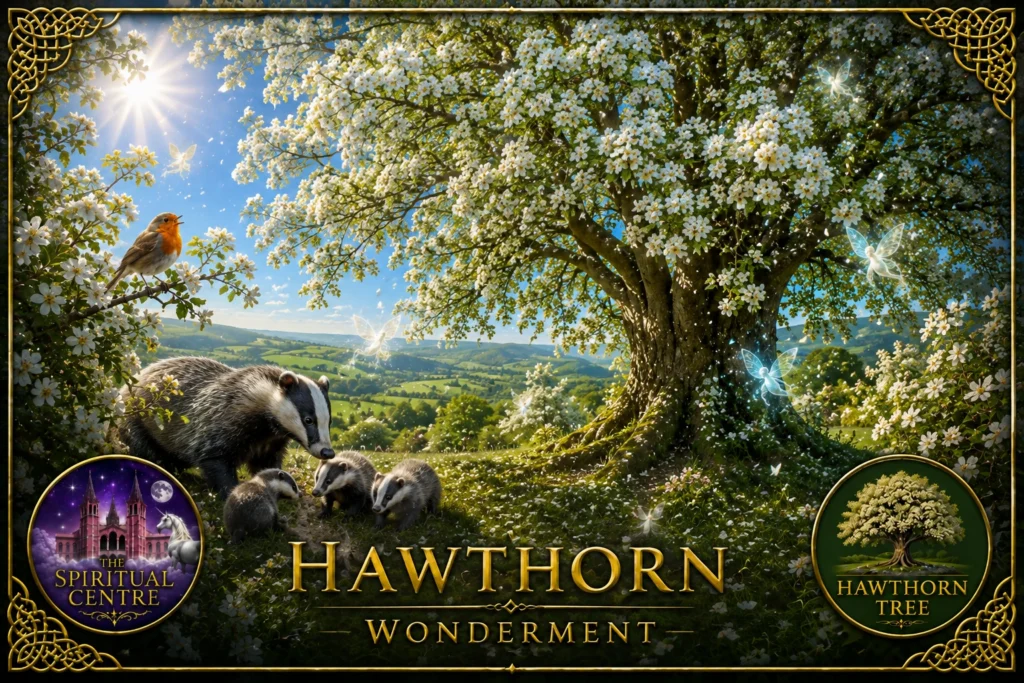
Badger moves beneath its roots while Robin Redbreast sings among its branches. One disappears into ancestral chambers and pathways beneath the earth; the other brings colour and song into the flowering canopy. Between them stands Hawthorn, rooted deeply within the land while its blossom reaches towards light, carrying generations of folklore in the space between.
Human hands have added their stories too. At Glastonbury, the Hawthorn of Joseph of Arimathea is remembered for flowering in the darkness of winter. Elsewhere the May blossom belongs to marriage, fertility and celebration, while traditions warn against treating the tree or its flowers without respect. Christianity, Celtic spirituality, folk custom and fairy lore have all found something within Hawthorn without ever quite possessing it.
And perhaps that is where Hawthorn becomes truly be-witching. Its magic does not depend upon leaving this world for another. It is already here: an old thorn suddenly covered in white blossom; a hidden sett beneath the roots; a robin among the branches; petals falling across a wedding; a solitary tree left untouched because generations remembered that some things should simply be respected.
Hawthorn transforms without becoming something else. Thorn remains thorn. Blossom remains blossom. The ordinary hedgerow becomes extraordinary simply because we have noticed what was there all along. That is Hawthorn’s enchantment — not an escape from the living world, but the wonderment of discovering just how magical the living world can be.
Healing Lore of the Hawthorn Tree
Bruce Clifton
Hawthorn has a long relationship with traditional healing, particularly through its flowers, leaves and berries. These different parts of the tree have been prepared as teas, infusions and other remedies, with Hawthorn becoming especially valued for its association with the heart and circulation.
Within the Healing Lore of Hawthorn, its traditional uses extend beyond the heart to explore the ways this familiar hedgerow tree has supported physical wellbeing across generations.
Scope & Notice
The material shared here reflects traditional knowledge, spiritual practice, and lived experience. It is offered for educational and reflective purposes and is not intended as medical advice or a substitute for professional care. If you are unsure or managing a health condition, consult a qualified practitioner.
Scope of the Healing List
This list of ailments is not complete in its entirety; it has been limited to the most popular, with the remedies coming firstly from the tree and then vegetation dependent on the tree. It is worthy of note that there is more than one way to make a cup of tea, and many of the ingredients can be purchased online.
Hawthorn Tree – Healing Remedies Oracle
We have alphabetised this list of healing qualities of the Hawthorn tree solely for ease of reference, they include but are not limited to:
1) Alzheimer’s
2) Anti-inflammatory
3) Anxiety
4) Asthma
5) Blood pressure
6) Cholesterol
7) Depression
8) Diabetes
9) Digestion
10) Heart
11) Insomnia
12) Skin Ageing
Alzheimer’s / Hawthorn Tree
Ingredients:
Hawthorn Berries
Hawthorn Leaves
Hawthorn Flowers
Key Properties:
Flavonoids – Proanthocyanidins – Antioxidants – Circulatory Tonics
Traditional Actions:
Supports cerebral circulation, nourishes the heart, protects against oxidative stress, steadies cognitive decline
Preparation:
Hawthorn berries, leaves, and flowers may be prepared together as a gentle infusion or tea, taken regularly in small amounts. The berries may also be made into a syrup or preserve, offering a steady and familiar way to receive their benefits. Preparations are taken consistently over time, allowing hawthorn to work quietly within the system rather than forcing change.
Traditional Use:
Where memory begins to soften and drift, and the sense of self feels less anchored, hawthorn has traditionally been turned to as a keeper of the heart’s rhythm and the mind’s connection. It is understood that the mind follows the movement of the blood, and where circulation weakens, clarity may also fade. Hawthorn works gently to restore flow to the head, supporting awareness in a way that is calm and unhurried.
In broader Celtic practice, hawthorn may be accompanied by Birch for renewal and gentle stimulation of vitality, or Willow where inflammation and internal heat may be contributing to imbalance, forming a wider circle of support that tends both the heart, memory, and overall flow of life force. In this way, care becomes a woven practice, held steadily over time rather than sought as a single intervention.
Hawthorn is not used to reverse what has passed, but to hold what remains with dignity, offering steadiness, familiarity, and a quiet sense of continuity where change is unfolding.
Anti-Inflammatory / Hawthorn Tree
Ingredients:
Hawthorn Berries
Hawthorn Leaves
Hawthorn Flowers
Key Properties:
Flavonoids – Proanthocyanidins – Antioxidants – Anti-inflammatory compounds
Traditional Actions:
Reduces inflammation, supports circulation, soothes vascular irritation, restores balance within tissues
Preparation:
Hawthorn berries, leaves, and flowers may be prepared as a gentle infusion or tea, taken regularly to allow their properties to build gradually within the body. The berries may also be made into a syrup or preserve, offering a steady and nourishing form of support. Preparations are traditionally taken over time, allowing hawthorn to work through circulation rather than immediate effect.
Traditional Use:
Where inflammation lingers within the body, often carried through the blood and vessels, hawthorn has been used to calm irritation and restore natural flow. Rather than acting directly upon surface symptoms, it works through the heart and circulatory system, easing the underlying movement that feeds inflammation.
Within broader Celtic practice, hawthorn may be supported by Willow where deeper inflammatory discomfort is present, or Rowan where cleansing and release are required, forming a balanced approach that cools, clears, and restores harmony within the system. In this way, hawthorn offers a steady, circulatory pathway to reducing inflammation, held gently over time.
Anxiety / Hawthorn Tree
Ingredients:
Hawthorn Berries
Hawthorn Leaves
Hawthorn Flowers
Key Properties:
Flavonoids – Proanthocyanidins – Nervine support – Circulatory Tonics
Traditional Actions:
Calms the nervous system, steadies the heart, eases emotional tension, supports restful rhythm
Preparation:
Hawthorn berries, leaves, and flowers may be prepared as a gentle infusion or tea, taken regularly in small amounts. The berries may also be made into a syrup, offering a comforting and steady form of support. Preparations are traditionally taken over time, allowing hawthorn to settle the system gradually.
Traditional Use:
Where anxiety unsettles the heart and breath, and the inner rhythm becomes irregular or strained, hawthorn has long been used to restore calm through the heart itself. It does not suppress feeling, but steadies the emotional current, allowing the body to return to a more natural pace.
Within Celtic practice, hawthorn may be supported by Apple for emotional softness and reassurance, or Willow where tension and internal strain are held within the body, forming a gentle and grounding approach to easing anxiety. In this way, hawthorn offers a quiet holding presence, bringing steadiness, reassurance, and a sense of inner balance.
Asthma / Hawthorn Tree
Ingredients:
Hawthorn Berries
Hawthorn Leaves
Hawthorn Flowers
Key Properties:
Flavonoids – Proanthocyanidins – Circulatory Tonics – Mild Antispasmodic Support
Traditional Actions:
Supports breath and circulation, eases chest tightness, steadies heart rhythm, soothes respiratory strain
Preparation:
A light hawthorn preparation may be taken as a warm infusion, or the berries may be preserved as a simple syrup, allowing for steady and familiar use over time.
Traditional Use:
Where breathing becomes tight or restricted, and the chest feels held or strained, hawthorn has been used to support the relationship between heart and breath, recognising that the rhythm of breathing is closely tied to the movement of blood. By improving circulation and steadying the heart, hawthorn may help ease the sense of constriction and bring a more open, settled breath.
Within Celtic practice, hawthorn may be supported by Ivy where mucus and congestion are present, or Willow where inflammation contributes to restriction, forming a balanced approach that opens the chest while calming underlying strain. In this way, hawthorn offers a gentle and steady support to the breath, working through rhythm rather than force.
Blood Pressure / Hawthorn Tree
Ingredients:
Hawthorn Berries
Hawthorn Leaves
Hawthorn Flowers
Key Properties:
Flavonoids – Proanthocyanidins – Vasodilatory support – Circulatory Tonics
Traditional Actions:
Regulates blood pressure, supports healthy circulation, strengthens heart function, eases vascular tension
Preparation:
Hawthorn may be taken as a light infusion prepared from its berries, leaves, and flowers, or the berries may be preserved as a simple syrup for steady use. Preparations are traditionally taken regularly, allowing the effects to build gently over time.
Traditional Use:
Where blood pressure rises or falls beyond its natural balance, hawthorn has long been regarded as a restorer of circulatory harmony, working through the heart and vessels to bring steadiness and ease. It does not force change, but supports the body in finding its own rhythm, easing pressure where it is high and strengthening tone where it is low.
Within Celtic practice, hawthorn may be supported by Vine where vessel tone and circulation require strengthening, or Olive where calming and gentle regulation are needed, forming a balanced approach to maintaining healthy blood flow and pressure. In this way, hawthorn offers a steady and harmonising influence, held over time through consistent use.
Cholesterol / Hawthorn Tree
Ingredients:
Hawthorn Berries
Hawthorn Seed
Hawthorn Berry Skin
Key Properties:
Flavonoids – Proanthocyanidins – Lipid-regulating compounds – Antioxidants
Traditional Actions:
Supports healthy cholesterol levels, assists lipid balance, protects blood vessels, encourages clear circulation
Preparation:
Hawthorn berries may be gently simmered to draw out their deeper compounds, or taken as a thicker preserve where both the seed and skin remain intact, allowing the full quality of the fruit to be received over time.
Traditional Use:
Where cholesterol gathers and the blood becomes heavier or more burdened, hawthorn has been used to support the clearing and balancing of the vessels, working through the nourishment and movement of the blood itself. Its action is steady, helping to maintain openness within the circulatory pathways rather than forcing reduction.
Within Celtic practice, hawthorn may be supported by Vine where vessel strength and blood movement require attention, or Apple where gentle renewal and cleansing are needed, forming a balanced approach to supporting cholesterol and long-term heart health. In this way, hawthorn offers a quiet clearing influence, held consistently over time.
Depression / Hawthorn Tree
Ingredients:
Hawthorn Flowers
Hawthorn Young Leaves
Hawthorn Buds
Key Properties:
Flavonoids – Proanthocyanidins – Mild Nervine Support – Heart Tonics
Traditional Actions:
Lifts emotional heaviness, steadies the heart, supports nervous balance, restores gentle vitality
Preparation:
Hawthorn flowers and young leaves may be taken as a light infusion, while the buds may be included in small quantities, allowing a softer, more subtle preparation that supports the system over time.
Traditional Use:
Where the spirit feels heavy and withdrawn, and the heart carries a quiet weight, hawthorn has long been used to gently lift emotional burden through the heart itself. It does not force brightness, but restores warmth and movement, helping the individual reconnect with a sense of inner presence.
Within Celtic practice, hawthorn may be supported by Apple for emotional renewal and softening, or Birch where a fresh beginning and renewed vitality are needed, forming a compassionate and steady approach to easing depression. In this way, hawthorn offers a quiet returning, bringing lightness back to the heart over time.
Diabetes / Hawthorn Tree
Ingredients:
Hawthorn Berries
Key Properties:
Flavonoids – Proanthocyanidins – Antioxidant support
Traditional Actions:
Protects vessels, supports circulation under metabolic strain
Preparation:
The berries may be gently simmered to form a simple decoction, or taken as a preserve in small, regular amounts, allowing their qualities to build steadily within the body.
Traditional Use:
Where blood sugar imbalance places quiet strain upon the system, hawthorn has traditionally been used to support the integrity of the blood and vessels, helping the body carry its burden with greater steadiness. It does not act directly upon sugar levels, but works through the circulatory pathways that are often affected over time, offering protection and continuity where decline might otherwise take hold.
Modern study has explored hawthorn’s role in vascular protection and oxidative stress reduction, which reflects its long-standing use in supporting the health of the blood and heart under sustained pressure.
In Celtic practice, it may be accompanied by Birch for cleansing and metabolic renewal, forming a balanced and steady approach to long-term support.
Digestion / Hawthorn Tree
Ingredients:
Hawthorn Berries
Key Properties:
Flavonoids – Organic acids – Digestive tonics
Traditional Actions:
Encourages digestive movement, eases fullness and heaviness, supports appetite, restores digestive rhythm
Preparation:
The berries may be gently prepared as a warm infusion or taken as a simple preserve, often used around mealtimes, allowing their qualities to support the natural process of digestion without force.
Traditional Use:
Where digestion becomes slow or burdened, and the body feels heavy after food, hawthorn has traditionally been used to encourage the quiet movement of digestion, helping the system process nourishment with greater ease. Its influence is not sharp or stimulating, but steady and supportive, easing the sense of stagnation and bringing a more comfortable rhythm to the stomach.
It is often turned to where eating no longer brings lightness but weight, where the body holds rather than flows. In these moments, hawthorn works to restore a natural relationship with nourishment, allowing digestion to settle and resume its own pace.
Within Celtic practice, it may be accompanied by Apple for gentle digestive balance, or Rowan where clearing and release are needed, forming a broader approach that supports both movement and renewal within the digestive system.
Heart / Hawthorn Tree
Ingredients:
Hawthorn Berry
Key Properties:
Flavonoids – Proanthocyanidins – Cardiac tonics – Antioxidants
Traditional Actions:
Strengthens the heart, supports circulation, regulates rhythm, nourishes the vessels
Preparation:
The berry may be taken as a slow decoction or as a thick preserve, allowing its deeper qualities to be drawn out and received gradually over time.
Traditional Use:
Where the heart grows tired, irregular, or strained, hawthorn has long been regarded as a primary ally of the heart, working to restore strength, rhythm, and resilience within the circulatory system. It does not act with force, but with a steady, sustaining presence, supporting the heart in finding its natural pace.
It is often turned to in times of both physical weakness and emotional burden, recognising that the heart carries more than blood alone. In this way, hawthorn works on both levels, helping to strengthen the physical heart while softening the weight it may carry.
Modern study has explored hawthorn’s role in cardiac function, circulation, and vascular tone, reflecting its long-standing place as a heart-supporting remedy.
Within Celtic practice, it may be supported by Vine for vessel strength and circulation, forming a complete and steady approach to heart health.
Insomnia / Hawthorn Tree
Ingredients:
Hawthorn Blossom
Key Properties:
Flavonoids – Mild nervine support – Calming tonics
Traditional Actions:
Calms the nervous system, steadies the heart rhythm, eases restlessness, encourages natural sleep
Preparation:
The blossom may be taken as a warm evening infusion, prepared lightly and sipped slowly, allowing the body to settle into rest.
Traditional Use:
Where sleep becomes broken or distant, and the mind continues to move long after the body seeks rest, hawthorn has traditionally been used to quiet the heart and soften the inner rhythm, allowing sleep to return in its own time. It is not a forcing remedy, but one that creates the conditions for rest, easing tension and calming the subtle agitation that keeps the body awake.
It is often turned to where sleeplessness is linked to emotional strain or an unsettled heart, bringing a sense of reassurance and steadiness as the night draws in. In this way, hawthorn supports a gentle return to natural sleep, held through calmness rather than sedation.
Within Celtic practice, it may be supported by Apple for emotional ease or Willow where tension and discomfort disturb rest, forming a quiet and balanced approach to restoring sleep.
Skin Ageing / Hawthorn Tree
Ingredients:
Hawthorn Berry Skin
Key Properties:
Flavonoids – Proanthocyanidins – Antioxidants
Traditional Actions:
Protects skin vitality, supports circulation to the skin, reduces oxidative stress, maintains tone and resilience
Preparation:
The outer skin of the berry may be included in a light infusion or used within a simple preparation, allowing its protective qualities to be taken in gradually over time.
Traditional Use:
Where the skin begins to lose its tone and brightness, hawthorn has traditionally been used to support the circulation that nourishes the skin, helping to maintain clarity, resilience, and natural vitality. Its action is subtle, working from within through the movement of blood and the protection of cells, rather than acting upon the surface alone.
It is often turned to where ageing reflects not only time, but reduced flow and nourishment, restoring a gentle vitality that supports the skin’s natural expression. In this way, hawthorn offers a quiet preservation of form, held through steady support rather than intervention.
Within Celtic practice, it may be supported by Apple for renewal and brightness, or Blackthorn where deeper resilience and structural strength are needed, forming a balanced approach to maintaining healthy, ageing skin.
Celtic Tree Lore of the Hawthorn Tree
Bruce Clifton
Hawthorn belongs to the turning of the year towards summer. Its white blossom fills the hedgerows around Beltane, transforming a tree of formidable thorns into one of the most conspicuous signs of May. Within Celtic Tree Lore, this contradiction is part of Hawthorn’s character: beauty and defence, fertility and protection, invitation and boundary all exist upon the same tree.
Known as Huath within the Ogham tradition, Hawthorn carries the vitality of the May Tree. Beltane celebrates the return of warmth, fertility and abundance, and Hawthorn flowers as the land itself becomes increasingly fertile. Blossom, sexuality, courtship and the promise of new life consequently gather naturally around the tree.
May Blossom, Marriage and Fertility
Hawthorn blossom became closely associated with May celebrations, courtship and marriage. Its flowers could be gathered for garlands and seasonal decoration, while the abundance of blossom provided an obvious symbol of fertility. Scattered petals eventually found another expression as wedding confetti, carrying wishes of love, prosperity and fruitful union.
Traditions that celebrate its blossom outdoors often regard bringing flowering Hawthorn into the home very differently. In British folklore, May blossom could be considered unlucky indoors, particularly outside the appropriate seasonal or ceremonial setting. Hawthorn therefore retains something of its boundary: the blossom may be welcomed and celebrated, but the tree itself demands respect.
The older text also connects the gathering of Hawthorn blossom on Friday with Freyja, the Norse goddess associated with love, fertility and desire. This is better understood as a neighbouring Germanic and Norse correspondence rather than Celtic tradition. Friday’s name ultimately belongs to that wider Germanic family of goddesses, while the association nevertheless complements Hawthorn’s established themes of fertility, love and marriage.
The Fairy Thorn
Perhaps nowhere is Hawthorn’s Celtic identity more distinctive than in its relationship with the Sidhe and the Fae. A solitary Hawthorn, particularly one growing upon an ancient mound, beside a sacred well or in an otherwise unusual position, may become the fairy thorn: a tree belonging not simply to the human landscape but to those who inhabit the Otherworld.
Such trees traditionally command respect. Cutting or destroying a fairy thorn can invite misfortune, while leaving the tree undisturbed acknowledges that the landscape contains boundaries and inhabitants beyond ordinary human ownership. The thorns themselves become wonderfully appropriate: Hawthorn flowers openly and abundantly, yet approaching what it protects is never entirely without consequence.
At Beltane, when Hawthorn is covered with May blossom, the relationship becomes particularly vivid. The tree stands between the cultivated landscape and the wild hedge, between spring and summer, and within spiritual tradition between the familiar world and the realm of the Fae. Its blossom brings wonderment and enchantment, while its thorns preserve the integrity of what lies within.
This is why Hawthorn remains much more than a beautiful flowering tree within Celtic Tree Lore. Huath is the May Tree, the marriage tree and the fairy thorn — flowering with fertility and possibility while retaining the protection, mystery and bewitchment that ensure its secrets are never surrendered too easily.
Folklore of the Hawthorn Tree
Bruce Clifton
The Glastonbury Thorn and the Staff of Joseph
Few Hawthorn traditions are as enduring as that of the Glastonbury Thorn. According to legend, Joseph of Arimathea arrived in Britain around 40 AD and, upon reaching Wearyall Hill at Glastonbury, thrust his staff into the ground. The staff took root and grew into a Hawthorn, giving rise to one of Britain’s most persistent Christian legends.
The remarkable character of the Glastonbury Thorn lies in its unusual flowering. Traditionally, the tree is said to blossom around Christmas as well as in spring, its white flowers appearing during the darkness of winter. Descendants and cuttings associated with the original thorn have helped the tradition survive even as individual trees have been damaged, removed or died.
The story transformed Hawthorn from a familiar tree of hedge and field into something sacred. At Glastonbury, its winter blossom became a sign of renewal, endurance and divine presence, while the tree itself became inseparable from the wider spiritual landscape surrounding Glastonbury Abbey and Chalice Well.
Whether the original thorn truly grew from Joseph’s staff belongs to folklore rather than provable history. Yet the longevity of the tradition is itself significant. For generations, people have travelled to Glastonbury not simply to see a Hawthorn, but to encounter a living tree around which almost two thousand years of belief, pilgrimage and storytelling have gathered.
Joseph, the Huathe Grove and the Waters of Wells
A much broader tradition surrounds Joseph’s supposed journey through Britain. Within this lore, Joseph becomes High Priest of the Huathe Grove and Sage or Bard to the Druids, establishing a church at Wells in Somerset and bringing with him teachings associated with Jesus and the emerging Christian faith.
The Huathe Grove, together with traditions surrounding Bran the Blessed, Branwen and the Ohn Grove, places the story within an extraordinary meeting of spiritual cultures. Joseph is no longer simply the Christian traveller of the Glastonbury legend; he becomes part of a landscape already understood through groves, sacred waters, Druids and the spiritual customs of Britain.
The tradition continues with James, described within the story as the son of Jesus, whose baptism at Wells becomes an act of union between different peoples and beliefs. The armies of Bran, Prostragus and Beli Mawr are said to have entered the river from the east bank, immersed themselves and emerged from the west bank before continuing towards St Albans to fight alongside Boadicea.
Here, water and Hawthorn become part of the same sacred landscape. The grove represents rootedness and continuity, while the river provides movement, cleansing and passage. Those entering the water symbolically leave one state behind and emerge into another before continuing towards battle.
These traditions weave together Hawthorn, Glastonbury, Wells, Druidic groves, early Christianity and the legendary rulers of Britain. History cannot substantiate every strand of the story, nor does folklore require it to. Its importance lies partly in the memory it preserves: an enduring belief that Hawthorn stood within places where different spiritual traditions could meet, intertwine and leave their stories rooted in the British landscape.
Animal Spirit of the Hawthorn Tree
Bruce Clifton
The Animal Spirit of the Hawthorn Tree moves both above and beneath the ancient hedgerow. Badger creates its hidden world below the roots, following pathways used by successive generations and returning to established setts within the same territory.
Robin Redbreast brings a very different presence to Hawthorn. Among its branches and brilliant May blossom, The red breast of Robin and the thorns of Hawthorn also meet within Christian folklore through the story of Christ’s crown of thorns.
Together, Badger and Robin reveal two different aspects of Hawthorn.
Hawthorn Tree – Animal Spirit Oracle
Bruce Clifton
We have alphabetised this list of animal spirit that harmonise with the hawthorn tree solely for ease of reference:
1) Badger
2) Robin Redbreast
Badger / Hawthorn Tree
Beneath the thorny embrace of the Hawthorn, where blossoms scent the spring air and the veil between worlds grows thin, the badger quietly emerges from its ancient sett. Long before mankind marked the boundaries of the land, badgers carved their homes beneath the roots of Britain’s oldest hedgerows, passing them from one generation to the next. Like the Hawthorn itself, they are faithful guardians of place, returning season after season to the ground that has always sustained them.
The Hawthorn has long been regarded as the keeper of sacred boundaries, standing watch where fields meet forests and where the seen world touches the unseen. The badger honours those same boundaries beneath the earth, travelling hidden paths known only to itself. Together they remind us that not every doorway is meant to be crossed in haste. Some are entered only with patience, humility and respect for the ancient spirits that dwell there.
Within the Bnwyfre Spiritual Order, the badger teaches us to remain rooted in the wisdom of our ancestors whilst the Hawthorn encourages us to pause before every new threshold. Their partnership reveals that true strength is rarely loud or forceful. Like the hidden sett beneath the flowering tree, the deepest wisdom is often found quietly beneath the surface, waiting for those prepared to seek it with an open heart.
Robin Redbreast / Hawthorn Tree
As the Hawthorn bursts into blossom and the woodland awakens beneath the warmth of spring, the cheerful song of the Robin Redbreast announces that winter has finally loosened its grip. Perched amongst the snowy-white flowers, the robin becomes the herald of Beltane, carrying hope, renewal and the promise of brighter days. Few birds are more closely associated with our gardens, churchyards and ancient hedgerows, where the Hawthorn has long stood as guardian of the sacred boundary between the seen and unseen worlds.
Ancient Christian tradition tells us that the Robin Redbreast plucked a thorn from the crown worn by Jesus during the crucifixion. In doing so, a drop of sacred blood fell upon its breast, leaving the crimson marking it has carried with honour ever since. Whether history or legend, the robin has become a symbol of compassion, sacrifice and faithful service, qualities reflected in its fearless nature and gentle song.
The robin is often called the church bird, appearing in churchyards and cemeteries where memory and love linger quietly amongst the ancient stones. Once it has captured your attention, it seems to appear everywhere until its message is understood. Within the Bnwyfre Spiritual Order, the robin is recognised as a messenger, bringing reassurance that a loved one has drawn near in their hour of need. Together, the Robin Redbreast and the Hawthorn remind us that every ending gives way to a new beginning, and that beyond every sacred threshold there remains hope, love and the quiet presence of those who continue to walk beside us.
Totems and Entities of the Hawthorn Tree
Bruce Clifton
The Totems and Entities of the Hawthorn Tree belong to a landscape where the seen and unseen exist alongside one another. An old Hawthorn standing alone in a field, beside a well or upon a boundary is more than a feature of the land; within Celtic spirituality and folklore, it can become a dwelling, a meeting place and a point of presence for those whose existence extends beyond the immediately visible world.
This relationship gives Hawthorn its distinctive sense of enchantment. The Sidhe, Fae and other elemental or Otherworldly beings associated with the tree are not simply decorative figures within its folklore. They express an understanding that certain places possess their own inhabitants, boundaries and customs, and that entering such a place requires recognition and respect.
The thorns of Hawthorn reinforce this relationship. They create a natural enclosure around blossom, branch and living space, establishing protection without isolation. What exists within remains connected to the surrounding world, yet the boundary itself is unmistakable. Hawthorn can therefore become both sanctuary and threshold, protecting those who belong while marking the point at which another presence may be encountered.
Through its Totems and Entities, Hawthorn reveals a world that is magical without being imaginary and mysterious without being inaccessible. Wonderment, enchantment and bewitchment arise from the possibility that the landscape contains far more life and awareness than can immediately be seen, and that beneath the flowering branches of Hawthorn, those different worlds may occasionally draw very close.
Hawthorn Tree – Totems and Entities Oracle
Bruce Clifton
We have alphabetised this list of totems and entities that harmonise with the hawthorn tree solely for ease of reference:
1) Crone
2) Druantia
3) Fairies
4) Joseph of Arimithea
Crone / Hawthorn Tree
The Hawthorn Tree has always stood in the threshold places of the land: hedgerows, boundary lines, old pathways, and the meeting ground between the known world and the unseen. For this reason Hawthorn belongs deeply with the Crone, the elder guardian who watches where worlds touch and ensures that harmony, respect, and sacred order are maintained. Where others see only blossom and thorn, she recognises gateways, timing, and consequence.
The Crone is the unseen sentinel beside Hawthorn. She encourages the fae, guides wandering spirits, and blesses those who approach with sincerity. In old lore, Hawthorn was never merely a shrub of the field. It was a living boundary tree, a place where the fairy folk, the sidhe, and the subtle presences of nature moved close to human life. The Crone stands among these currents as keeper of balance, ensuring no realm overwhelms another.
She understands the double nature of Hawthorn perfectly. In spring it flowers in beauty and fragrance, crowned in white blossom. Yet its branches bear thorns, teaching that all true blessings require discernment, boundaries, and reverence. Love without wisdom can wound. Protection without compassion can harden. The Crone holds the middle path, where heart and judgement walk together.
Old customs of courtship, handfasting, and May marriage also belong here. After a year and a day of proving devotion, couples who honoured the sacred rhythms of love were said to receive blessings through Hawthorn blossom. In this tradition, the petals carry the favour of the Crone, of Druantia, of the fairy folk, and of the wider living world. Hawthorn becomes not only a tree of romance, but a witness to vows made with integrity.
Later in the year Hawthorn offers its red berries, long associated with the heart, resilience, and emotional strength. This too is the Crone’s teaching. She knows the heart is not sustained by fantasy alone, but by endurance, truth, forgiveness, and the courage to love wisely after disappointment. Her medicine is mature love, not naïve longing.
Within The Spiritual Centre, Hawthorn and the Crone speak to those crossing life’s thresholds: love, loss, menopause, solitude, healing, and the reclaiming of personal authority. They remind us that there is beauty in maturity, power in boundaries, and blessing in wisdom earned through experience.
Druantia / Hawthorn Tree
The Hawthorn Tree has long stood in the threshold places of the land: hedgerows, old trackways, field boundaries, and the meeting ground between the human world and the unseen. For this reason Hawthorn belongs naturally with Druantia, Queen of the Dryads, guardian of woodland law, and mother of the earth-tied intelligences that move through root, leaf, and hidden grove. Where Hawthorn marks the boundary, Druantia keeps the balance.
Druantia is remembered as protector not only of the dryads within the trees, but also of the fae, fairies, and the sidhe, whose movements are often felt around Hawthorn. In old lore, Hawthorn was never approached carelessly. It was honoured as a gateway tree, a place where blessing and consequence stood side by side. Druantia watches over such places, ensuring that those who arrive with reverence may receive abundance, while those who mock sacred order meet only their own folly.
Though often associated with the Fir Tree or ancient woodland pines, Druantia’s sovereignty is not limited to one species. She moves wherever nature’s intelligence requires guardianship. In Hawthorn she is felt differently: less as mountain majesty and more as subtle vigilance, beauty joined with boundary, and grace joined with discernment. The white blossom of spring and the thorned branch speak the same truth she teaches: love must be protected and power must remain rooted in wisdom.
There are other elder presences here too. The old Crone, remembered as Hylde Moer, is also said to watch the threshold paths. This does not diminish Druantia, but deepens the mystery. Sacred places often hold more than one guardian, just as forests hold many forms of life within one living body.
Later in the year Hawthorn offers red berries, signs of vitality, heart-strength, and life carried through the darker months. Druantia governs this rhythm of flourishing and preservation. She knows when to open the blossom and when to harden the seed, when to welcome and when to withhold. Such timing is the essence of true guardianship.
Within The Spiritual Centre, Hawthorn and Druantia speak to those seeking protection, wise boundaries, fertility, love, and right relationship with the unseen world. They remind us that the land is generous, but never careless, and that blessing flows most freely where reverence is kept.
Fairies – Fae – Sidhe / Hawthorn Tree
The Hawthorn Tree has long been one of the most cherished trees of the faerie realms, standing in hedgerows, boundary places, old tracks, and fields where the ordinary world meets the unseen. For this reason Hawthorn belongs naturally with the fairies, who thrive in its atmosphere of harmony, threshold magic, and living enchantment. Where Hawthorn grows, the old stories say the hidden world is never far away.
Fairies are said to dance between realms around Hawthorn, moving through blossom, shadow, birdsong, and twilight air. They are not bound by the limits of physical sight, yet many have felt their presence as sudden joy, watchful stillness, or the unmistakable sense that a place is more alive than it first appeared. Hawthorn creates such places naturally.
Its spring flowers carry a special reputation in folklore. The petals of Hawthorn blossom, gathered at Beltane, were said to entice the fairy folk into the open, blessing homes, lovers, and communities with joy, fertility, prosperity, and good fortune. To scatter the petals was not merely decoration, but an act of welcome to the unseen powers of growth and celebration.
Yet Hawthorn is not only softness and bloom. Its branches bear thorns, reminding us that sacred gateways are protected as well as beautiful. The fairies linked with Hawthorn are therefore not simple ornaments of nature. They are guardians of balance, keepers of old boundaries, and protectors of the mystery that should not be carelessly handled.
Children have often been thought especially close to this tree and its presences, sensing what adults have forgotten how to notice. To sit quietly beside Hawthorn with an open heart is to remember that perception begins with receptivity, not force. The fairies come nearer to wonder than to demand.
Within The Spiritual Centre, Hawthorn and the fairies speak to those seeking love, blessing, renewal, intuition, playful joy, and reconnection with the enchanted life of the land. They remind us that some gates open not with keys, but with reverence, delight, and the willingness to believe that more is present than meets the eye.
Joseph of Arimithea / Hawthorn Tree
The Hawthorn Tree has long been honoured as a tree of thresholds, protection, sacred boundaries, fertility, blessing, and the meeting of worlds, making it a natural companion to Joseph of Arimathea within the sacred traditions of Britain. Where hedgerow meets field, where path meets woodland, and where the visible world draws close to the unseen, Hawthorn stands as guardian of transition. Joseph, too, is remembered as a keeper of passages, carrying wisdom safely from one age into another.
Within the tradition held here, Joseph had many interactions with the Druids of Britain. His knowledge of herbs, healing remedies, and practical alchemy made him a figure of mutual respect among the wisdom schools of the land. In this telling, he was welcomed as an ovate of the Huathe Grove, one who understood the virtues of plants, the hidden properties of nature, and the relationship between healing and spirit. The story speaks not of conquest, but of exchange, recognition, and shared reverence for wisdom.
Hawthorn deepens this union because it has long been linked with May blossom, handfasting, sacred beginnings, and protective gateways. It is a tree of new life, yet one guarded by thorns, reminding us that what is holy must be approached with right intent. Joseph’s role carries the same atmosphere. He does not force open doors. He honours the threshold and prepares the way for what must come next.
At Wearyall Hill, Joseph is said to have planted his staff into the earth, where it rooted and flowered as the Glastonbury Thorn, a sacred form of hawthorn. The traveller’s staff becomes living tree, a symbol of journey become home, pilgrimage become rooted presence, and memory become landscape. Its winter flowering came to represent hope in darkness, life beyond ordinary seasons, and continuity preserved through the sacred cycles of Britain.
The mystery of the Glastonbury Thorn continues into the present day through the old custom of its winter blossom being cut and presented at Christmas to the head of the Church of England. In this tradition, the flowering thorn becomes more than a tree of legend. It becomes a living sign of hope in darkness, life appearing out of season, and sacred continuity carried through the land of Britain. What Joseph is said to have planted in faith continues to flower in remembrance, linking pilgrimage, kingship, church, and the enduring life of the spirit.
Beside the waters near the Wattle Church, the Hawthorn mystery continues in the tradition of James, son of Jesus and Mary, being baptised in the brook by Joseph of Arimathea. Here Hawthorn becomes the tree of lineage blessed at the threshold of a new age. Flowing water speaks of cleansing, renewal, and entry into sacred inheritance, while Hawthorn stands nearby as guardian of the rite, protector of the child, and witness to the joining of Britain’s land tradition with the emerging Christ line.
There is healing here as well. Hawthorn has long been valued in traditional practice for matters of the heart, steadiness, circulation, and emotional restoration. Joseph, remembered as guardian and healer, naturally belongs beside such qualities. Not all medicine comes as remedy. Some arrives as protection, guidance, and faithful presence in decisive moments.
Within the understanding of the Bnwyfre Spiritual Order, Joseph and Hawthorn reveal the breath of life moving through sacred meeting points: between cultures, between sorrow and renewal, between journey and homecoming, between bloodline and blessing, between visible history and living legend. They remind us that some truths are carried best through symbol, service, and the patient flowering of time.
Within The Spiritual Centre, Hawthorn and Joseph of Arimathea speak to those seeking protection, healing, right timing, sacred beginnings, elder wisdom, lineage, and trust in the paths that open when approached with reverence.
Gods and Deities of the Hawthorn Tree
Bruce Clifton
The Gods and Deities of the Hawthorn Tree gather around fertility, sovereignty, sacred union and the mysterious boundaries between the physical world and the Otherworld. Flowering at the approach of summer, Hawthorn carries the vitality of Beltane, when the land awakens into abundance and the relationship between life, fertility and renewal becomes particularly visible.
Yet Hawthorn is never simply a tree of celebration. Its beautiful white blossom grows among thorns, creating a natural relationship between invitation and protection. This duality is reflected within the deities associated with the tree: those connected with love and fertility stand beside figures of guardianship, transformation, death and renewal. Hawthorn therefore belongs as readily to the sacred boundary as it does to the flowering landscape.
Within Celtic and Druidic spirituality, Hawthorn also stands close to sovereignty and sacred union. The flourishing of the land, the legitimacy of those who protect it and the continuing cycle of seasonal life become intertwined. Divine presence is encountered not as something distant from nature, but through the living landscape itself — blossom, thorn, fire, fertility and the changing seasons.
The deities gathered within this oracle consequently reveal different expressions of Hawthorn’s character. Some illuminate its sensual and fertile nature; others its protection, magic or connection with the Otherworld. Together they reveal why Hawthorn can be enchanting, magical and bewitching, while remaining one of the most formidable guardians of the threshold.
Hawthorn Tree – Gods and Deities Oracle
Bruce Clifton
We have alphabetised this list of gods and deities that harmonise with the hawthorn tree solely for ease of reference:
1) Camulos
2) Freya
3) Mars
4) Venus / Aphrodite
Camulos / Hawthorn Tree
Camulos stands within the guarded presence of the Hawthorn Tree, where sovereignty, vigilance and sacred boundary meet beneath the changing skies of Britain and Gaul. Like Hawthorn itself, he does not move carelessly. He watches. He holds the threshold. Around him gathers the atmosphere of the sentinel, the protector who understands that true strength is not merely force, but disciplined awareness guided by purpose.
The Hawthorn Tree has long stood as a tree of boundary, protection and defence, growing along field edges, tribal borders and sacred pathways where one territory gives way to another. Its thorns form natural barriers while its blossom arrives with the vitality of late spring and the awakening of the land. Within the living current of Bnwyfre, Hawthorn reflects the balance between restraint and action, peace and the readiness to defend what must endure.
Associated with the red wandering light of Mars, Camulos became linked with the celestial movements of the nocturnal sky, one of the great watchful presences moving slowly above the Celtic world. Like the unusual pathways traced by Mars across the heavens, Hawthorn also belongs to the places between certainty and mystery, where cycles turn, boundaries shift and sovereignty must remain awake.
Within the old tribal strongholds of Britain, especially around Camulodunum, the spirit of Camulos carried not only warfare, but also continuity, guardianship and sacred responsibility toward land and people alike. In this way, Hawthorn becomes more than a defensive tree. It becomes the living threshold where vigilance protects life itself, allowing renewal, fertility and kinship to continue safely within its shelter.
Beneath the blossom of Hawthorn and the red light of Mars, Camulos reminds us that enduring strength is often quiet, watchful and patient, standing firm at the boundary while the world changes around it.
Freya / Hawthorn Tree
Within the blossoming presence of the Hawthorn Tree, Freya moves through the warmth of late spring and the quiet awakening of the heart itself. Hawthorn stands within hedgerows, thresholds and hidden pathways where lovers once gathered beneath clouds of white blossom, and it is here that Freya’s softer atmosphere of affection, beauty and emotional openness is most naturally felt. The scent of the blossom drifts upon the evening air while bees move lazily through the flowers, carrying the sweetness of the season across meadow and field.
The Hawthorn Tree does not offer its beauty carelessly. Beneath the delicate blossom remain the protective thorns, reminding us that tenderness and vulnerability are sacred things deserving of care. Freya moves gently within this balance, encouraging emotional honesty, intimacy and affection while quietly protecting the deeper sensitivities of the soul. In this way, Hawthorn becomes both sanctuary and threshold, a place where guarded hearts slowly begin to open once more.
At twilight, beneath the flowering branches, Freya’s presence is often felt through the quieter moments of life rather than dramatic revelation. A soft breeze through the blossom, the warmth of another hand, the comfort of being understood without words, these become part of her living atmosphere. The hawthorn listens quietly to human longing while Freya encourages the courage required to love, trust and begin again after emotional hardship.
Within the living atmosphere of the Bnwyfre Spiritual Order, Freya and Hawthorn together reflect the harmony between beauty, emotional renewal and the protective wisdom carried within the natural world. Around the blossom gather bees, birdsong, hidden pathways and the gentle romance of spring itself, reminding us that healing often arrives softly through connection, tenderness and the quiet acceptance of life opening once again toward warmth and affection.
Mars / Hawthorn Tree
Mars was perceived as one of the five watchers, burning red during the month of the hawthorn, which was associated with anger, rage, and preparation for war. It was considered an omen and a time to defend or attack.
Mars, with its striking reddish hue, holds a special place in the celestial lore of the Celts and Druids, who regarded it as one of three wandering stars. These celestial bodies, which also include Saturn and Jupiter, are fascinating not just for their brilliance but for their unique movement through the night sky. Unlike the twinkling stars that seem to flicker in place, these wandering stars glide gracefully across the heavens as steadfast guides on our journey through life.
Every two and a half years, Mars shines particularly brightly, captivating observers with its vibrant presence. This period aligns intriguingly with what is known as the Metonic cycle, a fascinating astronomical phenomenon where a thirteenth moon makes its appearance in certain lunar calendars. This alignment of Mars and the lunar phases is considered an auspicious moment; it heralds a time ripe for celebration and reflection within many spiritual traditions.
Mars imitates the Metonic moon cycle and every two and a half years will come close to the earth, every nineteen years even closer. This also imitates a druid circle of learning, and by coincidence or synchronicity, it is the time lapsed between the Crucifixion and Joseph of Arimathea arriving in England. Joseph went on to become the Druid Bard or High Priest of the Huathe Grove.
Venus / Hawthorn Tree
Venus finds a natural expression within the Hawthorn, a tree long associated with love, union, and the sacred threshold of becoming. Hawthorn stands at the edges of fields and pathways, marking boundaries where one space gives way to another, much like Venus who appears at dawn and dusk, guiding the passage between night and day. In this shared language of thresholds, both the tree and the wandering star belong to moments of transition, where something new begins to stir and take form within the world.
The hawthorn blossom carries a deep connection with fertility, attraction, and the awakening of life, qualities that align closely with Venus as a force of desire, beauty, and connection. In Celtic tradition the blooming of hawthorn signals the movement into Beltane, a time of union, vitality, and the full expression of life’s generative power. Venus, as the principle that draws beings together, reflects this same blossoming energy, where life seeks connection and the world moves toward growth and relationship.
Hawthorn is also known as a tree of the Otherworld, often associated with fairy mounds and places where the veil between worlds is thin. This liminal quality mirrors Venus’s presence within the twilight hours, where perception softens and the unseen becomes more accessible. Within these spaces, both hawthorn and Venus carry a sense of enchantment, inviting a deeper awareness of the subtle forces that shape attraction, emotion, and the bonds between living things.
The tree itself offers both beauty and protection, its delicate blossoms contrasted by sharp thorns that guard what grows within. This dual nature reflects the deeper truth of Venus, where love and attraction are not without boundary, but are held within a natural balance of openness and discernment. In this way the hawthorn teaches that connection must be both invited and protected, a harmony that Venus quietly sustains.
Within the flowering hedgerows of late spring, Venus may be understood as the living current of attraction moving through the land, drawing blossom to pollinator, lover to beloved, and life toward its fullest expression. The hawthorn stands as her earthly counterpart, a tree that embodies the beauty, mystery, and sacred timing of union, reminding us that love unfolds most powerfully at the thresholds where life is ready to bloom.
Secret Harmonies of the Hawthorn Tree
Bruce Clifton
The Secret Harmonies of the Hawthorn Tree gather around the threshold, the place where one state of being gives way to another. Rooted firmly within the physical world yet deeply associated with the unseen, Hawthorn creates a boundary without closing the doorway. Its blossom invites wonderment and enchantment, while its thorns remind us that every crossing requires awareness, respect and discernment.
Within this protected space, the ordinary can become extraordinary. Apports and manifestation explore the appearance or expression of something that was previously unseen, absent or held only within intention. Astral travel and dream walking allow awareness to move beyond the familiar boundaries of the physical world, while communication with entities creates an exchange with those who exist beyond those boundaries.
The Portal completes the relationship, representing the threshold through which different realms, states of awareness and forms of existence may briefly connect.
Holding these movements together is equilibrium. Hawthorn does not encourage the threshold to remain permanently open, nor does it seal the unseen away. It maintains the balance between approach and withdrawal, openness and protection, movement and stillness. Protection therefore becomes more than defence; it is the sacred boundary that allows these other harmonies to be explored without losing the integrity of the space within.
The Secret Harmonies of Hawthorn are consequently less about escaping the physical world than becoming aware of what exists alongside it. Through Bnwyfre, Breath of Life, Hawthorn holds a place where time, circumstance, intention and awareness may briefly align, allowing the magical, the bewitching and the seemingly impossible to become perceptible within the everyday.
Hawthorn Tree – Secret Harmonies Oracle
Bruce Clifton
We have alphabetised this information purely for ease of reference and for no other reason.
1) Apports
2) Astral Travel
3) Communicating with Entities
4) Dream Walking
5) Equilibrium
6) Manifestation (see Apports)
7) Portal
8) Protection
Apport / Hawthorn Tree
The Hawthorn Tree has long stood as a tree of thresholds, enchantment, and moments where the ordinary world feels briefly altered. In Celtic tradition it is linked with gateways, liminal places, and the subtle nearness of unseen presences. This makes Hawthorn a natural companion to apport, where an object appears not as accident, but as part of a meaningful alignment.
With Hawthorn, an apport is less about possession and more about recognition. A feather on an empty path, a coin found at the exact needed moment, a stone appearing where none was before, or a token carrying private symbolism may arrive through synchronicity rather than chance. The tree teaches that significance often enters quietly, through timing, placement, and the feeling that something greater has arranged the meeting.
Hawthorn reminds us that not all gifts are practical. Some are markers, confirmations, or signs that awareness and environment have briefly come into harmony. Within the Bnwyfre Spiritual Order, an apport is witnessed as a subtle revelation, where the unseen touches the visible world for a moment and then passes on.
This tree will manifest objects specific to you. Ask the tree spirit for help, and they will provide objects that will assist your journey.
Sit close to the Hawthorn tree and ask for help. The tree spirits will provide an object or items (apports) that will help you today.
Astral Travel / Hawthorn Tree
With the Hawthorn Tree, astral travel is approached through the threshold, where one realm gives way to another and awareness pauses before crossing. It does not carry the traveller outward, but holds the moment of transition, where movement between worlds is recognised and permitted.
Hawthorn is a guardian of boundaries, often found at edges where the seen and unseen meet. In this way, astral travel is not a journey of distance, but of entry, where passage occurs through alignment, clarity, and respect for the threshold itself.
Through Hawthorn, the astral fields are encountered not by force, but through attunement to place and moment, where the crossing becomes possible and awareness moves between realms with steadiness and balance.
Communicating with Entities / Hawthorn Tree
Hawthorn stands at the boundary, long held as a guardian of thresholds where the seen and the unseen draw close. In its presence, communication with entities is not approached directly, but through respect for the boundary itself. Awareness sharpens, not through force, but through a quiet alertness, where presence is sensed without intrusion.
Within the field of Hawthorn, communication is clear and defined. It is not diffuse, but held with form. The boundary is not crossed carelessly. It is honoured. Through Bnwyfre, breath of life or life force energy, this exchange exists within a shared field, yet one that maintains distinction between what is met and what meets it.
To work with Hawthorn is to remain steady within that threshold. Breath is settled, attention is clear, and awareness does not reach outward, but stands within the boundary. In that stillness, communication is not pursued, but recognised, arising when the field is held with clarity and respect.
Dream Walking / Hawthorn Tree
With the Hawthorn Tree, dream walking begins at the threshold, where the world softens and the ordinary loosens its hold. It is not entered by force, but by stepping into a different quality of awareness, where the dream and waking life begin to overlap.
Hawthorn carries the energy of May blossom, of abundance and enchantment, where dreams do not arrive in order, but in bursts of life, rich, layered, and alive with meaning. Like standing within a flowering tree, the dream surrounds you, not as a path to follow, but as an experience to be within, where each moment holds its own presence.
In this space, time behaves differently. As in the old stories of the Otherworld, a moment may stretch, a sequence may dissolve, and awareness moves without the need to direct it. Dream walking here is not control, but participation, where the dream is entered as one would enter a sacred grove, with attention, with openness, with respect for what reveals itself.
Through Hawthorn, the dream becomes a place of meeting, where boundaries thin and awareness crosses between states. It is not gathered or taken, but shared and received, where meaning arises through presence, and the dream is recognised as part of a wider field of life, moving quietly alongside the waking world. (see: Astral Travel – Lucid Dreaming)
Equilibrium / Hawthorn Tree
Hawthorn holds equilibrium at the meeting point of opposites, where growth and restraint, inner and outer, visible and unseen are brought into balance. It is a tree of the threshold, often found where boundaries soften, reminding us that true equilibrium is not separation, but relationship held in harmony.
Within Hawthorn, equilibrium is felt through the heart space, where emotion, rhythm, and presence find their natural alignment. It neither forces stillness nor encourages excess, but steadies the movement between, allowing life to flow without overwhelm or depletion.
Where Hawthorn grows, balance is not imposed but gently restored. It teaches that equilibrium is not a fixed point, but a living state, shaped through awareness, breath, and connection. Through Hawthorn, equilibrium returns as a quiet centre, held within the rhythm of life itself.
Manifestation / Hawthorn Tree
The Hawthorn Tree has long been associated with manifestation, courtship, and the quiet unfolding of destiny. Hawthorn flowers and petals were traditionally scattered over the betrothed couple, not simply as decoration, but as a blessing of harmony, fertility, and hopeful becoming. Within the flowering of Hawthorn lives the suggestion that what is held gently within the heart may one day take form within the world.
Hawthorn does not manifest through force or demand. Its manifestation is relational, moving through love, innocent intent, and alignment with the natural rhythm of life. Like the flowering hedgerows of late spring, manifestation through Hawthorn unfolds gradually, where opportunity, companionship, and future pathways emerge through openness rather than control.
Within this harmony, Hawthorn acts as a quiet bridge between desire and becoming. Thoughts held with sincerity, emotion carried without distortion, and intentions rooted in harmony are believed to gather strength within its presence. In this way, Hawthorn supports the manifestation not only of material conditions, but of relationship, direction, and shared destiny.
The blossom itself carries an atmosphere of threshold awareness, where one stage of life gives way to another. Beneath the flowering branches, manifestation becomes less about acquiring and more about allowing, where what truly belongs begins to arrive through the meeting of time, place, and circumstance.
Portal / Hawthorn Tree
The Hawthorn Tree has long been recognised as a threshold tree, standing at the boundary between the ordinary world and the unseen realms beyond it. Beneath its blossom, awareness becomes quieter and more receptive, as though the space between worlds has softened for a moment. Hawthorn does not force the portal open. It invites perception to move differently within it.
Within Celtic tradition, Hawthorn was often associated with places where the veil between worlds became thin, where dreams deepened, intuition sharpened, and the presence of the Otherworld could be quietly felt. To sit within the essence of Hawthorn is to enter a state of heightened awareness, where symbols, impressions, elemental presences, ancestral currents, and otherworldly beings may be recognised more clearly through atmosphere, feeling, and subtle perception.
The portal of Hawthorn is not crossed through force or demand, but through stillness, innocent intent, and openness of awareness. In this harmony, the tree becomes a living bridge between worlds, where the visible and unseen briefly move together within the same field of experience.
Protection / Hawthorn Tree
The Hawthorn Tree offers protection through boundary, containment, and sacred enclosure, forming a living threshold where what lies within is held safely apart from what lies beyond. It does not force protection outward or resist through aggression. Like the old hedgerows dividing field from woodland and village from wildness, Hawthorn defines the edge clearly, ensuring that harmony is maintained through rightful distinction.
Long associated with borders, pathways, and sacred places, Hawthorn has been recognised as a guardian of both land and threshold, where protection arises through structure, balance, and quiet watchfulness rather than force. Beneath its blossom and thorn, life is allowed to move naturally within its bounds, while what would disturb or disrupt the harmony of the field is held at the boundary and prevented from moving further inward.
Where Hawthorn grows, protection is felt as a quiet enclosure, where awareness becomes steadier, energy remains contained, and the atmosphere itself feels held together. Its protection is not isolating, but preserving, maintaining the integrity of what rests within its field without closing life away from the world around it.
Through Hawthorn, protection becomes a harmony of threshold awareness, natural order, and sacred boundary, sustained not through fear or resistance, but through alignment with the living balance of Bnwyfre, Breath of Life.