
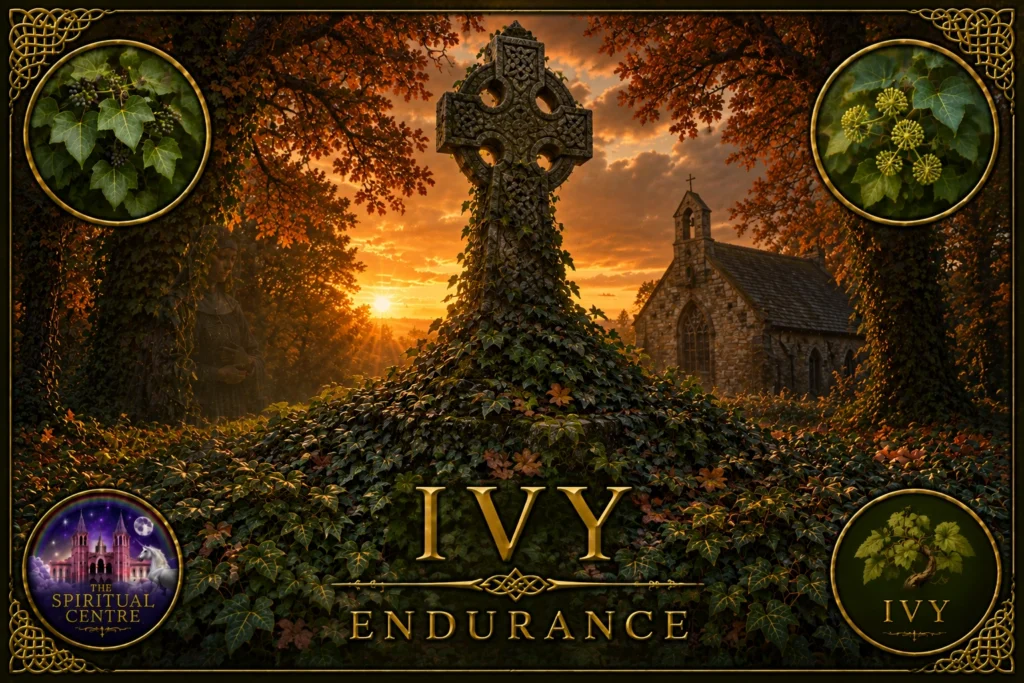
Secrets of the Ivy
Ivy (Hedera Helix)
Volume 12 of 31
Bruce Clifton
Ivy – Gort
vy (Hedera helix) is one of our most familiar evergreen plants, yet behind its twisting vines lies an extraordinary history of folklore, symbolism and spiritual meaning. Growing across the woodland floor and climbing towards the canopy, Ivy has gathered associations with protection, transformation, healing and the enduring mysteries of the natural world.
Within Celtic tree lore, Ivy is known through the Ogham Gort, while traditions far beyond the Celtic world have woven the plant into mythology, medicine and magic. Its ability to attach, adapt and continue growing has inspired stories stretching from ancient Greece to the old folklore of the British Isles.
The spiritual meaning of Ivy is found not in one story, but in the connections between them. Explore the Celtic tree lore, Ogham, folklore, healing traditions, animal spirits, deities and Secret Harmonies of Ivy, and discover why this remarkable evergreen has become such a powerful symbol within the spiritual landscape.
Ivy – Ogham Tree Profile
Bruce Clifton
Name: Ivy
Ogham: Gort > > > (gore – door) ~ Gert ~ pert ~ pear
Letter: G
Lunar: 11th Moon of the Celtic tree Calendar
Season: Autumn
Element: Fire
Direction: South / West
Moon Phase: 1st Quarter ~ Waxing Gibbous
Moon Name: Singing ~ Barley ~ Harvest
Influence: Masculine
Title: Chieftain
Age: Continuing Re-birth
Aura: Yellow
Healing: Arthritis ~ Asthma ~ Bronchitis ~ Bruise / Bruising / Contusions ~ Cellulite ~ Coughs ~ Nervous Conditions ~ Neurological ~ Rheumatism ~ Skin Rashes ~ Varicose veins
Animal Spirit: Horse ~ Salamander ~ Snake
Totems – Entities: Dryads ~ Gnomi ~ Green Man (Oak King) ~ Hildegard of Bingen ~ Holly Queen ~ Old Hag
Gods – Deities: Asclepius ~ Cernunnos ~ Hippocrates ~ Rhiannon
Secret Harmony: Akashic Records ~ Asclepian Incubation ~ Day Dreaming ~ Hermeticism ~ Lucid Dreaming
Festival: (coming soon)
Cosmos: (coming soon)
Key Words: Endurance ~ Greenery ~ Life
Essence of the Ivy
Bruce Clifton
Ivy understands that nothing living exists alone. She begins at the forest floor, but she is never content to remain there. A stem reaches outward, a root finds purchase, a leaf gathers light, and somewhere between them an invisible conversation continues. She climbs not by abandoning the earth, but by taking the earth with her.
This is the essence of Ivy: connection without surrendering identity. She entwines herself with tree, stone and ruin, adapting to each without becoming any of them. Beneath her, mycelium threads through the soil; above her, branches reach towards the heavens. Ivy occupies the space between. She is the living helix, the third strand, carrying information between root and leaf, darkness and light, what has been and what is still becoming.
There is no embarrassment in Ivy’s need for others. She does not confuse independence with strength. Give her a wall and she climbs it. Give her a tree and she travels through its architecture. Leave her upon the ground and she becomes an evergreen carpet. Remove one route and she searches for another. What has sometimes been mistaken for strangulation is something altogether different: Ivy is extraordinarily good at being Ivy.
And perhaps that is why she remains green. Ivy does not waste herself trying to preserve a particular shape. She changes direction, produces another root, extends another stem and sends another leaf towards the light. Like the snake shedding its skin, she understands that continuity sometimes requires reinvention. Life everlasting is not life frozen in time; it is life continually finding another way to live.
To enter the essence of Ivy is to recognise the threads running between things. The ancestors within the living, spirit within matter, the root within the leaf and the beginning already contained within the end. Ivy does not ask which came first. She simply keeps the connection alive.
Healing Lore of the Ivy
Bruce Clifton
Ivy has always occupied the curious space between medicine and poison. Its potency demanded respect, yet traditional healing lore found uses for the leaves in stubborn coughs, congested chests, wounds, burns, troubled skin and aching joints. There is something distinctly Ivy-like in its affinity with the lungs: branching and spreading like the bronchial tree, helping to loosen what has become stuck and allowing movement to return.
That same strength carries a warning. Ivy is not a gentle household herb; its leaves and berries can be harmful when improperly used, and even contact may irritate sensitive skin. Perhaps this duality belongs naturally within its healing lore. The healer and the poison are not always separate things. Ivy teaches that potency requires knowledge, measure and respect.
Scope & Notice
The material shared here reflects traditional knowledge, spiritual practice, and lived experience. It is offered for educational and reflective purposes and is not intended as medical advice or a substitute for professional care. If you are unwell, unsure, or managing a health condition, consult a qualified practitioner.
About the Healing List
The following healing associations are not exhaustive. They reflect commonly recorded and traditionally observed uses connected with Ivy and its wider healing reputation. Remedies may involve the vine itself or companion ingredients prepared alongside it. Methods of preparation vary and are explored in greater depth on the Holistic Healing Remedies page.
Ivy – Healing Remedies Oracle
We have alphabetised this list of healing qualities of the Ivy solely for ease of reference; they include but are not limited to:
1. Arthritis
2. Asthma
3. Bronchitis
4. Bruise – Bruising – Contusions
5. Cellulite
6. Coughs
7. Nervous Conditions
8. Neurological
9. Rheumatism
10. Skin Rashes
11. Varicose Veins
Arthritis – Ivy
Ingredients:
Ivy Leaf (Hedera helix)
Key Properties:
Saponins (Hederacoside C, Alpha-hederin) – Flavonoids – Polyphenols
Traditional Actions:
Anti-inflammatory support, circulatory stimulation, easing stiffness in joints
Preparation:
Fresh Ivy leaves are gently bruised to release their natural compounds, then warmed carefully. The softened leaves are applied externally as a poultice or warm compress to the affected area.
Traditional Use:
Where joints had grown stiff, swollen, or burdened by long-standing discomfort, Ivy was approached as a plant of strength and persistence. The warmed leaves were laid against the body to encourage circulation and soften the heaviness that gathers within the joints. It was not a gentle herb in nature, but a potent ally, used with care to support movement and ease restriction. In this way, Ivy reflects its own character, steady, enduring, and working gradually to restore balance where stiffness has taken hold.
Asthma – Ivy
Ingredients:
Ivy Leaf (Hedera helix)
Key Properties:
Saponins (Hederacoside C, Alpha-hederin) – Flavonoids – Polyphenols
Traditional Actions:
Expectorant support, antispasmodic action, easing congestion within the airways
Preparation:
Ivy leaves are carefully prepared through controlled extraction or infusion, releasing their active compounds in measured quantities. Traditional practice emphasises skilled preparation due to the plant’s potency.
Traditional Use:
Where the breath had grown tight and the chest burdened with congestion, Ivy was approached as a plant that supports the clearing of the airways. Its preparations were used to help loosen mucus, relax the bronchial passages, and ease the strain of restricted breathing. It was not taken lightly, but handled with knowledge and restraint, recognising its strength. In this way, Ivy reflects its own nature, persistent and penetrating, working steadily to open the breath and restore ease where constriction has taken hold.
Bronchitis – Ivy
Ingredients:
Ivy Leaf (Hedera helix)
Key Properties:
Saponins (Hederacoside C, Alpha-hederin) – Flavonoids – Polyphenols
Traditional Actions:
Expectorant, antispasmodic, anti-inflammatory support for the bronchial passages
Preparation:
Mature ivy leaves are traditionally gathered during the colder months when the vine remains evergreen and other plants have withdrawn. The darker winter leaves are generally thicker and more bitter, qualities that were historically associated with stronger medicinal action.
The leaves are gently rinsed and lightly bruised between the fingers before being placed into a small pot of water. They are then allowed to simmer slowly over gentle heat, drawing out the plant’s active compounds. Once prepared, the liquid is strained and sometimes sweetened with honey or citrus to soften the bitterness.
Because ivy contains naturally potent compounds, traditional knowledge emphasised modest quantities and careful preparation. Only small measures of the preparation were typically taken through the day.
Traditional Use:
When the colder months arrive and the chest grows heavy with winter air, ivy remains one of the few green companions still clinging to woodland trunks and stone walls. While many plants withdraw into the earth, ivy endures, and for this reason it became a trusted ally during the darker half of the year when coughs and bronchial complaints were most common.
Village healers often sought the mature winter leaves, believed to hold deeper bitterness and stronger medicine. The warming preparation made from these leaves was taken in small amounts to loosen stubborn mucus, relax the bronchial passages, and calm the persistent cough associated with bronchitis. Within traditional plant practice ivy was therefore approached with both respect and caution, recognising its strength while drawing upon its enduring winter medicine.
Bruise – Bruising – Contusions – Ivy
Ingredients:
Ivy Leaf (Hedera helix)
Key Properties:
Saponins – Flavonoids – Polyphenols
Traditional Actions:
Anti-inflammatory support, circulatory stimulation, easing swelling and tenderness
Preparation:
Fresh Ivy leaves are gently bruised or crushed to release their natural compounds, then applied externally as a cooling poultice or compress, often secured with cloth over the affected area.
Traditional Use:
Where the body had been struck or strained, leaving discolouration and tenderness beneath the skin, Ivy was used to encourage movement within the tissues and ease localised swelling. The softened leaves were laid directly against the skin, supporting the body’s natural process of recovery. Regarded as a potent plant, Ivy was used with care, working steadily to soften impact, restore circulation, and bring gradual relief where bruising had taken hold.
Cellulite – Ivy
Ingredients:
Ivy Leaf (Hedera helix)
Key Properties:
Saponins – Flavonoids – Polyphenols
Traditional Actions:
Circulatory stimulation, lymphatic support, softening of tissue and fluid stagnation
Preparation:
Fresh Ivy leaves are gently crushed and warmed into a base oil, sometimes blended with ground woodland nuts such as hazelnut or beech. The infused oil is applied externally and worked into the skin through slow, consistent massage.
Traditional Use:
Where the skin had grown uneven or fluid had settled beneath the surface, Ivy was used to encourage movement within the deeper tissues. The preparation was massaged slowly into the affected areas, supporting circulation and helping to disperse stagnation. Regarded as a potent plant, Ivy was applied with care, working gradually to restore warmth, tone, and balance where the tissues had become heavy or resistant.
Coughs – Ivy
Ingredients:
Ivy Leaf (Hedera helix)
Key Properties:
Saponins (Hederacoside C, Alpha-hederin) – Flavonoids – Polyphenols
Traditional Actions:
Expectorant support, antispasmodic action, soothing irritation within the throat and chest
Preparation:
Ivy leaves are carefully prepared through controlled infusion or extraction, sometimes combined with honey or citrus. Traditional practice emphasises measured preparation due to the plant’s potency.
Traditional Use:
Where the throat had grown irritated and the chest burdened by a persistent cough, Ivy was used to help loosen congestion and settle the breath. Its preparations were taken in small, considered amounts to ease the tightening of the airways and calm the reflex of coughing. Regarded as a potent plant, Ivy was handled with knowledge and restraint, working steadily to clear the chest and restore ease to the breath.
Nervous Conditions – Ivy
Ingredients:
Ivy Leaf (Hedera helix)
Key Properties:
Saponins – Flavonoids – Polyphenols
Traditional Actions:
Calming support, easing physical tension, settling nervous agitation, soothing the body during periods of nervous strain
Preparation:
Fresh ivy leaves are traditionally gathered and gently rinsed before being lightly bruised to release their natural oils. The leaves may then be placed in a small vessel with a base oil and warmed slowly over gentle heat, allowing the plant’s compounds to infuse into the oil.
Once prepared, the mixture is strained to produce a smooth oil that can be used as the base for a simple balm or ointment. In some village traditions the infused oil was blended with finely ground hazelnuts, beech nuts, or acorns, forming a soft woodland salve.
The preparation was typically applied lightly to areas where tension gathers within the body, particularly the temples, neck, and chest.
Traditional Use:
Within traditional village practice ivy was sometimes prepared as a soothing balm used externally during periods of nervous strain. The slow warming of bruised leaves in oil created a gentle preparation that could be rubbed lightly into the skin, encouraging calm and easing the restlessness often associated with nervous tension.
Healers occasionally combined the ivy oil with ground woodland nuts to produce a nourishing salve that carried warmth and softness to the skin. The slow rhythm of application, together with the natural qualities of the plant, was believed to help settle agitation and restore steadiness within the body.
Because ivy contains naturally potent compounds, traditional knowledge emphasised careful preparation and external use only, recognising the strength of the plant while drawing upon its calming properties.
Neurological – Ivy
Ingredients:
Ivy Leaf (Hedera helix)
Key Properties:
Saponins – Flavonoids – Polyphenols
Traditional Actions:
Calming support, easing tension around the nervous system, settling agitation within the body
Preparation:
Fresh Ivy leaves are gently bruised and warmed into a base oil, sometimes blended with ground woodland nuts such as hazelnut or beech. The infused oil is applied externally and worked into areas of tension such as the temples, neck, and along the spine.
Traditional Use:
Where the nerves had grown unsettled and the body held tension or restlessness, Ivy was used to encourage calm through steady, external application. The warmth of the oil and the slow rhythm of application were believed to ease agitation and restore a sense of balance within the nervous system. Regarded as a potent plant, Ivy was used with care, working gradually to soften tension and support steadiness where the nerves had become strained.
Rheumatism – Ivy
Ingredients:
Ivy Leaf (Hedera helix)
Key Properties:
Saponins (Hederacoside C, Alpha-hederin) – Flavonoids – Polyphenols
Traditional Actions:
Anti-inflammatory support, circulatory stimulation, easing stiffness and discomfort in joints
Preparation:
Mature Ivy leaves are gently bruised and warmed into a base oil, allowing their natural compounds to infuse slowly. The oil may be applied directly or prepared as a soft salve, worked into the joints with steady, warming pressure.
Traditional Use:
Where cold and damp had settled into the joints, bringing stiffness and persistent discomfort, Ivy was used to restore warmth and movement within the body. The infused oil was applied slowly, encouraging circulation and easing the heaviness that gathers within the limbs. Regarded as a potent plant, Ivy was used with care, working gradually to soften inflammation and support flexibility where rheumatic pain had taken hold.
Skin Rashes / Ivy
Ingredients:
Ivy Leaf (Hedera helix)
Key Properties:
Saponins – Flavonoids – Polyphenols
Traditional Actions:
Soothing, cooling, mild antimicrobial support, calming irritated skin
Preparation:
Ivy leaves are traditionally gathered during spring and early summer when the foliage is soft and newly opened. The leaves are gently rinsed and lightly bruised to release their natural compounds before being placed in warm water.
The leaves are then allowed to steep slowly, producing a mild herbal wash. Once cooled to a comfortable temperature, the liquid may be used externally as a rinse or compress for areas of irritated skin.
Because ivy contains naturally potent compounds, traditional knowledge emphasises careful preparation and external use only.
Traditional Use:
Within traditional village practice ivy has sometimes been prepared as a gentle wash for irritated or inflamed skin. The bruised leaves were steeped in warm water to produce a mild liquid used to bathe areas affected by rashes, redness, or environmental irritation.
The resulting preparation carried a faint bitterness from the vine that was believed to calm the skin and settle inflammation. Compounds found within ivy, including saponins, flavonoids, and polyphenols, are recognised for their anti-inflammatory, antimicrobial, and antioxidant properties, qualities associated with soothing irritated tissue and supporting the skin’s natural recovery.
Because ivy carries natural toxicity, such remedies were always approached with respect, used externally, and prepared with care, allowing the quiet cooling influence of the vine to settle the skin while acknowledging the strength of the plant.
Varicose Veins / Ivy
Ingredients:
Ivy Leaf (Hedera helix)
Key Properties:
Saponins (Hederacoside C, Alpha-hederin) – Flavonoids – Polyphenols
Traditional Actions:
Circulatory support, toning of vessel walls, reducing swelling and heaviness in the limbs
Preparation:
Fresh Ivy leaves are gently bruised and warmed into a base oil, allowing their natural compounds to infuse slowly. The oil is applied externally and worked into the legs using steady, upward strokes.
Traditional Use:
Where the legs had grown heavy and the veins pronounced through poor circulation, Ivy was used to encourage movement within the blood and restore strength to the vessels. The infused oil was applied with slow, upward massage, supporting the return flow of blood and easing the discomfort associated with varicose veins. Regarded as a potent plant, Ivy was used with care, working gradually to reduce swelling, improve tone, and restore a sense of lightness within the limbs.
Celtic Tree Lore of the Ivy
Bruce Clifton
Within Celtic Tree Lore, Ivy occupies a curious position. She is not a tree at all, yet she climbs among trees, lives upon the forest floor and remains green when many of her companions surrender their leaves. Perhaps that is precisely why she belongs there. Ivy does not need to become the tree in order to share its world.
Her Ogham is Gort, carrying the letter G. The name itself originally meant a field or enclosed piece of land, rather than Ivy, but the medieval Ogham tradition came to associate Gort with eidenn — Ivy. One of the old kennings describes her beautifully as greener than pastures. It is difficult to imagine a better description of the evergreen carpet that continues beneath the woodland when the grasses and herbs of the year have faded.
In the later Celtic Tree Calendar, Gort becomes the eleventh moon, following Vine and preceding Reed. This lunar arrangement is preserved within the Druids calendar; it belongs in the modern construction of Celtic tree lore. Its placement gives Ivy an interesting role. She arrives as the year moves deeply into autumn, when growth appears to be retreating. Ivy does the opposite. She remains green.
Her botanical name carries another remarkable echo. Hedera is the Latin name for Ivy, while helix describes something that coils, twists or spirals. Hedera helix is therefore a plant whose very name recognises the manner in which she moves. Long before the modern discovery of DNA gave the helix another meaning, Ivy had already written the spiral into her form.
That spiral offers a way of understanding Gort beyond the written Ogham stroke. Ivy grows through connection. Root gives rise to stem and leaf; the travelling stem produces further roots; those roots secure another extension from which new leaves emerge. There is no simple beginning or ending. Each part permits the next.
Seen through modern esoteric eyes, Ivy can resemble an additional strand running alongside the double helix of DNA — a third, connecting strand of life-force. It gives form to something the imagery of Ivy has always understood: life entwines, connects and continues.
Perhaps this is where the ancient description, greener than pastures, becomes more than an observation of colour. Ivy carries greenery beyond the expected season. She occupies the spaces between earth and tree, root and leaf, darkness and light. She does not follow the straight path upwards but spirals, attaches, adapts and continues.
Gort therefore brings something unusual to Celtic Tree Lore. Ivy teaches that endurance need not mean standing still and strength need not mean standing alone. Sometimes life survives because it can entwine itself with life around it, find another point from which to grow, and remain green while the rest of the forest changes.
Folklore of the Ivy
Bruce Clifton
Ivy has been accused of many things. She strangles trees, steals their life and overwhelms whatever she touches. Yet the old accusation mistakes endurance for destruction. Ivy is not a parasite. She does not feed upon the tree she climbs; she attaches, ascends and competes. Given the opportunity, she simply keeps going. Ivy is the Olympian of the plant world.
Perhaps this is why the ancient mythology surrounding Ivy is filled with ordeals, transformations and second lives. When Semele was consumed by the divine fire of Zeus, Ivy was said to have risen amid the flames, sheltering the unborn Dionysus. Semele descended into death, but her story did not finish there. Dionysus later brought his mother back from the Underworld and she ascended to Olympus as the goddess Thyone. Elsewhere, Cissus, a companion of Dionysus, was himself transformed into Ivy. Again and again the message is the same: form may perish while life continues.
Ivy became sacred to Dionysus, the twice-born god. It crowned his head, concealed him as an infant and accompanied his mysteries. Greeks and Romans even believed that a wreath of Ivy could protect against drunkenness. The plant of the god of intoxication was simultaneously imagined as its remedy. Ivy could represent abandon and restraint, death and continuation, attachment and transformation.
Her evergreen leaves carried this mystery into later folklore. Ivy became a symbol of fidelity because she holds fast, of friendship because she remains attached, and of everlasting life because she stays green when the deciduous forest appears to die. In medieval tradition she was paired with Holly, sometimes as companion and sometimes as rival: female and male, darkness and light, outside and inside, two evergreens carrying life through winter.
But Ivy’s greatest folklore may be written by the plant herself.
Look closely at how she grows and the familiar division between root and leaf begins to blur. A stem reaches forward; adventitious roots emerge along it and secure another beginning. Root permits leaf, leaf feeds further growth, and between them runs the living strand that allows each to become the other. Which came first becomes less important than the continuity between them.
Ivy can therefore be imagined as a third strand of DNA: the connecting strand, winding between apparent opposites and allowing the pattern of life to continue. She resembles the serpent that sheds its skin yet remains itself, the Salamander that carries the mystery of life through fire, and the great evergreen network of the forest in which no living thing exists entirely alone.
Even Ivy herself changes identity as she matures. The young climbing plant and the mature flowering Ivy produce different leaves and behave so differently that they can appear to be separate plants. Yet they are one life expressing itself in another form.
That may be the oldest lesson hidden within Ivy. Life does not necessarily survive by remaining unchanged. Sometimes it survives by climbing, attaching, shedding, transforming and beginning again without ever truly beginning again.
Ivy endures because Ivy reinvents herself.
Animal Spirit of the Ivy
Bruce Clifton
Ivy does not conquer the forest by standing above it. She succeeds by becoming part of its living network. Beneath the trees, where grasses struggle for light, Ivy creates her own evergreen pasture. For the horse, she can become forest grass — food growing through woodland, connecting the animal directly to the green vitality of the forest floor.
Yet Ivy carries fire as readily as she carries green. The Salamander, ancient spirit of flame, belongs to the transformative energy within her. Fire destroys form, but it also releases energy and creates the conditions for renewal. Ivy understands this instinctively. Damage her, cut her back or disturb the world around her and she responds with growth, redirecting her energy and finding another way forward.
The Snake expresses this transformation differently. It sheds what has become too restrictive and emerges renewed. Ivy continually performs a similar act. Old leaves fall while new growth extends beyond them; ageing stems become the foundation for fresh shoots. She preserves her essence without remaining trapped within a single form.
Horse, Salamander and Snake therefore reveal three movements within Ivy: connection, transformation and renewal. They belong to an organism that behaves almost like the mycelial world beneath the forest — spreading, joining, responding and finding opportunity wherever life permits it.
Ivy is an Olympian of the plant world. She endures shade, weather, disturbance and the changing seasons, yet remains green and keeps reaching. Her Animal Spirit is not simply survival. It is the extraordinary ability to adapt without surrendering identity, to renew without starting again, and to remain connected while continually becoming something new.
Ivy – Animal Spirit Oracle
Bruce Clifton
We have alphabetised this list of animal spirit that harmonise with the Ivy solely for ease of reference:
1) Horse
2) Salamander
3) Snake
Horse – Ivy
The essence of Ivy is endurance. It will grow where others cannot, climbing through shade and stone, remaining evergreen when the woodland has fallen silent for winter. In the depths of the forest, when pasture has vanished beneath frost, Ivy becomes what some have called forest grass, spreading across the ground and climbing low branches with rich green leaves. For the hardy forest pony it offers nourishment when little else survives, and its dense growth provides shelter from wind and winter weather.
Ivy is the survivor, the Olympian of the woodland, the quiet provider whose presence sustains life in the harshest season. If man is the horse’s best friend, Ivy stands close beside him, offering food, shelter, and endurance when the land grows lean. Its secrets are not shouted across the forest; they are known quietly by those who live within its shade and recognise the strength of the vine.
(See: Horse)
Salamander – Ivy
Within elemental tradition the Salamander is the spirit of fire, the unseen presence that lives within flame itself. When Ivy feeds the hearth, its dried wood offering itself to the spark, it releases the warmth hidden within its fibres. The Salamander moves through this rising heat, transforming vine to flame, and with that flame comes warmth, protection, and healing. The fire that begins with Ivy kindling warms the body, dries the damp of winter from the bones, and restores vitality to those gathered around it. In this way the quiet forest vine becomes a companion to the Salamander, carrying the woodland’s strength into the living fire of the hearth.
The warmth of fire is mirrored in the healing held within the leaves themselves. When Ivy leaves are gently massaged and broken between the fingers, their natural oils are released, carrying the bitter compounds of the vine. In traditional practice these softened leaves were sometimes warmed beside the hearth and wrapped around aching joints, or the infused oils rubbed slowly into the skin. The rising warmth from the hearth and the warmth drawn from the oils worked together, easing stiffness and encouraging movement where arthritis had settled into the bones. In this way the fire of the Salamander and the living strength of Ivy joined in quiet partnership, bringing heat, circulation, and relief to the body.
Though Ivy is a plant of shade and cool woodland walls, it has long played its part in the awakening of fire. When its older stems are dried they become quick to catch the spark, used as kindling to coax flame from the hearth. In this quiet role Ivy becomes a bridge between the green life of the forest and the warmth that sustains the home through winter.
Snake – Ivy
Where Ivy moves across the land it does not claim a single place. It grows along the forest floor, climbs stone walls in the meadow, and reaches toward the light beside rivers and ancient trees. The vine adapts wherever it finds ground to hold, renewing itself season after season. In this quiet persistence it mirrors the nature of the snake, a creature long associated with transformation and rebirth. Just as the snake sheds its skin to begin anew, Ivy continually reshapes its path, weaving fresh growth from old stems and finding life in places where others fade.
The snake is drawn to warmth and sunlight, emerging in summer to renew its strength, while Ivy carries the memory of life through winter’s cold. Together they speak of the great cycle of renewal that moves through all living things. In spiritual understanding this cycle reflects the deeper pattern of rebirth and reincarnation, the turning of existence recorded within what many traditions call the Akashic record, the living memory of all experience. Where Ivy climbs and the snake passes quietly through grass and stone, the land itself seems to remember that nothing truly ends; it transforms, sheds, and begins again.
Totems and Entities of the Ivy
Bruce Clifton
There is more to Ivy than the vine we see climbing towards the light. Around her exists another kind of growth: an invisible greening, an esoteric vitality that entwines the living world and draws other presences towards it.
Ivy resembles a helix, winding upwards while maintaining her connection below. Esoterically, she can be imagined almost as an additional strand of DNA — not replacing what already exists, but moving around and between it, binding one level of life to another. Like the Tree of Life, she becomes a pathway between worlds, connecting earth and spirit, the seen and unseen.
Within this greening presence the Totems and Entities of Ivy find their natural home. Elementals, nature spirits and those sensitive enough to perceive them participate in the same living current. Hildegard of Bingen called something remarkably similar viriditas: the greening power, the vital force flowing through creation.
Ivy does not ask us to separate these worlds. Her magic lies in their connection. Evergreen, entwining and continually reaching, she reveals a living web in which plant, person, spirit and earth remain intimately bound — different expressions of the same green life force.
Ivy – Totems and Entities Oracle
Bruce Clifton
We have alphabetised this list of totems and entities that harmonise with the Ivy solely for ease of reference, no sense of hierarchy or entitlement is intended or implied:
1) Dryads
2) Gnomi
3) Green Man (Oak King)
4) Hildegard of Bingen
5) Holly Queen
6) Old Hag
Dryads – Ivy
Where Ivy climbs, the woodland becomes richer, deeper, and more intimate. Trunk, branch, shadow, bark, birdsong, and hidden root are drawn into one living tapestry. For this reason Ivy belongs naturally with the Dryads, the primordial spirits of the trees, whose presence is woven through the first life of the forest. Where a tree stands alone, Ivy teaches relationship. Where bark ends, Ivy begins another layer of life.
The Dryads are not separate from the trees they inhabit. Their being moves with the sap, breath, and quiet intelligence of woodland growth itself. When Ivy embraces Oak, Ash, Elder, or any elder trunk, it forms not an enemy to the tree, but a second garment of green. In this living mantle the Dryads are said to dwell more closely, their homes deepened by shelter, secrecy, and the soft architecture of leaf and vine.
In old woodland lore, Ivy was often seen as a keeper of hidden life. Its evergreen leaves provide refuge for birds, insects, and small creatures, especially when winter strips the branches bare. The Dryad, guardian of the tree, becomes also guardian of this wider sanctuary. Nothing in the forest lives alone. Ivy makes visible the truth of interdependence that the Dryads have always known.
There is patience in Ivy. It does not rush the canopy. It climbs slowly, steadily, and with quiet certainty. The Dryads carry the same rhythm. They are ancient presences who do not measure success by speed, but by harmony. Together they teach that growth is not only upward toward light, but outward through connection, reciprocity, and the ability to remain alive through changing seasons.
To walk beneath trees wrapped in Ivy is to enter a place where the woodland seems to hold its breath. Twisting stems and dark green leaves form a living veil, and behind that veil the unseen feels close. Many have sensed such places as watchful, peaceful, and strangely alive. This is the atmosphere in which Dryads are most easily imagined or gently felt.
Within The Spiritual Centre, Ivy and the Dryads speak to those seeking belonging, renewal, companionship, hidden strength, and the wisdom of relationship. They remind us that life is richest when shared, that shelter can be sacred, and that some of the deepest growth happens quietly in the shade.
Gnomi – Ivy
Where Ivy grows, the hidden orders of nature quietly meet. Its roots grip the soil where the Gnomi move patiently through earth, stone, and the deep unseen passages beneath the woodland floor. Its climbing stems wind themselves around Oak, Ash, Elder, and ancient trunks where the Dryads dwell, while its older vine, once cut and dried, may feed the hearth and awaken the transforming presence of the Salamander. In Ivy, the realms of earth, tree, and fire are drawn into one living thread.
The Gnomi know Ivy first through the ground. Before the leaf reaches sunlight, root has already entered darkness. This is their wisdom. They govern foundations, soil health, hidden structure, mineral wealth, and the slow preparations that make later growth possible. Ivy reveals this truth clearly: what is seen above exists because something faithful has been built below.
Unlike trees that rise alone from a single trunk, Ivy teaches relationship, adaptability, and shared strength. It climbs by attachment, not domination. It finds pathways others have already opened and turns them into new life. The Gnomi recognise such intelligence, for they too work through connection rather than display, supporting forests from beneath rather than seeking praise in the open light.
There is endurance in Ivy as well. Evergreen through winter, it holds colour when other leaves have fallen and offers shelter to birds, insects, and small creatures in the lean months. This resilience reflects the earth elemental nature of the Gnomi, whose strength is steady, practical, and enduring rather than dramatic. They are keepers of what lasts.
Within the understanding of the Bnwyfre Spiritual Order, these beings are not separate dominions but expressions of one living current: Bnwyfre, the breath of life and life force energy flowing through all creation. Ivy becomes a visible bridge within that mystery. It rises from the soil of the Gnomi, embraces the life of the trees, and may one day return itself to flame, warmth, and ash. Through Ivy, life is shown to be continuous rather than divided.
Thus Ivy teaches a quiet truth. Growth is not always solitary. Strength is not always rigid. Much of what sustains the world happens silently, through support, patience, and unseen labour.
Within The Spiritual Centre, Ivy and the Gnomi speak to those seeking grounding, resilience, belonging, hidden strength, and trust in slow growth. They remind us that the deepest foundations are often invisible, yet everything living depends upon them.
Green Man / Ivy
Ivy is one of the great teachers of continuity, devotion, resilience, and living connection, making it a natural companion to the Green Man. Where trees rise in singular trunks, Ivy moves by relationship, binding root to bark, branch to branch, ruin to woodland, and season to season. It reveals that life does not flourish through isolation alone, but through intertwining paths.
The Green Man is the living face of nature’s renewal, the intelligence within growth that returns again and again through changing forms. In Ivy, that mystery becomes visible in another way. It does not blaze into spring with sudden blossom, nor fall silent when autumn strips the branches bare. It remains. Evergreen, climbing, patient, and faithful, Ivy carries the life-current through every season.
There is ancient companionship here. Ivy has long embraced Oak, Ash, and elder trunks, clothing age with fresh green and turning still bark into layered vitality. The Green Man moves through such unions, for he is not confined to one species of tree but to the principle of life continually renewing itself. Where Ivy wraps an old tree, time itself seems joined: youth and age, memory and fresh growth, endurance and renewal.
Ivy also belongs to hidden places: old walls, woodland ruins, boundary stones, forgotten paths. In these spaces the Green Man is often most strongly felt, not in polished gardens or places of control, but where nature gently reclaims what has been abandoned. Ivy teaches that life does not merely survive. It returns, covers, heals, and transforms.
Within the understanding of the Bnwyfre Spiritual Order, Ivy and the Green Man reveal the movement of Bnwyfre, the breath of life and life force energy, as an unbroken current flowing through root, leaf, stone, timber, and soul. What appears separate is quietly being joined. What appears finished may already be beginning again.
Within The Spiritual Centre, Ivy and the Green Man speak to those seeking renewal, belonging, resilience, healing after loss, and trust in life’s returning power. They remind us that growth is not always sudden, and that some of the deepest transformations happen slowly, quietly, and by degrees.
Hildegard of Bingen – Ivy
Ivy is one of the clearest living images of continuity, resilience, renewal, and the quiet victory of life, making it a natural companion to Hildegard of Bingen. Where walls grow cold, ruins weather, and old trunks bear the marks of time, Ivy answers not with force but with greening presence. It clothes what has endured in fresh vitality, turning age into living beauty.
Hildegard spoke of viriditas, the sacred greening power moving through creation. For her, this was more than botanical growth. It was the inner vitality by which life heals, flourishes, reaches outward, and reveals the divine breath within the world. Ivy reflects this mystery in visible form. Its patient ascent, evergreen nature, and refusal to surrender to barren seasons embody the same truth: life is always seeking expression.
Where stone stands silent, Ivy speaks in leaf. Where woodland bark seems weathered and complete, Ivy begins a new chapter. In Hildegard’s language, such greening is both physical and spiritual, the life-force inviting humanity to participate in renewal rather than merely observe it. The vine becomes a teacher of hope, showing that flourishing can begin again even where time has left its mark.
Within this living current, the hidden orders of nature also take their place. The Gnomi tend the deep earth from which Ivy draws strength. The Dryads watch from the trees the vine patiently embraces. What appears as one plant is already a relationship of many beings and forces, each contributing to the greater harmony of growth.
Within the understanding of the Bnwyfre Spiritual Order, Ivy and Hildegard reveal Bnwyfre, the breath of life and life force energy, moving through root, soil, bark, leaf, and soul alike. Ivy becomes its messenger, rising from darkness into light, climbing steadily through the forest, and extending its green vitality toward humankind as a reminder that renewal is never absent where life is allowed to grow.
There is also humility in this union. Ivy does not boast. Hildegard did not seek fame. Both teach through faithful expression of what they are. Quiet things can transform worlds.
Within The Spiritual Centre, Ivy and Hildegard speak to those seeking healing, renewal after hardship, spiritual vitality, feminine wisdom, perseverance, and trust in life’s returning power. They remind us that the greening force of creation is always near, waiting only for room to grow.
Holly Queen – Ivy
The Ivy belongs naturally to the realm of the Holly Queen, for both carry the mysteries of endurance, persistence, and life that does not withdraw when the colder months arrive. Where summer flowers fade and softer leaves are lost, ivy continues its climb, clothing stone, oak, and ruined wall in living green. It thrives where others recede, and in this it mirrors the Queen who reigns through the inward half of the year.
The Holly Queen recognises in ivy a kindred nature. She is not the power of sudden blossom, but of quiet strength, steadfast growth, and the beauty that reveals itself slowly. Ivy does not rush the season. It winds patiently upward, finding its path through time rather than force. So too does the Queen guide the soul, not through noise or display, but through constancy, wisdom, and the hidden work of transformation.
In winter woodlands, when frost silvers the ground and branches stand bare, ivy remains as a sign that the green current of life still moves beneath appearances. Its leaves catch the dim light, its vines hold fast, and old trees wear it like a mantle. Here the Holly Queen is often felt most strongly, moving through grove and hedgerow with watchful grace, crowned in berries, accompanied by the hush of ancient places.
There is also protection in ivy. Long linked with fidelity, resilience, and sacred attachment, it teaches that true bonds endure weather and time. Under the Holly Queen’s gaze, ivy becomes more than a plant. It becomes a lesson in devotion to what is living and true.
To walk with ivy in the season of the Holly Queen is to understand that growth is not always loud, and beauty is not always bright. Some gifts arrive in silence, some strengths are revealed in winter, and some forms of life become most visible when the world appears asleep.
Old Hag / Ivy
The Ivy has long been honoured as a plant of endurance, persistence, hidden pathways, protection, survival, and the quiet life that continues through winter, making it a natural companion to the Old Hag. Where brighter plants belong to open fields and easy seasons, Ivy climbs old walls, enters forgotten places, and keeps its green when other growth has fallen away. It understands what endures in shadow.
In folklore, the Old Hag walks the boundary between fear and wisdom. She is remembered in night tales where sleep grows heavy and the body refuses to move, the unsettling experience later called the Old Hag’s visit. Yet this is only one face of her. She also appears as the village wise woman, keeper of herbs, remedies, thresholds, and the older knowledge not always welcomed by polite society. She is the crone who knows what others fear to learn.
Her harsher nature may be linked with Blackthorn, tree of sharp edges and difficult lessons. Her healing wisdom may be felt through Elder, whose medicine runs through many traditional cures. Yet Ivy sits quietly between these two expressions of her power. It neither wounds like thorn nor offers itself openly like elderflower. It climbs in silence, reveals itself slowly, and rewards only those who look closely.
Ivy carries both healing and toxicity. Its leaves contain potent compounds that must be approached with care. In traditional practice, warmed and prepared leaves were sometimes applied externally to ease aching joints or calm inflamed tissues. In careless hands, however, the same plant could irritate or harm. For this reason Ivy becomes a fitting teacher of the Old Hag’s law: knowledge is power only when joined to wisdom.
Like the wise woman herself, Ivy teaches that the boundary between poison and medicine is not always found in the plant, but in the understanding of the one who uses it. What heals one person may harm another. What is remedy in right measure becomes trouble in ignorance. The Old Hag does not sentimentalise nature. She asks for respect.
There is another kinship between them. Ivy embraces ruins, gravestones, ancient trunks, and weathered stone. It keeps company with what time has touched. So too does the Old Hag dwell among memories, endings, winter seasons, and truths that youth often overlooks. Yet neither is merely about decline. Both protect hidden life through the cold months until renewal returns.
Within the understanding of the Bnwyfre Spiritual Order, the Old Hag and Ivy reveal the breath of life moving through shadow, resilience, elder wisdom, caution, healing knowledge, and the sacred intelligence that survives beyond appearances. They remind us that not all guides arrive smiling, and not all blessings come dressed in light.
Within The Spiritual Centre, Ivy and the Old Hag speak to those seeking protection, discernment, resilience, ancestral wisdom, healing through hard-earned knowledge, and the courage to face what lies in the darker corners of the self.
Gods and Deities of the Ivy
Bruce Clifton
Ivy belongs to a world in which healing, nature and spirit are closely entwined. Evergreen and persistent, it survives through changing seasons, binding itself to the landscape and returning continually to life. The gods and figures associated with Ivy reflect this enduring relationship between the human body, the natural world and the unseen forces believed to move through both.
Asclepius, Cernunnos, Hippocrates and Rhiannon approach this relationship from different traditions. Asclepius embodies sacred healing and restoration; Cernunnos evokes the vitality and abundance of the wild; Hippocrates represents the observation of nature in the understanding of health and disease; while Rhiannon brings sovereignty, transformation and the mysterious otherworld of Celtic tradition.
Together, they reveal different expressions of Ivy’s character. Healing is found beside wilderness, knowledge beside mystery, and human experience beside the rhythms of the natural world. Their stories remind us that renewal does not always mean beginning again, but may instead mean enduring, adapting and continuing to grow.
The Gods and Deities of the Ivy therefore form an entwined mythology of healing, vitality, wisdom and renewal — qualities reflected in a plant that remains green when much of the surrounding world has fallen dormant.
Ivy – Gods and Deities Oracle
Bruce Clifton
We have alphabetised this list of gods and deities that harmonise with the Ivy solely for ease of reference, no sense of hierarchy or entitlement is intended or implied:
1) Asclepius
2) Cernunnos
3) Hippocrates
4) Rhiannon
Asclepius – Ivy
Within the temples of Asclepius, healing began not with medicine alone, but with stillness, sacred sleep and the long quiet surrender of night. Those seeking restoration entered the temple softly, trusting that dreams, symbols and the deeper movements of the soul might reveal what waking thought could not. The serpent of Asclepius, coiled gently around the healing staff, became a living emblem of renewal, shedding its skin and beginning again.
Beyond these sanctuaries, Ivy often climbed across stone walls, temple paths and shaded groves, winding itself upward in the same patient spiral as the serpent itself. It does not rush toward growth. It rises gradually through relationship, drawing strength from earth, tree and shelter alike. In this way, Ivy carries a quiet harmony with the healing current surrounding Asclepius.
During the colder months, when the world withdraws inward and the body seeks warmth, recovery and protection, the leaves of Ivy remain green against frost and darkening skies. Like the rod of Asclepius, it reminds us that healing is rarely hurried. Breath slows. The mind softens. Vitality returns by degrees rather than force.
Within the living current of Bnwyfre, Ivy and Asclepius together speak of restoration as something that grows patiently within the human vessel itself, encouraged by the same quiet intelligence moving through vine, serpent, dream, and human heart alike.
Cernunnos – Ivy
Deep within the forest where light filters softly through leaf and branch, the presence of Cernunnos is often felt before it is ever seen. Like the Green Man, he belongs to the hidden life of the woodland, the quiet intelligence moving through root, animal, moss and shadow. Ivy carries this same atmosphere. It does not seek attention, yet once noticed it appears everywhere, weaving itself through trunks, stone and forgotten places where the deeper rhythms of the forest continue quietly beyond human awareness.
Cernunnos does not stand above the forest as ruler separated from it. He dwells within it. His strength emerges through the living harmony connecting tree, creature and land together as one continuous current. Ivy reflects this same hidden movement, binding woodland to earth, sheltering smaller lives beneath its leaves and carrying unseen vitality through the darker places where the forest gathers itself inward.
Within the living flow of Bnwyfre, Ivy becomes an expression of Life Force Energy moving silently through the hidden architecture of the woodland itself. Even through winter, when branch stands bare and much of the forest appears asleep, Ivy remains alive, carrying continuity through the colder seasons. Around the trunks of ancient trees it coils like a green current of endurance, linking root to branch, earth to canopy and life to renewal.
Like Ivy, the presence of Cernunnos moves quietly through the background of existence, rarely demanding recognition yet shaping the living balance of the forest from within. Together they remind us that true authority is rarely loud. It is patient, rooted and enduring, present in every hidden thread of the woodland long before the human eye learns how to see it.
Hippocrates – Ivy
In the age of Hippocrates, when medicine was beginning to move away from superstition and toward careful observation of nature, healing remained deeply rooted within the living world itself. Plants were studied through scent, bitterness, texture and the way they influenced the body and spirit alike. Among the climbing plants known to ancient physicians was Ivy, a vine whose dark leaves, enduring nature and strength across the Mediterranean landscape made it familiar to herbal practitioners for centuries.
Hippocrates taught that healing arises through harmony within the body, guided by nature rather than imposed against it. Ivy reflects this same quiet principle. Clinging steadily to tree, stone and woodland edge, the vine survives through balance, adaptation and relationship with the environment surrounding it. Its leaves carried qualities long associated with easing inflammation, soothing the chest and clearing the breath, and for generations they were prepared carefully within traditional remedies for coughs and winter ailments.
The Ivy itself carries an atmosphere of endurance and continuity. It remains green through the colder months, winding patiently through woodland and ruin alike, reminding observers that life continues quietly even beneath winter shadow. Around old walls and trees it gathers moisture, birds and hidden shelter, becoming part of the deeper ecology surrounding human habitation and healing.
Within the meeting of Hippocratic medicine and older land-based traditions, Ivy becomes more than medicinal plant alone. It stands as part of the long relationship between humanity and the living landscape, where healing began not within laboratories or distant institutions, but through attentive observation of the natural world itself. The physician, the herbalist and the woodland healer each learned by listening carefully to the qualities already present within root, leaf and season.
Within the understanding of the Bnwyfre Spiritual Order, Hippocrates and Ivy together remind us that healing often begins through renewed relationship with the quieter rhythms of life. Observation, patience and harmony with the living world remain at the heart of both the physician’s art and the wisdom carried silently through the vine itself.
Rhiannon – Ivy
Rhiannon’s presence within the Ivy reflects the qualities of endurance, loyalty, and quiet sovereignty that both the goddess and the plant embody. Ivy is known for its remarkable determination, climbing steadily upward and spreading across forest floors and ancient walls while remaining evergreen through the turning seasons. This persistence mirrors Rhiannon’s own story within Welsh mythology, where she endures hardship and false accusation with dignity and composure, demonstrating the deeper strength that arises through patience and inner balance.
Unlike many plants, ivy does not compete directly with the tree it climbs but uses it as support, rising toward the light through adaptation and perseverance. In Celtic symbolism this quality reflects a quiet form of sovereignty, not domination but the ability to remain steady and purposeful regardless of circumstance. Rhiannon represents this same graceful authority, moving through her trials with calm determination and emerging with her dignity intact.
The evergreen nature of ivy also carries a symbolism of continuity and enduring connection, remaining vibrant when many plants fall dormant. This enduring vitality echoes the deeper themes surrounding Rhiannon’s mythology, where the cycles of loss, endurance, and renewal ultimately lead to restoration and balance. In this way the ivy becomes a natural emblem of her presence, reminding us that strength often appears not through force, but through resilience and quiet perseverance.
Within the shelter of ivy-covered woodland and ancient stone, Rhiannon may therefore be understood as a presence of sovereign endurance and guiding wisdom. Just as ivy continues its steady ascent through time and season, her mythology reflects the quiet authority that emerges through patience, loyalty, and the ability to remain true to one’s path even through adversity.
Secret Harmonies of the Ivy
Bruce Clifton
Ivy grows between worlds. Rooted in the earth yet reaching beyond itself, it climbs, entwines and crosses the boundaries that would contain it. Its Secret Harmonies follow the same path, exploring the hidden territories of consciousness and the ways knowledge may be encountered beyond ordinary waking awareness.
Through the Akashic Records, Asclepian Incubation, Day Dreaming, Hermeticism and Lucid Dreaming, Ivy becomes a guide to inner exploration. These traditions and practices approach hidden knowledge differently: through sacred sleep and dreams, altered states of awareness, contemplation, symbolic understanding and the deliberate exploration of consciousness.
Like Ivy finding its way across stone, tree and ruin, these harmonies suggest that consciousness need not remain within familiar boundaries. Dreams become places of encounter, imagination becomes a means of discovery, and symbols become pathways through which deeper patterns may be recognised.
The Secret Harmonies of the Ivy therefore concern more than dreaming alone. They explore the connections between mind, mystery, healing and hidden knowledge — and the possibility that, by learning to move consciously through our inner worlds, we may discover pathways that ordinary awareness cannot easily see.
Ivy – Secret Harmonies Oracle
Bruce Clifton
We have alphabetised this list of secret harmonies of the Ivy solely for ease of reference, no sense of hierarchy or entitlement is intended or implied:
1) Akashic Records
2) Asclepian Incubation
3) Daydreaming
4) Hermeticism
5) Lucid Dreaming
Akashic Records – Ivy
To stand before ancient Ivy is to witness a living tapestry of memory. Leaf upon leaf, stem upon stem, each layer unfolding into another, until the eye can no longer find where the pattern begins or ends. Behind every leaf another waits, and behind that leaf yet another still. The vine climbs patiently through time, weaving its green architecture across stone and woodland alike. In this endless layering the mind begins to sense something deeper, a pattern that resembles the spiralling language of life itself, like strands of living DNA quietly repeating their ancient design.
In this way Ivy becomes a mirror for the Akashic record, the quiet archive of existence. Each layer of leaf suggests another layer of memory, each turning stem another passage through time. Look upward and the vine reaches toward the future; look downward and its roots disappear into centuries already passed. Decade follows decade, century follows century, yet the vine continues its slow ascent. Ivy reminds us that the story of life is never truly lost. It is simply layered, waiting for those who pause long enough to see beyond the surface and feel the depth of the living record that surrounds us.
Asclepian Incubation – Ivy
Within the quiet temples of Asclepius, those seeking healing entered not with urgency but with surrender. They lay down within the sacred chambers and allowed sleep to come, trusting that the deeper intelligence of the body and spirit would speak through dreams. Around these sanctuaries the walls and courtyards were often wrapped in living green, Ivy climbing slowly over stone, its leaves carrying a cool bitterness and a subtle aroma when warmed by the air of the hearth.
In this setting Ivy became a gentle companion to the art of Asclepian incubation. Fresh leaves could be laid upon the forehead to cool the mind, while warmed leaves released a faint fragrance that softened the senses. The quiet presence of the vine seemed to slow the rhythm of thought, guiding the body toward the dream-state where healing insight might appear. The winding form of Ivy, spiralling and patient, echoed the movement of the serpent of Asclepius itself, inviting the sleeper into a deeper layer of perception.
Far to the north, across the sea and many centuries of distance, a similar practice quietly appeared among the Celtic peoples of Britain. Ivy leaves were sometimes gathered and used within bedding, believed to encourage rest and vivid dreams during the long winter nights. The vine that climbed through the forests of Europe carried the same influence across distant landscapes. Though the cultures stood thousands of miles apart, the same plant offered the same quiet invitation: to sleep, to dream, and to listen to the hidden intelligence of the body.
In this way Ivy reveals a quiet synchronicity between worlds. Whether in the marble sanctuaries of Greece or the forest dwellings of ancient Britain, the vine seems to whisper the same message. Healing does not always arrive through effort or intervention. Sometimes it comes through stillness, through dream, and through the subtle presence of the living plants that share our world.
Day Dreaming – Ivy
To sit beneath Ivy is to enter a quieter rhythm of awareness, where the pace of thought slows and the mind begins to soften. Layers of green gather light and shade, creating a cool stillness that draws attention inward without effort. In this gentle enclosure, daydreaming arises naturally, not as distraction, but as a drifting of awareness into a quieter, more reflective state.
Ivy does not rush toward the light. It climbs patiently, and in this slow movement it teaches the mind to release urgency. Thoughts loosen, memory and imagination begin to move together, and awareness travels between what is and what might be. Through Bnwyfre, breath of life and life force energy, this movement is not separate from presence, but part of a wider field where perception can wander without losing its centre.
To work with Ivy is to allow this soft drifting to become conscious. Awareness remains gently present within the movement, recognising the daydream as it unfolds. In that recognition, what once passed unnoticed becomes steady and creative, where the quiet landscapes of the mind reveal themselves without force, and daydreaming becomes a living expression of inner harmony.
Hermeticism – Ivy
Hermetic philosophy teaches that the universe is woven together through hidden correspondences, the principle expressed in the maxim “as above, so below.” In the living world, the Ivy reflects this same understanding. Its roots move downward into the soil while its stems climb patiently upward toward the light, binding earth and sky through the same continuous vine. What begins unseen beneath the ground slowly reveals itself in leaf and branch above, a living reminder that the smallest forms of nature often mirror the greater patterns of existence.
Within Hermetic traditions, the four directions and the four elements hold their own guardians. To the North, the Gnomi move through the deep earth where Ivy’s roots take hold. To the West, the Undines carry the quiet waters that nourish the soil. To the South, the Salamanders awaken the transforming warmth of fire. To the East, the Sylphs move with the breath of the wind through leaf and branch. Ivy touches each of these realms in its own way, rooted in earth, nourished by water, warmed by fire, and stirred by air.
In this quiet harmony, the vine becomes a living expression of Hermetic balance, revealing how the elements and their unseen companions move within the same living field.
Lucid Dreaming / Ivy
Beneath the quiet canopy of Ivy the mind begins to soften. The layered leaves gather shade and coolness, creating a stillness where waking thought loosens its grip. In such places the boundary between waking imagination and dreaming awareness becomes thinner. Ivy has long been associated with rest, incubation, and the gentle slowing of the senses, inviting the mind to drift into deeper states where dreams begin to move with greater clarity.
Within the ancient temples of Asclepius, those seeking healing entered sleep deliberately, trusting that dreams could reveal guidance hidden beneath the surface of ordinary thought. In a similar spirit, Ivy encourages a dream-state that remains lightly conscious. The mind wanders through images and symbols while a small part of awareness remains awake, observing the unfolding landscape. This is the threshold where lucid dreaming begins, where the dreamer recognises the dream while still within it.
The winding stems of Ivy offer a quiet metaphor for this inner journey. Like the vine climbing through layered leaves, the dreaming mind moves through layer upon layer of memory and imagination. Some traditions speak of this as touching the Akashic record, the deeper archive of experience woven through time. Whether understood as symbolism or subtle perception, Ivy reminds us that the dreaming mind can travel far beyond the limits of waking logic.
In this way Ivy becomes a companion to the arts of dream walking and astral awareness. It does not force the mind outward but invites it gently inward, into the spaces where imagination, memory, and perception meet. The vine simply teaches patience: slow the breath, quiet the senses, and allow the dreaming mind to climb its own hidden pathways through the inner world. (see: Astral Travel – Dream Walking)