
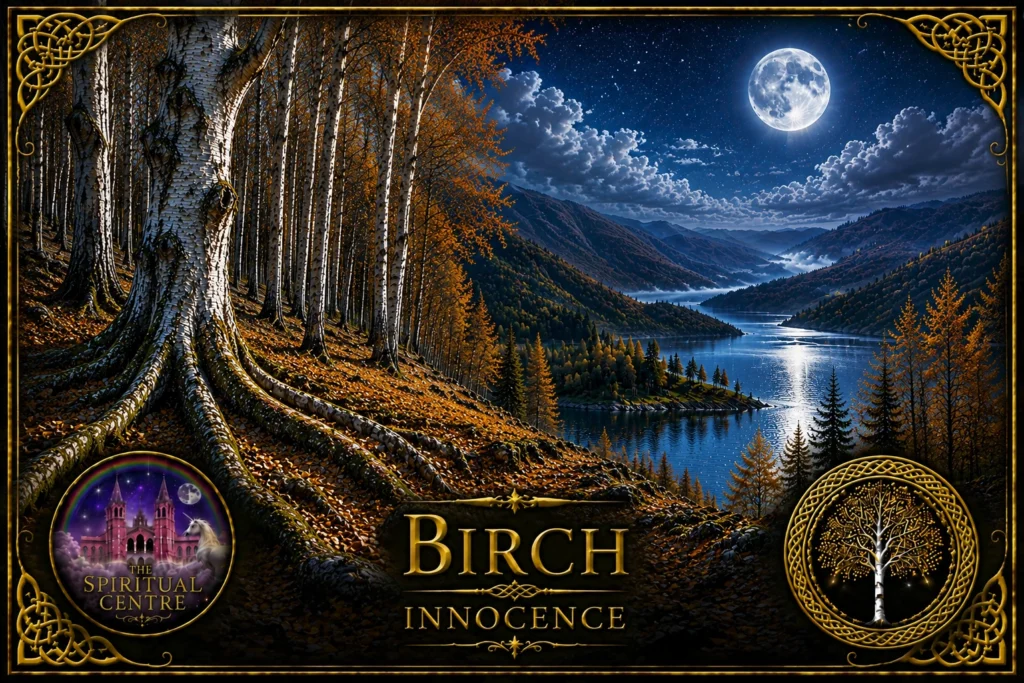
Secrets of the Birch Tree
The Birch Tree (Betula pendula)
Volume 1 of 31
Bruce Clifton
Birch Tree – (Beithe)
The Birch Tree (Betula pendula), known as Beith in Ogham Tree Lore, stands at the beginning of the Ogham journey. First tree, first letter and first of the Druidic New Year, Birch emerges beneath the new moon carrying the ancient correspondences of innocence, cleansing, renewal and new beginnings.
A natural pioneer, Birch is among the first trees to reclaim open ground and begin the return of woodland. Her silver-white bark and remarkable resilience have inspired centuries of Celtic folklore, healing traditions and spiritual lore, connecting Beith with birth and rebirth, Animal Spirit, Gods and Deities, woodland entities and the mysteries of the spiritual realms.
Birch begins where something else has ended. Rooted in the physical woodland yet reaching deeply into Celtic spirituality and Druidry, Beith opens the doorway to the Ogham trees and the secrets held within them.
Birch Tree – Ogham Tree Profile
Bruce Clifton
Name: Birch
Ogham: Beith >>> Beth – Beh
Letter: B
Lunar: 1st New Moon of the Bnwyfre Celtic Tree Calendar 2025/6 (November 20th – December 19th )
Season: Winter
Element: Earth
Direction: North/East
Moon Phase: New Moon ~ Waxing Crescent
Moon Name: Hunters ~ Dark ~ Tree ~ Frosty
Influence: Feminine
Title: Peasant
Age: Four Human generations
Aura: Blue / Indigo
Healing: Anti-inflammatory ~ Arthritis ~ Bladder ~ Blood ~ Cancer ~ Dandruff ~ Detoxification ~ Digestive Health ~
Hair Loss ~ Kidneys ~ Kidney Stones ~ Menstruation ~ Rheumatism ~ Skin Rashes ~ Urinary Tract ~ Wound
Animal Spirit: Deer (Doe) ~ Eilidh ~ Stag
Totems – Entities: White Lady of the Woods
Gods – Deities: Branwen ~ Cailleach/Brighde` ~ Cernunnos ~ Cliodna ~ Fear Doirche ~ Gwennefoedd ~
Oisin ~ Venus/Aphrodite
Secret Harmony: Afterlife Awareness ~ Akashic Records ~ Astral Travel ~ Clairs ~ Death ~ Dream Walking ~
Lucid Dreaming ~ Past Life ~ Protection ~ Rebirth ~ Walking between Worlds ~ Walking with Spirit.
Festival: Samhain (coming soon)
Cosmos: Gaia – Leonids – Mercury – Northern Cross – Orion – Orionids – Pegasus – Taurids – Venus (coming soon)
Key Words: Innocence ~ New Beginnings ~ Harmony
Essence of the Birch Tree
Bruce Clifton
Birch is the first breath of the forest after silence. Slender, luminous and unmistakable in her silver-white bark, she is a pioneer of disturbed and open ground, one of the trees capable of returning where woodland has been lost. She does not wait for the forest to exist around her; Birch begins the forest.
This is reflected within Ogham. Beith is the first fid, the first letter and the beginning of the first Aicme. Her season belongs to winter, her moon moves from darkness into the waxing crescent, and her essence carries innocence, new beginnings and harmony. The physical tree and the spiritual tree speak remarkably similar languages: emergence, resilience, cleansing and renewal.
Birch also opens the Druidic New Year, beginning with the first new moon of the new cycle as winter gathers around the land. The calendar follows the Moon rather than forcing the heavens into the fixed boundaries of a solar year: twelve lunar months carry the cycle forward, while at intervals a thirteenth moon restores the relationship between lunar and solar time. Across the greater Metonic cycle, nineteen solar years correspond closely with 235 lunar months, allowing Moon, season and year repeatedly to return towards alignment.
There is something wonderfully mysterious in placing Birch here. Beith waits in the darkness of the new moon, at the threshold of another Druidic year, when the old cycle has closed but the new one has barely revealed itself. The first tree therefore begins beneath an almost invisible Moon: not with completion, but with possibility. As the first silver crescent emerges from darkness, so Birch carries the woodland forward into another turning of Moon, season, life and spirit.
Yet Birch is not simply a tree of beginnings. She stands upon the mysterious boundary between what has been and what may become. Her harmonies reach into death and rebirth, dream and spirit, past lives and the Akashic Records, the Clairs and walking between worlds. Her white bark becomes almost symbolic of a blank page — not an empty life, but a life upon which something new can be written.
There is gentleness within Birch, but never fragility. Doe and Stag move through her woodland; the White Lady inhabits her spiritual landscape; gods, spirits and ancient folklore gather beneath her branches. She cleanses without destroying the past and renews without denying what came before.
Birch is Beith: the opening mark of Ogham, the awakening woodland, the waxing light and the quiet possibility contained within every beginning. She asks for nothing more than an empty place in which to grow — and from that emptiness, a forest can arise.
Healing – Lore of the Birch Tree
Bruce Clifton
The Ogham calendar consistently reveres the birch tree, which holds the foremost position. Symbolising purity and new beginnings, it was likely considered the principal source for healing, eliminating old energy or infections, and enabling a fresh start.
The druids’ philosophy of comprehensive preparation for all facets of life influenced their beliefs and practices, shaping all that they held dear.
It is the mark of a wise healer to understand that healing is not singular. Healing comes in many ways and frequently involves more than one remedy. The Druids used a multi-faceted approach that today’s commercial society would recognise as herbalism, naturopathy, feng shui, homoeopathy and others. The Druids recognised it as natural remedies — a unified practice rather than separate disciplines. (Alchemy)
Modern Western clinical studies have revealed birch inhibits pathogenic microorganisms. In effect, it will reduce inflammation, relieve pain, heal cancer, prevent oxidation, and protect nerves and blood vessels. There is also ‘Chaga’, a type of mushroom that grows exclusively on birch, and ‘Polypore’, which also grows on this tree.
Scope & Notice
The information contained herein is for educational and entertainment purposes only. All efforts have been made to present accurate, up-to-date, reliable and complete information; however, no warranties of any kind are stated or implied. As readers, please acknowledge the author is not engaging in the rendering of medical or professional advice. The content herein should not be perceived as a substitute for professional or personal guidance. If in doubt, consult a professional before attempting any techniques outlined herein.
The appropriate dosage is contingent upon various factors, including the user’s age, health status, and additional conditions. It is important to remember that natural products are not necessarily safe, and dosages may be critical. It is always best practice to start with a lower dose and increase as necessary. Another important element is the time of day when the remedies are taken.
About the Healing List
This list of ailments is not complete in its entirety; it has been limited to the most popular, with the remedies coming firstly from the tree and then vegetation dependent on the tree. It is worthy of note that there is more than one way to make a cup of tea, and many of the ingredients can be purchased online.
Birch Tree – Healing Remedies Oracle
This list is categorised alphabetically for ease of reference for no other reason.
1. Anti-inflammatory
2. Arthritis
3. Bladder
4. Blood
5. Cancer
6. Dandruff
7. Detox
8. Digestive Health
9. Hair Loss
10. Kidneys
11. Kidney Stones
12. Menstruation
13. Rheumatism
14. Skin Rashes
15. Urinary Tract
16. Wound
Anti-inflammatory / Birch Tree
Ingredients:
Birch Chaga
Birch Leaf
Birch Bark
Birch Sap
Key Properties:
Betulin • betulinic compounds • polyphenols • antioxidant compounds • mineral support
Traditional Actions:
Cooling support, soothing inflammation, gentle cleansing, restorative nourishment, supporting natural balance
Preparation:
Birch may be prepared in several ways according to what is available and what is needed. Birch leaf can be infused in hot water to make a light tea. Birch bark may be simmered more slowly for a deeper decoction. Birch sap can be taken in small amounts as a cleansing spring tonic, while birch chaga may be dried, broken down, and steeped into a dark earthy infusion.
For external use, strained leaf or bark preparations may also be used as a warm cloth or compress over areas that feel hot, swollen, or unsettled. In this way Birch offers both inward and outward support, working quietly rather than forcefully.
Traditional Use:
Birch has long been regarded as a tree of purification, release, and renewal, so it naturally found its place wherever heat, irritation, or inflammatory burden had begun to gather in the body. In traditional use, it was valued not simply for easing discomfort, but for helping the system clear what had become heavy, stagnant, or overburdened.
This gives Birch a slightly different character from Willow, which is often approached more directly for pain, or Rowan, which carries a clearer cooling sharpness. Birch feels cleaner, lighter, and more preparatory, as though it is helping the body return to a better starting point. In that sense it works well within the wider flow of Bnwyfre, the breath of life, supporting balance through gentle clearing rather than excess.
Arthritis / Birch Tree
Ingredients:
Birch Leaf
Birch Bark
Birch Twig
Birch Oil
Birch Sap
Key Properties:
Betulin • flavonoids • mineral salts • natural oils • anti-inflammatory compounds
Traditional Actions:
Soothing joint discomfort, easing stiffness, supporting circulation, reducing inflammation, encouraging gentle mobility
Preparation:
Birch leaf, bark, and twigs may be infused in hot water to create a tea, sometimes enriched with birch sap for added strength. The strained remains of the preparation may be used as a warm poultice and applied directly to affected joints for short-term relief.
Birch oil may be blended with a base cream or lotion and gently massaged into the joints, allowing the warmth and movement to support absorption and ease stiffness.
Traditional Use:
Within traditional practice, Birch has been used where joints have become stiff, heavy, or burdened by inflammation, particularly where stagnation has settled over time. It is not seen as a forceful remedy, but as one that works steadily, helping to loosen restriction and restore ease of movement.
Birch carries a cleansing quality that supports the body in releasing what has accumulated within the joints, while its gentle warmth encourages circulation and mobility. In this way, it works quietly within the flow of Bnwyfre, the life force energy, helping the body return to a more fluid and balanced state.
Bladder / Birch Tree
Ingredients:
Birch Leaf
Birch Bark
Birch Sap
Birch Twig
Key Properties:
Flavonoids • mineral salts • betulinic compounds • natural diuretic elements
Traditional Actions:
Supporting urinary flow, gentle cleansing, flushing the bladder, easing irritation, supporting fluid balance
Preparation:
Birch leaf, bark, and twigs may be infused in hot water to create a light tea, sometimes prepared with birch sap for added strength. Birch sap may also be taken on its own in small amounts. Preparations are traditionally taken little and often, allowing the body to respond gradually.
Traditional Use:
Birch has long been used where the bladder feels irritated, sluggish, or burdened, supporting the natural movement of fluids through the body. Its gentle diuretic nature encourages flushing without harshness, helping to clear what has settled while maintaining balance.
Rather than forcing the system, Birch works quietly, encouraging a steady release and supporting the natural rhythm of the body through the flow of Bnwyfre, the breath of life.
Blood / Birch Tree
Ingredients:
Birch Sap
Birch Chaga
Birch Polypore
Birch Bark
Key Properties:
Polyphenols • antioxidants • betulinic compounds • mineral salts • fungal compounds
Traditional Actions:
Supporting blood nourishment, gentle cleansing, antioxidant support, aiding circulation, supporting vitality
Preparation:
Birch sap (water) may be taken fresh in small quantities as a light tonic. Birch chaga and birch polypore may be dried, grated, and steeped in hot water to produce a dark, earthy infusion. Birch bark may also be added in small amounts to enrich the preparation.
Birch sap is gathered in early spring, in the weeks following Imbolc, when the tree begins to awaken and the sap rises before the leaves fully open. This short window reflects the upward movement of Bnwyfre, the breath of life, returning through the tree after winter.
Traditional Use:
Birch has long been associated with cleansing and strengthening the blood, particularly where the system feels heavy, depleted, or burdened. Chaga and polypore were valued as deep woodland allies, supporting nourishment and resilience, while birch sap offered a lighter, mineral-rich tonic.
Rather than acting quickly, Birch works steadily, helping to restore clarity and balance within the blood while supporting the natural flow of Bnwyfre, the life force energy.
Cancer / Birch Tree
Ingredients:
Birch Chaga
Birch Bark
Birch Sap
Key Properties:
Polyphenols • antioxidants • betulinic compounds • polysaccharides • melanin
Traditional Actions:
Supporting immune strength, reducing inflammation, antioxidant support, supporting cellular balance, restorative nourishment
Preparation:
Birch chaga may be dried, grated, or broken into pieces and steeped slowly in hot water to create a dark, earthy infusion. The same pieces may be reused several times before their strength diminishes. Birch bark may be added in small amounts to enrich the preparation, and birch sap may be taken separately in small quantities as a light tonic.
Birch sap is gathered in early spring, in the weeks following Imbolc, when the tree begins to awaken and the sap rises before the leaves fully open.
Traditional Use:
Within traditional practice, Birch, particularly through chaga, has been approached where the body is weakened, burdened, or under prolonged strain. It has been valued for its ability to support the body’s natural defences while helping to reduce inflammatory load and restore internal balance.
In more recent times, growing interest in birch and chaga has led to increasing study of their natural compounds, particularly those associated with cellular balance and resilience. Early findings have encouraged further exploration, with ongoing research continuing to investigate their wider potential. This modern attention reflects what traditional practice has long observed, that Birch works as a steady, strengthening presence rather than a forceful intervention.
Chaga has long been regarded as a deep woodland ally, taken steadily rather than urgently, supporting resilience and nourishment over time. Birch does not act as a direct cure, but as a strengthening presence, working within the flow of Bnwyfre, the breath of life, helping the body maintain equilibrium and vitality.
Dandruff / Birch Tree
Ingredients:
Birch Leaf
Birch Bark
Birch Oil
Birch Sap
Key Properties:
Flavonoids • betulinic compounds • natural oils • mineral salts • cleansing compounds
Traditional Actions:
Cleansing the scalp, soothing irritation, reducing flaking, supporting skin balance, restoring scalp condition
Preparation:
Birch leaf and bark may be infused in warm water to create a light wash, used to rinse the scalp after cleansing. Birch sap may also be applied directly as a gentle rinse.
Birch oil may be blended with a base oil or conditioner and massaged into the scalp, left for a short time before rinsing. Preparations are best used regularly and adjusted according to sensitivity.
Traditional Use:
Birch has long been associated with cleansing and renewal of the skin, making it a natural choice where the scalp becomes dry, irritated, or unsettled. It works gently to clear excess build-up while soothing the surface and restoring balance.
Rather than masking symptoms, Birch supports the scalp in returning to a healthier state, encouraging clarity and comfort through the steady movement of Bnwyfre, the breath of life.
Detoxification / Birch Tree (Chaga)
Ingredients:
Birch Chaga
Birch Bark
Birch Sap
Key Properties:
Polyphenols • antioxidants • betulinic compounds • polysaccharides • melanin
Traditional Actions:
Supporting cleansing, encouraging elimination, antioxidant support, restoring balance, strengthening the system
Preparation:
Birch chaga may be dried, grated, or broken into pieces and steeped slowly in hot water to create a dark, earthy infusion. The same pieces may be reused several times before their strength diminishes. Birch bark may be added in small amounts to enrich the preparation, and birch sap may be taken separately in small quantities as a light tonic.
Birch sap is gathered in early spring, in the weeks following Imbolc, when the tree begins to awaken and the sap rises before the leaves fully open.
Traditional Use:
Birch, through chaga, has long been associated with cleansing and renewal, particularly where the body feels heavy, sluggish, or burdened by accumulation. It supports the gradual clearing of unwanted build-up while strengthening the system at the same time.
Across different cultures, chaga has been taken steadily rather than forcefully, allowing the body to restore its own balance. In more recent times, growing research across multiple countries and institutions has explored its natural compounds, with continued study reflecting its long-standing reputation as a restorative ally.
Working within the flow of Bnwyfre, the breath of life, Birch supports the body in releasing what no longer serves while gently rebuilding strength and vitality.
Digestive Health / Birch Tree
Ingredients:
Birch Chaga (Inonotus obliquus)
Birch Water (Betula species sap)
Birch Bark, Buds, Leaves, and Twigs (Betula species)
Key Properties:
Antioxidants – Polyphenols – Betulinic compounds – Mineral salts – Natural vitamins
Traditional Actions:
Digestive support, mild cleansing, antioxidant activity, nutritional nourishment, restoration of digestive balance
Preparation:
Birch chaga may be dried, grated, or powdered and steeped in freshly boiled water to prepare a dark, earthy tea. The same chaga pieces may often be reused several times before their strength diminishes. Powdered chaga may also be sprinkled directly into hot water or added to foods and drinks as a flavouring ingredient.
Birch tea may be prepared by steeping fresh bark, buds, leaves, and twigs in hot water. This infusion produces a light, refreshing drink traditionally associated with digestive support and general wellbeing. Chaga or other woodland fungi such as birch polypore may sometimes be added to enrich both flavour and nutritional properties.
Birch water, the natural sap drawn from the tree, may also be consumed on its own or combined with chaga preparations. The sap is naturally rich in vitamins and minerals and provides a light, refreshing drink that supports hydration and gentle cleansing.
Traditional Use:
Across the northern birch forests, chaga, birch tea, and birch water have long been valued as restorative preparations that support digestion and general vitality. Chaga tea or powdered chaga added to food was traditionally associated with strengthening the digestive system while helping the body process heavier foods.
Birch water, harvested as sap from the tree, has historically been used as a refreshing tonic rich in minerals and nutrients. Combined with birch tea or chaga preparations, these remedies were believed to encourage digestive balance, cleanse the system, and support overall wellbeing. Traditionally, preparations were taken in modest amounts, often beginning with small quantities and gradually increasing as the body responded.
Hair Loss / Birch Tree
Ingredients:
Birch Leaf
Birch Bark
Birch Oil
Birch Sap
Key Properties:
Flavonoids • betulinic compounds • mineral salts • natural oils • antioxidant compounds
Traditional Actions:
Supporting scalp circulation, nourishing hair follicles, strengthening hair, restoring scalp balance, encouraging regrowth
Preparation:
Birch leaf and bark may be infused to create a light rinse for the scalp. Birch sap may also be applied directly as a gentle tonic. Birch oil may be blended with a base oil or conditioner and massaged into the scalp, allowing warmth and movement to support absorption before rinsing.
Traditional Use:
Birch has long been used where the hair becomes thin, weakened, or slow to grow, working gently through the scalp rather than forcing change. Its preparations support circulation and nourishment at the root, helping to create the conditions in which healthy hair may return.
Rather than acting as a quick remedy, Birch works steadily, restoring balance to the scalp and supporting natural growth through the flow of Bnwyfre, the breath of life.
Kidneys / Birch Tree
Ingredients:
Birch Leaf
Birch Bark
Birch Twig
Birch Sap
Birch Chaga
Key Properties:
Flavonoids • mineral salts • betulinic compounds • antioxidants • natural diuretic elements
Traditional Actions:
Supporting kidney function, encouraging fluid movement, gentle cleansing, aiding elimination, supporting circulation
Preparation:
Birch leaf, bark, and twigs may be gently simmered or infused in hot water to create a light tea. Birch sap may be taken in small quantities on its own or added to preparations for added strength. Birch chaga may be included in small amounts where deeper support is desired.
Birch sap is gathered in early spring, in the weeks following Imbolc, when the tree begins to awaken and the sap rises before the leaves fully open.
Traditional Use:
Birch has traditionally been used where the kidneys feel sluggish, burdened, or in need of support, helping to encourage the natural movement and filtering of fluids within the body. Its gentle diuretic nature supports cleansing without force, allowing the system to clear gradually.
Rather than acting harshly, Birch works steadily, supporting the kidneys while maintaining balance and flow within the body. In this way, it aligns with the movement of Bnwyfre, the breath of life, encouraging clarity, lightness, and internal equilibrium.
Kidney Stones / Birch Tree
Ingredients:
Birch Leaf
Birch Bark
Birch Twig
Birch Sap
Key Properties:
Flavonoids • mineral salts • betulinic compounds • antioxidants • natural diuretic elements
Traditional Actions:
Encouraging fluid movement, supporting flushing of the kidneys, easing discomfort, aiding natural elimination, supporting urinary flow
Preparation:
Birch tea may be prepared by gently simmering or steeping leaf, bark, and twigs in hot water, creating a light infusion taken slowly and regularly. Birch sap may be taken in small quantities as a refreshing tonic, supporting hydration and fluid balance.
Birch sap is gathered in early spring, in the weeks following Imbolc, when the tree begins to awaken and the sap rises before the leaves fully open.
Traditional Use:
Birch has traditionally been used where the kidneys are burdened by sediment or obstruction, supporting the steady movement of fluids through the system. Its gentle diuretic nature encourages flushing without force, helping the body work through accumulation over time.
Rather than acting aggressively, Birch supports the body’s own processes, encouraging release, easing pressure, and restoring flow. Working within the movement of Bnwyfre, the breath of life, it supports the return to clarity and balance within the urinary system.
Menstruation Problems / Birch Tree
Ingredients:
Birch Leaf
Birch Bark
Birch Sap
Key Properties:
Flavonoids • mineral salts • betulinic compounds • natural balancing compounds
Traditional Actions:
Supporting menstrual balance, easing discomfort, regulating flow, gentle cleansing, supporting circulation
Preparation:
Birch leaf and bark may be infused in hot water to create a light tea, taken in small, regular amounts. Birch sap may also be taken as a gentle tonic, gradually increasing as the body becomes accustomed.
Birch sap is gathered in early spring, in the weeks following Imbolc, when the tree begins to awaken and the sap rises before the leaves fully open.
Traditional Use:
Birch has traditionally been used where the menstrual cycle feels heavy, irregular, or uncomfortable, supporting the body in restoring a more natural rhythm. Its gentle nature helps to ease intensity while encouraging balance rather than suppression.
Modern research across multiple countries has explored birch for its anti-inflammatory, antioxidant, and circulatory-supporting properties. While not focused specifically on menstrual conditions, these wider actions reflect its long-standing use in supporting balance within the body.
Rather than forcing change, Birch works quietly through the system, supporting flow, softening discomfort, and helping the body return to its own timing. In this way, it aligns with the movement of Bnwyfre, the breath of life, supporting renewal, balance, and cyclical harmony.
Rheumatism / Birch Tree
Ingredients:
Birch Leaf Buds
Birch Leaf
Birch Bark
Birch Oil
Key Properties:
Flavonoids • betulinic compounds • natural oils • mineral salts • antioxidant compounds
Traditional Actions:
Reducing inflammation, easing joint stiffness, supporting circulation, encouraging movement, soothing discomfort
Preparation:
Fresh birch leaf buds may be steeped in hot water to create a light tea, traditionally taken in small amounts and gradually increased over time. Birch leaf and bark may also be infused to create a broader preparation where needed.
For external use, birch oil may be blended with a base oil or cream and gently massaged into affected areas, allowing warmth and movement to support absorption.
Traditional Use:
Birch has long been used where the joints feel stiff, inflamed, or burdened by long-standing discomfort, helping to ease restriction and restore a sense of movement. It works gently rather than forcefully, encouraging circulation and softening areas where heaviness has settled.
Modern research across multiple countries has explored birch for its anti-inflammatory and antioxidant properties, reflecting its traditional use in easing joint discomfort and supporting mobility.
Working within the movement of Bnwyfre, the breath of life, Birch supports the gradual return of ease, flexibility, and balance within the joints.
Skin Rashes / Birch Tree
Ingredients:
Birch Bark
Birch Leaf
Birch Sap
Key Properties:
Betulin – Betulinic Acid – Flavonoids – Polyphenols – Vitamin C
Traditional Actions:
Cleansing, soothing irritated skin, mild anti-inflammatory support, supporting skin renewal
Preparation:
Birch leaves may be gathered during the growing season and gently dried for later use. The dried leaves can be steeped in warm water to create a mild infusion used as a skin wash or compress for irritated areas.
Birch bark may be shaved or lightly grated and simmered slowly in water to produce a mild decoction. Once cooled, the liquid may be used externally as a rinse or applied with cloth as a compress where rashes or surface irritation are present.
Fresh birch sap, collected in early spring, has also traditionally been used as a gentle skin rinse. The clear liquid carries naturally occurring minerals and compounds associated with cleansing and supporting the skin’s natural balance.
Traditional Use:
Within traditional plant practice birch has long been associated with purification and renewal. Preparations made from the leaves, bark, or sap were sometimes applied where the skin became irritated, inflamed, or unsettled by environmental conditions.
Birch washes and compresses were valued for their mild cleansing qualities and their ability to soothe irritated tissue while supporting the skin’s natural process of recovery. The natural compounds within birch, including betulin and flavonoids, have been associated with calming inflammation and encouraging gentle renewal of the skin.
For this reason birch has traditionally been regarded as a cleansing and restorative presence, helping the skin regain clarity and balance when rashes or irritation arise.
Urinary Tract / Birch Tree
Ingredients:
Birch Sap
Birch Leaf
Birch Bark
Birch Twigs
Birch Chaga (Inonotus obliquus)
Key Properties:
Antimicrobial compounds – Antioxidants – Betulinic derivatives – Polyphenols – Trace minerals – Natural electrolytes
Traditional Actions:
Cleansing support, mild diuretic action, antimicrobial protection, supporting kidney and bladder function
Preparation:
Birch tea may be prepared by steeping fresh or dried birch leaves, bark, buds, and small twigs in freshly boiled water. These parts of the tree release their compounds slowly into the liquid, producing a mild infusion traditionally associated with cleansing and strengthening the body.
Birch chaga may also be added to the infusion. The fungus can be steeped directly in boiling water to prepare a tea, or small pieces may be rehydrated in hot water and incorporated into food preparations. Powdered chaga may likewise be sprinkled into hot water to release its properties.
Birch sap, sometimes called birch water, may be collected during the early spring when the tree naturally releases its stored moisture. Traditionally it is consumed in small quantities at first, with intake gradually increased as the body becomes accustomed to it.
The remnants of the prepared tea may be dried and preserved for later use as a compress or wash where gentle cleansing preparations are desired.
Traditional Use:
Within traditional northern woodland practice birch has long been associated with purification and the movement of water within the body. Birch sap was traditionally valued as a refreshing and cleansing liquid rich in natural minerals and plant compounds that support hydration and vitality.
Infusions prepared from the leaves, bark, and twigs were sometimes taken to assist the body where urinary discomfort or infection was present, encouraging the natural movement of fluids through the kidneys and bladder.
Birch chaga has also been valued for its antimicrobial, antioxidant, antiseptic, immunomodulating, and analgesic properties. Within traditional understanding these qualities were associated with protecting the urinary tract from infection while assisting the body in clearing harmful pathogens.
Together these preparations were regarded as cleansing and restorative, supporting the body’s natural processes of purification while helping to maintain balance within the urinary system.
Birch Tea – Water – Chaga – Twigs – Bark – Drink birch water in small quantities; as the body becomes accustomed, more can be drunk. Add leaf tips to make tea; bark, twigs, and chaga can be added in small quantities as needed.
Wound / Birch Tree
Ingredients:
Birch Polypore
Birch Bark
Birch Leaf
Key Properties:
Antimicrobial compounds • betulinic compounds • tannins • antioxidant compounds • natural protective fibres
Traditional Actions:
Protecting the wound, supporting clotting, cleansing, reducing infection risk, aiding skin repair
Preparation:
Birch polypore may be sliced, and the inner membrane used directly as a natural dressing, placed over the wound to protect and support healing. Birch bark may be gently prepared as a wash or decoction and applied with cloth to cleanse the area. Birch leaf may also be infused to create a mild rinse for surface application.
Traditional Use:
Birch has long been used where the skin is broken, exposed, or in need of protection, particularly through the use of birch polypore as a natural covering. Acting as both barrier and support, it helps shield the wound while allowing the body to begin its repair.
Birch’s cleansing nature supports the prevention of unwanted contamination while encouraging the skin to restore itself. In more recent times, research across multiple countries has explored birch compounds for their antimicrobial and skin-supporting properties, reflecting traditional use.
Working within the flow of Bnwyfre, the breath of life, Birch supports protection, cleansing, and the steady renewal of the skin.
Celtic Tree Lore of the Birch Tree
Bruce Clifton
Birch stands at the beginning. Beith (ᚁ) is the first fid of Ogham, the first member of Aicme Beithe, and the character from which that first family of five Ogham letters takes its name. Even the traditional collective name Beith-luis-nin begins with Birch. Before Alder, Willow, Oak or Hazel can speak through Ogham, Birch has already made the first mark.
There is an old Ogham tradition behind that precedence. In the medieval account of the creation of Ogham, Ogma devises the script, and the first message is connected with Lugh. Seven b marks are cut upon Birch as a warning concerning Lugh’s wife and her threatened removal into the Otherworld. The tradition then explains why B belongs to Beith: Birch received the first Ogham, and therefore Birch was placed first.
That makes Birch much more than the first tree in a sequence. Within the spiritual understanding of Ogham, Birch is the first act of communication. Ogma has knowledge that must pass from one consciousness to another; thought becomes symbol, symbol becomes message, and the message is entrusted to Birch. The beginning of Ogham is therefore simultaneously tree, language and communication.
The surviving Bríatharogaim, the poetic kennings through which the Ogham letters were remembered and contemplated, preserve three remarkable descriptions for Beith. Morann mac Moín gives féochos foltchain, usually translated as “withered foot with fine hair.” Mac ind Óc gives glaisem cnis, “greyest of skin.” The Cú Chulainn tradition gives maise malach, “beauty of the eyebrow.”
These are not the modern keywords so often attached to Birch. They are poetic observations. “Greyest of skin” immediately evokes the pale grey-white surface of the tree. “Fine hair” can be seen in the multitude of slender twigs hanging from its branches, while “beauty of the eyebrow” offers an extraordinarily delicate image for the graceful arch and fine tracery of Birch. The old poets did not need to write purity, renewal, new beginnings. They described the tree and allowed the image to carry its own meaning.
There is another surviving Ogham correspondence that fits Birch particularly well. In the Colour Ogham, Beith corresponds with bán — white. The association could scarcely be more appropriate. Birch changes dramatically as it matures, its young reddish-brown bark developing towards the pale and conspicuous white for which Silver Birch is known. Thus the manuscript tradition’s colour for the first Ogham character is also the defining visual characteristic of its tree.
And the physical nature of Birch strengthens its position at the beginning. Birch is a genuine pioneer tree, readily colonising open and disturbed ground and helping woodland establish itself. Where land has been opened, Birch can be among the first trees to return. The Ogham sequence therefore begins with a tree whose behaviour in nature mirrors its spiritual position: Beith enters the empty space and begins the woodland.
This gives greater depth to the traditional relationship between Birch and renewal. It is not simply that somebody assigned “new beginnings” to Birch. The tree behaves as a beginning. It occupies new ground, begins the regeneration of woodland, stands first within Ogham, gives its name to the first Aicme and, within the surviving tradition, receives the first Ogham communication.
For the Druids of today, Beith can therefore be understood as the moment at which potential acquires form. Before the first stroke there is silence; with ᚁ, something has been expressed. This is where the Ogham journey begins — not with an abstract calendar date, but with the making of the first mark.
Birch stands at the entrance to the Ogham grove.
Beith is the first tree.
The first stroke.
The first message.
The place where silence becomes language,
and where the forest begins.
Folklore of the Birch Tree
Bruce Clifton
Few trees have gathered folklore around themselves quite as naturally as the Birch. Its brilliant white bark, ability to colonise cleared ground and appearance among the first trees of the recovering woodland have made it a tree of beginnings, cleansing and renewal. These qualities occur repeatedly in the customs surrounding Birch, from the Celtic lands and Britain to Scandinavia, Finland and Russia.
One of the oldest stories surrounding Birch is that it can sweep away what belongs to the past. Bundles of birch twigs were traditionally associated with cleansing at Samhain and the casting out of the old year. The practical birch besom therefore acquired another identity: the broom could cleanse not only the floor and hearth but the spiritual environment surrounding them.
From here Birch enters the folklore of the witch’s broom. Traditional besoms were commonly made from bundles of birch twigs, and the broom eventually became inseparable from the image of the travelling witch. Yet Birch produces another wonderfully strange connection. The tree is particularly susceptible to the tangled masses of twigs known as witches’ brooms, caused principally on birch by Taphrina fungi. High in a winter birch these dark nests of twisted growth can look uncannily like brooms caught among its otherwise bare branches. The natural tree and the supernatural story appear almost to imitate one another.
Birch also belongs to the folklore surrounding birth and childhood. Birch cradles were said to protect newborn children, while dried birch leaves were placed around a baby’s cot in the belief that they would impart strength and help the child cast off weakness. Here the tree’s association with beginnings becomes quite literal: Birch accompanies a new life at the beginning of its journey.
In the Scottish Highlands, Birch was also connected with fertility among cattle. A barren cow driven or herded with a birch stick was believed capable of becoming fertile, while its use with a pregnant cow was associated with the birth of a healthy calf. Birch therefore belonged not merely to symbolic renewal but to the continuation of life within the farming community.
The Highland birchwood had its own spiritual inhabitant. Ghillie Dhu, the solitary fairy of Scottish folklore, was said to dwell among birch trees. Remembered as a wild woodland being with a particular kindness towards children, his presence gives Birch another identity: not simply a tree possessing spiritual symbolism, but a place in which an entity could actually make its home.
Across northern Europe the folklore becomes different again. Birch branches remain deeply embedded in Finnish sauna tradition, where leafy whisks are used against the body as part of cleansing and healing. In older Finnish belief, even the wood chosen to heat the Christmas sauna mattered: burning Birch was said to help prevent misfortune during the coming year. Birch therefore carried cleansing from the body into the fortunes of the household itself.
There were stranger beliefs too. Unusual tangled growths in birch trees were associated in Finnish and Swedish-speaking folklore with the mara, the supernatural nightmare-being from which the English word nightmare ultimately derives. The distorted branches were imagined as evidence that the tree itself had been ridden by the night spirit. What modern botany recognises as abnormal growth could therefore become, within folklore, the physical footprint of a spiritual encounter.
Even birch sap accumulated its own customs. In northern tradition the first spring sap was associated with returning vitality after winter. One recorded Finnish custom had girls wash their faces with the first sap of spring, but only after tasting it, in the belief that this would protect their faces from burning during the coming summer. The tree awakening from winter was thus thought capable of passing something of its own renewed vitality to human life.
There is an intriguing natural companion to all of this folklore: the fly agaric, the unmistakable red-and-white mushroom frequently found growing with Birch. Birch and fly agaric form a genuine ecological relationship, and later traditions have connected the mushroom, birch woodland, altered states and the image of magical flight. Whatever interpretation is placed upon those later stories, the sight itself is ancient and distinctive — the white trunks of Birch rising above the scarlet caps of fly agaric on the woodland floor.
Birch folklore therefore forms an unusually coherent whole. Birth, fertility, cleansing, witchcraft, fairies, healing, nightmares, winter and renewal all gather around the same tree. The legends differ from country to country, but again and again Birch appears where something is being cleared away and something else is beginning. That makes its position at the opening of the Ogham sequence particularly appropriate: Birch does not merely symbolise the beginning — generations of folklore have placed it at the moment when one state of existence gives way to another.
Animal Spirit of the Birch Tree
Bruce Clifton
Birch woodland provides food, shelter and habitat for a remarkable variety of animal life, and its Animal Spirit correspondences grow from this intimate relationship between tree, creature and landscape. The animals associated with Birch each reveal something of the character of the woodland in which the tree lives and the natural rhythms that surround it.
The Doe and Stag belong naturally within this woodland landscape, their browsing, movement and seasonal behaviour connecting them closely with the forest. Starlings introduce a different expression of animal spirit through their extraordinary communal behaviour, gathering in great murmurations in which thousands of individual birds appear to move as a single living presence.
The White Fawn carries the correspondence beyond the everyday woodland into Celtic folklore and spiritual tradition, where the appearance of a white animal can mark an encounter with the Otherworld. Together, these animals allow the spirit of Birch to be explored through wildlife, behaviour, season, folklore and spiritual correspondence, rather than through symbolism imposed upon the creatures themselves.
Birch Tree – Animal Spirit Oracle
Bruce Clifton
We have alphabetised this list of animal spirit that harmonise with the birch tree solely for ease of reference no sense of hierarchy or entitlement is intended or implied:
1) Deer (Doe)
2) Stag
3) Starlings
4) White Fawn
Deer (Doe) / Birch Tree
The deer, known for their graceful demeanour and soft presence, move quietly through the underbrush, embodying a tranquil spirit that mirrors the delicate beauty of this revered tree. The deer, known in its female form as a doe, is a poignant symbol of patience, kind-heartedness, and the serene qualities of peace and quietude. This graceful creature embodies the essence of gentleness and tranquillity, often reminding us to slow down and appreciate the beauty that surrounds us.
Calling her forward requires an open heart, as she has something profound to share. She might convey a message of self-acceptance or extend an invitation to re-establish a connection with her inner self. If she approaches, she will stand gazing softly with her large expressive eyes; it signifies something truly special: she is attuned to the happiness present. In that moment of connection, it becomes clear that her presence contributes positively towards success and well-being. The Doe encourages us to embrace our vulnerabilities while fostering our strengths; she whispers that joy begets joy and is a reminder of how vital it is to cultivate a nurturing spirit within ourselves. Engaging with this beautiful symbol provides inspiration to live more harmoniously within our surroundings and lead lives filled with compassion and understanding.
The deer symbolises fragility and gentleness. The deer symbolises patience, benevolence, and tranquility. The feminine qualities of the doe evoke nurturing energy. The synergy of birch attracts deer, enhancing and amplifying the harmonious energies that appeal to them. These qualities not only foster a sense of community among those who resonate with them but also inspire a deeper connection to nature. Embracing this gentle spirit can lead to profound personal growth and a greater understanding of our place within the wider realms of life and energies.
Stag / Birch Tree
The majestic stag dominates this woodland realm; he is not only a creature but also a formidable protector, standing tall and vigilant within his domains. With antlers that reach towards the sky like branches themselves, he embodies strength and watchfulness. His presence commands respect while also providing safety to those who dwell beneath his watchful gaze.
The stag stands at a respectful distance from the graceful birch tree, embodying an air of aloofness that speaks of wisdom and strength. Nearby, though hidden from view, the gentle doe maintains a watchful presence. In this magnificent creature, we find not only majesty but also the essence of leadership and independence.
The stag, standing tall with an innate sense of purpose, symbolises courage and confidence. When the Stag chooses to step forward, it is an invitation to embrace his profound gifts. These gifts may manifest as guidance or insight; he serves as a silent partner in navigating life’s complexities. Consider him as a powerful yet delicate figure, serving as a constant reminder that genuine strength frequently resides beneath a serene façade.
In challenging moments and uncertainties, remember that the spirit of the Stag is there to bolster resolve and provide inspiration, and lead with grace and assertiveness. His presence encourages trust in one’s own strength while remaining connected to the people around, fostering an environment where both independence and community can thrive harmoniously.
Starlings / Birch Tree
The starling is a messenger of cleansing, harmony and renewal, gathering in ever-growing numbers as the Hunter’s Moon fades and the Month of Birch begins. Its breathtaking murmurations ripple across the evening sky in a living tapestry of movement, each bird responding instinctively to the other as though sharing a single breath. As they feed upon midges, flies, gnats and mosquitoes, they quietly purify the air, their flowing formations creating a gentle murmur that seems to echo the very rhythm of the natural world.
Like the Birch Tree, whose presence restores Bnwyfre, the Breath of Life, throughout the woodland, the starling performs its work within the heavens. What the birch renews upon the earth, the starling renews in the sky, together preparing the land for the Druidic New Year. Their shared purpose reminds us that before every new beginning comes a sacred cleansing, where earth and air are brought back into harmony, allowing the Breath of Life to flow freely through all creation.
White Fawn / Birch Tree
The Sacred White Fawn (buck or doe fawn), often regarded as a symbol of purity and peace, stands as an ethereal companion to the Birch. Its white coat glimmers in dappled sunlight, blending seamlessly with the pale bark of its arboreal counterpart, a striking reminder of nature’s seamless designs and interconnectedness. Together, they create an enchanting tableau of serenity and grace.
The Sacred White Fawn, a mystical creature of folklore, gracefully inhabits the enchanting embrace of the birch tree. This delicate being embodies purity and serenity, and should it choose to reveal itself, it is a profound testament to the deep connection shared with nature. Their emergence signifies not only their absence of fear but also an appreciation for a personal innate kindness and gentle spirit.
A harmonious way of engaging with the world resonates with them; it reflects a nurturing soul that respects all forms of life. In moments when one can realise the energy of being surrounded by towering birches, heed the whispers in the wind; they may carry messages from these ethereal beings, a reminder that compassion creates a sanctuary where even the most elusive creatures feel safe to emerge from their hidden realms. Embrace this beautiful relationship with nature, for it enriches spirit and soul in a dance as ancient as time itself.
In this sacred space surrounded by birch trees, one can truly sense the interconnectedness of these animals, each contributing to an ecosystem steeped in profound wisdom and deep-rooted history. It is here where we see how nature nurtures not only life but also harmony across species, a beautiful reminder that we too are connected to all living beings surrounding us.
Totems and Entities of the Birch Tree
Bruce Clifton
The totems and entities of the Birch Tree reflect her spiritual qualities of renewal, purity, transformation and the awakening of new life. As the first tree of the Ogham cycle, Birch occupies a threshold where the old gives way to the new, creating a natural correspondence with spiritual beings associated with the woodland, regeneration and the changing cycles of nature.
The Cernunni embody the living spirit and fertility of the forest, belonging to the continuing relationship between tree, animal and the wider natural world. The White Lady of the Woods expresses another aspect of Birch: her pale beauty, feminine presence and association with the spiritual landscape, particularly where the woodland becomes a meeting place between the physical and spiritual realms.
Within the flow of Bnwyfre, the breath of life, these entities share Birch’s harmony of renewal and transition. Their correspondence belongs to a living spiritual woodland in which Birch stands not simply as a tree, but as part of a greater community of spirit, nature and elemental life.
Birch Tree – Totems and Entities Oracle
Bruce Clifton
We have alphabetised this list of totems and entities that harmonise with the birch tree solely for ease of reference, no sense of hierarchy or entitlement is intended or implied:
1) Cernunni
2) White Lady of the Woods
Cernunni / Birch Tree
The Birch Tree is the first light of the woodland year, the pale trunk that rises where old ground has been cleared and life is ready to begin again. For this reason Birch stands naturally beside the Cernunni, whose mysteries are bound to fertility, renewal, kinship, and the continuation of life through the turning seasons. Where heavier trees hold memory, Birch opens the door to what comes next.
Among the old antlered folk, Birch was known as a tree of preparation. Its groves marked places where winter scarcity gave way to movement, courtship, gathering, and the quiet choosing of new paths. The white bark was seen as a sign of purity, not innocence without experience, but life made ready after hardship. When the land softened and the first green returned, the Birch signalled that creation could begin again.
The Cernunni carry the wisdom of natural timing. They know that life cannot be forced before its season. In this telling, Samhain holds the hidden spark of conception, when resources are gathered, bonds are renewed, and the unseen future is seeded in darkness. By the height of summer, when food is plentiful and the earth is generous, that hidden promise becomes visible life. Birch stands between these mysteries as the tree that whispers, prepare, trust, begin.
To walk with Birch and the Cernunni is to understand that new beginnings are rarely loud. They begin as instinct, attraction, tenderness, and a subtle readiness within the soul. The forest does not announce every birth. Many sacred things begin quietly.
Within The Spiritual Centre, the union of Birch and the Cernunni speaks to anyone entering a fresh chapter of life. It is for those rebuilding after loss, stepping into love, seeking family, restoring hope, or answering the call to live closer to nature. Birch offers the path, and the Cernunni understand the sacred ancient secrets of Bnwyfre, the life force energy that encourages us to walk it.
White Lady of the Woods / Birch Tree
The Birch Tree has long been a doorway tree, standing at woodland edges, old tracks, and places where one chapter of life gives way to another. It is here that the White Lady of the Woods is most often felt, for her nature belongs to crossings, awakenings, and the gentle guidance that arrives when a soul is ready to begin again. She does not belong to every tree in the same way. With Birch, she is at home.
Her presence mirrors the spirit of Birch itself: pale, graceful, cleansing, and quietly protective. As Birch sheds its bark and renews itself, so the White Lady is linked with release from old burdens, worn identities, and the heaviness of what has passed. Many who are drawn to Birch do so in seasons of change, and it is often then that her nearness is sensed most clearly.
Where darker woodland powers test endurance, the White Lady beside Birch restores hope. She is the hush after grief, the calm after confusion, the first clear breath after long inner winter. She does not force transformation. She accompanies it. To sit beneath Birch in silence is to enter a space where healing may begin without struggle.
In some traditions she is seen as a woodland spirit; in others, a messenger of Gwennefoedd, carrying a finer light into the earthly realm. She may also be understood as the softer counterpart to the ancient Cernunni, bringing grace where they bring strength, tenderness where they bring instinct, and reassurance where they guard the deeper laws of nature.
To walk with Birch and the White Lady is to trust that renewal need not be dramatic. Sometimes the greatest change begins quietly, like silver bark in morning light, or the sudden feeling that life is inviting you forward once more.
Gods and Deities of the Birch Tree
Bruce Clifton
The gods and deities of the Birch Tree reflect her place at the beginning of the Ogham cycle, where renewal emerges from what has gone before. Birch carries the harmony of birth, transformation, purification and new beginnings, but these qualities are inseparable from winter, age, death and the turning of time. Her deities therefore belong not simply to beginnings, but to the greater cycle through which endings make renewal possible.
Branwen brings love, loss and renewal; Cailleach carries the ancient power of winter and the transformation of the land; Cernunnos expresses the continuing fertility and regeneration of the natural world; while Cronos embodies the passage of time through which every cycle unfolds. Gwennefoedd extends the correspondence towards the spiritual realms, connecting Birch with the boundaries between earthly existence and the Otherworld.
Together, these gods and deities reveal different aspects of the same underlying harmony. Within the flow of Bnwyfre, the breath of life, Birch stands where one cycle gives way to another, carrying the spiritual potential for life to begin again.
Birch Tree – Gods and Deities Oracle
Bruce Clifton
We have alphabetised this list of gods and deities that harmonise with the birch tree solely for ease of reference, no sense of hierarchy or entitlement is intended or implied:
1) Branwen
2) Cailleach
3) Cernunnos
4) Cronos
5) Gwennefoedd
Branwen / Birch Tree
Branwen embodies the gentleness of womanhood and fulfils her duties with care. She inspires those who encounter her to embrace the love and innocence carried quietly within all things, both seen and unseen. Around her gathers the romance of life itself, beauty softened by sorrow, tenderness strengthened through endurance, and the quiet hope that survives even after suffering. She is protected by life and by the unseen energies moving gently around her.
She stands beneath the silver canopy of the Birch Tree, her red hair bright against the first light of dawn as the new day begins to rise. Her willowy frame waits patiently for the moment to embrace life again, encouraged by her own strength of character, nobility, majesty and morality. Like Birch itself, Branwen carries the atmosphere of renewal, emotional awakening and the fragile beauty of new beginnings after hardship.
Surrounded by the murmurs of starlings and protected by the quiet beauty of the natural world, Branwen restores innocence where it has been wounded or lost. Her presence moves through soft recognitions rather than spoken declarations, whispers of love understood only by those who most need to feel remembered, comforted and seen.
Cailleach / Birch Tree
Cailleach stands within the presence of the Birch Tree, arriving with Samhain as the land turns inward toward winter. The evening appearance of Venus, the hunter’s moon, the Holly Queen, the old hag of the elder tree and the innocence of Birch together gather the energies surrounding her arrival. She changes the winds from west to north and takes her place as guardian and guide through the colder months of the year.
It is Cailleach who creates pathways for the deer herds, guiding them toward shelter, fresh grazing and protection from frost, snow and bitter winds. Using her staff or hammer, she shapes passes through mountains, opens coves within the rock face and breaks the ice upon frozen waters so the animals beneath her care may survive and prosper even during the harshest of winters.
Within the birch forests and winter groves, her presence carries both severity and protection. Around her move the stag, the deer and the sacred white eilidh beneath the quiet watch of the sleeping woods. Within the living current of Bnwyfre, winter becomes not death, but a season of endurance, stillness and hidden renewal beneath the frozen earth.
Cailleach holds her place until Imbolc, when she gracefully yields to Brighde and the returning warmth of spring. Sometimes, when winter lingers heavily upon the land, she remains beside Brighde until Beltane, ensuring balance is maintained between hardship and renewal, rest and awakening.
Together, Cailleach and Brighde reflect the turning cycles of the land itself, winter giving way to spring, silence yielding to birdsong, and life moving endlessly through the sacred rhythms of becoming.
Cernunnos / Birch Tree
Cernunnos stands within the shadowed edges of the Birch Tree, where forest and open land meet beneath the quiet breath of the wild. His dominion over the deer and stag is not ownership, but safeguarding, moving with the same silent awareness carried by the creatures beneath his protection. Like the stag concealed among woodland mist and silver bark, Cernunnos reveals himself only when he chooses, recognised not through force, but through instinct, stillness and deeper perception.
Within the birch groves, he becomes part of the living fauna of the forest itself, moving through branch, antler and breath as one continuous current. Around him gather the pathways of deer, the silence of the woodland floor and the hidden intelligence of the natural world. Within the living flow of Bnwyfre, Birch reflects the quiet harmony through which life remains balanced, connected and aware beneath the surface of ordinary sight.
As guardian of woodland sovereignty, Cernunnos carries the rare ability to harmonise energies where others bring division or imbalance. Like Birch standing pale and resilient at the threshold of the forest, he reminds us that true strength often moves unseen, recognised only by those who have learned how to listen to the deeper rhythms of the land itself.
Cronos / Birch Tree
Cronos, son of Uranus and Gaia, stands within the older cycles of the world, closely associated with Saturn and the passing of time itself. From Saturn comes Saturday, the day long linked with endings, reflection, winter, and the turning of one cycle into another. In many traditions of the northern hemisphere, this movement marked the dark threshold before renewal returned with spring.
Within the Birch Tree, Cronos is not remembered simply as a fallen ruler or imprisoned god, but as a figure of transition, where one age gives way to the next. The Golden Age associated with his reign carried themes of peace, fertility, abundance, and harmony between mankind, nature, and the divine order. Like Birch standing at the threshold of renewal, Cronos belongs to the moment where an old world passes away so that another may begin.
After the war of the gods, Cronos was said to dwell within Elysium, the paradise beyond ordinary life, often understood as Heaven on Earth or the Blessed Realm. Yet within this movement there is a strange parallel to Birch itself. What appears as exile also becomes clearing. What appears as ending becomes continuation in another form. Birch carries this same quiet truth through death, rebirth, and the release of what has completed its cycle.
There are also echoes between Cronos and figures such as Cernunnos, both carrying associations with fertility, seasonal passage, animals, abundance, and the continuity of life moving through nature. Whether these stories emerged separately or flowed gradually into one another across cultures and centuries matters less than the recognition that the same archetypal movements continue to reappear through human memory.
Within Birch, Cronos becomes less a god of destruction and more a keeper of transition, where time itself sheds its outer layer like Birch bark peeling from the tree. One cycle falls away. Another quietly begins. Nothing is truly ended; it is simply released into the next movement of life through the enduring continuity of Bnwyfre, Breath of Life, and Life Force Energy.
Gwennefoedd / Birch Tree
Within the silver brightness of the Birch Tree, Gwennefoedd is felt as the first gentle awakening of light after darkness and long winter silence. Birch stands at the threshold of beginnings, pale against the woodland edge, its bark reflecting dawnlight and moonlight alike. In this atmosphere Gwennefoedd moves naturally, not as distant heaven, but as the soft radiance that encourages life to open once more toward renewal, beauty and becoming.
The Birch Tree carries the feeling of freshness after rain, of cold air softening beneath early spring warmth and of sunlight returning slowly to the land. Around its branches gather birdsong, drifting mist and the quiet movement of breeze through young leaves. Gwennefoedd belongs within these delicate transitions where the world seems to hold its breath between endings and beginnings, allowing the soul to recognise hope returning gently through the changing season.
When Venus appears low beside the crescent moon before sunrise, the pale bark of birch seems almost luminous beneath the heavens. The tree becomes a living reflection of Gwennefoedd’s softer aspect, radiant without harshness, graceful without force. Like the birch itself, she does not overpower the landscape. She brightens it quietly, encouraging warmth, affection and emotional openness to move once more through the living world.
Within the older elemental traditions, the lighter breath of the Sylphs moves easily through birch groves, carrying fragrance, birdsong and the subtle emotional atmosphere belonging to the tree itself. Beneath the roots gather the quieter earth-consciousness of the Gnomes, sustaining renewal within soil, root and hidden moisture below the forest floor. Together they create an atmosphere of lightness, movement and awakening surrounding Gwennefoedd’s presence within the birch.
Within the understanding of the Bnwyfre Spiritual Order, Gwennefoedd and Birch together reflect the gentle return of harmony after emotional or seasonal darkness. The birch does not carry the weight of ancient authority like oak or the hidden depth of willow. It carries beginnings, openness and the promise of light returning. Through Gwennefoedd, the tree reminds us that renewal often arrives softly, first as brightness upon the horizon, then as warmth moving quietly back into the heart itself.
Secret Harmonies of the Birch Tree
Bruce Clifton
The Secret Harmonies of the Birch Tree explore the deeper spiritual correspondences that exist beyond the physical tree. Birch is the tree of renewal, cleansing and new beginnings, standing at the threshold between what has passed and what is yet to emerge. Within her harmony lies an affinity with transition itself: between life and death, waking and dreaming, the physical and spiritual worlds, and one incarnation and another.
Through Bnwyfre, the breath of life, Birch becomes part of the living current that connects these different states of existence. Her association with rebirth extends naturally into past life, the Akashic Records, astral travel, dream walking and lucid dreaming, while her sensitivity to the spiritual world finds expression through the Clairs, spirit communication and walking between worlds.
Birch does not represent these harmonies as separate spiritual practices, but as different expressions of the same underlying correspondence. Death, rebirth, protection, spiritual awareness and communication all belong to a continuing movement from one state into another. Just as Birch renews the woodland and begins the Ogham cycle, her spiritual harmony carries the principle that an ending can also become a threshold.
The Secret Harmonies Oracle brings these correspondences together, revealing the different ways in which the spirit of Birch moves through the spiritual realms and the continuing cycle of existence.
Birch Tree – Secret Harmonies Oracle
Bruce Clifton
We have alphabetised this information purely for ease of reference and for no other reason.
1) Afterlife Awareness
2) Akashic Records
3) Astral Travel
4) Clairs
5) Death
6) Dream Walking
7) Lucid Dreaming
8) Past Life
9) Protection
10) Re-Birth
11) Walking between Worlds
12) Walking with Spirit
Afterlife Awareness / Birch Tree
The Birch Tree approaches afterlife awareness through renewal, transition, and quiet continuation, standing at the threshold where one state gives way to another. It does not hold the afterlife as distant, but as a natural extension of life, where movement continues beyond what is seen.
In relation to afterlife awareness, Birch brings a sense of gentle passage, where communication and connection arise not through force, but through clarity and openness. It supports the recognition that what has transitioned is not lost, but present in another form, accessible through subtle awareness.
Where Birch grows, afterlife awareness is felt as lightness rather than weight, where the transition between worlds is softened and understood. Through Birch, the connection between this life and the next is not broken, but renewed, allowing awareness to move freely across the threshold.
Akashic Records / Birch Tree
The Birch Tree does not hold the Akashic Records as something hidden or distant. It reveals them in moments of clearing, where thought quietens and awareness returns to its simplest state. What is known does not arrive as information, but as recognition, as if it has always been present.
Within the life of Birch, generations pass quickly. It does not carry the long weight of centuries, but instead reflects the immediacy of human experience, where memory is close, accessible, and still alive within the land. The records are not stored elsewhere; they are felt within continuity, where life leaves an imprint that remains.
Here, access is not gained through searching, but through beginning again. Birch strips away what is unnecessary, allowing perception to reset. In that reset, the Akashic field becomes visible, not as a distant archive, but as something encountered in the present moment, through clarity, simplicity, and direct awareness.
Astral Travel / Birch Tree
The Birch Tree is a tree of beginnings, renewal, and first movement into unknown ground. In Ogham tradition, Birch stands at the threshold of new cycles, clearing what has passed and opening the way for what is yet to come. This makes it a natural ally for astral travel, where awareness steps beyond familiar limits and enters wider realms of experience.
With Birch, astral travel begins in lightness and release, where awareness lifts without force and the boundary of the body softens. It is not a departure, but a gentle shift, where consciousness moves while the body remains anchored. Birch does not carry the weight of deep descent, but the clarity of first movement, where perception opens and the path becomes visible.
Where Birch stands, the passage between states is clean and unobstructed, allowing awareness to move freely without distortion. Through stillness, breath, and the quiet easing of thought, the journey is not driven but allowed. Within the Bnwyfre Spiritual Order, Birch reveals astral travel as clarity in motion, where the transition between realms is light, direct, and naturally guided.
Clair-Abilities / Birch Tree
With the Birch Tree, clair abilities arise through clarity and first awareness, where perception begins to extend beyond the physical senses without force. Birch does not deepen or intensify sensation, but clears the surface, allowing the subtle senses to become noticeable for the first time.
In this way, the Clairs are not developed, but recognised, appearing as faint impressions that grow stronger through attention. A thought that is not your own, a feeling without origin, a knowing without reasoning. Birch holds the moment where these experiences are first acknowledged rather than dismissed.
Where Birch stands, perception is light, clean, and unobstructed, allowing each Clair to emerge in its simplest form. Through Birch, clair abilities are experienced not as something extraordinary, but as a natural extension of awareness, arising through stillness, openness, and the quiet resetting of the mind.
Death / Birch Tree
Birch should be placed above the head on the left side. Death is the end of the physical body and the transition of the etheric body into the afterlife. It is a journey, not an ending. Birch bark will assist the journey and ensure it is swift.
In this way, the Birch Tree stands at the moment of passing, offering clarity, lightness, and release, where the movement from one state of being into another is eased. It does not hold the weight of death, but the gentle beginning that follows it, where transition is clean and unobstructed.
Through Birch, death is not something to be resisted, but allowed, where the crossing is softened and guided. It reflects the understanding that what leaves the body does not disappear, but continues onward, carried through a natural progression of life into another form.
Where Birch is present, the passage becomes clearer and more direct, where the journey is not delayed or confused, but supported with quiet steadiness, allowing the transition to unfold with ease, dignity, and continuation.
Dream Walking / Birch Tree
With the Birch Tree, dream walking begins in lightness and first awareness, where the dream is entered without effort and awareness remains clear. It is not a place of depth or intensity, but of gentle recognition, where the dream reveals itself without resistance.
The essence of Birch, as a bedside pot pourri, encourages innocence within the dream space. A strip of bark, a twig, or hop carries this same quality, where the presence of Birch supports the etheric field, allowing dreams to become clearer, softer, and more easily entered.
In this way, the dream is not controlled, but witnessed, where perception moves freely and meaning arises through presence. Birch holds the moment where awareness first realises it is dreaming, where the boundary between waking and dreaming becomes soft and permeable.
Where Birch stands, the dream space is clean and unobstructed, allowing movement without confusion or distortion. Through Birch, dream walking is experienced as a quiet and natural extension of awareness, where the dream is entered lightly, explored openly, and left without attachment. (see: Astral Travel – Lucid Dreaming)
Lucid Dreaming / Birch Tree
The Birch Tree has long been associated with new beginnings, clear pathways, and the lightness of awakening awareness. A piece of Birch bark, a twig, fresh buds, or leaves placed within the bedroom carries the living essence of Birch into the dream space, encouraging clarity within the dream as awareness begins to remain present.
Through Birch, lucid dreaming is not forced or controlled. It is gently recognised. The dreamer becomes aware without disturbing the dream itself, where perception remains light, open, and quietly attentive. In this state, the dream unfolds naturally as a place of exploration, reflection, and subtle guidance.
The White Lady of the Forest, Gwennefoedd, may be felt within this harmony alongside the elemental presences moving through Birch. They do not direct the dream, but walk beside awareness softly, revealing pathways, symbols, and quiet recognitions as consciousness moves between worlds.
Within Birch, lucid dreaming becomes a harmony of innocence, presence, and quiet awakening, where awareness moves gently within the dream without fear, resistance, or force.
Past Life / Birch Tree
Birch stands at the threshold where one life gives way to another, not as an ending, but as a clearing of passage. She is the first light after darkness, the white bark of renewal, the quiet assurance that what has been lived does not bind what is to come. In the presence of Birch, past life is not something to be uncovered and examined piece by piece. It is something to be released, softened, and re-entered with innocence.
Where other trees hold memory, Birch refines it. What rises through past life awareness under Birch does not come as weight or burden, but as clarity without attachment. The impressions may still appear, recognitions through place, through dream, through sudden knowing, yet they arrive without confusion. Birch does not allow entanglement. She separates what belongs to now from what simply echoes through continuity.
This is why Birch moves so naturally alongside the subtle harmonies already known within her field. In astral travel, she does not pull the traveller into distant realms but ensures a clean return, a stable anchor, where awareness may move freely without losing itself. In dream walking, she restores innocence to the dream space, allowing observation without distortion, where what is seen is received clearly rather than interpreted through fear or expectation. In lucid dreaming, Birch opens the moment of recognition, the quiet realisation within the dream that awareness is present and steady.
All of these are threads of the same current. Birch does not separate them, she aligns them. The movement between states, waking, dreaming, astral, and what is called past life, becomes one continuous field of awareness, held together through her clarity.
Within this, past life reveals itself differently. It is not regression into something lost, but recognition within a clean space. The aetheric body may touch other moments of itself, other expressions of life, yet Birch prevents confusion between them. She does not allow overlap to become entanglement. What is seen is understood, then gently released.
There is a reason Birch has always been placed at the head, guiding transition. In death, she clears the path forward. In dreaming, she clears the mind. In awakening, she clears perception. In past life awareness, she clears identity itself, reminding us that we are not confined to any single expression we have lived.
Birch teaches that continuity does not require carrying. It requires allowing.
Under her canopy, past life becomes light. Not erased, not denied, but returned to its proper place within the whole, where awareness is free to move without weight, and Bnwyfre flows without obstruction through all that has been, all that is, and all that continues.
Protection / Birch Tree
The Birch Tree offers protection through renewal, clarity, and fresh beginnings, standing at the threshold where what has passed is released and what follows may enter cleanly. Birch does not protect through heaviness, containment, or resistance. Like the pale bark and clear light of early spring, it restores openness by clearing what no longer belongs within the field.
In relation to protection, Birch works by refining and renewing awareness where disruption, exhaustion, or imbalance have taken hold. It encourages the restoration of mind, body, and spirit, allowing life force to move more freely so that outside influences find less to attach themselves to or remain within.
Where Birch grows, protection is found through lightness, movement, and the quiet re-establishment of healthy boundaries. These boundaries are not walls, but living thresholds, where awareness remains clear enough to recognise what should enter and what should pass by.
Through Birch, protection is not enforced through struggle or fear, but renewed naturally through clarity, coherence, and alignment with the living movement of Bnwyfre, Breath of Life.
Rebirth / Birch Tree
Birch does not carry rebirth as a concept. She enacts it.
Her bark peels. Not once, but continually. Thin skins lifting, curling away, revealing a surface that is always becoming new without ever losing what lies beneath. This is Birch rebirth, not a single event, but a living shedding, where nothing is clung to long enough to harden.
Placed at the head in death rites, Birch does not guide by holding. She guides by clearing the way ahead, ensuring the passage is unencumbered. What is left behind is left cleanly. What moves forward does so without residue. Rebirth here is not transformation through struggle, it is lightness through release.
There is a brightness to Birch that is easily misunderstood. It is not fragile. It is precise. She does not allow memory to thicken or identity to accumulate weight. Even where past life impressions arise, Birch does not deepen them. She thins them out, until only what is essential remains, and the rest falls away like her bark.
This is why her presence sits so naturally at the edge of sleep, at the edge of death, at the edge of beginning. The same movement exists in all three. A softening. A letting go. A step forward that does not look back. Not because the past has no value, but because it has already been lived.
In Birch, rebirth is not earned. It is allowed.
Where during the twilight hours angels tread lightly waiting to be called into service, Birch holds that threshold open. Not calling, not summoning, simply making space. What comes, comes. What goes, goes.
And in that space, something quiet becomes clear. Not memory, not identity, but Veritas, a simple greening truth that does not argue for itself. It rises because nothing is in its way.
Birch does not teach you how to begin again.
She shows you that you never stopped.
Walking between Worlds / Birch Tree
Birch does not hold the worlds apart. She thins the space between them.
Her white bark marks the place where one state gives way to another, not as a barrier, but as a clearing, where movement can happen without resistance. Under Birch, walking between worlds is not a crossing in distance, but a light shift in awareness, where the familiar loosens and something else becomes quietly present.
This is why Birch stands at the edge of so many moments. At the bedside. At the threshold of sleep. At the point of death. She does not accompany the traveller as a guide who leads. She creates the condition in which movement is possible, where nothing obstructs the passage and nothing clings.
Within this clearing, presence becomes lighter. What is carried falls away. Awareness is able to move between states without confusion, touching one, then another, without becoming lost in either. The boundary is not removed, it is simply no longer heavy.
It is here that the more subtle presences may be known. Gwennefoedd, the White World, is not reached through effort, but revealed when the field is clear. The elementals, the quieter beings of air and light, move easily within Birch, not summoned, but already present, waiting for recognition rather than command.
There is no density here, no pressure to interpret or define. Walking between worlds through Birch is an experience of innocence within awareness, where what is seen is not grasped, and what is felt is not held. It comes, it is known, and it passes.
Birch does not anchor the traveller, nor does she test them. She lightens them. She removes what would weigh the crossing down, allowing movement to happen naturally, as easily as breath passing between one moment and the next.
In this way, walking between worlds is not an act of will. It is a state of readiness, where awareness rests lightly enough to move, and clear enough to recognise that the worlds were never separate to begin with.
Under Birch, you do not travel far.
You simply step through what was already open.
Walking with Spirit / Birch Tree
Birch is often met first, yet rarely understood first.
She appears where the forest opens, where light reaches the ground, where the air feels newly washed after rain. There is something about Birch that makes space around a person, and it is within that space that Spirit is most easily noticed. Not through spectacle, not through force, but through the quiet removal of what was crowding perception.
To walk with Spirit through Birch is to learn that guidance can arrive gently. A sudden calm where there was worry. A clear thought where the mind was tangled. The feeling that you are not alone while standing in complete silence. Birch does not overwhelm the senses. She refines them until the subtle becomes unmistakable.
Her white bark has long carried associations of passage, purity, and the threshold between states. For this reason Birch stands naturally beside moments of sleep, death, dreaming, and renewal. She is present wherever one condition loosens and another begins. In such places, Spirit is often nearer than expected, because the old shape of things is already opening.
Those who serve others through Spirit, the medium, the healer, the one who sits beside grief or listens for what cannot be spoken, find a natural ally in Birch. She clears the room before words are said. She softens fear before comfort arrives. She creates an atmosphere where truth may enter quietly and be received without resistance.
There is also joy in Birch. A lightness too often mistaken for simplicity. Yet many of the deepest encounters with Spirit come not through solemn effort, but through innocence, laughter, relief, and the sudden return of hope. Birch reminds us that the unseen does not only visit in darkness. It also comes in brightness.
Under Birch, walking with Spirit is less about seeking voices from elsewhere and more about becoming clear enough to recognise what has always been near. The elemental field, the ancestors, the gentle intelligence moving through life itself, none need to be commanded. They are already present when the space is right.
And Birch is a maker of such spaces.
She does not drag you into mystery. She opens a doorway of air and light, then waits for you to notice that you have already stepped through.
Page updated 05/09/2026