Secrets of the Yew Tree
The Yew Tree (Taxus baccata)
Volume 20 of 31
Bruce Clifton
Yew Tree ~ Ioho
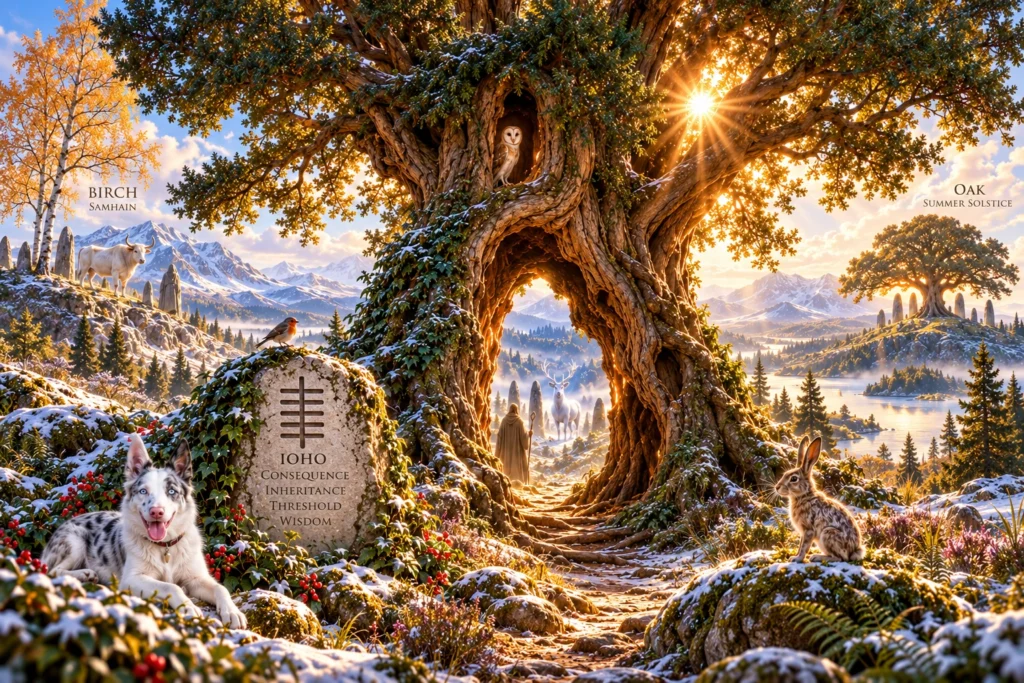
The Yew Tree stands at the culmination of the original Ogham, traditionally associated with Ioho, the twentieth and final letter of the twenty feda. Ancient, evergreen and extraordinarily long-lived, the Yew carries a spiritual presence shaped by Consequence, Inheritance, Threshold and Wisdom. Yet this is not simply the tree at the end of the Ogham alphabet. The Yew completes one journey so that everything gathered along the way can be carried into another.
Within Celtic Tree Lore and Druidic spirituality, the Yew belongs naturally with death, ancestors, eternity, transformation and renewal. Its remarkable ability to survive great age, hollow from within and continue producing living growth makes it difficult to separate ending from beginning. The ancient and the new can inhabit the same tree, turning the Yew into a living expression of continuation through change.
As one of the Three Pillars of Wisdom, the Yew shares the turning year with Birch and Oak. Yew carries the wisdom of winter and the Winter Solstice, Birch receives the returning cycle at Samhain, the Druidic New Year, and Oak reaches its great expression at the Summer Solstice. Together they carry the movement from what was, through what is, towards what is still becoming.
The spiritual meaning of the Yew reaches far beyond death. Its ancient presence brings together Ogham Tree Lore, Celtic mythology, folklore, healing lore, Animal Spirit, Gods and Deities, Totems and Entities, and Secret Harmonies. Across these traditions, the Yew repeatedly appears wherever humanity encounters memory, consequence, spiritual thresholds and the mystery of what continues when one state of existence reaches its completion.
As the last tree of the original Ogham, the Yew does not close the door. It stands upon the threshold, carrying the inheritance of everything that came before and preserving its wisdom for whatever comes next.
Yew Tree – Ogham Tree Profile
Bruce Clifton
Name: Yew Tree
Ogham: Ioho – Eye her
Letter: I
Lunar: N/A
Season: Winter
Element: Earth ~ Wind
Direction: North
Moon Phase: Four Quarters
Moon Name: N/A
Influence: Androgynous
Title: Chieftain
Age: Eternal Rebirth
Aura: Purple
Healing: Arthritis ~ Asthma ~ Bronchitis ~ Colds ~ Coughs ~ Cystitis ~ Digestive Health
Animal Spirit: Bull ~ Frog ~ Owl ~ Robin Redbreast
Totems – Entities: Archangel Uriel ~ Daoine Sithe
Gods – Deities: Matres Eburnicae ~ Tisiphone ~ Ullr
Secret Harmonies: Akashic Records ~ Ancestral Spirit Communication ~ Consequence ~ Death ~ Walking between Worlds
Festival: (coming soon)
Cosmos: (coming soon)
Key Words: Consequence ~ Inheritance ~ Threshold ~ Wisdom
Essence of the Yew Tree
Bruce Clifton
The essence of the Yew is Continuation through Completion. It stands at the end of the original Ogham not as a final ending, but as the place where everything experienced becomes wisdom and everything learned becomes inheritance.
The Yew carries Consequence, Inheritance, Threshold and Wisdom within its ancient form. It remembers what has passed without becoming bound by it, allowing old experience to nourish new understanding. Its remarkable ability to endure, hollow and renew reflects the continuing movement from what was, through what is, towards what is still becoming.
As one of the Three Pillars of Wisdom, the Yew holds the winter stillness in which experience settles into understanding. It teaches that completion has value, that consequence carries meaning, and that crossing a threshold does not require leaving everything behind.
The Yew is therefore the essence of wisdom carried forward — the ending that remembers, the threshold that transforms, and the ancient life from which renewal can begin.
Healing Lore of the Yew Tree
Bruce Clifton
The healing lore of the Yew reaches beyond remedies for the physical body. Within The Spiritual Centre, healing embraces Mind, Body and Spirit, recognising that wellbeing is not confined to the treatment of an ailment, but includes emotional balance, spiritual health and an openness to the greater life that exists around us.
The Yew is a tree of powerful contrasts. It contains highly toxic compounds, yet from this same tree modern medicine has discovered substances of considerable therapeutic importance. This relationship between toxicity and healing reminds us that the natural world does not divide itself simply into what heals and what harms; knowledge, understanding and appropriate use matter.
For the Body, the Healing Remedies Oracle preserves traditional associations and practices connected with the Yew, while respecting the particular care demanded by such a toxic tree. These remedies form only one part of its healing lore.
For the Mind, the Yew encourages stillness and a widening of perception. Its extraordinary age places an individual human lifetime within a much greater continuity, allowing thought to move beyond immediate concerns and become receptive to memory, reflection and understanding.
For the Spirit, the Yew opens awareness to spiritual existence beyond the density of physical reality. Its relationship with continuation, ancestors, parallel spiritual planes and the turning cycles of life encourages spiritual health through connection rather than separation.
Healing through the Yew is therefore not simply concerned with curing what is physically unwell. It is the continuing search for harmony between Mind, Body and Spirit, allowing each to support the health and expression of the others.
Scope & Notice
The information contained herein is for educational and entertainment purposes only. All efforts have been made to present accurate, up-to-date, reliable and complete information; however, no warranties of any kind are stated or implied. Readers should acknowledge that the author is not engaged in the rendering of medical or professional advice. The content herein should not be perceived as a substitute for professional or personal guidance. If in doubt, consult a qualified professional before attempting any techniques outlined.
The appropriate dosage or application of any natural remedy is dependent upon various factors, including age, health status, and individual circumstances. Natural products are not inherently safe, and dosage may be critical. It is best practice to begin with lower amounts and adjust as necessary. Consideration should also be given to timing, as the effectiveness of remedies may vary according to time of day and individual sensitivity.
About the Healing List
This list of ailments is not complete in its entirety; it has been limited to the most popular, with the remedies coming firstly from the tree and then vegetation dependent on the tree. It is worthy of note that there is more than one way to make a cup of tea, and many of the ingredients can be purchased online.
Yew Tree – Healing Remedies Oracle
We have alphabetised this list of healing qualities of the Yew Tree solely for ease of reference; they include but are not limited to:
1) Arthritis
2) Asthma
3) Bronchitis
4) Colds
5) Coughs
6) Cystitis
7) Digestive Health
8) Fevers
9) Gout
10) Urinary Tract Bladder
Arthritis / Yew Tree
Ingredients:
Yew bark
Yew leaves / needles
Key Properties:
Taxanes
Diterpenoids
Phenolic compounds
Flavonoids
Traditional properties:
Anti-inflammatory
Analgesic
Antirheumatic.
Yew has a long-standing place in traditional healing for arthritis, rheumatism and aching joints, where its bark and leaves belong particularly to remedies for stiffness, inflammation and persistent joint pain.
Traditional Actions:
Yew is traditionally associated with warming stiff joints, easing rheumatic aches and soothing persistent muscular and joint discomfort. Its antirheumatic character makes it particularly suited to the deep stiffness and aching traditionally associated with arthritis.
Preparation:
Make a Yew steam bath consisting of bark and leaves gently heated in water. Allow the rising warmth and steam to surround the affected joints, keeping them comfortably within the warm vapour.
Traditional Use:
The Yew steam bath is traditionally used for stiff, aching and rheumatic joints, allowing warmth and the properties of the tree to work together to soothe discomfort and encourage greater ease of movement.
Asthma / Yew Tree
Ingredients:
Yew leaves / needles
Young Yew shoots
Key Properties:
Taxanes
Diterpenoids
Flavonoids
Phenolic compounds
Traditional properties: Antispasmodic, expectorant, respiratory and anti-inflammatory.
Yew has a long place in traditional respiratory healing, where its leaves and young shoots are associated with asthma, bronchial congestion and difficulty in breathing. The tree’s medicinal lore particularly connects it with easing constriction and calming spasmodic conditions of the chest.
Traditional Actions:
Yew is traditionally used to settle bronchial spasm, ease tightness within the chest and encourage freer breathing. Its association with asthma belongs to a wider tradition of using Yew for coughs, bronchitis and other respiratory complaints.
Preparation:
A traditional respiratory preparation consists of Yew leaves and young shoots gently heated in water to produce an aromatic steam. The rising vapour forms the basis of an old-fashioned Yew inhalation rather than an internal brew.
Traditional Use:
The warm Yew-infused vapour is traditionally inhaled as part of the treatment of asthma, wheezing and constricted breathing, combining the warmth of steam with Yew’s long-standing association with respiratory healing.
Bronchitis / Yew Tree
Ingredients:
Yew leaves / needles
Yew bark
Key Properties:
Taxanes
Diterpenoids
Flavonoids
Phenolic compounds
Traditional properties: Expectorant, antispasmodic, anti-inflammatory and respiratory.
Yew has a place in traditional respiratory healing, with its leaves and bark associated with bronchitis, persistent coughs and congested breathing. Its warming preparations belong to folk practices intended to loosen the chest and settle troublesome respiratory spasms.
Traditional Actions:
Yew is traditionally associated with loosening bronchial congestion, calming coughing and easing tightness within the chest. Its use for bronchitis sits alongside its wider folk-healing relationship with asthma, coughs and other complaints of the airways.
Preparation:
A traditional preparation consists of Yew leaves and pieces of bark gently heated in water, allowing the rising aromatic steam to carry the presence of the tree. The preparation is used as a steam inhalation, rather than an internal brew.
Traditional Use:
The warm Yew-infused vapour is traditionally inhaled to soothe a congested chest, loosen stubborn mucus and ease the discomfort of bronchitis, bringing together warmth, moisture and Yew’s traditional respiratory properties.
Colds / Yew Tree
Ingredients:
Young Yew shoots
Yew leaves / needles
Key Properties:
Flavonoids
Phenolic compounds
Diterpenoids
Volatile compounds
Traditional properties:
Anti-inflammatory
Antipyretic
Expectorant
Respiratory
Yew belongs to traditional remedies for colds, congested breathing and winter respiratory complaints. Its evergreen leaves and young shoots are used in old respiratory preparations where warmth and aromatic vapour help relieve the discomfort of a heavy, stuffy cold.
Traditional Actions:
Yew is traditionally associated with opening congested breathing, soothing the airways and easing the stuffiness and heaviness accompanying a cold.
Preparation:
Make a traditional Yew steam preparation consisting of young shoots and leaves gently heated in a bowl of water. The plant material releases its aromatic presence into the rising warmth and vapour.
Traditional Use:
The Yew-infused steam is traditionally inhaled to ease nasal and chest congestion and encourage clearer breathing, particularly during troublesome winter colds.
Coughs / Yew Tree
Ingredients:
Yew leaves / needles
Young Yew shoots
Key Properties:
Diterpenoids
Flavonoids
Phenolic compounds
Volatile compounds
Traditional properties:
Anti-inflammatory
Antispasmodic
Expectorant
Respiratory.
Yew belongs to traditional respiratory healing, where its leaves and young shoots are associated with troublesome coughs and irritation of the airways. Its use sits alongside the tree’s wider folk association with bronchitis, asthma and congested breathing.
Traditional Actions:
Yew is traditionally associated with calming a persistent cough, soothing irritated airways and helping loosen congestion within the chest.
Preparation:
Make a traditional Yew leaf juice, crushing the fresh foliage and pressing it to extract the liquid. Leaf juice is one of the recorded preparations within Yew folk medicine for coughs and colds. (It is important to remember that the Yew Tree carries levels of toxicity that is generally accepted to be poisonous. The historical preparation is recorded as folklore rather than an instruction for modern use.)
Traditional Use:
The warm Yew-infused vapour is traditionally inhaled and is of equal value to the elixir itself to settle coughing, soothe the chest and encourage easier breathing, particularly where a cough accompanies congestion.
Cystitis / Yew Tree
Fresh young Yew shoots
Key Properties:
Diterpenoids
Flavonoids
Phenolic compounds
Taxanes
Traditional Properties:
Anti-inflammatory
Antispasmodic
Diuretic
Urinary
Yew has a long-standing place in traditional healing for cystitis and urinary complaints, particularly where there is irritation of the bladder, frequent urging to urinate, discomfort and difficulty passing urine. Historical Yew materia medica specifically associates Taxus baccata with cystitis and dysuria.
Traditional Actions:
Yew is traditionally associated with calming an irritated bladder, easing urinary spasm and encouraging the natural passage of urine. Its relationship with the urinary system also extends to kidney complaints, urinary difficulty and bladder discomfort.
Preparation:
Make a traditional Yew tincture from the fresh young shoots, allowing the properties of the young foliage to infuse into the tincture before straining. The use of fresh young Yew shoots as a tincture is specifically recorded within traditional Taxus baccata materia medica.
Place fresh young Yew shoots in alcohol and leave them to steep, allowing the properties of the foliage to infuse into the liquid. Once sufficiently infused, the plant material is strained away, leaving the traditional concentrated Yew preparation.
Traditional Use:
The Yew preparation is traditionally associated with cystitis, bladder irritation and difficult or uncomfortable urination, particularly where there is persistent urging, bladder spasm or a weak urinary flow.
Digestive Health / Yew Tree
Ingredients:
Yew leaves / needles
Key Properties:
Diterpenoids
Flavonoids
Phenolic compounds
Taxanes
Traditional Properties:
Antispasmodic
Carminative
Digestive
Stomachic
Yew belongs to traditional healing for indigestion and digestive discomfort, with its leaves particularly associated with dyspepsia and disturbances of the stomach. Yew traditions also connect the tree with stomach pain, diarrhoea and digestive disorders.
Traditional Actions:
Yew is traditionally associated with settling digestive discomfort, calming intestinal spasm and easing indigestion and stomach pain. Its digestive lore particularly suits the uncomfortable fullness, disturbance and abdominal discomfort traditionally associated with poor digestion.
Preparation:
Historical healing lore records Yew leaves being simmered in water to produce a decoction, which was traditionally associated with indigestion and digestive discomfort. Yew is highly poisonous and these historical preparations are recorded here as traditional folklore rather than instructions for modern use.
Traditional Use:
The Yew preparation is traditionally associated with indigestion, stomach discomfort and disturbed digestion, where it belongs to remedies intended to settle the stomach and restore digestive ease.
Celtic Tree Lore of the Yew Tree
Bruce Clifton
The Yew arrives at the end of the original Ogham, traditionally associated with Ioho, the twentieth and final letter of the twenty feda. Yet its position is not simply an ending. Yew completes the first great journey through the Ogham and carries everything that has been learned towards what comes next. What was becomes part of what is.
Within the Ogham Tree Lore of The Spiritual Centre, Yew, Birch and Oak form the Three Pillars of Wisdom, their relationship expressed through the great turning points of the Druidic year. They are not three isolated trees, but companions within a continuing movement of completion, renewal and fulfilment.
At Samhain, the Druidic New Year, Yew reaches the completion of the old cycle and hands its wisdom to Birch. Birch receives what has been carried forward and begins again, bringing emergence and renewal into the new year. Nothing is discarded in that exchange. The wisdom of what has passed becomes part of the life that is beginning.
Yew then stands within the darkness of winter and reaches its great expression at the Winter Solstice, when the year has travelled into its deepest night and the return of light begins. The evergreen Yew holds continuity through this stillness. It carries what was through the darkness until what is becoming can emerge.
Across the wheel stands Oak at the Summer Solstice, when light reaches its greatest strength. Yew and Oak therefore hold the two great solstice thresholds: Yew within the depth of winter and Oak within the height of summer. Between them, Birch carries the renewal born at Samhain, creating a threefold movement through darkness, emergence and fullness.
This is the quiet miracle within their relationship. Yew remembers. Birch begins. Oak fulfils. Then the year turns again. Summer moves towards harvest, harvest towards Samhain, and what has reached completion returns once more to Yew.
The physical Yew reflects the same mystery. Ancient wood can disappear while the living tree continues around it; new growth can emerge from structures already carrying immense age. Old and new therefore exist within one continuing life. The tree does not escape time — it gathers time into itself.
As the twentieth tree, Yew consequently represents far more than death or conclusion. It becomes Completion, Inheritance, Continuity and Wisdom, receiving the accumulated journey of the Ogham and carrying it towards renewal.
Within the Three Pillars of Wisdom, the whole movement becomes beautifully simple: Yew carries what was, Birch awakens what is, and Oak reveals what it may become.
Folklore of the Yew Tree
Bruce Clifton
The folklore of the Yew gathers in the spaces where history stops explaining and the story begins. An ancient tree that refuses to surrender easily to time was never going to remain simply a tree; generations have surrounded it with sacrifice, spirits, poison, death, renewal and tales of worlds existing alongside our own.
The White Bull and the Yew — A white bull was no small offering. It represented wealth, fertility and years of value to the breeder and the wider community, and neighbouring settlements might share in the importance of such an animal. As its fertile years ended and winter approached, sacrificing the bull transformed something of immense earthly value into a sacred offering. The meaning of sacrifice lay precisely in its value: something precious was surrendered because it was precious.
The Frog and the Yew — The Frog carries its own chemistry within its skin while the Yew conceals powerful toxicity within its leaves, seeds and wood. Folklore brings the two together as unlikely companions, each reminding the curious that what appears quiet and familiar may carry considerably more power than expected.
The Hollow Yew — When the heart of an ancient Yew disappears, the tree does not necessarily die; it continues living around an emptiness at its centre. Folklore has little difficulty imagining that hollow as somewhere the ordinary world grows thin — not an entrance beneath our own, but a meeting place with a parallel spiritual world existing alongside it.
Uriel in the Winter Yew — When winter comes from the North and the landscape falls quiet, Archangel Uriel stands beside the evergreen Yew carrying light into the darkest season. The folklore is simple: when most of the woodland has surrendered its leaves, look for the tree that remains green, and perhaps Uriel will not be very far away.
Tisiphone and the Burning Yew — Ancient poetry placed a blazing Yew branch in the hand of Tisiphone as she moved among the dead. The old Avenger of Murder has travelled a very long way since then, and within the folklore of The Spiritual Centre she emerges from the ancient world as the Keeper of Consequence, still carrying the Yew and reminding humanity that every action becomes part of what follows.
The Yew That Remembers — Villages change, families disappear, buildings rise and fall, yet an ancient Yew may remain where generations once gathered around it. Perhaps this is why so many stories cling to the tree: when everyone who knew what really happened has gone, the Yew is still there — and it isn’t telling.
Animal Spirit of the Yew Tree
Bruce Clifton
The Animal Spirits of the Yew Tree reflect a tree of endurance, transformation, ancient wisdom and continuation. The Bull, Frog, Owl and Robin Redbreast approach the Yew through very different relationships with the natural and spiritual worlds, each revealing another aspect of a tree whose life can extend across countless human generations.
The Bull brings strength, fertility and the seasonal turning from harvest towards winter, while the Frog embodies transformation as life changes completely from one form into another. The Owl, at home within ancient woodland and the hollow spaces of old Yews, carries wisdom, stillness and an affinity with darkness, death and spiritual passage. The Robin Redbreast brings life and colour into the winter landscape, its familiar presence among churchyards and Yews creating a gentler correspondence with remembrance and those who have passed into spirit.
Together, these Animal Spirits reveal that the Yew is not solely a tree of death or eternity. It is equally a tree of life continuing through change — strength becoming endurance, transformation becoming renewal, darkness becoming understanding, and remembrance remaining present while the seasons continue to turn.
Yew Tree – Animal Spirit Oracle
Bruce Clifton
We have alphabetised this list of animal spirit that harmonise with the yew tree solely for ease of reference; no sense of hierarchy or entitlement is intended or implied:
1) Bull
2) Frog
3) Owl
4) Robin Redbreast
Bull / Yew Tree
The Bull belongs to the Yew through Samhain, when the harvest is gathered, the herds return from their summer pastures and the Celtic year moves towards winter. The Bull embodies strength, fertility, abundance and prosperity, carrying within him the continuation of the herd and the wealth upon which the community depends.
As the fertile year draws to its close, the Bull also represents sacrifice and sustenance. Celtic tradition preserves the sacred importance of the Bull and the sacrifice of white bulls, while Samhain marks the time when livestock that could not be sustained through winter were slaughtered. What has lived and prospered through the year now becomes nourishment for the community during the darker months.
The Yew stands beside the Bull at this threshold between life and death. Evergreen and extraordinarily long-lived, it carries life through winter and regeneration through apparent death. Even an ancient Yew can hollow with age while continuing to grow around its own emptiness, making the tree a powerful expression of death, renewal and eternity.
Together, Bull and Yew express one of the deepest harmonies of Samhain. The Bull gives life through death, while the Yew carries life through death. One represents the abundance of the year gathered and transformed into sustenance; the other holds the promise that life continues beyond the darkness.
Within the Animal Spirit of the Yew, the Bull therefore embodies strength, sacrifice, prosperity, transformation and the eternal cycle of life, death and rebirth.
Frog / Yew Tree
The Frog belongs naturally to the Yew through transformation, renewal and the eternal movement of life. From egg to tadpole, from tadpole to frog, it passes through distinct states of existence while remaining part of one continuing life. The Yew carries the same mystery, standing between birth, life and afterlife, death becoming regeneration and endings returning once more to beginnings.
Both carry the Power of Three. The Frog expresses three stages through egg, tadpole and frog, while the Yew stands within the Three Pillars of Wisdom alongside Birch and Oak. Through this threefold nature they correspond with Abred, Gwynfyd and Ceugant, and with Past, Present and Future, each state flowing into another rather than existing alone.
Frog also moves between water and land, crossing from one realm of existence into another. Yew similarly belongs to the threshold, rooted within the physical world while spiritually associated with ancestors, death, rebirth and the continuing journey of spirit. Both therefore become creatures of transition and passage between states and realms.
There is another harmony within their apparent toxicity. The Yew carries powerful poisonous constituents while remaining a tree of healing, longevity and regeneration. Many frogs likewise carry protective substances within their skin. Spiritually, this becomes a correspondence of cleansing and realignment, reducing incompatible and negative influences so that harmony and positive spiritual energy can return.
Together, Frog and Yew embody transformation, the Power of Three, divine intervention, spiritual cleansing and the continuation of life beyond change. Frog transforms visibly before returning between water and land; Yew transforms quietly through extraordinary longevity, regeneration and renewal. Both carry the understanding that change is not an ending, but another movement within an eternal cycle.
Owl / Yew Tree
The Owl belongs naturally to the Yew, sharing its affinity with darkness, ancient wisdom and the threshold between the physical and spiritual worlds. This relationship exists within the living tree itself, as ancient Yews develop deep hollows and cavities that provide shelter and nesting places for woodland birds, including the Tawny Owl.
As a creature of the night, Owl moves confidently through darkness, seeing what daylight conceals. The Yew carries a similar spiritual understanding. Associated with death, ancestors, eternity and regeneration, it stands at the boundary where one state of existence passes into another. Together, Owl and Yew become guardians of hidden wisdom and the mysteries beyond ordinary sight.
The silent flight of the Owl strengthens this correspondence. The Tawny Owl moves almost invisibly through woodland at night, inhabiting the same ancient landscape as the Yew. It moves between earth and sky while Yew stands between life, death and rebirth, both carrying an affinity with stillness, contemplation and spiritual awareness.
Within Celtic tradition, Owl also carries associations with transformation and the Otherworld, most famously through Blodeuwedd and her transformation into an owl. Yew likewise expresses transformation through extraordinary longevity and regeneration, continuing to live and renew itself even as its ancient heartwood disappears.
Together, Owl and Yew embody wisdom, transformation, ancestral connection, spiritual vision and passage between worlds. The Tawny Owl sheltered within the ancient Yew gives physical form to that spiritual correspondence: a creature of darkness and hidden sight dwelling within a tree of eternity, death and continuing life.
Robin Redbreast / Yew Tree
The Robin Redbreast belongs naturally to the Yew, finding food and shelter among its dense evergreen branches during the colder months. While much of the woodland retreats into winter, the Yew remains green and bears its bright red arils, providing an important autumn and winter food source for birds including the Robin. The Robin’s own brilliant red breast echoes the scarlet fruit against the deep green Yew, creating a striking natural correspondence between bird and tree.
Spiritually, both carry the mystery of life continuing in the presence of death. Yew stands among burial places and ancestors as the tree of eternity, regeneration and rebirth, while Robin remains conspicuous through the darkness of winter, its song and colour bringing a living presence to a landscape apparently at rest.
Robin also carries a longstanding relationship with death, the departed and the continuation of spirit within British folklore. Its familiar presence around gardens, churchyards and burial grounds places it naturally within the landscape of the ancient Yew, where remembrance and continuing life exist side by side.
There is also a shared symbolism of blood and sacrifice. The Robin’s red breast carries several old legends explaining how it received its colour, while the blood-red arils of the Yew surround the seed from which another generation may emerge. Within both lies the correspondence of death giving way to continuing life.
Together, Robin Redbreast and Yew embody remembrance, renewal, sacrifice, ancestral connection and life beyond death. Beneath the evergreen Yew, the small red-breasted bird becomes a living reminder that even within the deepest winter, life continues and the cycle begins again.
Totems and Entities of the Yew Tree
Bruce Clifton
The Yew carries a spiritual presence shaped by great age, endurance, remembrance and eternity. It has watched generations pass while continuing its own extraordinary life, making it a natural companion for spiritual beings whose presence reaches beyond the boundaries of ordinary human time.
Archangel Uriel brings the light of wisdom into this ancient landscape. His relationship with the Yew is not about overcoming darkness, but illuminating the mystery held within it — the understanding that death, memory and continuation all belong within the greater spiritual harmony.
The Daoine Sìthe, the People of Peace, bring another relationship with time and existence. Like the ancient Yew, their presence reaches beyond the limits of individual human lives. They exist alongside the physical world within a parallel spiritual plane, and through the Yew the distinction between these different densities of existence becomes less certain, allowing spiritual presence and physical landscape to meet within the same sacred space.
Together, Uriel and the Daoine Sìthe reveal two different aspects of the Yew: the light that carries wisdom through eternity and the spiritual presence that exists beyond human measures of time.
Yew Tree – Totems and Entities Oracle
Bruce Clifton
We have alphabetised this list of totems and entities that harmonise with the yew tree solely for ease of reference; no sense of hierarchy or entitlement is intended or implied:
1) Archangel Uriel
2) Daoine Sithe
Archangel Uriel / Yew Tree
Archangel Uriel walks with the yew where time itself seems to stand still. Beneath its ancient branches, centuries gather quietly within living wood, while roots descend into the earth of those who came before and new growth continues beneath the same enduring crown. Here, Uriel is not simply the Angel of the North or the bearer of divine light. He becomes the keeper of the light that survives time.
The yew belongs equally to life and death. Its dark evergreen foliage remains when the woodland retreats into winter, while its extraordinary longevity allows one living tree to witness generation after generation pass beneath its branches. Uriel brings illumination to this threshold, not to banish death, but to reveal death as part of a greater continuity. What disappears from one world is not necessarily lost to another.
There is something beautiful in the way an ancient yew renews itself. Branches descend, roots form, trunks hollow and fresh growth rises around what appears old. The boundaries between beginning and ending become difficult to define. Uriel’s light moves through this same mystery: not the sudden light of dawn, but the small eternal flame carried from one existence into the next.
This places Uriel within the yew as a guardian of memory. The tree remembers through its living presence: the footsteps beneath its canopy, the generations gathered around it, the changing seasons and the countless winters through which it has remained green. Uriel gives illumination to that memory, carrying wisdom forward rather than allowing it to disappear with those who first possessed it.
At Samhain, this relationship becomes especially profound. The harvest has ended, darkness gathers and the boundary between the physical and spiritual worlds grows close. The yew stands at that threshold with its roots among the ancestors and its evergreen branches among the living. Uriel stands there also, his light neither belonging entirely to one side nor the other, illuminating the meeting place between them.
The yew therefore reveals another face of Archangel Uriel. With the fir, his light accompanies renewal through the depths of winter. With the yew, his light accompanies eternity. He stands beneath its ancient canopy as witness to everything that passes and everything that remains — Earth beneath his feet, eternity within the tree, and the quiet flame of divine wisdom continuing between worlds.
Daoine Sithe / Yew Tree
There are trees beneath which the Daoine Sìthe might be encountered, and there are trees ancient enough to seem as though they have always known them. The Yew belongs to the latter. Long before paths became roads, before boundaries were drawn across the land and before generations gave their names to particular places, the Yew was already capable of standing there — dark, evergreen and extraordinarily long-lived.
This gives the Yew a very different relationship with the People of Peace. The tree is not simply a doorway into their world. It is a witness shared between worlds. Human generations may arrive, gather beneath its branches and disappear again, while the Yew continues. The Daoine Sìthe belong to that same deeper sense of time, where centuries need not carry the significance humanity gives them.
Ancient Yews are particularly remarkable because age does not always lead simply towards death. Their trunks may hollow, divide and decay while living wood continues around them. Branches can descend towards the earth and establish new growth, so that beginning and ending become entwined within the same tree. The Yew can therefore appear almost impossible to place within ordinary time: old and young, dying and living, ancestor and descendant together.
Here the correspondence with the Daoine Sìthe becomes profound. Their world exists alongside the physical landscape but does not necessarily obey human expectations of distance or time. Stories of the Sìth repeatedly disturb ordinary chronology: a brief encounter may conceal the passing of years, while places apparently empty to human eyes may possess histories and inhabitants of their own. Beneath the Yew, this becomes less a tale of entering another world than of recognising that another measure of existence has always been present.
At Samhain, when remembrance turns naturally towards those who came before, the Yew gathers these ideas beneath one evergreen canopy. Its roots descend through the earth of generations while its living branches remain above them. The Daoine Sìthe stand within that same spiritual landscape — not as ghosts of the human dead, but as another people whose relationship with the land reaches beyond the span of individual human lives.
Within the Yew, the Daoine Sìthe therefore embody Ancient Presence, Ancestral Landscape, Timelessness and Continuity. Gorse gives their boundary a shape and White Poplar whispers that they may be passing. The Yew asks something altogether older: perhaps it is not the People of Peace who enter our landscape, but humanity that briefly passes through theirs.
Gods and Deities of the Yew Tree
Bruce Clifton
The Gods and Deities of the Yew Tree come from different lands and different spiritual traditions, yet each discovers something within the Yew that belongs naturally to their own story. Matres Eburnicae, Tisiphone and Ullr are not brought together by a shared mythology, but by a tree whose extraordinary character allows three very different spiritual relationships to emerge.
The Matres Eburnicae bring the Divine Mothers and the continuation of life through generations, their name carrying the Celtic ebur- root traditionally associated with the Yew. Tisiphone carries the blazing Yew branch between the worlds of the living and the dead, transforming her ancient role as Avenger of Murder into the Keeper of Consequence. Ullr, the northern god of the bow, winter skill and sacred oath, dwells at Ýdalir, the Yew-Dales, giving him one of the clearest surviving mythological relationships with the tree.
Together they reveal the remarkable breadth of the Yew’s spiritual character. It can be Mother, Memory, Consequence, Endurance, Promise and Continuation, without any one tradition needing to surrender its own identity.
Within The Spiritual Centre, the Yew therefore becomes a place of meeting rather than ownership. Celtic, Classical and Northern traditions approach the same ancient tree from different directions, each recognising within it something sacred that the others do not diminish, but deepen.
Yew Tree – Gods and Deities Oracle
Bruce Clifton
We have alphabetised this list of gods and deities that harmonise with the yew tree solely for ease of reference; no sense of hierarchy or entitlement is intended or implied:
1) Matres Eburnicae
2) Tisiphone
3) Ullr
Matres Eburnicae/ Yew Tree
The Matres Eburnicae, the ancient Eburnican Mothers, belong naturally beneath the evergreen branches of the Yew. Their devotion reaches from the older Celtic spiritual landscape into the surviving stones of second-century Gaul, where their collective name was preserved as part of an already established reverence for the Divine Mothers. Within their name lies the ancient ebur- root, traditionally associated with the Yew, binding Mother, tree and sacred landscape together.
The Mothers belong to the sacred power of three. Within The Spiritual Centre, they find their living expression as Maiden, Mother and Crone — becoming, fulfilment and wisdom. The Yew carries all three within itself: young growth rises from ancient wood, the mature tree shelters life beneath its evergreen crown, while hollow trunks and immense age hold the memory of generations that have passed.
Their worship was intimate and reciprocal. People approached the Mothers with hopes for family, fertility, abundance and the continuation of life. Offerings were brought, incense rose, libations were poured and vows were made. When prayers were answered, people returned with gratitude. The relationship was therefore not simply worship of distant goddesses, but an enduring exchange between the Mothers, the people and the living land.
Their devotion also crossed into Britain, where the Matres were honoured from the south of the country to the northern frontier. At ancient Eboracum — York — Gallic Mother Goddesses were specifically remembered, creating a remarkable echo between the Mothers of Gaul and a British place whose ancient name also belongs to the ebur- linguistic world of the Yew.
Beneath the Yew, the Matres Eburnicae become Mothers of Continuity. The Maiden carries what is beginning, the Mother nurtures what has come into being, and the Crone holds the wisdom that must pass onwards. Generation follows generation while the ancient Yew remains, its roots among the ancestors and its evergreen branches among those still to come.
The stone remembers the Mothers by name. The Yew remembers their devotion.
Tisiphone / Yew Tree
The ancient Yew welcomes Tisiphone, Keeper of Consequence, a formidable presence whose origins reach into the earliest layers of Greek spirituality. Born among the Erinyes when the blood of Uranus fell upon Gaia, she belongs to a time before the Olympian order, witnessing the Golden Age of Cronus and the changing relationship between humanity and harmony. Once feared as the Avenger of Murder, she carried the ancient understanding that actions cannot simply disappear once the moment has passed.
As humanity moved further from the harmony of the Golden Age, Tisiphone’s purpose became increasingly apparent. Violence, betrayal and broken obligations created consequences that travelled beyond the people who first caused them. Within this modern world, this ancient Fury undergoes her own transformation. Vengeance becomes consequence, punishment becomes understanding, and Tisiphone becomes the guardian of the truth that every action becomes part of what follows.
Her relationship with the Yew is beautifully preserved in the ancient Roman Thebaid, where Tisiphone is summoned from the Underworld carrying a blazing branch of Yew. The image could hardly be more appropriate. The Yew stands between death and continuation, carrying the memory of generations within living wood, while Tisiphone carries the memory of actions and their consequences through time. Neither allows the past simply to disappear.
Through the Yew, Tisiphone therefore finds a new place within the modern spiritual world. She no longer needs to pursue humanity as the terrifying Fury of antiquity; she stands instead as the Keeper of Consequence, reminding us that harmony is not restored by forgetting what has happened, but by allowing its consequences to be recognised and understood. The Yew remembers; Tisiphone ensures that remembrance has meaning.
Ullr / Yew Tree
Ullr belongs to the Yew through Ýdalir, the Yew-Dales, the ancient northern landscape remembered as his home. God of the bow, winter, hunting, skill and the sacred oath, he stands among trees whose strength lies not in rigidity but in their ability to bend, endure and return. The Yew gives its wood to the bow; Ullr gives the bow patience, judgement and purpose.
There is a quietness to this relationship. Before the arrow can fly there must be stillness. The bow is drawn and held between movement and release, gathering its strength within the tension of the Yew. Ullr inhabits that moment — the breath before action, when instinct becomes discipline and possibility becomes intention.
Winter deepens the correspondence. The evergreen Yew remains alive when much of the woodland has withdrawn, while Ullr moves confidently through the northern winter landscape. Neither challenges the season nor seeks to overcome it. Their strength comes through understanding its nature and belonging within it.
The Yew also carries the weight of the sacred promise. Ancient, enduring and capable of surviving generation after generation, it becomes a fitting companion for a god associated with oaths. Words spoken beneath such a tree are placed against something far older than the person speaking them. Ullr reminds us that an oath does not end when the voice falls silent; like the Yew, it continues to live after the moment in which it was created.
When the Norse world reached the northern and western shores of Britain, Ullr entered a landscape where the Yew was already ancient. In places such as the Hebrides, Norse and Celtic cultures met without either needing to have always been the other. Ullr could cross the sea with his own name, his own traditions and his Yew-Dales behind him, finding recognition within another land that already understood the enduring presence of the Yew.
Within The Spiritual Centre, Ullr and the Yew belong to Endurance, Precision, Patience, Honour and Sacred Intention. The Yew bends without surrendering its strength; the archer waits without surrendering his purpose. Between them lies the stillness of the drawn bow — a moment when strength is held quietly, direction is chosen, and only then is the arrow released.
Secret Harmonies of the Yew Tree
Bruce Clifton
The Secret Harmonies of the Yew Tree arise from its extraordinary relationship with time, memory, death and continuation. Few trees remain within a landscape for so long, witnessing generations pass beneath their branches while continuing to renew themselves from ancient living wood. The Yew carries the past without becoming imprisoned by it, allowing memory and renewal to exist together.
The Yew challenges the very idea of a simple beginning and ending. Ancient wood may disappear from its centre while the tree continues around it; branches can descend, root and contribute to further growth, while new stems rise beside structures already centuries old. Within one ancient Yew, disappearance, survival and renewal become part of the same continuing life. Death therefore becomes less a final event than one movement within a much longer story.
Through Akashic Records, Ancestral Spirit Communication, Consequence, Death and Walking Between Worlds, the Yew reveals harmonies concerned with what remains, what continues and what passes from one state into another. Each approaches the same mystery differently, yet all recognise that the past, present and what is still becoming are never entirely separate.
Within The Spiritual Centre, the Yew becomes a Keeper of Living Memory and Continuation, carrying the experiences of generations within the greater movement of Bnwyfre, Breath of Life, and Life Force Energy.
Yew Tree – Secret Harmonies Oracle
Bruce Clifton
We have alphabetised this list of secret harmonies of the white yew tree solely for ease of reference; no sense of hierarchy or entitlement is intended or implied:
1) Akashic Records
2) Ancestral Spirit Communication
3) Consequence
4) Death
5) Walking Between Worlds
Akashic Records / Yew Tree
The Yew stands as a living expression of the Akashic Records, carrying memory not simply through years, but through generations. While human lives come and go beneath its branches, the ancient Yew remains, witnessing the changing landscape and holding the continuity of all that has passed around it.
Its remarkable ability to hollow, regenerate and continue growing gives this relationship particular meaning. The Yew does not preserve the past by remaining unchanged; old wood and new growth exist together within the same living presence. What has been is never entirely separated from what is becoming.
Within the Akashic Records, every life, action and experience becomes part of a greater spiritual memory. The Yew reflects this principle through its own existence. Its roots occupy the earth of the ancestors, its trunk carries centuries of experience, and its evergreen branches continue reaching into the present.
The Yew therefore becomes more than a witness to history. It is a Keeper of Living Memory, standing where past, present and future meet. Beneath its branches, the Akashic Records are not imagined as a distant spiritual library, but as a continuing presence in which everything that has been contributes to everything that follows.
The Yew remembers — and within its memory, nothing is truly lost.
Ancestral Spirit Communication / Yew Tree
The Yew stands as a natural meeting place between the living and the ancestors. Its extraordinary lifespan allows the same tree to remain while generations are born, live and pass into spirit, giving the Yew a continuity that reaches beyond any single human lifetime. Beneath its evergreen branches, the boundary between remembrance and spiritual presence becomes beautifully thin.
Its roots grow through the earth of those who came before, while new growth continues among those living today. At Samhain, when ancestral presence draws particularly close, the Yew becomes a spiritual bridge through which memory, wisdom and love may continue between generations. Communication with the ancestors is therefore not about calling the past back, but recognising that the relationship between generations has never entirely been broken.
Within Ancestral Spirit Communication, the Yew represents Continuity, Remembrance and Spiritual Connection. It stands quietly between generations, carrying the presence of those who have gone before into the lives of those who follow.
Consequence / Yew Tree
The Yew gives physical form to the Secret Harmony of Consequence, standing across generations while the actions of the past continue into the present. Its extraordinary longevity allows it to witness human lives come and go, carrying the memory of what has happened while continuing to grow into what follows.
Ancient wood, wounds, hollow spaces and new growth can exist within the same living Yew. Nothing that has happened to the tree simply disappears, yet neither does the past prevent renewal. In this way, the Yew reflects Consequence as the continuing relationship between an action and everything that action sets in motion.
The Yew does not judge the past, and Consequence is neither punishment nor reward. What has happened becomes part of the greater harmony, creating movements that may continue through people, places, generations and the spiritual world. Remembrance allows those movements to be recognised, while acknowledgement creates the possibility of realignment.
Through the Yew, Consequence becomes a harmony between what was, what is and what is still becoming. The past remains part of the living whole without being allowed to determine everything that follows.
Death / Yew Tree
The Yew carries an ancient relationship with Death, standing where the ending of physical life meets the continuation of spiritual existence. Its presence in burial grounds and sacred landscapes places it among generations of the dead, while its evergreen foliage continues to grow above them. Within the Yew, death and life are not opposites but different parts of the same continuing cycle.
The tree itself embodies this mystery. Ancient Yews can become hollow as their oldest wood disappears, yet the living tree continues around that emptiness and new growth may rise from what appears impossibly old. Death becomes part of renewal rather than the destruction of life.
The Yew therefore represents Death as Passage, Transformation and Continuation. Its roots belong among the ancestors while its branches remain among the living, allowing the tree to stand between physical and spiritual existence without belonging entirely to either.
Through the Yew, Death becomes a threshold rather than a final boundary. What has completed its physical journey passes beyond the visible world, while memory, spirit and the greater harmony of life continue.
Walking Between Worlds / Yew Tree
Yew stands within the threshold between life and afterlife, where one state passes into another without breaking the greater continuity of existence. Its extraordinary age, evergreen presence and ability to renew from ancient wood make it a living expression of a boundary that is crossed without becoming an ending.
As the Yew hollows, the space within the tree grows while life continues around it. Presence and absence occupy the same living form, reflecting a place between worlds where physical life and spiritual existence are not divided, but held within the same continuing harmony.
Through Yew, Walking between Worlds becomes continuation rather than departure. Awareness rests at the threshold without needing to force it open, recognising that what passes beyond physical life does not simply disappear, but continues within the greater movement of Bnwyfre, Breath of Life, and Life Force Energy.