Secrets of the Sea
The Sea
Volume 25 of 31
Bruce Clifton
Sea ~ Mór
The Sea completes the twenty-five profiles of the Ogham and Celtic Tree Lore, carrying the journey beyond the twenty-four Trees of the Grove and into Water. Here Earth, Air, Fire and Water meet Spirit; Sun finds Moon, physical reality meets spirituality, and the known world opens towards the mysteries of emotion, intuition and psychic awareness.
Within the spiritual meaning and folklore of the Sea, Gods and Deities cross its waters, Animal Spirits reveal their wisdom, and Water Elementals, Totems and Entities inhabit the worlds above and beneath the waves. Its mythology, healing lore and ancient stories explore humanity’s relationship with the ocean, the Moon, the tides and the unseen forces traditionally associated with Water.
The Sea is not another Ogham Tree, but the other half of every Tree that comes before it. As the twenty-fifth profile, it completes the Celtic Tree Lore through the relationship between Grove and Sea, Land and Water, body and spirit — bringing the physical and spiritual halves of the journey together.
Sea – Ogham Tree Profile
Bruce Clifton
Name: Sea
Ogham: Mór >> Moo-err
Letter: EA
Lunar: 13 Houses
Season: Winter ~ Spring ~ Summer ~ Autumn
Element: Earth ~ Wind ~ Fire ~ Water ~ Spirit
Direction: North ~ East ~ South ~ West ~ Centre
Moon Phase: Variable
Moon Name: Variable
Influence: Unified
Title: Community
Age: Eternal
Aura: Variable
Healing: Evidenced
Animal Spirit: Evidenced
Totems – Entities: Evidenced
Gods – Deities: Evidenced
Secret Harmonies: Evidenced
Festival: (coming soon)
Cosmos: (coming soon)
Key Words:
Essence of the Sea
Bruce Clifton
For twenty-four Trees we have walked within the physical world. We have touched bark, followed roots, gathered fruit, watched blossom become seed and allowed each Tree to reveal something of life through its own nature. Birch begins. Rowan protects. Willow bends. Oak endures. Hazel perceives. Apple loves. Yew carries life through completion, while the Grove gathers difference together and calls it belonging.
Then we reach the shore.
Nothing we have learned is left behind. Earth remains beneath our feet. Air moves across our skin. Fire travels from the Sun and dances upon the Water. Before us lies the Sea, while Spirit moves through them all. Earth ~ Air ~ Fire ~ Water ~ Spirit are not separate worlds. They are different expressions of the same living existence.
The Grove gives that existence form. Root, trunk, branch, leaf, body and Land belong to the density of physical reality, where life can be touched, smelled, tasted, heard and seen. Yet physical reality has never been the whole story. Every Tree has carried emotion, intuition, memory, love, consciousness and spiritual presence within its physical form. The Sea does not introduce these things; it allows us to meet them without needing them to become solid first.
Here the balance turns. Sun finds Moon. Land finds Water. The rooted finds the flowing. What is known meets what remains unknown. The masculine and feminine cease to be competing descriptions and become complementary movements within the same whole. Neither is complete without the other, just as no Tree survives through Earth and sunlight alone.
Between them flows Bnwyfre — Life Force Energy / Breath of Life. It moves through the Grove and across the Sea, through animal and human, rain and root, thought and emotion. Hildegard finds another expression of that living presence within Viriditas, the greening, flourishing vitality of creation. Different words reach towards an experience humanity repeatedly recognises: beneath the appearance of separate things, life is continually entering into relationship.
The Sea makes that relationship impossible to ignore. A wave reaches the shore from somewhere beyond sight. The Moon moves the tide from a distance no hand could bridge. A Salmon leaves its river and returns years later. A Turtle crosses an ocean and finds the region of the beach from which its life began. The Seal leaves the weight of Land and discovers grace within Water. Manannán looks across the same horizon we see and finds a road towards another world.
Even our emotions begin to resemble the Water. Love flows. Grief gathers when love can find no place to go. Fear holds and restricts, while release allows movement to begin again. Water meets the stone, finds its way around it and, given time, softens what once appeared immovable. The Sea does not teach us to escape physical existence; it teaches us that we can move through it without allowing fear to become our anchor.
And somewhere within that freedom is Love.
Not love as possession, reward or agreement, but love that allows another life to exist according to its own nature. The Oak remains Oak. The Hazel remains Hazel. The Salmon remains Salmon. The stranger remains themselves. Love does not require sameness before connection becomes possible. It allows difference to remain while separation begins to soften.
This is where the Sea completes the Grove.
The twenty-fifth is not another Tree standing beside the other twenty-four. The Sea is their other half. Every root has known its Water. Every leaf has opened into its Air. Every life within the Grove eventually returns something to the greater cycle, while the Sea receives without asking where the Water began its journey.
Ogham brings us to this threshold through Eamhancholl — Twin Coll, Twin Hazel — where perception reaches beyond the immediately visible. Mór takes the next step. We leave the shelter of the Trees and look towards a horizon we cannot reach with our eyes. The known world does not end there; only our ability to see it does.
And perhaps this is what thousands of years of Trees, stories, Gods, animals, ancestors, healers, Elementals, folklore and human experience have been quietly showing us.
We are physical, but we are not only physical. We are individual, but we do not live alone. We are capable of fear, but we are equally capable of Love. We belong to Earth while looking towards Spirit, rooted for a lifetime within one body while participating in something that began before us and will continue after us.
The rain does not fear becoming river, and the river loses nothing by entering the Sea. The Sea does not keep what it receives; it gives its Water back to the Sky so that somewhere beyond the horizon rain can fall upon another Grove.
Within that endless movement, nothing needs to stand alone. The Grove and the Sea, Sun and Moon, Earth and Water, body and Spirit, the known and the unknown are not opposing worlds waiting to be reconciled. They are already in relationship, already moving through one another, already part of the same living whole.
The Essence of the Sea is the recognition that we are too.
Healing Lore of the Sea
Bruce Clifton
The healing lore of the Sea cannot easily be contained within an oracle of individual remedies because the Sea belongs to the healing of mind, emotion and spirit. Its Water is forever moving, responding to the Moon, travelling through rain, river and tide, offering an understanding of healing that is less about what we can take from the Sea and more about what we can allow the Sea to carry away.
Water does not stand still. Rain leaves the cloud and falls to Earth; mountain streams become rivers and rivers find their way towards the Sea. When stone stands in the way, Water finds another path, flowing around it while slowly softening its edges. Given time, even the hardest rock is changed. Emotion has that same freedom to move, because fear, sorrow, anger and grief become heavier when they are held rather than allowed their natural passage.
Grief may be understood as love with nowhere to go. We hold tightly to someone or something that has been lost because releasing the grief can feel as though we are also releasing the love. Yet love does not depend upon grief for its existence. When sorrow is allowed to move, the love remains; it simply finds another way to live within us. Like Water meeting stone, emotion does not have to destroy what stands before it. It can move around it, soften it and continue its journey.
Much of the density we experience within physical reality comes from fear: fear of loss, change, uncertainty and everything that cannot be controlled or known. Fear closes and restricts, while love allows life to flow. As fear is released, Bnwyfre — Life Force Energy, the Breath of Life — is given greater freedom to move, bringing us towards Viriditas, the greening and flourishing of life. Peace ~ Love ~ Light becomes not an escape from physical existence, but another way of walking within it: loving more freely, fearing less and allowing others the freedom to do the same.
The Sea gives that release a natural rhythm. Tears become Water; rain returns to streams and rivers; rivers return to the Sea, while above them the Moon draws the tides towards the shore and releases them again. Nothing within this cycle remains completely still, and nothing needs to be held forever. A paddle in the Sea can ground emotion just as surely as walking through a meadow grounds the body — one an ocean of Water, the other an ocean of grass, both bringing us back into the movement of the living world.
This is the healing offered by the Sea. It does not ask us to stop feeling grief, fear, sorrow or love, nor does it promise that these experiences simply disappear. It offers a different understanding: emotion can be felt without being imprisoned, released without being lost and allowed to find its own path towards peace. As Water finds its way back to source, fear can be allowed to follow, leaving love free to remain, to move and to flourish.
Celtic Tree Lore of the Sea
Bruce Clifton
The Celtic Tree Lore begins within the Grove, where twenty-four Trees root us within the physical world. Each carries its own nature and correspondence through root, wood, leaf, flower and fruit, while Ogham gives voice and symbol to the relationship between Tree, Land and those who walk amongst them. Yet no Tree lives through Earth alone.
Rain falls through its branches. Roots draw Water from the ground while leaves open into Air and sunlight. Streams leave the Grove, rivers cross the Land and eventually their Water reaches the Sea. Every Tree therefore carries something of the Sea within it, just as every river carries something of the Land towards the ocean.
This is where the twenty-fifth finds its place. The Sea is not another Tree and has no need to become one; it is the other half of every Tree within the Grove. Earth and Fire, expressed through Land and Sun, give warmth, form and physical presence. Water and Air open towards Sea and Sky, movement and feeling, while Sun finds its reflection in Moon. These are not opposing worlds, but different expressions of the same living whole.
Between them moves Spirit. Bnwyfre — Life Force Energy, Breath of Life — belongs neither to Grove nor Sea alone. It moves through root and river, body and emotion, Earth and Water, connecting what can be touched with what can only be felt. The Grove gives that life physical form; the Sea carries it beyond the boundaries of form and towards intuition, emotion, psychic awareness and the unknown.
Ogham brings us towards that threshold through Eamhancholl — Twin Coll, Twin Hazel. Hazel carries knowledge and perception; its doubling takes that perception beyond the familiar, towards what cannot be understood through the physical senses alone. Eamhancholl therefore stands naturally at the edge of the Grove, looking beyond the Trees towards the Water and everything the horizon refuses to reveal.
The Sea becomes the twenty-fifth not by changing the ancient Ogham, but by completing the Celtic Tree Lore carried through these pages. Twenty-four Trees explore the density and wonder of physical existence; the Sea opens their other half — Water and Air, Moon and Spirit, emotion and intuition, the visible and invisible, the known and everything waiting beyond it.
The Grove does not end when we reach the shore. Its Water has been travelling here all along.
Folklore of the Sea
Bruce Clifton
The Sea begins where certainty ends. A ship disappears beyond the horizon and nobody upon the shore knows what waits for it there. Mist closes around distant islands, strange lights move across the Water and something breaks the surface beside a fishing boat before disappearing into the depths. The Sea keeps its secrets well.
Mermaids sing beyond the rocks, Selkies leave their skins upon lonely shores and Finfolk travel between their hidden world and ours. Enchanted islands appear where yesterday there was only open Water, while phantom ships continue voyages that should have ended generations ago. Somewhere beneath the waves are kingdoms, creatures and spirits known only through the stories of those who return to tell of them.
Those who live beside the Sea learn to listen. The behaviour of birds speaks of Land and weather; the changing Water warns of what is approaching; an unexpected visitor may carry an omen. Folklore and experience live comfortably beside one another. The fisherman knows the tide but still respects what should not be spoken before sailing, while the sailor understands the stars without needing every light upon the horizon to have an explanation.
Along the shoreline, the boundary becomes thinner. The tide withdraws and another landscape appears — caves open, pathways emerge and rock pools hold tiny worlds until the Water returns to claim them. Footprints cross wet sand and disappear beneath the next wave. Nothing here belongs entirely to Land or Sea, and it becomes difficult to say where one world finishes and another begins.
There is fear within these stories, but there is also love, laughter, longing and wonder. The Sea takes people away and brings them home. It feeds families, carries travellers towards distant shores and gives children shells, stones and impossible treasures washed up by the tide. We stand at its edge and search the horizon because some part of us still wants to know what lies beyond it.
We know more about the ocean than those who first tell these stories, yet the mystery refuses to leave. The Water still darkens beneath us, mist still hides the horizon and something can still surface unexpectedly among the waves. The old stories remain because the Sea still gives us room to believe there is more to this world than the things we already know.
Animal Spirit of the Sea
Bruce Clifton
The animals of the Sea carry qualities shaped by a world very different from our own. They live within movement, following tides and currents, crossing extraordinary distances and finding their way through depths where human senses can no longer guide us. Some return to the same shores across generations; others disappear beneath the surface into a world we can only glimpse.
Within Animal Spirit, these creatures offer more than symbolism. The Seal finds freedom when it enters the Water, the Salmon leaves its river and returns transformed, the Turtle crosses oceans without losing the way home, while the Seahorse finds strength within gentleness. Each reveals something different through the way it belongs to the Sea.
Their wisdom comes from living within a world that never stops moving. They teach of instinct, adaptation, transformation, freedom and return, allowing the Animal Spirit of the Sea to speak through lives already surrendered to its rhythms.
Sea – Animal Spirit Oracle
Bruce Clifton
We have alphabetised this list of animal spirit that harmonise with the sea solely for ease of reference; no sense of hierarchy or entitlement is intended or implied:
1) Dragon (Water)
2) Salmon
3) Seahorse
4) Seal
5) Turtle
Dragon / Sea
The Water Dragon belongs to movement. It follows the current rather than demanding that the current follows it, and nowhere is that freedom greater than within the Sea. Here there are no paths to remain upon, no banks to hold the Water to its course and no single direction in which the Dragon must travel.
It can descend into the deep, rise with the swell or allow an ocean current to carry it across impossible distances. Its strength does not depend upon resistance. The wave yields to the rock and still reshapes it; the tide retreats and still returns; Water changes its course without abandoning its nature.
This gives Water Dragon an unusual relationship with emotion. The Sea can be tranquil, playful, turbulent or terrifying without ever ceasing to be Water. Compassion and empathy ask something similar of us: to enter another’s experience without losing ourselves within it. Water Dragon can feel the movement around it without becoming that movement.
Freedom comes from the same understanding. The Dragon does not need the Sea to remain calm before it can move through it. A storm belongs to the surface; beneath it lie other currents, other depths and other ways forward.
And sometimes the Water Dragon simply rises.
A long body breaks through the waves, sunlight catches against wet scales and, for a moment, something ancient moves between Water and Sky. Then the Sea closes above it.
The Dragon has not disappeared.
It has returned to where it belongs.
Salmon / Sea
The Salmon is born with the Sea somewhere ahead of it. It begins life in freshwater, among the gravel of the river in which it hatches, yet eventually something calls it downstream. The current carries it towards an environment utterly different from the one it knows — from river to estuary, freshwater to salt, and finally into the immensity of the ocean.
The Sea is where the young Salmon becomes something more. It leaves the river small and vulnerable and spends years travelling and feeding within rich ocean waters. Here it grows into the powerful adult capable of making the journey home. The Sea does not erase where the Salmon comes from; it gives the Salmon what it needs to return.
And return it does.
Across enormous distances, the Salmon finds its way back towards the coastline, enters freshwater once again and begins travelling upstream. Currents push against it. Rapids rise before it. Waterfalls become obstacles to be leapt rather than reasons to turn around. Somewhere ahead lies the river of its birth, and the Salmon remembers the way home.
This gives its ancient association with wisdom another dimension. The Salmon does not carry wisdom because it remains safely within familiar waters. It leaves. It enters another world, matures within it and returns transformed by everything encountered there.
There is magnificence in that relationship with the Sea. The ocean is not simply somewhere the Salmon lives between two river journeys. It is the great transformation between departure and return — the place where youth becomes maturity, instinct becomes experience and the small creature carried downstream becomes the Salmon powerful enough to swim against the river.
Seahorse / Sea
The Seahorse brings gentleness to the Sea. Among waves, tides and powerful currents lives a creature that appears almost impossibly delicate, yet it has found its own way to belong. It does not need the strength of the shark or the speed of the dolphin. Its survival comes through patience, adaptation and knowing when to hold on.
That last ability gives the Seahorse something wonderful. Its prehensile tail curls around seagrass, coral and other anchors when the Water becomes too strong, allowing the current to move around it without carrying it away. The Sea can move while the Seahorse remains. There is no battle between them; strength is found in recognising what can be allowed to pass.
Then there is love.
Seahorses form pair bonds in many species and perform beautiful courtship displays, meeting through movement and changing colour as they reconnect. Most remarkably, it is the male Seahorse that carries the developing young, receiving the eggs from the female and protecting them within his brood pouch until they are ready to enter the Sea.
This reversal makes the Seahorse extraordinary without making it strange. Male and female contribute differently to the creation of new life, and the familiar expectations we bring from the Land simply dissolve beneath the Water.
Even its body seems to belong to two worlds. A head resembling a tiny horse rises above an armoured, curling body made entirely for the Sea. It swims upright, looking almost as though a creature from the Land has entered the Water and been gently redesigned by it.
The Seahorse does not dominate its world. It holds to the seagrass, dances with its mate, carries new life and allows the great movement of the Sea to continue around it. There is tenderness here, but never weakness; the Seahorse has made gentleness a perfectly successful way of belonging to the ocean.
Seal / Sea
The Seal becomes itself within the Sea. On Land its body appears cumbersome, dragging and rolling across rock and sand; the moment it enters the Water, everything changes. Weight becomes grace. Awkwardness becomes agility. The creature that struggles across the shore suddenly twists, dives and plays with effortless freedom.
This is why the Seal carries such a strong sense of happiness, ease and self-love. It does not need to become something else in order to flourish; it needs to be within the environment that allows its true nature to emerge.
And the Seal rarely belongs entirely to itself. Colonies gather around familiar shores, resting together, raising their young and finding security within the community. Yet curiosity continually draws individuals back towards the Water. A dark head appears beyond the waves, watching the shoreline as intently as we watch it.
There is something wonderfully playful in that exchange. We stand upon the Land looking towards the Sea; the Seal floats within the Sea looking back at us. Neither needs to cross the boundary for curiosity to exist between them.
The Sea also carries the Seal into folklore. From this sleek, bright-eyed creature comes the Selkie: the seal-person who leaves the Water, sheds the skin and walks amongst humanity. It is easy to understand why such stories grow around an animal that appears so transformed simply by moving between shore and Sea.
For the Seal, the Water is more than habitat. It is the place where everything cumbersome falls away, where movement becomes effortless and where its natural exuberance is released. The same Seal rests heavily upon the rocks before slipping beneath the surface and becoming almost weightless.
Turtle / Sea
The Turtle carries eternity through the Sea. Its ancestors swim through ancient oceans long before humanity walks their shores, and still the Turtle follows pathways across the Water that one generation passes silently to the next.
Yet for all the immensity of the ocean, there comes a time when the female Turtle turns towards Land. She leaves the freedom of the Sea, pulls her heavy body across the sand and returns to the shore to create new life. Here she digs her nest, lays her eggs and entrusts them to the warmth of the Earth before returning to the Water.
Then, beneath the Moon, something extraordinary happens.
Tiny hatchlings break through the sand and turn towards the Sea. They have never entered the ocean, yet they know where they belong. Their first journey carries them away from the safety of the nest, across an exposed beach and into waves immensely more powerful than themselves.
Those that survive may travel thousands of miles. The Sea becomes their home, their nourishment and their freedom; years become decades and distance becomes almost meaningless. Yet the female carries something of that first beach with her. When her own time comes to create life, she can return towards the region where her life began, bringing the great journey of the Sea back towards its beginning.
The Moon watches over both departures and returns. Its light belongs naturally to the Turtle’s world, while its pull moves the tides against the shore. Sea, Moon and Turtle become part of the same ancient rhythm: Water moving, life continuing, one generation following another.
This is where the Turtle’s Eternity, Ease and Self-Love find their depth. Eternity is not standing still forever. It is movement without losing connection — crossing oceans, changing with time, carrying life onwards and finding the shore again.
Within the Turtle, the Sea becomes both freedom and return, holding an ancient traveller that can journey across an ocean while never entirely forgetting where the journey began.
Sea ~ Idols ~ Oracle
Bruce Clifton
The Sea has always been inhabited by more than the creatures that swim within it. Gods and deities cross its waters, Elementals move through its depths, entities wait beyond familiar shores, while animals and Totems carry their own wisdom through tide, current and wave. Mythology, folklore and spiritual tradition have filled the Sea with presences through which humanity has tried to understand something too vast to ever be completely known.
This is why the Sea Idols Oracle is unique. Elsewhere, Animal Spirits, Gods, Deities, Totems and Entities have their own places and their own stories; here they are deliberately brought together. The Sea does not recognise the boundaries we place between them. A Seal can become a Selkie, a Mermaid carries both human and ocean form, Manannán moves between mortal and Otherworld shores, while Water Elementals give presence to the Water itself. Within the Sea, the boundaries between animal, spirit, deity and folklore become wonderfully uncertain.
Each Idol reveals another face of the Sea. Some bring protection or wisdom, others transformation, freedom, love, warning, mystery or return. Together they form a spiritual population as rich and varied as the physical life beneath the waves, allowing the Oracle to ask not simply which being appears, but what part of the Sea has chosen to speak through it.
Sea ~ Idols ~ Oracle
Animals ~ Gods ~ Deities ~ Elementals ~ Entities ~ Totems
Bruce Clifton
We have alphabetised this list of Idols of the Sea solely for ease of reference; no sense of hierarchy or entitlement is intended or implied, they include but are not limited to:
1) Angels
2) Bean Nighe
3) Bran
4) Dragon (Water)
5) Elementals
6) Finfolk
7) Hildegard of Bingen
8) Lir / Llyr
9) Lugh
10) Mananan mac Lir
11) Meliae
12) Mermaids
13) Naiads
14) Nereids
15) Nymphs
16) Oceanids
17) Oceanus
18) Salmon
19) Seahorse
20) Seal
21) Selkie
22) Sylphs
23) Turtle
24) Undines
Angels
Angels / Sea
“Where the land meets the water, meets the sky, Angels gather at the twilight hour.”
There are places where the boundaries of the physical world seem less certain. Stand at the water’s edge as the day begins or draws towards its close and the world changes around you. The land remains solid beneath your feet, yet before you the water moves towards a horizon where it appears to meet the sky. The wind crosses its surface and touches your face, while the rising or setting Sun lays its fire across the water.
For a few moments, everything seems to meet.
These are the five elements as we recognise them within the Spiritual Centre: Earth beneath us, Water before us, Wind around us, Fire within the Sun, and Spirit moving through them all.
The Sea is perhaps the most magnificent place to experience their meeting. There is something about standing upon a beach with an open horizon before you: the smell of salt upon the wind, the rhythm of the tide, gulls disappearing into the distance, mist moving between water and land, and sunlight scattering itself across the waves. Yet the Sea holds no ownership over this place. A great lake, a Scottish loch, a Scandinavian fjord or the still water of an oasis beneath a desert sky carries just as much weight. Wherever Earth meets open Water beneath an endless Sky, the threshold can be found.
At sunrise and sunset another boundary disappears. Day and night briefly occupy the same world. Darkness remains while light approaches, or light lingers while darkness gathers. Fire touches Water upon the horizon, Wind moves between them, and Earth holds the person who has come simply to stand and watch.
It is here that the elementals gather within their elements and Celestial Intelligence draws close. We call these celestial beings Angels, although no single name could contain everything that may gather at such a meeting place. They do not belong to the Sea, any more than they belong to a church, a temple or a particular faith. They belong to Spirit.
There is no ritual required to find this place. No prayer needs to be remembered and no belief demanded. Walk beside the water. Sit upon a rock. Stand barefoot upon the shore. Watch the light change and allow the noise of ordinary life to become distant. Water finds its rhythm, Wind carries its voice, the Sun changes the colour of the world, and for a little while there is nowhere else that needs to be.
Perhaps an Angel will never be seen. Celestial presence need not arrive with wings or announce its name. It may be experienced as tranquillity, an unexpected thought, an awareness of something greater, or simply that peculiar moment when solitude no longer feels like being alone.
Twilight asks nothing more than stillness.
It is a threshold available to anyone who can find open Water and Sky. On one shore there may be an ocean stretching beyond sight; elsewhere a mountain may descend into a dark loch, a fjord may hold the evening light between its cliffs, or an oasis may reflect the first stars of the desert night. The landscape changes, but the meeting remains.
Earth. Water. Wind. Fire. Spirit.
For a brief moment they can all be experienced together.
Where the land meets the water, meets the sky, Angels gather at the twilight hour.
Bean Nighe
Bean Nighe / Sea
There is an old terror in meeting the Bean Nighe beside the Water. She washes the clothes of someone who has not yet died.
The death is still somewhere ahead. The person may be at home, aboard a ship, preparing for battle or entirely unaware that anything has changed — yet beside the Water, the Bean Nighe already knows. She washes their blood from clothing that has not yet been stained.
Bring her to the Sea and suddenly we meet the women who wait upon the shore.
For generations, fishing communities live with the possibility that someone who leaves in the morning may not return with the evening tide. The Sea can take a husband, son, brother or lover without returning a body to bury. There may be no grave, no final farewell and no certainty beyond an empty place at the table and eyes repeatedly turning towards the Water.
Here, the Bean Nighe becomes painfully intimate.
Imagine finding her before the boat sails: crouched beside the burn where freshwater runs towards the coast, beating a familiar shirt against the stone. You recognise the cloth. You recognise who wears it. And she is washing away blood from something that, at that moment, remains perfectly clean.
That is what makes her different from a ghost. The Bean Nighe does not come afterwards.
She comes before.
The Sea is still calm. The boat may still be tied to the harbour wall. The person whose clothes she washes may still be laughing somewhere behind you. Nothing has happened — except that the Bean Nighe has already seen its ending.
And somewhere between her hands and the waiting Sea lies the terrible question at the heart of her folklore: if we are shown what is coming, are we being warned because it can be changed, or told because it cannot?
The Bean Nighe continues washing.
The tide continues coming in and the moonlight cleanses all that it touches.
Elementals
Elementals / Sea
The Undines are the Elementals of Water, and at the Sea their world becomes immense. Every spring, stream and river eventually carries Water towards them; every tide answers the Moon; rain falls upon their surface and mist rises from it. Here Water gathers on a scale large enough to create weather, shape coastlines and sustain worlds hidden beneath its surface.
Paracelsus gives them the name Undines in the sixteenth century, placing them beside the Gnomi of Earth, Sylphs of Air and Salamanders of Fire. Yet Water has carried its beings for far longer than the name. Naiads inhabit the springs and rivers, Nereids ride the Sea, Nymphs emerge from the Water and Mermaids give its mysteries a human face. Different traditions give them different forms, personalities and stories; Undine allows us to recognise the elemental family to which they belong.
At the Sea, that family becomes wonderfully difficult to separate. A shape rises through the Water: Mermaid, Nereid, Nymph or Undine? A presence moves within a wave and disappears. Something watches from the rocks. Something else travels beneath the dolphins. The Water does not stop to explain which name humanity should give to what has revealed itself.
And this is where the Elementals meet again. Gnomi hold the cliffs and sand beneath our feet. Sylphs arrive upon the wind and become visible within mist and sea fog. The Sun brings Fire across the surface of the Water, while the Undines move within the Sea itself. None exists entirely alone; each touches the others while remaining true to its own nature.
The Sea therefore gives the Undines more than a home. It gives them depth, distance, movement and concealment. A woodland pool allows us to look into Water; the Sea allows Water to look back from somewhere beyond our sight.
Stand at its edge and the elemental world is no longer an abstract teaching. Earth is beneath you, Air moves around you, Fire travels from the Sun, and Water stretches towards the horizon.
Within that Water, the Undines are home.
Finfolk
Finfolk / Sea
The Finfolk belong to the Sea, not simply as creatures living within it, but as a people whose world exists alongside our own. Beneath the same Water that carries our boats and breaks upon our shores lies Finfolkaheem — their home, hidden from human sight.
To the Finfolk, the Sea is not an empty wilderness. It has pathways, territories and places known only to those who belong there. Finn Men cross its surface with impossible speed, Finn Women move between their world and ours, and somewhere beyond ordinary sight Hildaland waits within the mist.
This changes the way we look across open Water. A bank of fog no longer simply hides the horizon; it can conceal an island. A distant boat may carry someone whose journey began somewhere we cannot follow. Beneath the waves, life does not end where our vision does.
The fisherman enters these waters as a visitor, and the old stories remind him to behave accordingly. The Finfolk can guide, heal and form relationships with humanity, but they can also defend what is theirs. The Sea belongs to them long before we arrive upon it.
Stand upon the shore and we see the surface of the Sea. The Finfolk invite us to consider everything the surface prevents us from seeing.
Hildegard of Bingen
Hildegard of Bingen / Sea
Nearly a thousand years ago (1098–1179), Hildegard of Bingen perceived creation as something alive and interconnected. Her senses reached beyond the appearance of the natural world towards the vitality that moved within it, a living greenness for which she used the word Viriditas.
Earth, air, water, fire and aether were not isolated. Each existed in relationship with the others, dependent upon one another, and through their coming together arose fecundity: the abundance, fertility and living potential of creation.
Perhaps there are few places where this is easier to experience than at the water’s edge.
Stand there as the Sun begins to rise or set. Earth is beneath the feet; water stretches towards the horizon; wind moves across its surface and touches the skin; fire colours the sky and dances upon the water. The senses are encouraged to awaken. We smell the water upon the air, hear its movement, feel the changing temperature and watch as land, water and sky seem to lose their boundaries in the fading light. Aether surrounds it all.
This experience belongs as much to the present as it did to Hildegard’s world. Viriditas does not belong to the twelfth century. The word may be hers, but the experience remains available to anyone prepared to become still enough to notice it.
Within the Spiritual Centre, another word reaches towards this living presence: Bnwyfre. Viriditas and Bnwyfre need not be the same word, nor born from the same tradition, for both to invite recognition of a world that is alive beyond its physical appearance. It is recognised by many and experienced more deeply by the sensitive and extra-sensitive, those for whom a place can possess a presence as surely as it possesses a landscape.
And perhaps this is why Hildegard has found her way into the Sea.
Her path comes through Hazel. The older fifth Forfid, Eamhancholl — Twin Coll, Twin Hazel — preserves an ancient connection with Coll, while the modern Ogham Tree Lore places Mór, the Sea, within that fifth position. Hildegard already belongs with Hazel through the heightened senses, perception and her extraordinary awareness of the living world.
At the water’s edge those threads meet.
The elements become visible, the senses awaken, the boundaries soften and the living presence of creation becomes a little easier to feel. For the sensitive, perhaps this is also where the unseen draws closer—where elementals stir within the elements and where the Angels that walk among us become a little easier to recognise.
Hildegard gave one expression to that living wonder almost a thousand years ago.
Standing at the water’s edge the experience is waiting to be discovered.
Meliae
Meliae / Sea
The Meliae begin far from the Sea, where fresh Water rises from the Earth and gathers around the roots of the Ash. Springs become streams, streams join rivers, and the Water begins its long journey through the landscape.
The Meliae travel within that movement. They pass through woodland and meadow, beneath bridges and between villages, carrying the freshness of the spring towards waters they have never touched. Along the way the river gathers rain, minerals, fallen leaves and the countless traces of life encountered upon its journey. Bnwyfre flows with it — the breath of life moving through the land.
Eventually the river widens, the current changes and salt enters the Water. There is no sudden ending where river becomes Sea; one flows into the other. Freshwater that rises quietly beneath an Ash joins something immeasurably greater, carrying the life of the land with it.
And the journey does not finish there. The Sea rises into cloud, cloud returns as rain, rain enters the Earth and springs rise again.
The Meliae give us a beautiful way to follow that journey: from spring to stream, stream to river, river to Sea, and eventually home again.
Mermaids
Mermaids / Sea
The Mermaid is the human face of the Sea, and her story reaches back thousands of years. Across distant cultures, humanity repeatedly gives the Water a being that resembles us, yet belongs to a world beneath the surface. Her name, appearance and nature change, but the Mermaid herself refuses to disappear.
She is beautiful, intelligent and unpredictable because the Sea is all of these things. To the sailor she can become protector, calling across the Water to warn of rocks, storms or danger ahead. To the pirate, invader or unwelcome stranger approaching her shore, that same voice can become irresistible, drawing a ship towards the very rocks she warns others to avoid. She does not need to be either benevolent or dangerous; she decides who encounters which face.
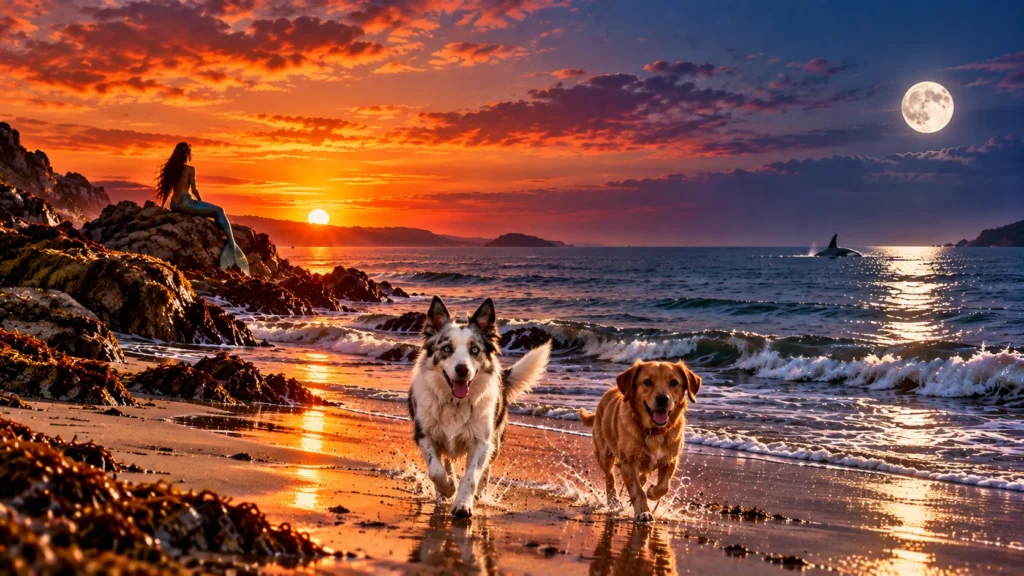
There is another creature sharing her waters that makes an intriguing companion. Dolphins possess remarkable intelligence, complex social relationships and empathy, and have their own long association with sailors and stories of rescue at Sea. When a pod appears close to the coastline, breaking through the waves before disappearing beneath them, we see only those moments when they choose to surface. What travels alongside them beneath the Water remains unseen. The old image of the Mermaid swimming amongst dolphins suddenly feels remarkably comfortable.
Once, encounters with Mermaids belong naturally within the stories of fishermen and sailors. Today they are considerably quieter. We carry cameras in our pockets, coastlines are watched and almost every unusual sighting is expected to produce evidence. Mermaids, it seems, do not particularly like cameras. Whether they have retreated into deeper waters, become more careful about when they surface, or simply stopped allowing themselves to be seen is for the Mermaid to know.
Yet her absence from the camera has never removed her from the Sea. She remains in folklore, art, memory and the stories we continue to tell. A dolphin still breaks the surface. A distant figure still appears upon a rock. A voice still carries strangely across the Water.
And every so often, the Sea gives us just enough to wonder.
Naiads
Naiads / Sea
The Naiads belong to freshwater: to springs rising from the Earth, quiet wells, streams, rivers and the hidden waters that nourish the land. Yet Water seldom remains where it begins. A spring becomes a stream, streams gather into rivers, and rivers eventually journey towards the Sea.
At the river mouth, the world of the Naiad reaches a threshold. Freshwater meets saltwater. The familiar current encounters the tide; river and Sea mingle, and for a while neither can be completely separated from the other.
Here the Naiads approach the realms of the Nereids, Oceanids and Undines, carrying with them the waters of the land. Rain that fell upon mountains, water that travelled beneath limestone, springs that emerged within woodland and rivers that crossed entire landscapes are gathered together and released into the greater body of the Sea.
For Sia, Queen of the Naiads of Seaham, that journey is particularly close. Her waters move through the limestone and streams of the Durham coast before finding their way into the North Sea. What begins hidden beneath Earth eventually reaches the open horizon.
The Naiads remind us that the Sea does not begin at the shore. Its waters have been travelling towards it all along.
Nereids
Nereids / Sea
Long before the Sea became something humanity could chart, measure and cross with certainty, people stood upon its shores and recognised another world beyond them. The ancient Greeks populated that world with Gods, Nymphs and elemental beings, and among the most enduring were the Nereids — the daughters of Nereus, the Old Man of the Sea, and Doris, an Oceanid.
Traditionally fifty in number, the Nereids were not distant celestial beings looking down upon the ocean. They belonged within it. They inhabited its waves, shores, caves and depths, accompanying sailors across dangerous waters and embodying different expressions of the Sea itself. Among them were figures such as Thetis, mother of Achilles, Amphitrite, who became associated with Poseidon, and Galene, whose name became connected with the tranquillity of a calm Sea.
Their stories belong to Greece, but the experience from which they arose belongs to the world. Wherever humanity has lived beside great waters, the Sea has gathered stories around itself. Different cultures gave different names to the presences encountered there: spirits, Gods and Goddesses, mermaids, Selkies, Nymphs and elemental beings. The names change because the people and traditions change. The mystery of the Water remains.
Pytheas of Massalia, the fourth-century BC Greek explorer, navigator and geographer, travelled the Atlantic seaways and the lands of north-western Europe around 325–320 BC, reaching Britain and journeying into the far north. His lost work, On the Ocean, recorded the peoples, coastlines and extraordinary natural phenomena he encountered. His journey also brought the Mediterranean world into direct contact with the cultures and traditions of the North Atlantic, creating another ancient meeting place between Greek and Celtic worlds. The natural correspondence that was there was now being discovered.
The Nereids therefore become more than characters preserved within Greek mythology. Pytheas encouraged them into world mythology and allowed us to encounter the Sea as our ancestors encountered it: alive, inhabited and possessing depths beyond ordinary human experience. The movement beneath apparently still water, the changing tide, the wave arriving from beyond the horizon and the strange tranquillity of standing alone beside the ocean all belong to their world.
And this brings the Nereids naturally into Ogham Tree Lore. The ancient Ogham did not call its fifth Forfid the Sea; historically that position belonged to Eamhancholl — Twin Coll, Twin Hazel. Yet within the modern Tree Lore, that final position has become Mór — the Sea. Hazel carries perception and the awakening of the senses; the Sea carries that perception beyond the familiar shore and towards what cannot immediately be seen.
The Naiads brought us to the water’s edge through spring, stream and river. With the Nereids, we finally enter the Sea itself.
Nymphs
Nymphs / Sea
The Nymph belongs to the Water, and the Sea gives her a world without banks or boundaries. She moves within the tide, rides the waves towards the shore and rests upon rocks where Water meets Land. Sometimes she reveals herself completely; sometimes all we see is a shape beneath the surface before it disappears into deeper water.
Here we meet the Nereids, the Nymphs of the Sea, beautiful daughters of the ancient waters who swim through the Mediterranean stories of gods, sailors and heroes. Further into the great waters, the Oceanids carry the presence of Water towards the furthest reaches of the world.
But the Nymph is not confined to ancient stories. Stand beside the Sea and allow the Water to become alive. Foam gathers around the rocks like fabric, sunlight moves beneath the surface, something breaks through a distant wave and is gone before the eye can settle upon it. The Sea constantly creates forms and then takes them back.
At the shoreline she comes closest to us. A Nymph may rise from the Water and walk upon the Land, leaving the Sea behind her while still carrying something of it with her. This is the romance of the Nymph: she belongs to another realm, yet the shore allows our worlds to touch.
And when she returns to the waves, watch carefully. The Water closes around her, the surface settles, and the Sea keeps her secret.
Oceanids
Oceanids / Sea
Origin: Ancient Greek Tradition ~ c. 700 BC
Nature: Divine Water Nymphs ~ Daughters of Oceanus
Element: Water
Realm: Waters ~ Rivers ~ Springs ~ Clouds ~ Sea
Role: Water Spirits ~ Guardians ~ Divine Presences
Associated Beings: Oceanus ~ Tethys ~ Potamoi ~ Nereids ~ Naiads
The Oceanids are the divine daughters of Oceanus and Tethys, born from the great waters that surrounded the world in ancient Greek cosmology. Hesiod described three thousand Oceanids, an immense sisterhood whose number suggests something of the abundance and diversity of Water itself.
Although their name inevitably draws the modern imagination towards the ocean, the Oceanids were not simply sea nymphs. Their presence extended throughout the watery world: springs and rivers, rain and clouds, freshwater and the distant waters surrounding the Earth. Some became associated with particular places or qualities, while others entered the stories of Gods and humanity in their own right. Among the better-known Oceanids are Styx, Metis, Eurynome, Doris, Electra and Clymene.
This separates them naturally from the Naiads, whose presence belongs particularly to freshwater, and the Nereids, daughters of Nereus who belong more intimately to the Sea. The Oceanids occupy something larger. They arise from an ancient vision in which the waters of the world are connected, flowing from and ultimately belonging to a greater whole.
Through the Oceanids, Water becomes a vast family rather than a single element. Spring, river, rain, cloud and Sea may appear separate to human eyes, yet each participates in the same living world of Water.
Selkie
Selkie / Sea
The Sea holds something for the Selkie that the Land never can: another way of being. At the water’s edge she stands between two lives, able to remain in human form or take up her sealskin and return to the Water.
There is no barrier preventing her return and no transformation she cannot reverse. She may walk beside us, share our lives and choose to make the Land her home, while the Sea remains within reach.
Selkie walks among us, chooses her life here, chooses her mate, chooses a form that is appeasing to the mate of her choosing. Her sacrifice is the life she knew for the life she wants. She reveals herself to her mate and it becomes their secret to keep. True love, trust and a vow of eternal harmony shared will make their love eternal. Their lives forever entwined unless the vow is broken.
Perhaps this is why a Selkie looking out across the Water carries such romance. We see an immense Sea stretching towards the horizon; she sees the choices made and everything she has surrendered for the life she has chosen.
And if one day she takes up her sealskin and enters the waves, the Sea does not take her from us. She chooses to return to it.
Sylph
Sylph/ Sea
The Sylph comes to the Sea upon the wind, free to wander where no path can contain her. Across the open water there are no trees to interrupt her passage, no hills to turn her aside; only the great expanse of the Sea reaching towards the horizon.
Here she can dance.
She races across the waves, plays amongst their crests and carries the taste of salt far beyond the shore. When the Sea grows restless, she rises with it; when it falls quiet, she becomes the gentlest breath upon its surface.
At the horizon, where Sea and Sky appear to meet, the Sylph finds no boundary at all. There is simply another horizon waiting beyond the one we can see.
There are times when the Sea disappears.
Mist rises from the Water and the Sylph descends with the Air until neither belongs entirely to one realm or the other. Sea and Sky become veiled, the horizon is lost, and familiar shapes begin to change.
Walk beside the Sea in a thick fog and something may appear ahead — a figure where moments before there was nothing. Perhaps the mist has simply taken form. Perhaps a Sylph has allowed herself to be seen. Or perhaps a nymph has risen from the Water and, for a moment, you have caught her between worlds.
The old stories become easier to understand here. Through rain and mist, a shape upon the rocks need not immediately reveal what she is. Water runs from her hair, fog curls around her body, and before we have drawn close enough to know her, she is gone.
Perhaps this is where Sylph and nymph have always met: within the mist, where Air becomes Water and Water becomes Air, and neither is quite willing to tell us which one we have seen.
Undines
Undines / Sea
The Undines belong wherever Water gathers, moves and gives life. At the Sea, their world becomes almost without boundary.
Here are the great waters, fed by rivers and rain, crossed by currents and tides, rising into mist before returning again to the Earth. The Undines move within this endless transformation of Water, accompanied by the countless beings who have gathered within its stories: Nymphs and Naiads, Nereids and Oceanids, mermaids and Selkies, the Whale Maiden and Sia, Queen of the Naiads. Around them move the ancient Gods and Goddesses of Water, while Archangel Gabriel carries another expression of its spiritual presence.
The Sea does not divide these beings simply because humanity has given them different names. Some belong to freshwater, some to the shore, some to the deepest ocean and others to the places where one kind of Water becomes another. Each carries something of Water’s nature: movement, emotion, intuition, reflection, concealment, transformation and life.
Even the boundary of the element itself refuses to remain still. Water rises from the Sea into mist and vapour, and the realm of the Undine begins to mingle with that of the Sylph. Water enters Air; Air enters Water. Cloud becomes rain, rain becomes river, river becomes Sea, and Sea rises once again towards the Sky.
Perhaps this is why so many beings have been encountered within Water. The mermaid beneath the waves, the Selkie crossing between Sea and land, the Sea Witch within the mysteries of the deep, the Nymph beside the spring and the Gods who travel across the ocean are not required to tell the same story. They belong to the same immeasurable realm.
At the water’s edge we see only its surface.
The Undines remind us how much may live beneath it.
Gods and Deities of the Sea
Bruce Clifton
The Sea has always offered a natural home for Gods and Deities. Its horizon marks the edge of the visible world, while its depths conceal a realm beyond ordinary human reach. It gives life and takes it, separates distant lands while providing the passage between them, and moves beneath the influence of a Moon hanging impossibly far above. It is little wonder that humanity has found the divine within its Water.
Yet not every God or Deity found here is a God of the Sea. Some rule its waters, while others meet the Sea through journey, ancestry, transformation, prophecy, love, loss or the passage between worlds. Manannán mac Lir travels its hidden roads; Lir belongs to it through inheritance and name; other deities arrive from Land, river or distant mythology and reveal something new when their stories reach the shore.
These meetings allow the Sea to become more than a setting for mythology. Each God or Deity reveals another character within it — protector and destroyer, mother and father, boundary and pathway, mystery and revelation. Their stories have crossed cultures and centuries because the Sea itself carries the same contradiction: familiar enough to stand beside, yet vast enough that much of it will always remain beyond us.
Sea – Gods and Deities Oracle
Bruce Clifton
We have alphabetised this list of Gods and Deities that harmonise with the sea solely for ease of reference; no sense of hierarchy or entitlement is intended or implied:
1) Bran
2) Lir / Llyr
3) Lugh
4) Manannan mac Lir
5) Oceanus
Manannan mac Lir/ Sea
At the western edge of the Apple orchard, the last branches lean towards the salt wind. Behind them are blossom, fruit and the Silver Branch; ahead lies nothing but the Sea and a horizon hiding whatever waits beyond it.
This is where Manannán mac Lir leaves the orchard and enters his own kingdom.
The Apple gave the invitation. Its enchanted branch carried the promise of another shore, of islands where sorrow loosens its hold and time no longer moves as it does among mortals. But an invitation is not a journey. Somewhere between the orchard and those distant islands lies the Sea — and here Manannán becomes far more than the mysterious keeper of enchanted fruit.
He has Enbarr, who can carry a rider across the waves as easily as across the Land. He has Wave-Sweeper, needing neither ordinary sail nor oar to find its way across the Water. Around him gathers the mist, closing over islands, pathways and distant shores until the familiar world disappears behind it.
There is wonderful romance in this. The mortal stands beneath the Apple Tree holding the promise of somewhere beyond the horizon. Manannán knows the way there.
And so the Sea changes beneath him. What appears to us as distance becomes his road. Waves become pathways, mist becomes a curtain, and somewhere beyond sight the orchard waits again — not the orchard we left behind, but the Otherworld orchard from which the Silver Branch first came.
The circle is complete. Apple leads us to Manannán; Manannán leads us to the Sea; and the Sea carries us back towards the enchanted Apple. Manannán mac Lir is the journey between them.
Bran the Blessed / Sea
Bran belongs to the Sea because he understands what it means to cross beyond sight and remain connected. The horizon takes ships from view without taking them from existence. Bran crosses a greater horizon: his body dies, yet his presence remains. His head continues to speak, his companions remain with him and, for a time, death seems unable to separate them.
The Sea has always asked something similar of those left upon the shore. A ship sails until the people aboard become silhouettes, then a distant sail, and finally nothing at all. Love continues beyond the point at which sight fails. We wait, trust and listen for something returning from beyond the horizon.
For Bran, that messenger is often a bird. His name carries the Raven, Branwen’s starling brings the message that calls him across the Water, and birds themselves move effortlessly between shore and ship. At Sea, a bird appearing from an empty horizon can carry knowledge: land exists beyond what the sailor can see. The crow’s nest raises human sight towards that same possibility — to see further, to know sooner, to watch over those below.
This is where Bran’s protection finds the Sea. He is not simply the warrior who protects the body; his guardianship survives distance, separation and even death. The Blessed Head continues to advise those who carry him, just as memory, instinct and the voices of those we have loved can continue to travel with us long after they are physically absent.
And the Sea gives Bran’s mystery a physical form. Its surface divides the visible from the hidden; its horizon divides what we can see from what we know continues beyond it. Beneath the waves lies another world, while beyond the horizon lies somewhere we cannot yet perceive.
Bran lives within that same uncertainty — not quite here, never entirely gone, his wisdom continuing beyond the place where ordinary sight says he should have disappeared.
Lir – Llŷr/ Sea
Lir belongs to the Sea through his son Manannán. In the Irish tradition, Manannán mac Lir moves across the Water as though Land and Sea are simply different roads. Islands appear and disappear within his world, journeys cross between the human and Otherworld, and the horizon is never quite the boundary it appears to be. His very name carries his father with him — Manannán, son of Lir.
Through Manannán, Lir becomes more than a father remembered in an ancient genealogy. His name travels upon the waves. The Sea becomes a place of passage, mystery and possibility, where distance does not necessarily mean separation and what disappears beyond the horizon may still continue somewhere beyond sight.
Across the Water, the Welsh tradition remembers Llŷr through Brân the Blessed. Brân belongs to rivers and streams, to Water travelling through the Land before it ever reaches the coast. His journey towards the Sea begins inland, where rain gathers, springs rise and rivers carry the Water onwards.
The river does not end when it reaches the Sea. Freshwater meets saltwater and becomes part of something greater, carrying with it everything gathered along the way. Through Brân, Llŷr follows that same journey: from the rivers of the Land towards the open Water, just as Lir reaches towards the shore through Manannán.
Two traditions have carried the father’s name differently. One remembers him through a son who moves upon the Sea; the other through a son whose Water travels towards it. Manannán comes with the waves. Brân comes with the rivers.
And between Ireland and Wales lies the Sea — not separating Lir from Llŷr, but receiving the Water of both.
Lugh / Sea
Lugh comes to the Sea as the Many-Skilled. On Land, the warrior, craftsman, healer, poet and navigator may practise their skills separately; aboard a vessel, their knowledge becomes part of the survival of everyone around them. The Sea has little patience for the person who can do only one thing.
A sailor must read the Sky and Water, understand wind and tide, repair what breaks and recognise when conditions are changing. Strength has its place, but so do judgement, preparation and experience. At Sea, knowledge becomes practical, measured not by what someone claims to know but by what they can do when circumstances demand it.
This is where Lugh’s many gifts find another expression. His greatness at Tara comes because no single craft defines him; he understands how different abilities work together. The Sea asks the same of those who cross it. Rope, sail, timber, stars, weather and human hands must work together before a distant shore can ever be reached.
The Sea does not ask Lugh which skill he possesses. It asks which skill is needed now. And for the Many-Skilled, the answer is always waiting.
Oceanus
Oceanus / Sea
For the ancient Greeks, Oceanus flowed around the entire known world. Beyond the furthest lands his waters continued, forming the great boundary between the familiar world and everything that lay beyond it. Rivers and springs ultimately belonged to his waters, while the celestial world also touched his realm: the Sun rose from Oceanus and returned to him, and the stars followed their passage towards his distant waters.
Stand before the Sea at sunrise or sunset and that ancient truth becomes remarkably easy to understand. The horizon gives no indication that the Water will ever end. The Sun appears to emerge from it and later disappears into it; Earth reaches its visible limit while Water and Sky seem to become one. Oceanus brings something different to the Sea: not simply a God who belongs to Water, but an ancient recognition that at the furthest edge of the visible world, Water becomes the threshold to something greater.
Secret Harmonies of the Sea
Bruce Clifton
The Secret Harmonies of the Sea cannot be separated into individual correspondences, because the Sea is itself a meeting place. River meets ocean, Land meets Water, Moon meets tide, the physical meets the spiritual and the known world reaches towards everything that remains beyond the horizon.
Throughout the Sea, its Animals, Gods, Deities, Totems, Elementals and Entities reveal these harmonies in different ways. Each brings something of its own nature to the Water, and the Sea returns something that could not exist without their meeting. Neither remains quite what it was before.
As the Forfeda and being the fifth and final aicme of Ogham, the Sea therefore needs no single Secret Harmony of its own. Its harmony lies in receiving all the others — the other half of the coin, where what we know meets what we have yet to discover.