Secrets of the Vine
Vine (Vitis vinifera)
Volume 11 of 31
Bruce Clifton
Vine – (Muin)
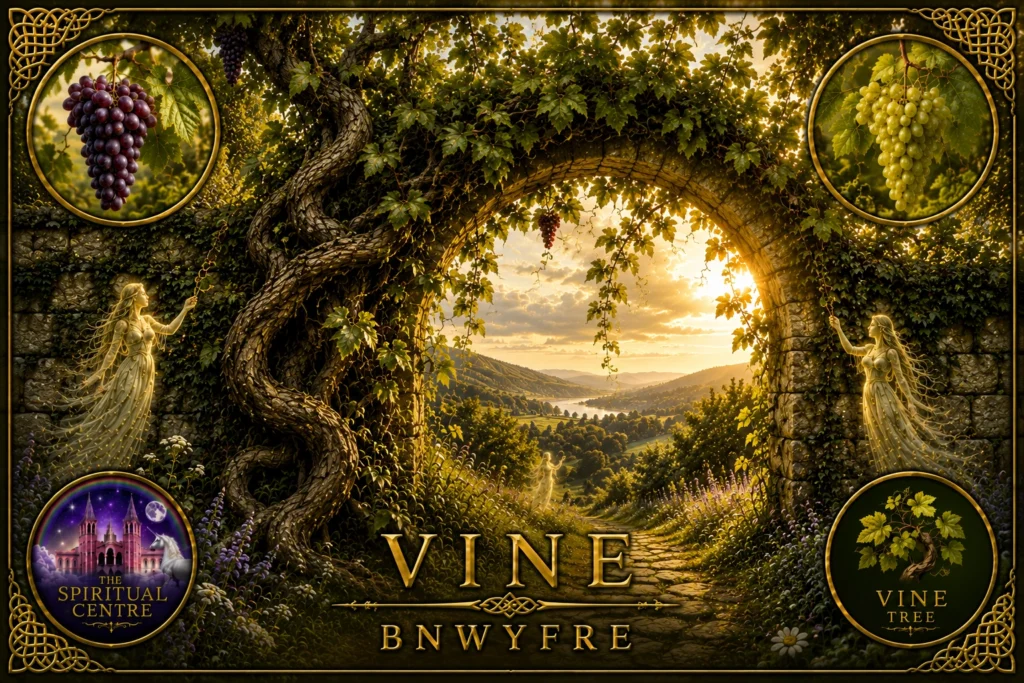
Vine, Muin of the Ogham, is the tree of ripening and release. It does not rise in straight certainty like Oak, nor shimmer in newness like Birch. It coils, it twists, it seeks support and then climbs toward fullness. Vine teaches that growth is not always vertical. Sometimes it is circular, intimate, and deeply entwined with what surrounds it.
In the Celtic tradition, Vine carries the mystery of fermentation, the quiet alchemy that turns fruit into wine and experience into wisdom. What is gathered must mature. What is felt must move. Muin governs the inner pressure that builds before expression, the moment when emotion, inspiration, or truth can no longer remain contained. It is the tree of timing, of knowing when something is ready to be spoken, shared, or released.
On a healing level, Vine is associated with circulation, rhythm, and flow. Where energy becomes stagnant, Vine restores movement. Where feeling is suppressed, Vine encourages safe expression. Bnwyfre, life force energy, moves through the body as blood, pulse, and warmth. Vine supports that movement, strengthening the channels through which vitality travels and reminding us that life must circulate in order to nourish.
Spiritually, Muin speaks of sacred intoxication, not excess but expansion. It is the loosening of rigidity, the softening of resistance, the willingness to feel deeply without being overwhelmed. Vine invites us to mature without hardening, to ripen without collapsing, and to allow the richness of experience to become wisdom rather than burden.
Vine – Ogham Tree Profile
Bruce Clifton
Name: Vine
Ogham: Muin > > > Muhn
Letter: M
Lunar: 10th New Moon of the Celtic Tree Calendar (Aug 12th – Sept 10th)
Season: Autumn
Element: Water
Direction: West
Moon Phase: Waxing Crescent ~ 1st Qtr.
Moon Name: Lightning
Influence: Androgynous
Title: Chieftain
Age: Continuing re-birth (to the age of five)
Aura: Indigo
Healing: Anti-ageing ~ Anti-inflammatory ~ Blood ~ Blood Pressure ~ Bruise ~ Digestion ~ Fatigue ~ Hormones ~ Nervous Conditions ~ Oedema ~ PAD ~ Skin Ageing ~ Varicose Veins
Animal Spirit: Bee ~ Fox ~ Snake
Totems – Entities: Magdalene ~ Rosmerta ~ Sucellus
Gods – Deities: Asclepius ~ Cernunnos
Secret Harmony: Akashic Records ~ Altered States ~ Asclepian Incubation ~ Bi-Location Healing ~ Communication with Entities ~ Dream Walking ~ Hermeticism ~ Slumber ~ Walking Between Worlds
Festival: (coming soon)
Cosmos: (coming soon)
Key Words: Bnwyfre ~ Consciousness ~ Aether
Essence of the Vine
Bruce Clifton
Vine is rarely found standing alone. She leans into the world, taking hold where she can, winding herself through branch, wall and boundary as she searches for warmth and light. There is something deeply trusting in the way she grows. Her tendrils reach into empty space before they know what they will find, yet when support appears they recognise it immediately and hold fast.
This relationship with everything around her lies at the heart of Vine. She accepts support without surrendering her own nature, using what is strong enough to hold her while offering leaf, shelter and fruit in return. Root depends upon soil, fruit upon season, and the heavy clusters upon stems that seem impossibly slight for what they carry. Vine reminds us that independence and isolation are not the same thing, and that there are times when accepting the strength of another allows our own strength to travel further.
Within the Inner Landscape, Vine often grows across the boundaries we have created for ourselves. She may climb an old wall, disappear into the branches of another tree or follow a forgotten path until one part of the landscape becomes connected with another. Some of these connections still carry life; others remain only because they once gave us somewhere to hold. Vine asks us to recognise the difference without assuming that everything tangled must therefore be cut away.
Her fruit offers another expression of the same nature. Grapes do not ripen alone but gather in clusters, each distinct and yet nourished through a common stem. Their abundance has drawn people together for thousands of years, around harvests and tables, through celebration and remembrance, in the simple act of sharing what has been gathered. Vine carries something of that fellowship into the Inner Landscape, restoring the understanding that a life can remain entirely its own while still being intimately connected with others.
The essence of Vine is found within these relationships: the support that allows growth without controlling it, the connection that does not demand possession, and the quiet recognition that some parts of ourselves flourish more fully when they are allowed to grow alongside something else. She reaches outward without losing her root, teaching that belonging does not require us to disappear into what surrounds us.
Healing Lore of the Vine
Bruce Clifton
The healing lore of the Vine begins with an understanding of measure. Few plants demonstrate so clearly that what nourishes in the right amount may become harmful when taken beyond it. Grape, leaf, seed, sap and wine have all found their place within traditional healing, yet Vine has always asked something of the healer in return: judgement, moderation and respect for the nature of the remedy.
Across the ancient world, the grape was valued as both food and medicine. Fresh fruit offered nourishment and sweetness; dried grapes concentrated that nourishment for storage and travel; leaves found their way into traditional preparations; while wine became a carrier for herbs, a cleansing agent, a warming preparation and a means of preserving medicinal plants beyond their season. The Vine therefore belonged not to a single remedy, but to the healer’s wider store of ingredients and preparations.
Within Druidic healing, this lends Vine a particular character. Healing is not always achieved by adding more. Sometimes the body requires nourishment; sometimes stimulation; sometimes rest; and sometimes restraint. The skill lies in recognising which is needed. Vine teaches the healer to observe the difference between deficiency and excess and to restore proportion where either has disturbed the natural balance.
There is also something deeply communal within Vine healing. The cup is poured, the fruit shared, the preparation passed from one person to another. Healing takes place not only through what enters the body, but through care, hospitality, companionship and the knowledge carried between generations.
Within the movement of Bnwyfre, Vine reminds us that life force must be allowed to circulate without becoming stagnant or overwhelming. Its healing lore is therefore one of flow and right measure — knowing what to receive, what to release, and when enough has truly been given.
Scope & Notice
The information contained herein is provided for educational and contemplative purposes only. Every effort has been made to ensure accuracy and reliability; however, no guarantees are stated or implied. The author is not offering medical or professional advice, and this content should not be considered a substitute for qualified guidance. If in doubt, readers are advised to consult a suitable professional before undertaking any remedies or practices referenced.
About the Healing List
The following list of ailments and applications is not exhaustive. It has been limited to the most commonly recorded and traditionally associated uses, with remedies drawn primarily from the vine itself and secondarily from companion plants traditionally grown alongside it.
There are many ways to prepare herbal infusions, including teas, tinctures, poultices, oils, and decoctions. Ingredients may be gathered traditionally or sourced responsibly. As with all natural remedies, preparation, intention, and respect for the plant are considered as important as the method itself.
Vine – Healing Remedies Oracle
We have alphabetised this list of healing qualities of the vine solely for ease of reference; they include but are not limited to:
1) Anti-ageing
2) Anti-inflammatory
3) Blood
4) Blood Pressure
5) Bruise – Bruising – Contusions
6) Digestion
7) Fatigue
8) Hormones
9) Nervous Conditions
10) Oedema
11) PAD (Peripheral arterial disease)
12) Skin Ageing
13) Varicose Veins
Anti-ageing / Vine
Ingredients:
Red Grape Skin (Vitis vinifera)
Grape Seed (Vitis vinifera)
Key Properties:
Resveratrol – Proanthocyanidins (OPCs) – Anthocyanins – Flavonoids – Phenolic Compounds
Traditional Actions:
Antioxidant support, protection of collagen structures, vascular strengthening, support for skin elasticity, defence against premature ageing caused by environmental and circulatory stress
Preparation:
Red grapes are traditionally gathered at full ripeness when the skin is richest in pigment and protective compounds. The fruit may be eaten whole so that the skin, flesh, and seed are taken together, or the skins may be carefully dried and powdered for later use in restorative preparations.
Grape seeds may be dried and ground into powder, pressed into a light oil, or taken as a prepared extract. The oil has traditionally been applied lightly to clean skin where dryness, dullness, or loss of suppleness is becoming evident. Internally, the seed and skin were valued for their strengthening and protective influence upon the tissues.
Both skins and seeds should be thoroughly dried before storage and kept in airtight containers away from heat, light, and moisture. Grape seed oil should be stored in a cool, dark place.
Traditional Use:
Within traditional European plant practice, vine preparations were valued where the signs of ageing were linked with dryness, poor circulation, loss of tone, or environmental strain upon the skin. The skin of the red grape was associated with preserving vitality within the tissues, while grape seed was regarded as a strengthening ally for the vessels and connective structures that help maintain firmness and resilience.
In older understanding, ageing was not treated as a fault to be fought, but as a natural ripening that could be supported with care. Vine, governing maturity, circulation, and the preservation of vitality, was therefore used to help the skin remain supple, nourished, and protected as the body moved through its seasons.
Anti-inflammatory – Vine
Ingredients:
Red Vine Leaf (Vitis vinifera)
Red Grape Skin (Vitis vinifera)
Grape Seed (Vitis vinifera)
Key Properties:
Flavonoids – Proanthocyanidins (OPCs) – Anthocyanins – Tannins – Phenolic Compounds
Traditional Actions:
Circulatory support, vascular toning, mild anti-inflammatory support, calming heat and swelling within the tissues
Preparation:
Red vine leaves are traditionally gathered in early autumn as they deepen in colour, then carefully dried for storage. The dried leaves may be steeped in hot water to create a strong infusion, which can be used as a warm compress for areas where heat, swelling, or vascular congestion are present. Fresh leaves may also be gently warmed and applied directly to the skin as a soothing compress.
Red grapes, taken at full ripeness, were historically valued for supporting internal balance where irritation or circulatory strain was present. The skins contain concentrated plant pigments and antioxidant compounds that were associated with calming inflammatory processes within the body.
Grape seeds may be dried and ground or pressed into oil. The oil has traditionally been applied lightly to the skin to soothe sensitive or irritated areas, while the ground seeds were sometimes incorporated into preparations intended to support circulation and vascular strength. Leaves and seeds should be thoroughly dried before storage and kept in airtight containers away from moisture and light.
Traditional Use:
Within traditional European plant practice, vine preparations were used where inflammation was linked with circulatory congestion or heat within the tissues. Infusions of the leaf were applied externally to calm swelling and heaviness, while preparations involving grape skins and seeds were valued for their strengthening influence on blood vessels and connective tissues. The vine was therefore regarded as both a soothing and toning plant, supporting the body’s ability to restore balance where irritation and vascular strain were present.
Blood Circulation / Vine
Ingredients:
Red Vine Leaf (Vitis vinifera, autumn leaf preferred)
Grape Seed (Vitis vinifera)
Key Properties:
Flavonoids – Proanthocyanidins (OPCs) – Anthocyanins – Tannins – Phenolic Acids
Traditional Actions:
Circulatory support, vascular strengthening, venous toning, improvement of peripheral circulation, reduction of stagnation and heaviness
Preparation:
Red vine leaves are gathered in early autumn once they have deepened in colour, then carefully dried for storage. The dried leaves are steeped in freshly boiled water to create a strong infusion, traditionally taken warm to support venous return and reduce pooling in the limbs.
Grape seeds may be dried and ground into powder or taken as a prepared extract to strengthen blood vessels and capillaries from within. The two may be used separately or in sequence depending on the nature of the imbalance.
All plant material should be thoroughly dried before storage and kept in airtight containers away from heat, light, and moisture.
Traditional Use:
Within traditional European plant practice, vine preparations were used where blood circulation had become sluggish, leading to cold extremities, heaviness, or venous congestion. Red vine leaf infusions were valued for their ability to tone the veins and encourage steady upward flow, while grape seed was associated with strengthening the vessel walls and maintaining circulatory integrity.
Vine, governing flow, movement, and the circulation of Bnwyfre, was regarded as a restoring ally where vitality had lost momentum, helping to re-establish warmth, balance, and a natural rhythm of circulation throughout the body.
Blood Pressure (Mild Imbalance) / Vine
Ingredients:
Red Grape (Vitis vinifera)
Grape Seed (Vitis vinifera)
Red Vine Leaf (Vitis vinifera)
Key Properties:
Flavonoids – Proanthocyanidins (OPCs) – Anthocyanins – Resveratrol – Phenolic Compounds
Traditional Actions:
Support for vascular elasticity, circulatory balance, mild regulation of blood pressure, reduction of oxidative stress, and strengthening of blood vessels
Preparation:
Fully ripened red grapes may be consumed fresh to support vascular health and overall circulatory balance, with the skin and seed retained for their concentrated compounds.
Grape seed may be dried and ground, pressed into oil, or taken as a prepared extract to strengthen vessel walls and improve resilience within the circulatory system.
Red vine leaf, gathered in early autumn and dried, may be prepared as a warm infusion and taken in moderation to support venous tone and encourage a steady circulatory rhythm.
All plant material should be stored in airtight containers away from heat, light, and moisture.
Traditional Use:
Within traditional European plant practice, vine preparations were used where blood pressure imbalance was associated with poor circulation, loss of vascular tone, or internal strain within the vessels. Rather than forcing change, vine was valued for supporting balance, encouraging the vessels to remain flexible, and assisting the natural rhythm of circulation.
Vine, governing flow, timing, and the movement of Bnwyfre, was regarded as a steadying ally, helping the body return to a more harmonised state where pressure could settle without force, and circulation could move with ease and continuity.
Bruise – Bruising – Contusions / Vine
Ingredients:
Red Vine Leaf (Vitis vinifera, autumn leaf preferred)
Grape Seed (Vitis vinifera)
Key Properties:
Flavonoids – Proanthocyanidins (OPCs) – Anthocyanins – Tannins – Phenolic Compounds
Traditional Actions:
Capillary strengthening, reduction of swelling, dispersal of pooled blood, vascular support, and easing of localised inflammation
Preparation:
Red vine leaves are gathered in early autumn once they have deepened in colour, then carefully dried for storage. A strong infusion is prepared by steeping the dried leaves in freshly boiled water. Once cooled, a cloth may be soaked in the liquid and applied gently to the affected area as a compress.
Grape seed may be dried and ground into powder or pressed into oil. The oil may be applied lightly to the skin, while the ground seed may be taken internally to support vascular strength and the restoration of capillary integrity.
All plant material should be thoroughly dried before storage and kept in airtight containers away from heat, light, and moisture.
Traditional Use:
Within traditional European plant practice, vine preparations were used where bruising and contusions were associated with disrupted circulation and pooled blood beneath the skin. Red vine leaf compresses were applied to calm swelling and encourage the natural dispersal of blood, while grape seed was valued for strengthening the vessels and supporting tissue recovery.
Vine, governing circulation and flow, was regarded as a restoring ally where blood had lost its proper path, helping to reduce discolouration, ease heaviness, and return the affected area to balance through steady movement of Bnwyfre.
(See: Holistic Healing Remedies / Bruise – Bruising – Contusions)
Digestion / Vine
Ingredients:
Fresh Grape (Vitis vinifera)
Wine Vinegar (Vitis vinifera, fermented)
Key Properties:
Fruit Acids – Natural Sugars – Flavonoids – Phenolic Compounds – Acetic Acid
Traditional Actions:
Digestive stimulation, encouragement of gastric flow, support for appetite, easing of heaviness, and restoration of digestive rhythm
Preparation:
Fully ripened grapes may be eaten fresh, ideally before or between meals, to gently encourage digestive movement and reduce stagnation within the stomach and bowels.
Wine vinegar may be diluted in water and taken in small quantities before food to awaken digestion and support appetite without overwhelming the system.
Grapes should be taken at full ripeness and free from spoilage. Vinegar should always be well diluted before use.
Traditional Use:
Within traditional European plant practice, vine preparations were used where digestion had become sluggish, leading to heaviness, reduced appetite, or poor digestive flow. Grapes were valued for their gentle ability to stimulate movement without burden, while vinegar was associated with awakening the digestive fire and restoring natural rhythm.
Vine, governing flow, fermentation, and the movement of Bnwyfre, was regarded as a restorative ally where the digestive system required gentle encouragement, helping to re-establish balance, ease, and steady transformation within the body.
Fatigue / Vine
Ingredients:
Red Grape (Vitis vinifera)
Grape Must (Vitis vinifera, unfermented juice)
Key Properties:
Natural Sugars – Flavonoids – Anthocyanins – Resveratrol – Phenolic Compounds
Traditional Actions:
Restorative nourishment, support for energy levels, replenishment of vitality, gentle support for blood, and recovery from exhaustion without overstimulation
Preparation:
Fully ripened red grapes are taken fresh, ideally in season, to nourish and gently rebuild strength. The fruit may be eaten whole to retain the skin and seed, supporting deeper restoration.
Grape must, freshly pressed and unfermented, may be taken in small daily quantities during periods of fatigue to provide steady nourishment and support energy without strain.
Grapes should be taken at full ripeness. Juice is best consumed fresh and not overly processed.
Traditional Use:
Within traditional European plant practice, vine preparations were used where fatigue and exhaustion had depleted the body’s natural reserves. Red grapes were valued as a source of gentle nourishment, restoring warmth, colour, and strength to the blood without forcing the system.
Vine, governing ripening, circulation, and the movement of Bnwyfre, was regarded as a restorative ally that rebuilds rather than stimulates, helping the body return to a state of steady vitality, balance, and renewed energy over time.
Hormonal Balance / Vine
Ingredients:
Red Grape (Vitis vinifera)
Grape Seed (Vitis vinifera)
Key Properties:
Flavonoids – Proanthocyanidins (OPCs) – Anthocyanins – Resveratrol – Phenolic Compounds
Traditional Actions:
Support for hormonal balance, nourishment of the blood, reduction of internal stress, support for circulatory stability, and gentle regulation of natural rhythms
Preparation:
Fully ripened red grapes may be taken fresh, ideally in season, to nourish the blood and support overall vitality, with the skin and seed retained for their concentrated compounds.
Grape seed may be dried and ground, pressed into oil, or taken as a prepared extract to support vascular strength and reduce internal strain, allowing the body’s natural rhythms to stabilise.
All plant material should be stored in airtight containers away from heat, light, and moisture.
Traditional Use:
Within traditional European plant practice, vine preparations were used where hormonal imbalance was associated with stress, circulatory disruption, or a disturbance in the body’s natural cycles. Rather than forcing change, vine was valued for supporting balance, nourishing the blood, and easing internal tension so that natural rhythms could return.
Vine, governing ripening, timing, and the movement of Bnwyfre, was regarded as a steadying ally, helping to restore equilibrium, support cyclical harmony, and encourage the body to regulate itself with ease and continuity.
Nervous Conditions / Vine
Ingredients:
Red Grape Skin (Vitis vinifera)
Grape Seed (Vitis vinifera)
Red Vine Leaf (Vitis vinifera)
Key Properties:
Flavonoids – Resveratrol – Proanthocyanidins (OPCs) – Anthocyanins – Phenolic Compounds
Traditional Actions:
Vascular support, strengthening during nervous strain, antioxidant protection, restorative support during prolonged stress
Preparation:
Red grapes are traditionally gathered at full ripeness and consumed whole so that the skin and flesh are taken together. The skin contains many of the plant’s protective compounds and has long been valued as part of nourishing preparations associated with restoring strength.
Grape seeds may be dried and ground into powder or prepared as oil or extract. In traditional preparations the ground seed could be incorporated into simple foods or restorative mixtures, while the oil was sometimes used in small quantities as part of nourishing preparations.
Red vine leaves are typically gathered during the growing season and dried carefully in a shaded, well-ventilated place. Once dried they may be steeped in hot water to prepare a light infusion traditionally associated with supporting circulation and relieving heaviness in the limbs.
Traditional Use:
Within traditional plant practice vine has often been approached where nervous strain is accompanied by fatigue, irritability, or circulatory tension. Red grapes taken at full ripeness were valued as gently restorative nourishment, providing strength without stimulation.
Grape seed preparations were associated with strengthening vascular integrity and protecting delicate tissues during prolonged periods of stress. In this understanding, nervous conditions were not viewed solely as disturbances of the mind but also as states where circulation and vitality had become strained.
Red vine leaf infusions were sometimes used where nervous unrest presented alongside heaviness in the limbs or poor peripheral circulation. Vine therefore became associated with supporting resilience and gradual restoration, strengthening the body where nervous tension and vascular fatigue meet.
Oedema / Vine
Ingredients:
Red Vine Leaf (Vitis vinifera, autumn leaf preferred)
Key Properties:
Flavonoids – Anthocyanins – Proanthocyanidins (OPCs) – Tannins – Phenolic Acids
Traditional Actions:
Support for fluid movement, reduction of swelling, venous toning, encouragement of circulation, and easing of fluid retention
Preparation:
Red vine leaves are gathered in early autumn once they have turned deep crimson, then carefully dried in shade for storage. A strong infusion is prepared by steeping the dried leaves in freshly boiled water and taken warm to support circulatory flow and reduce fluid retention.
The cooled infusion may also be applied externally as a compress to areas of swelling, particularly the lower limbs, to encourage the movement of stagnant fluid.
Leaves should be thoroughly dried before storage and kept in airtight containers away from heat, light, and moisture.
Traditional Use:
Within traditional European plant practice, vine preparations were used where oedema was associated with poor circulation, fluid retention, and heaviness in the limbs. Red vine leaf infusions were valued for their ability to tone the veins and encourage the natural movement of fluid through the body, both internally and externally.
Vine, governing circulation, flow, and the movement of Bnwyfre, was regarded as a restoring ally where fluid had lost its proper course, helping to reduce swelling, ease heaviness, and restore balance through steady and natural movement within the system.
Peripheral Arterial Disease (PAD) / Vine
Ingredients:
Red Vine Leaf (Vitis vinifera, autumn leaf preferred)
Grape Seed (Vitis vinifera)
Recipe:
Red vine leaves are gathered in autumn once fully flushed and dried in shade. A warm infusion is prepared by steeping the leaves in freshly boiled water. Taken in moderation, it is traditionally used to support circulation in the limbs.
Grape seed may be dried and ground or taken as a prepared extract to strengthen vessel walls and support vascular resilience.
The intention is to encourage peripheral blood flow, support vessel integrity, and assist the natural movement of blood through the extremities. This is supportive rather than corrective care.
Leaves and seeds should be stored in airtight containers away from heat and moisture.
The main properties of Red Vine Leaf and Grape Seed are:
Flavonoids – Proanthocyanidins (OPCs) – Anthocyanins – Tannins – Phenolic Compounds
Traditionally:
Cold or weakened limbs were understood as blood that had lost its warmth and reach. Vine, governing circulation and life force, was called upon to restore movement to the outer edges of the body. It was believed to strengthen the pathways through which vitality travels, encouraging warmth and steadiness where there was decline.
Skin Ageing / Vine
Ingredients:
Grape Seed Oil (Vitis vinifera)
Red Grape Skin (Vitis vinifera)
Key Properties:
Proanthocyanidins (OPCs) – Resveratrol – Flavonoids – Anthocyanins – Vitamin E
Traditional Actions:
Support for skin elasticity, protection of collagen structures, antioxidant defence, nourishment of the skin, and maintenance of suppleness
Preparation:
Grape seeds are pressed to produce a light oil, traditionally applied directly to clean skin to support hydration, elasticity, and overall skin condition.
Red grape skins may be dried and powdered, or the fruit taken whole so that the skin, flesh, and seed are retained, supporting the body from within through their concentrated compounds.
Grape seed oil should be stored in a cool, dark place, while dried skins must be kept in airtight containers away from heat, light, and moisture.
Traditional Use:
Within traditional European plant practice, vine preparations were used where skin ageing was associated with dryness, loss of tone, and exposure to environmental stress. Grape seed oil was valued for maintaining softness and elasticity, while red grape skin supported the preservation of vitality within the tissues.
Vine, governing ripening, circulation, and the movement of Bnwyfre, was regarded as an ally of mature vitality, helping the skin remain supple, nourished, and resilient as it moves through its natural cycles of change.
Varicose Veins / Vine
Ingredients:
Red Vine Leaf (Vitis vinifera, autumn leaf preferred)
Grape Seed (Vitis vinifera)
Recipe:
Red vine leaves are gathered in early autumn once they have turned deep crimson. The leaves are dried in shade and steeped in freshly boiled water to create a strong infusion. Taken warm, the infusion is traditionally used to support venous tone and improve circulation in the lower limbs.
The cooled infusion may also be applied externally as a compress to visible or uncomfortable veins. Grape seed may be taken internally as a ground powder or prepared extract to strengthen vessel walls from within.
The intention is to tone weakened veins, reduce pooling of blood, and encourage steadier return flow without force.
Leaves and seeds should be fully dried before storage and kept in airtight containers away from light and moisture.
The main properties of Red Vine Leaf and Grape Seed are:
Flavonoids – Proanthocyanidins (OPCs) – Anthocyanins – Tannins – Phenolic Compounds
Traditionally:
Varicose veins were understood as blood that had settled and lost its upward movement. Vine, which climbs and circulates, was called upon to restore strength to the vessels. The red autumn leaf, mirroring the colour of blood itself, was believed to steady and cool the veins, guiding the flow back toward balance.
Celtic Tree Lore of the Vine
Bruce Clifton
The lore of the Vine begins upon the road.
Long before the grape became familiar in Britain, wine was already travelling north from the Mediterranean world, crossing mountain passes and following the great river valleys into the Celtic lands of Europe. These were not empty trade routes. Where goods travelled, people travelled with them, and with people came language, belief, story, ritual and memory.
The Hallstatt world stood upon these ancient crossings.
From the south came wine, bronze vessels, ornament, wealth and influence. From the Celtic heartlands came their own customs, their own gods and their own ways of understanding the land. The meeting of these worlds did not happen in a single place or generation. It unfolded along pathways that were used again and again until commerce, pilgrimage and culture became almost impossible to separate.
Vine belonged to that movement.
Its wine passed from hand to hand and settlement to settlement, carried through Gaul and eventually towards Britain. The road that carried the amphora also carried conversation. Around the cup, strangers became guests, alliances were formed, stories were exchanged and knowledge moved beyond the boundaries of tribe and territory.
Muin is the eleventh letter of the Ogham and the first letter of the third aicme. Its insignia is a single downward stroke crossed by a single horizontal stroke, a simple but distinctive mark that places Vine firmly within the Ogham sequence. As the opening letter of the third aicme, Muin marks the beginning of a new movement within the alphabet and gives Vine its place not only within Celtic tree lore, but within the living language of Ogham itself.
This is where the romance of Celtic Tree Lore begins to open into the deeper world of Ogham.
Ogmios belongs to the path.
He is the power of eloquence, the binding force of speech and the one whose strength lies not merely in the body but in the ability of words to lead others. In the old image of Ogmios, people follow willingly, bound by delicate chains that run from his tongue to their ears. The image is strange and beautiful because it expresses something the Celtic world understood deeply: words create roads between people.
Before Ogham was cut into wood or stone, the path already existed.
It existed in speech, memory and journey. It existed wherever wisdom passed from one person to another and wherever knowledge travelled farther than the feet of the person who first carried it.
The great European routes gave that movement shape.
Through Hallstatt and beyond, tracks crossed mountain and forest, followed river and valley, and connected communities that might otherwise have remained apart. Wine moved northwards along them. Ideas moved with it. Later, from Britain and the western Celtic world, Druidic learning could move back across those same lines of connection.
The road flowed in both directions.
This matters because Druidry was never only a matter of standing beneath a tree in an isolated grove. The Druid was also a traveller, a keeper of memory who moved between communities, courts and sacred places. Knowledge needed roads. Teaching needed roads. The spoken word needed someone willing to carry it.
Ogmios created those roads in the imagination.
Ogham followed them.
The marks of Ogham can therefore be understood not simply as letters, but as the fixing of something that had always travelled orally: names, sounds, trees, memory and meaning. What had once passed from tongue to ear could now be cut into a lasting surface.
Vine sits naturally within this story because Vine itself travels by reaching.
It extends, searches, catches and binds. One growth leads into another. Its shape is a living network, much like the routes upon which wine and wisdom moved across the Celtic world.
The cup followed the road.
The Druids followed the road.
The word followed the road.
And eventually, the word became Ogham.
Within Celtic Tree Lore, Vine therefore becomes more than the plant of wine or harvest. It becomes part of the ancient movement of culture itself: the crossing of boundaries, the sharing of knowledge and the creation of paths between peoples.
Ogmios gives those paths a voice.
Ogham gives them a mark.
And Vine remembers the road between them.
Folklore of the Vine
Bruce Clifton
Few plants entered the Celtic world carrying as much mystery as the Vine. Unlike Hazel, Oak or Hawthorn, it did not need to grow beside every settlement to become significant. Its fruit could travel, and more importantly, so could the wine made from it. Long before vineyards became familiar across much of western Europe, vessels of Mediterranean wine were already moving northwards along rivers, roads and trading routes into the territories of Iron Age peoples.
Archaeology allows us to follow that journey more clearly than surviving folklore does. From the great settlements and burials of Central Europe to the feasting places of Gaul and eventually Britain, wine appears beside drinking vessels, cauldrons, jugs, cups and amphorae. These objects tell us something important. Wine was not simply another drink. It arrived surrounded by ceremony.
At Vix in Burgundy, the burial of an extraordinary Iron Age woman contained one of the largest bronze wine-mixing vessels ever discovered, together with equipment associated with drinking and serving wine. At Heuneburg in southern Germany, chemical traces preserved within pottery show that Mediterranean grape wine had reached the settlement during the Early Iron Age. Across Gaul, amphorae carried wine northwards in quantities large enough for their broken remains still to mark the places where people gathered, traded, celebrated and feasted.
The Vine therefore entered Celtic experience partly through the cup.
This gives its folklore an unusual character. The mystery was not simply the grape but what happened after the grape was gathered. Fruit was crushed, its juice placed away, and something unseen began to work within it. Sweetness became fermentation; fermentation became wine; and wine could warm the body, loosen speech, alter behaviour and change the way the world was perceived.
To people who understood nature through season, transformation and relationship, such a process could hardly have seemed ordinary.
Wine belonged naturally to the feast. To pour it was to share something valuable, and to drink together created relationship between host and guest, leader and follower, household and stranger. The vessel itself could become part of the occasion: filled, passed, emptied and filled again while food, conversation, music and storytelling moved around it.
Yet the cup always carried two possibilities. Wine could create fellowship, generosity and celebration, but taken beyond measure it could also bring foolishness, quarrel and loss of control. Much later folklore would make this contradiction familiar, but its roots are ancient. The Vine gives abundantly, while wisdom determines how that abundance is received.
There is another, darker thread running beside the feast.
In parts of Iron Age Europe, wine and its containers entered funerary practice. Amphorae and drinking equipment occur within graves and around cremation rites, suggesting that the drink of the living could accompany ceremonies for the dead. In late Iron Age Britain, imported wine vessels appear among rich burials alongside cauldrons, cups and other equipment associated with feasting.
Here the meaning of the Vine deepens. A cup may be raised among companions, but it may also become part of farewell and remembrance. The feast gathers the living together while memory keeps a place for those who are absent.
Perhaps this is why Vine sits so comfortably within traditions concerned with altered states and movement between worlds. Wine changes ordinary consciousness. In moderation it softens inhibition and encourages speech, song and companionship; in excess it overwhelms judgement. The person who drinks remains themselves and yet, temporarily, becomes different. The transformation taking place inside the vessel is repeated within the person who drinks from it.
The folklore of the Vine therefore cannot be separated from transformation.
The grape must reach ripeness before it can be gathered. It must then be broken before its deeper transformation begins. The juice disappears into darkness and is left to change beyond ordinary sight. What returns is not what entered.
There is an old wisdom in that sequence even where no surviving tale explains it. Ripening cannot be hurried. Transformation cannot always be watched. Some things become what they are meant to become only after they have been released from their first form.
By the late Iron Age, wine had crossed mountains, rivers and seas to reach Celtic communities from Central Europe to Britain. It travelled as a valuable commodity, but its significance cannot be measured only through trade. Wherever the amphora was opened and the cup passed from hand to hand, Vine entered another story: hospitality, alliance, celebration, status, memory, mourning and the temporary loosening of the ordinary world.
The folklore of the Vine is therefore not preserved within one tale or one Celtic land. It survives more quietly in the ancient feast, the shared vessel, the burial cup, the ripening fruit and the mysterious change that takes place unseen.
Vine teaches that what fills the cup began long before the cup was raised.
Animal Spirit of the Vine
Bruce Clifton
Among the twisting stems, broad leaves and heavy clusters of the Vine exists another story, told through the creatures that share its world. Some come for the sweetness of its fruit, some shelter within its tangled growth, while others have become connected with the Vine through mythology, symbolism and the ancient relationship between animals and the cultivated land.
The animal spirits of the Vine reveal qualities that are easily overlooked when we consider the plant alone. They introduce instinct and movement into its symbolism, carrying messages of transformation, adaptability, patience and awareness. Each creature encounters the Vine differently, and through that relationship another aspect of its character is revealed.
The Bee moves between flower and hive, transforming what it gathers. The Fox brings intelligence, adaptability and an ability to move between the cultivated and the wild. The Snake carries an older symbolism of renewal, hidden knowledge and transformation, shedding one form so that another may continue.
Together, these animal spirits bring the Vine to life as an inhabited landscape. They remind us that its mysteries do not exist in isolation, but within a living web of relationships in which plant, animal and human have influenced one another for thousands of years.
Vine – Animal Spirit Oracle
Bruce Clifton
We have alphabetised this list of animal spirit that harmonise with the vine solely for ease of reference; no sense of hierarchy or entitlement is intended or implied:
1) Bee
2) Fox
3) Snake
Bee / Vine
The Bee does not arrive at Vine by accident. She comes when flowering has begun and sweetness is forming. She recognises readiness. She knows when nectar is present and when patience is required. Within the field of Vine, the Bee represents circulation, cooperation, and the quiet industry that turns blossom into abundance.
In Celtic understanding, the Bee is a keeper of harmony within community. She moves between blossoms, carrying unseen threads of life from one form to another. What appears small becomes transformative. Through her movement, fruit becomes possible. Through her devotion, sweetness is secured. She does not force growth. She participates in it.
Aligned with Vine, the Bee speaks of shared vitality. Bnwyfre, Breath of Life and Life Force Energy, moves through exchange. Nothing ripens alone. The Bee reminds us that abundance is relational, that nourishment flows through connection, and that what we gather must also be given.
To recognise the Bee within Vine is to understand that fertility is not excess but balance. It is measured rhythm, mutual support, and sweetness earned through devotion to the whole.
Fox / Vine
The fox moves at the edge of things, just as the vine grows along boundaries. It does not command the forest like the stag, nor soar above it like the hawk. It weaves through hedgerows and vineyard rows with quiet intelligence, alert, adaptive, and always aware of timing.
In the presence of vine, fox becomes the spirit of ripeness and restraint. It knows when to wait and when to act. Just as grapes must gather sun before they sweeten, the fox watches before it moves. Nothing is wasted. Nothing is rushed.
Among old vineyard lands, foxes were familiar dusk companions, slipping between rows heavy with fruit. Their russet coats echoed the deepening reds of late summer leaves. In folklore, this colour harmony tied fox to the same current as the vine: warmth in the blood, cunning in the mind, and instinct guided by season rather than impulse.
Fox under vine teaches discernment. Fermentation can intoxicate; abundance can overwhelm. The fox reminds us to take only what is needed, to move lightly, and to remain aware even in celebration. It is the guardian of measured indulgence.
Where vine governs circulation and shared joy, fox governs survival and wit. Together they speak of maturity: the wisdom to enjoy without excess, to speak without revealing everything, and to move forward only when the moment is truly ripe.
Snake / Vine
The snake and the vine share a language of movement. Both coil. Both wind. Both travel by subtle, deliberate progression rather than force. Where the vine climbs toward light, the snake glides close to the earth, yet their motion mirrors one another, spiral upon spiral.
In the presence of vine, snake becomes the keeper of transformation. Fermentation, like shedding, is a hidden change. What appears whole on the surface is undergoing quiet alteration within. The grape softens, the skin loosens, sweetness deepens. The snake sheds its old skin when the time is right, emerging renewed. Vine and serpent both understand that renewal is not sudden; it is prepared in silence.
Across older European and Celtic landscapes, the serpent was a symbol of life force moving through the land, much like sap through vine or blood through the body. Its winding form echoed ancient spiral carvings, signs of continuity and rebirth. In this sense, snake under vine speaks of circulation not only of blood, but of wisdom passed through generations.
Snake also guards thresholds. Fermentation can intoxicate. Power can be misused. The serpent reminds us that knowledge requires discernment. Vine offers ecstasy; snake offers awareness. Together they teach maturity: to transform without losing balance, to taste deeply without surrendering clarity.
Where vine ripens fruit, snake sheds skin. Both move through cycles of renewal, reminding us that life, like the spiral, never truly stands still.
Totems and Entities of the Vine
Bruce Clifton
The totems and entities of Vine emerge from the stories that gathered around her as she travelled between cultures. Some belong to the vineyard and harvest, others to the feast, the wild procession or the strange world that opens when ordinary boundaries become less certain. They are figures shaped by imagination as much as belief, carrying aspects of Vine that could be given a face, a character and a story.
Unlike the great gods whose names belong to temples and established traditions, these figures often inhabit the edges. They appear in folklore, mythology, ritual and later storytelling, changing as they pass from one culture to another. Some are companions, some tricksters and yet each preserves something of the people who encountered Vine and sought a way to express what they found there.
Within the Inner Landscape, such entities give form to qualities that might otherwise remain difficult to recognise. They allow Vine to speak through character and encounter, bringing the old stories into a more personal landscape where their meaning can continue to change.
Vine – Totems and Entities Oracle
Bruce Clifton
We have alphabetised this list of totems and entities that harmonise with the Vine solely for ease of reference; no sense of hierarchy or entitlement is intended or implied:
1) Magdalene
2) Rosmerta
3) Sucellus
Magdalene / Vine
The Vine has long been honoured as a symbol of love, sacred union, abundance, transformation, devotion, and the sweetness that ripens through time, making it a natural companion to Mary Magdalene. Where Vine climbs, gathers sunlight, and bears fruit in season, Magdalene is remembered as one whose soul carried light through sorrow and whose fidelity deepened rather than diminished through trial.
Within Christian mysticism, Mary Magdalene stands as witness, devotee, and bearer of sacred continuity. In later European tradition, particularly among the vineyard lands of southern Gaul, she is remembered as a figure of retreat and contemplation, dwelling in caves among sun-warmed hills where vines grow thick and generous. Whether taken as legend or layered spiritual memory, the imagery belongs naturally to the Vine current.
Vineyards are places of protection, labour, patience, and provision. Grapes gather sunlight quietly. Fermentation unfolds unseen in darkness. What begins as fruit becomes something deeper through time, pressure, and hidden change. Magdalene, too, is associated with transformation of this kind. Her story moves from grief to revelation, from loss to witness, from concealment to recognition.
In the language of Vine, she represents ripened devotion. Not the first blossom of faith, but the mature and enduring current that survives hardship and grows wiser through experience. Just as fruit must soften before it becomes wine, Magdalene’s path is one of inner fermentation, where suffering is not wasted but refined into compassion, wisdom, and strength.
Within this current she may also be understood as guardian of sacred anointing. Oil and wine both emerge through pressing. Both require care, waiting, and right timing. Both have long been used in healing, blessing, hospitality, and ritual. Magdalene belongs beside such mysteries, not as a harvest deity, but as keeper of what matures in darkness and emerges luminous.
Here the wider language of the sacred feminine also gathers. Venus moves through the Vine as beauty, attraction, desire, fertility, and joyful embodiment. The Hesperides, keepers of the golden orchard, stand nearby as guardians of love ripened into blessing and spiritual abundance. Magdalene does not compete with these figures. She completes the pattern by revealing love made faithful, embodied beauty made compassionate, and desire transformed into devotion.
The cave and the vineyard become symbolic mirrors: retreat and ripening, stillness and sustenance, hidden depth and revealed grace. Where Vine stores sunlight within fruit, Magdalene carries light through shadow. Where Vine transforms sweetness into wine, she transforms sorrow into wisdom.
Within the understanding of the Bnwyfre Spiritual Order, Magdalene and Vine reveal the breath of life moving through love, sacrifice, fertility, sacred pleasure, healing transformation, and the quiet abundance that follows patience. They remind us that the richest gifts are often those matured slowly in the unseen places of life.
Within The Spiritual Centre, Vine and Mary Magdalene speak to those seeking love, feminine grace, sacred union, emotional healing, spiritual maturity, joyful devotion, and the wisdom born from transformation.
Rosmerta / Vine
The Vine has long been honoured as a symbol of abundance, joy, sacred hospitality, fertility, transformation, and the sweetness that ripens through patient care, making it a natural companion to Rosmerta. Where Vine climbs, flowers, and bears fruit in season, it reveals an ancient truth: prosperity is not sudden wealth, but life slowly matured through right tending.
Rosmerta, remembered as the Great Provider, belongs naturally beside the vineyard. She is not the spirit of excess or careless indulgence, but of measured plenty, steady provision, and gifts rightly shared. A vineyard demands labour, pruning, patience, weathered wisdom, and trust in unseen processes. In the same way Rosmerta teaches that true abundance is cultivated over time and becomes sacred when it nourishes more than the self.
In the old world, wine was never only pleasure. It was celebration, medicine, offering, trade, covenant, and the mark of a table where strangers might become kin. Rosmerta governs this deeper wealth: the generous cup poured without fear, the cellar prepared for winter, the household where enough has been made ready for all who arrive.
The Vine also speaks of transformation. Grapes gather sunlight quietly, then in darkness are changed into wine. What is sweet becomes deeper, fuller, and more enduring. This mystery mirrors Rosmerta’s own current, where raw resource becomes shared blessing, and harvest becomes continuity across seasons.
Within the vineyard another presence may be felt: the gentle current of Mary Magdalene. In later tradition she is remembered among the vineyard lands of southern Gaul, carrying a purity not of denial, but of devotion, inner truth, healing love, and the soul refined through trial. Her energy within the vines is one of quiet radiance, where sorrow has become wisdom and tenderness has become strength.
This Magdalene energy does not compete with Rosmerta. It complements her. Where Rosmerta provides the outward abundance of table, field, and shared cup, Magdalene carries the inward abundance of compassion, fidelity, and sacred presence. One nourishes the household. The other nourishes the heart. Together they reveal that prosperity without love is empty, and love without sustenance struggles to endure.
Around them moves Bnwyfre, the breath of life flowing through root, grape, barrel, hearth, and human bond alike. In the Vine it rises as sweetness transformed. In Rosmerta it becomes generosity in motion. In Magdalene it becomes grace preserved through every season.
Within the understanding of the Bnwyfre Spiritual Order, Rosmerta and Vine reveal the breath of life through abundance, hospitality, healing joy, sacred sharing, emotional maturity, and the blessings that ripen slowly in hidden places.
Within The Spiritual Centre, Vine and Rosmerta speak to those seeking prosperity, generosity, joyful provision, sacred union, emotional healing, household blessing, and the wisdom that the richest gifts are those matured with love and shared freely.
Sucellus / Vine
The Vine has long been honoured as a symbol of abundance, transformation, hospitality, fertility, and the sweetness that matures through time, making it a natural companion to Sucellus. Where Vine climbs, fruits, and yields its harvest, life teaches that the richest gifts are seldom instant. They are cultivated, protected, stored, and shared in season. This is the very field in which Sucellus moves.
Remembered in the ancient Celtic world as a god of grounded strength, stewardship, provision, and continuity, Sucellus is often shown carrying the long-handled hammer and the vessel or barrel. These symbols reveal a power that builds rather than merely destroys, a force that safeguards what has been earned and prepares abundance to endure beyond the moment of harvest.
Beside the vineyard, Sucellus is not the wild revel of excess, but the keeper of the vintage. He is the hand that raises the beam, repairs the storehouse, binds the barrel, tends the boundary, and ensures the fruit of one season remains a blessing in the next. He reminds us that abundance without guardianship is easily lost.
The Vine itself mirrors his nature. Grapes gather sunlight quietly, then in darkness are transformed into wine. What is soft becomes enduring. What is fleeting becomes preserved. This movement from fruit to vintage, from season to continuity, belongs deeply to the current of Sucellus. He governs not only the gaining of wealth, but its wise keeping and rightful use.
There is also hospitality in this union. Wine has long belonged to feast, welcome, covenant, and shared table. Sucellus protects the conditions in which such joy can exist: safe hearths, steady households, strong boundaries, and labour honoured by rest. His strength serves celebration rather than overshadowing it.
In some traditions he stands naturally beside Rosmerta, and the vineyard makes their harmony clear. Where Rosmerta offers the flowing cup, Sucellus guards the cellar. Where she distributes blessing, he preserves the means by which blessing continues. Together they reveal that prosperity requires both generosity and structure.
Around them moves Bnwyfre, the breath of life flowing through root, grape, timber, barrel, hearth, and kinship alike. In the Vine it becomes sweetness transformed. In Sucellus it becomes strength in service of continuity.
Within the understanding of the Bnwyfre Spiritual Order, Sucellus and Vine reveal the breath of life through stewardship, protected abundance, hospitality, resilience, sacred labour, and the wisdom that true wealth must be both cultivated and guarded.
Within The Spiritual Centre, Vine and Sucellus speak to those seeking prosperity, grounded strength, household blessing, wise provision, emotional maturity, sacred hospitality, and the power to preserve what truly matters across the seasons of life.
Gods and Deities of the Vine
Bruce Clifton
Few plants have gathered so many gods around them as Vine. Wherever the grape was cultivated and wine was poured, divine figures appeared beside it: gods of harvest and fertility, ecstasy and celebration, theatre and prophecy, death and renewal. Their stories crossed borders just as Vine itself crossed them, changing names and forms while preserving something recognisable at their heart.
The sacred world of Vine was rarely quiet. It belonged to procession, music, dance and the feast, to the loosening of ordinary restraint and the possibility that, for a little while, the human and divine might draw closer together. Wine could be poured as an offering, shared in ceremony or raised in celebration, allowing the fruit of the earth to become part of an exchange between people and their gods.
These deities reveal how deeply Vine entered the spiritual imagination of the ancient world. Some protected her cultivation and harvest, while others embodied the exhilaration, disorder and revelation associated with her wine. Together they preserve an older understanding of Vine as something that could nourish the body, alter the senses and open a doorway into the sacred.
Vine – Gods and Deities Oracle
Bruce Clifton
We have alphabetised this list of Gods and Deities that harmonise with the vine solely for ease of reference; no sense of hierarchy or entitlement is intended or implied:
1) Asclepius
2) Cernunnos
Asclepius / Vine
Asclepius stands within the classical world as bearer of the single rod entwined by a living serpent, the enduring symbol of healing, renewal and the restoration of balance. Though not a Celtic deity, his presence entered western consciousness through trade, pilgrimage and the shared human search for restoration. Within the current of the Vine, his symbolism feels neither distant nor forced, but naturally aligned.
The Rod of Asclepius carries one staff and one serpent. The Vine climbs in much the same way, spiralling upward through support and structure toward light. Both carry the image of life force rising through disciplined growth. The serpent sheds its skin. The grape darkens and ferments in silence. Healing, in both forms, becomes less about suppression and more about transformation, release and renewal.
Across the ancient Mediterranean world, healing sanctuaries stood among living landscapes of springs, groves and vineyards. Wine was used within ritual, medicine and herbal preparations, not simply as intoxication, but as a vessel through which healing properties could be carried and absorbed. Within this atmosphere, the Vine becomes a symbol of circulation, maturity and living vitality.
Sap rises through the stem. Blood moves through the body. Breath settles back into rhythm. The same spiral movement appears again and again through serpent, vine and healing rod alike.
Within the current of Bnwyfre, Asclepius under Vine speaks of restoration through gradual renewal rather than sudden cure. The Vine teaches that vitality must continue to move or it begins to stagnate. The serpent teaches that renewal often requires shedding, release and the quiet surrender of what can no longer be carried forward.
Together they form a single image: healing as a spiralled ascent, rooted deeply within earth yet always reaching upward toward greater harmony.
Cernunnos / Vine
Cernunnos is most often remembered as lord of wild places, guardian of animals, and embodiment of untamed fertility. Yet beneath the antlers and forest imagery lies a deeper current. Cernunnos governs circulation. Life that moves. Vitality that does not stagnate.
The Vine belongs within this current. Though cultivated, it remains vigorous and untamed in spirit. It coils, it climbs, it spreads where it finds support. Its fruit swells under late summer sun, heavy with stored warmth. Cernunnos presides over this abundance, not as indulgence, but as continuity of life force through season.
In Celtic iconography, Cernunnos is often depicted holding a serpent. The serpent coils. The vine coils. Both speak of spiralled vitality rising and renewing itself. Where the serpent sheds skin, the vine sheds leaf. Where one renews through transformation, the other ripens through time. Both embody the same living spiral.
Under Cernunnos, the Vine becomes an expression of Bnwyfre, breath of life and life force energy, circulating through land, blood, and community. Harvest is not excess. It is balance maintained. Abundance is not hoarding. It is vitality expressed and shared.
Cernunnos represents fertile circulation, disciplined wildness, and the quiet strength that underlies ripening. He reminds us that true abundance flows from rooted vitality, not from force, and that the spiral of life continues whether seen in antler, serpent, or climbing vine.
Secret Harmonies of the Vine
Bruce Clifton
Vine enters the Secret Harmonies through the senses. Its fruit carries sweetness, its leaves create shade, its tendrils respond to touch, while the wine produced from the grape has accompanied humanity into altered states of awareness for thousands of years. Within Vine, sensual experience and extra-sensory perception sit unusually close together, the physical senses providing the doorway through which subtler awareness may begin to emerge.
Muin works through loosening rather than separation. Awareness remains within the body while becoming more receptive to feeling, atmosphere, intuition and the energies moving through the surrounding environment. Sight, sound, taste, touch and scent do not disappear as perception expands; they become part of the harmony, grounding subtle experience within physical sensation while Bnwyfre moves through and beyond the ordinary senses.
This gives Vine a natural relationship with altered consciousness, intuitive perception and the sensual awareness of energy. Its harmony may arise through music, rhythm, fragrance, taste, touch, movement or simply the atmosphere created when people gather together. What begins as physical sensation can become emotional recognition, intuitive knowing or a subtle awareness of something that cannot be identified through the five senses alone.
Synchronicity remains important within this relationship. Time, place and circumstance influence the way Vine harmonises with the individual, and the same sensory experience may open very different forms of awareness according to the moment in which it occurs. Vine does not remove the physical senses in order to reach the extra senses. It allows one to flow naturally into the other, revealing sensuality and spiritual perception as different expressions of the same living awareness.
Vine – Secret Harmonies Oracle
Bruce Clifton
We have alphabetised this list of secret harmonies of the vine solely for ease of reference; no sense of hierarchy or entitlement is intended or implied:
1) Akashic Records
2) Altered States
3) Asclepian Incubation
4) Bi-location Healing
5) Communicating with Entities
6) Dream Walking
7) Hermeticism
8) Slumber (Emotional)
9) Walking between Worlds
Akashic Records / Vine
Wine has long been used to soften the rigid edge of the waking mind. In measured form, it relaxes the surface of thought and allows deeper perception to stir. Vine governs fermentation, the quiet transformation that alters without destroying. In spiritual practice, this mirrors the gentle loosening required to move beyond ordinary awareness.
Some mystics describe the Akashic field as entered not through force, but through attunement. Vine teaches that ripening cannot be rushed. A small surrender may quiet the analytical mind just enough for memory and symbol to rise. Too much clouds vision; balance clarifies it.
Within the Vine current, meditation becomes inner fermentation. Sit, breathe, and allow thought to settle as must settles before clearing. Insight emerges not from excess, but from maturity. Vine reminds us that deeper knowledge is accessed through measured release and steady awareness, not intoxication alone.
Altered States of consciousness / Vine
Vine has long been associated with altered states of consciousness, not through excess, but through softening. What begins as fruit is transformed through time and fermentation, and in that transformation perception itself begins to shift. A measured cup can quiet the restless edge of the mind, allowing awareness to widen and the inner landscape to come forward. Vine governs this threshold between control and surrender, where rigidity loosens and something deeper begins to move.
In older traditions, this was never indulgence, but initiation. The purpose was not escape, but insight. When approached with awareness and restraint, wine became a symbol of conscious softening, dissolving the barriers that hold perception in place. In excess, clarity is lost. In balance, vision is revealed.
Within the current of Vine, altered states of consciousness are understood as a ripening. Nothing is forced. The vessel is prepared, the breath steadied, and awareness is allowed to deepen in its own time. Vine teaches that true expansion is guided and held, where transformation emerges through maturity, not through abandon.
Asclepian Incubation / Vine
In the healing temples dedicated to Asclepius, seekers would enter a state known as incubation. They lay down in stillness, often within sacred precincts, surrendering conscious control and allowing dream, symbol, and serpent to work beneath the surface. Healing did not arrive through force. It ripened in darkness.
The Vine carries the same rhythm.
Fermentation unfolds unseen. Fruit softens, sugars transform, and sweetness deepens without noise or spectacle. What appears dormant is undergoing quiet alteration. The outer skin remains intact while the inner nature changes completely.
In this harmony, Vine mirrors incubation. It teaches that restoration requires enclosure. Warmth. Containment. Patience. Just as the serpent coils around the staff, energy gathers before it rises. Just as grapes rest in shadow before becoming wine, insight matures beneath awareness before becoming knowing.
Within the Vine current, Asclepian incubation becomes a process of inner fermentation. One does not chase healing. One creates the conditions for it. Withdrawal, breath, and surrender allow Bnwyfre, breath of life and life force energy, to circulate freely and reorganise what has become stagnant.
Vine does not demand immediate transformation. It teaches that true healing, like wine, must ripen before it is poured.
Bi-Location Healing / Vine
The Vine offers a clear expression of bi-location healing through its natural form. It remains rooted in one place while extending outward, weaving across surfaces and structures without losing its source. This reflects the essence of bi-location, not division, but extension of awareness, where presence moves while the body remains grounded.
Within the Vine current, healing becomes a matter of connection and continuity. One root, many tendrils. One origin, multiple points of contact. Energy does not need to be sent or forced; it travels through relationship. In this way, Vine aligns with harmonies such as Walking with Spirit, Intuition, Familiar Knowledge, and Synchronicity, where awareness meets another through alignment of time, place, and circumstance rather than distance alone.
Vine is also deeply linked with traditions of Dionysian and Bacchic rites, through Dionysus and Bacchus, where altered states were used to loosen the boundaries of the self and enter shared experience. Alongside these, Vine touches the quieter presence of nature spirits, vine guardians, and subtle land intelligences that move through cultivated ground, reinforcing the idea that connection extends through both cultivated and wild environments.
Traditionally, a measured use of wine was sometimes employed to soften the conscious mind, allowing deeper layers of awareness to emerge. This is not excess, but balance, where inhibition reduces just enough for connection to become perceptible. In this state, bi-location healing is not effortful. It arises through relaxation, openness, and receptivity, where awareness naturally extends into another’s field.
Within the Bnwyfre Spiritual Order, Vine teaches that healing does not require movement across space, but participation in a shared current of Life Force Energy. Through connection, alignment, and presence, the healer remains whole while reaching beyond the immediate, allowing restoration to emerge through relationship rather than force.
Communicating with Entities / Vine
Vine moves between spaces, weaving connection from root to structure, from earth to sky, and in this it reflects communication with entities as a reaching across fields rather than a calling in. It does not force contact, it prepares the ground. In its presence, awareness softens just enough for perception to extend beyond the immediate without losing stability.
In older traditions, this softening was sometimes supported through measured ritual, where a small quantity of wine quieted inhibition and allowed perception to open. This was never indulgence, but discipline. Within Asclepian practice, such states were approached with restraint and clarity, where the aim was not escape, but attunement. Excess blurred perception, while balance revealed it.
Within the current of Vine, communication with entities is understood as readiness. Breath is settled, awareness ripens, and perception becomes receptive without strain. Through Bnwyfre, breath of life and life force energy, this exchange is not separate, but part of a shared field where connection reveals itself in its own time.
To work with Vine is to remain measured. Nothing is forced and nothing is pursued. Awareness is held with maturity, allowing clarity to emerge without distortion. In this state, communication is not created, but recognised, arriving when the field is steady enough to receive it.
Dream Walking / Vine
With the Vine, dream walking does not arrive all at once, but ripens, forming slowly beneath the surface before revealing itself. It is not a clear path or a sudden opening, but a gathering of impressions, where images deepen, mature, and begin to connect.
Within the dream, Vine moves through fermentation, where one image transforms into another, where meaning is not immediate, but develops through presence and time. What is first unclear becomes richer, more complex, as awareness remains within it. The dream is not followed, but allowed to evolve, revealing itself in layers.
Here, the dream carries pressure and release, where something within is ready to surface. Words not spoken, feelings not expressed, truths not yet formed begin to take shape, not as chaos, but as emerging clarity. Vine does not rush the dream, it times it, allowing what is ready to rise.
To walk within this space is to remain with the process, not forcing understanding, but trusting that what is forming will become known. Through Vine, dream walking becomes an inner alchemy, where experience matures into insight, and where what is held within is given form through readiness, rhythm, and quiet transformation.
Hermeticism / Vine
The Vine reflects Hermeticism through its natural process of transformation and inner alchemy, where the raw becomes refined and the simple becomes elevated. Fruit ripens, is pressed, and ferments in darkness until sweetness deepens into wine. Nothing is lost; it is transmuted.
The Hermetic maxim, “As above, so below,” is the signature of Hermes Trismegistus. Vine embodies this principle clearly. Roots draw from earth while tendrils climb toward light. Sap rises. Fruit swells. What begins below is reflected above. The same pattern repeats across levels, seen and unseen, where matter, awareness, and life move through the same underlying correspondence.
The Caduceus, Hermes’ staff, shows two serpents spiralling around a central rod. This is not conflict but balance, a harmonious entwining of currents. Vine mirrors that spiral. It climbs by harmony, not force. In this way, Hermeticism under Vine becomes the art of integration, where seeming opposites are held in relationship rather than opposition. Warmth and coolness. Restraint and release.
As the currents settle into alignment, Bnwyfre flows more freely, and transformation arises naturally from harmony itself.
Slumber / Vine
Slumber has long been recognised as a gateway to restoration, where the body, mind, and aura soften enough for healing to continue beneath waking awareness. The twilight hour prepares this descent naturally. Light fades, sound quietens, breath slows, and emotion begins to loosen its hold. Under the Vine, this movement is gradual and unforced, like fruit ripening toward harvest or wine deepening slowly within darkness.
Within the healing temples of Asclepius, sacred sleep formed part of the wider healing practice. Before entering incubation, the seeker was prepared through ritual quiet, stillness, breath, and at times a measured cup of wine. The purpose was never excess, but surrender, allowing agitation to settle and the mind to release its rigid hold upon waking thought.
Under the Vine current, emotional slumber becomes a form of gentle yielding, where the aura relaxes its outer tension and reconnects with subtler movements of Bnwyfre. Like fermentation unfolding unseen beneath the surface, healing continues quietly within the deeper layers of awareness while the sleeper rests.
Vine teaches that slumber is not absence or escape. It is integration, where what has become fragmented gathers itself again, and what has been strained begins to return toward harmony through stillness, rhythm, and quiet restoration.
Walking between Worlds / Vine
Walking between worlds is the art of remaining grounded while perceiving beyond the visible. It is not escape, but extension. With the Vine, this movement is understood through living form: rooted in earth, yet climbing into light, bridging ground and height without ever severing its source. It belongs fully to both, and so teaches how awareness may do the same.
Vine does not cross in a straight line. It coils, reaches, binds, and ascends through relationship. In this way, walking between worlds through Vine is not a sudden leap, but a grown connection, formed gradually through balance, maturity, and trust. The bridge is not forced open. It is cultivated.
In older traditions, twilight and measured ritual were honoured as natural thresholds for such crossings. A small cup of wine was sometimes taken, not to overwhelm the senses, but to soften the rigid edge of ordinary awareness. The aim was always attunement. Too much clouds perception. Too little leaves the mind tightly held. Vine teaches that the crossing requires steadiness as much as surrender.
This same current flows through Vine’s wider harmonies. In dream walking, images ripen and reveal their meaning over time. In lucid dreaming, awareness remains present without gripping too tightly. In Akashic perception, deeper memory is approached through readiness rather than force. In healing, where energy stagnates, Vine restores movement so that what is held may begin to circulate again.
Within this harmony, walking between worlds becomes a ripened state of consciousness, where the practitioner remains anchored in body while awareness extends into subtler realms. One may sense more than one reality at once, yet remain centred within both.
Through Vine, the crossing is never violent or abrupt. It rises, returns, and deepens in rhythm, carried through the spiral movement of Bnwyfre, until what once seemed divided is recognised as part of one continuous field of life.