
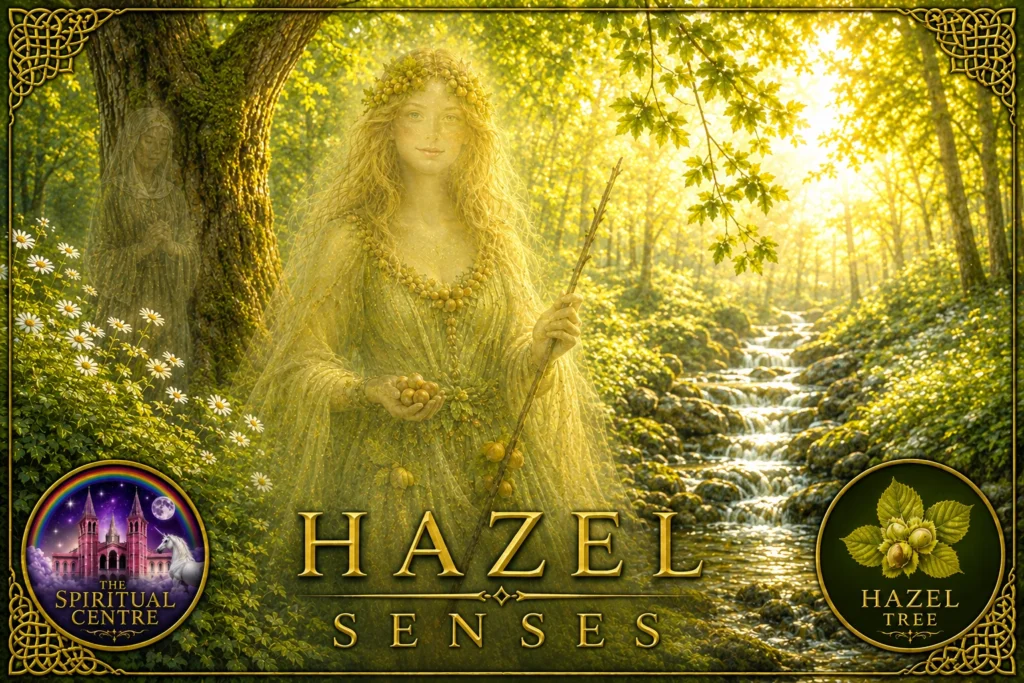
Secrets of the Hazel Tree
The Hazel Tree (Corylus avellana)
Volume 9 of 31
Bruce Clifton
Hazel Tree ~ Coll
The Hazel Tree is a tree of the senses, where perception reaches beyond sight, sound and touch into intuition, empathy and understanding. Known as Coll in the Ogham, Hazel carries an enduring relationship with wisdom, eloquence and the ability to recognise what may otherwise remain hidden.
Its nut conceals knowledge within a shell, its wand seeks what lies beneath the surface, and its branches lead towards divination, inspiration and the mysteries of the living world. Hazel does not simply ask us to know. It asks us to sense, perceive and understand.
The Rivers of Avalon, Camelot, Merlin, the Hazel tree hold many secrets. A wand made from Hazel brings focus to the mysteries of magic. To set an intent and point the wand will bring thoughts into being, Merlin used a wand made from Hazel. Hazel Trees can be found in abundance on the banks of the Rivers of Avalon, Glastonbury, Wells, and the ever elusive Camelot.
Hazel Tree – Ogham Tree Profile
Bruce Clifton
Name: Hazel
Ogham: Coll > > > Cole ~ Coal ~ Koll
Letter: C
Lunar: 9th New Moon of the Bnwyfre Celtic Tree Calendar (July 14th – August 11th)
Season: Summer
Element: Fire
Direction: South
Moon Phase: New Moon ~ Waxing Crescent
Moon Name: Lightning ~ Wort moon
Influence: Feminine / Androgynous
Title: Chieftain
Age: Constant Re-Generation
Aura: Yellow
Healing: Burns ~ Colds ~ Coughs ~ Diarrhoea ~ Fevers ~ Haemorrhoids ~ Headaches ~ Indigestion ~ Liver ~ Mental health ~ Obesity ~ Throat Infections ~ Varicose Veins.
Animal Spirit: Mouse ~ Salmon ~ Squirrel
Totems – Entities: Crone ~ Faery ~ Hildegard of Bingen
Gods – Deities: Brigid ~ Hermes Trismegistus
Secret Harmonies: Clairs ~ Divination ~ Lucid Dreaming ~ Portal ~ Psychic Abilities.
Festival: (coming soon)
Cosmos: (coming soon)
Key Words: Senses ~ Empathic ~ Perception
Essence of the Hazel Tree
Bruce Clifton
The essence of the Hazel Tree is perception. It is the moment when seeing becomes more than sight, hearing becomes more than sound, and touch awakens an understanding that cannot always be explained by reason alone. Hazel engages the senses, but invites them to reach further — towards intuition, empathy and the quiet recognition of what lies beneath the immediately visible world.
This is a tree of wisdom that is experienced before it is explained. The hazelnut encloses its nourishment within a shell; the hazel wand responds to what is hidden beneath the earth; its branches lean towards water and woodland margins. In Irish tradition, the hazels of Segais stand beside the Well of Wisdom, their nuts falling into the water and becoming part of a living passage through which knowledge is received. Wisdom does not remain upon the tree. It moves.
This movement lies at the heart of Hazel. Sensation becomes perception; perception becomes understanding; understanding becomes eloquence. The poet, storyteller, diviner, healer and empath each receive something before they can express it. Hazel therefore belongs as naturally to the spoken word as it does to divination. It is not enough to possess knowledge: wisdom requires the sensitivity to recognise what has been received and the eloquence to give it meaningful form.
The animals of Hazel express this in their own ways. The Salmon of Wisdom receives, the squirrel gathers, and the dormouse withdraws into sleep and dreaming. Around them exists the greater community of creatures that feed, shelter, listen, scent, touch and navigate their world through senses very different from our own. Hazel reminds us that intelligence does not exist only within thought. The living world is continually sensing itself.
It is here that Hildegard of Bingen first enters The Spiritual Centre. She does not belong to the historical Ogham tradition, nor do we need to make her a Druid to welcome her beneath Hazel. Hildegard understood creation through viriditas — greenness, the vital, fertile power she perceived moving through the living world. Her spirituality, observations of nature, healing knowledge, music and extraordinary visionary consciousness were not separate compartments. They belonged to an interconnected creation in which the physical and spiritual continually spoke to one another.
For The Spiritual Centre, this is why Hildegard has a place beside the Hazel Maiden. She represents a way of knowing that Hazel understands: attentive, embodied and alive. She looked into the green world and found more than plants; she recognised vitality, relationship and sacred meaning. Her presence introduces an important principle that will follow her elsewhere through this work — nature can be studied without ceasing to be felt.
Hazel is consequently sensual without being merely physical and psychic without abandoning the physical world. Its harmony encompasses the Clairs, divination, lucid dreaming, intuition and empathic awareness, but begins with the ordinary miracle of sensation. To smell rain, hear leaves moving, taste the nut, feel bark beneath the fingers or notice another being’s presence is already to participate in the conversation.
The essence of Hazel is therefore not simply knowledge. It is receptivity. It asks for senses awake enough to notice, empathy deep enough to feel, perception clear enough to recognise and wisdom mature enough to understand.
Healing Lore of the Hazel Tree
Bruce Clifton
Healing and the Hazel Tree
Within the Ogham tradition, the Hazel tree is revered as a source of wisdom, discernment, and right knowing. Where Birch clears and renews, Hazel refines and directs. Its healing quality lies not in removal, but in alignment — restoring clarity where confusion, imbalance, or uncertainty have taken hold.
Druidic healing recognised that illness and imbalance were often rooted in misalignment between mind, body, and environment. Hazel was valued for its ability to bring order to scattered energies, supporting sound judgement, intuitive awareness, and the proper flow of inner intelligence. In this way, Hazel was associated with healing that required insight as much as remedy — particularly where decisions, direction, or future outcomes were involved.
Healing, as understood by the Druids, was never singular. Hazel formed part of a wider, integrated approach to natural medicine — one that modern society might separate into herbalism, divination, environmental harmony, and psychology. To the Druids, these were not distinct practices, but expressions of a unified understanding of nature, consciousness, and health. Hazel’s role within this system was to guide the healer toward the correct application of remedies, timing, and intent. (Alchemy)
Historically, Hazel has been associated with the nervous system, cognitive clarity, and circulatory balance. Its nuts were valued as nourishing and strengthening, while its twigs were used diagnostically — locating water, tracing energetic pathways, and revealing unseen influences that could affect health and wellbeing. In this sense, Hazel was not only a healing agent, but a tool for identifying the underlying causes of imbalance.
Scope & Notice
The information contained herein is for educational and entertainment purposes only. All efforts have been made to present accurate, up-to-date, reliable and complete information; however, no warranties of any kind are stated or implied. Readers should acknowledge that the author is not engaged in the rendering of medical or professional advice. The content herein should not be perceived as a substitute for professional or personal guidance. If in doubt, consult a qualified professional before attempting any techniques outlined.
The appropriate dosage or application of any natural remedy is dependent upon various factors, including age, health status, and individual circumstances. Natural products are not inherently safe, and dosage may be critical. It is best practice to begin with lower amounts and adjust as necessary. Consideration should also be given to timing, as the effectiveness of remedies may vary according to time of day and individual sensitivity.
About the Healing List
This list of ailments is not complete in its entirety; it has been limited to the most popular, with the remedies coming firstly from the tree and then vegetation dependent on the tree. It is worthy of note that there is more than one way to make a cup of tea, and many of the ingredients can be purchased online.
Hazel Tree – Healing Remedies Oracle
We have alphabetised this list of healing qualities of the Hazel Tree solely for ease of reference, they include but are not limited to:
1. Burns
2. Colds
3. Coughs
4. Diarrhoea
5. Fever
6. Haemorrhoids
7. Headaches
8. Indigestion
9. Liver
10. Mental Health
11. Obesity
12. Throat Infections
13. Varicose Veins
Burns / Hazel Tree
Ingredients:
Hazel Bark Ash (Corylus avellana)
Key Properties:
Astringent qualities – Mineral ash – Soothing action – Drying support – Skin-settling properties
Traditional Actions:
Soothes minor burns, eases surface heat, calms irritation, supports skin repair, assists recovery of damaged tissue
Preparation:
Bark from the base of the Hazel tree is traditionally dried, reduced to ash, and then blended with a little clean water to form a simple poultice, or diluted further for use as a gentle wash. It is applied externally in small amounts to the affected area, with care taken that the preparation is clean and the burn is minor in nature.
Traditional Use:
Where the skin has been affected by minor burns, scalds, or surface heat, Hazel has traditionally been used as a quiet restorative to soothe irritation and support recovery. The ash of the bark was valued in household practice as a simple external remedy, helping to settle the damaged area and encourage the skin toward repair.
Its action is not regarded as harsh or forceful, but steady and calming, easing discomfort while helping the surrounding tissue regain balance. In this way, Hazel was used not only to cool the distress of the burn, but to assist the body in restoring order where heat and injury had disturbed the skin.
Within Druidic understanding, a burn reflects sudden excess, where heat has overwhelmed the natural balance of the body. Hazel responds through right measure, drawing the injury back toward calm, containment, and repair. It restores not by force, but by helping the skin settle into the conditions where healing may begin naturally once more.
Colds / Hazel Tree
Ingredients:
Hazelnut (Corylus avellana)
Key Properties:
Nutrient-rich oils – Vitamin E – Healthy fats – Trace minerals – Gentle restorative compounds
Traditional Actions:
Supports recovery, restores vitality, nourishes the body, softens dryness, aids return to balance after illness
Preparation:
Hazelnuts are taken fresh, dried, or lightly roasted, then eaten whole or ground into a powder and added to warm drinks or simple foods. They may also be blended into milk or plant-based preparations to create a nourishing drink, taken regularly in moderate amounts as strength returns.
Traditional Use:
Where the body has been weakened by colds, chills, or seasonal illness, the Hazelnut has long been regarded as a gentle restorative, supporting recovery rather than forcing change. It nourishes the system, helping to rebuild strength and warmth once the intensity of the illness has passed.
Its action is subtle yet steady, easing the dryness and depletion often left behind after cold conditions, while supporting the natural return of energy, breath, and resilience. Hazel does not act to suppress the cold itself, but to strengthen the one who carries it, encouraging a gradual and stable recovery.
Within Druidic understanding, a cold reflects a lowering or dispersal of Bnwyfre, where warmth and vitality have been diminished. Hazel restores through nourishment and balance, helping the body gather itself again so that health may re-establish naturally over time.
Coughs / Hazel Tree
Ingredients:
Hazelnut – Leaves – Bark (Corylus avellana)
Key Properties:
Soothing compounds – Anti-inflammatory properties – Nutrient-rich oils – Gentle respiratory support
Traditional Actions:
Eases cough irritation, supports respiratory recovery, softens dryness, assists clear breathing, restores balance after illness
Preparation:
Hazelnuts may be ground and added to warm drinks with honey and lemon to create a soothing preparation. Leaves or small amounts of bark may be gently infused in hot water. Steam inhalation can also be used, allowing the warmth and moisture to ease the airways.
Traditional Use:
Where the breath has become unsettled through coughs or lingering respiratory irritation, Hazel has traditionally been used as a gentle restorative, supporting the body as it returns to ease. Its action is not forceful, but softening and steady, helping to calm irritation within the throat and chest while encouraging natural recovery.
Taken as a warm preparation, Hazel helps ease dryness and restriction, allowing the breath to move more freely. It supports the body after illness, particularly where coughing persists beyond the initial cause, restoring comfort without strain.
Within Druidic understanding, a cough reflects disruption within the flow of Bnwyfre through the breath. Hazel responds through balance and containment, settling the disturbance and allowing the natural rhythm of respiration to re-establish itself.
Diarrhoea / Hazel Tree
Ingredients:
Hazel Catkins (Corylus avellana)
Key Properties:
Astringent compounds – Antioxidants – Mild antibacterial qualities – Gut-settling properties
Traditional Actions:
Helps steady the gut, reduces looseness, calms irritation, supports digestive balance, restores stability
Preparation:
Hazel catkins are carefully dried and stored, then rehydrated or used in very small quantities, lightly sprinkled over food or taken with warm preparations. Use is moderate and measured, reflecting their concentrated nature.
Traditional Use:
Where the digestive system has become unsettled through diarrhoea, Hazel catkins have traditionally been used to help steady and restore balance within the gut. Their naturally astringent quality was valued for helping to reduce excess movement and calm irritation within the digestive tract.
The action of Hazel in this form is gentle yet containing, helping the body regain control without force. Rather than suppressing symptoms abruptly, it supports the natural return to stability, easing discomfort and encouraging proper function to re-establish.
Within Druidic understanding, such imbalance reflects a loss of containment within the flow of Bnwyfre, where movement has become excessive or ungrounded. Hazel responds through restraint and right measure, drawing the system back toward balance so that digestion may settle naturally once more.
Fevers / Hazel Tree
Ingredients:
Hazel Bark – Twigs (Corylus avellana)
Key Properties:
Antipyretic properties – Anti-inflammatory compounds – Circulatory support – Cooling action
Traditional Actions:
Helps reduce fever, supports temperature regulation, calms internal heat, encourages recovery, restores balance
Preparation:
Small shavings of hazel bark and twigs are gently boiled in water to create a simple tea. The liquid is then strained and taken warm in moderate amounts, traditionally used during periods of elevated temperature.
Traditional Use:
Where the body is affected by fevers and rising internal heat, Hazel has traditionally been used as a cooling and balancing remedy, helping to regulate temperature and support recovery. The bark and twigs were valued for their antipyretic qualities, assisting the body in easing excess heat without force.
Its action is steady and regulating, working with the body rather than against it, encouraging the natural reduction of fever while supporting the system as it restores equilibrium. Hazel does not suppress the process, but guides it toward resolution.
Within Druidic understanding, fever reflects an intensification of Bnwyfre, where heat has risen beyond balance. Hazel responds through moderation and right measure, drawing the body back from excess and allowing natural harmony to return.
Haemorrhoids / Hazel Tree
Ingredients:
Hazel Leaves – Bark (Corylus avellana)
Key Properties:
Astringent qualities – Anti-inflammatory compounds – Antibacterial properties – Soothing action
Traditional Actions:
Reduces inflammation, soothes irritation, supports tissue tightening, eases discomfort, promotes local recovery
Preparation:
Hazel leaves are traditionally infused or distilled, then incorporated into a simple cream or wash for external application. In some practices, a mild decoction of bark may also be used. Applied gently and in small amounts to the affected area.
Traditional Use:
Where discomfort arises through haemorrhoids, Hazel has traditionally been used as a soothing and containing remedy, helping to reduce inflammation and ease irritation in the affected area. Its astringent nature supports the tightening of tissues, encouraging stability and relief.
The action is calming and restorative, assisting the body in regaining balance without harsh intervention. Used externally, it supports the delicate tissues while helping to reduce swelling and discomfort.
Within Druidic understanding, such conditions reflect pressure and stagnation within the lower flow of Bnwyfre. Hazel responds through containment and right measure, easing excess and restoring balance so that the body may return to comfort naturally.
Headaches / Hazel Tree
Ingredients:
Hazelnut (Corylus avellana)
Key Properties:
Magnesium – Omega-3 fatty acids – Vitamin E – Healthy fats – Nervous system support
Traditional Actions:
Eases tension-related headaches, supports nervous system balance, reduces mental strain, encourages clarity, restores steadiness
Preparation:
Hazelnuts are taken whole, lightly roasted, or ground, and incorporated into simple foods or warm drinks. They may also be kept nearby in a bowl, allowing their presence to contribute to a calmer environment.
Traditional Use:
Where headaches arise through tension, mental strain, or overwhelm, Hazel has traditionally been regarded as a steadying influence, supporting both the body and the mind. The nutrient-rich hazelnut nourishes the nervous system, helping to ease the underlying conditions that contribute to discomfort.
Its action is gentle and grounding, working to reduce internal pressure rather than forcing relief. By supporting clarity and calming mental agitation, Hazel helps the body return to a more balanced state where headaches may naturally subside.
Within Druidic understanding, headaches reflect congestion or imbalance within the flow of Bnwyfre, particularly in the realm of thought and perception. Hazel responds through clarity and right measure, easing the pressure and allowing natural rhythm to return.
Indigestion / Hazel Tree
Ingredients:
Hazelnut (Corylus avellana)
Key Properties:
Dietary fibre – Antioxidants – Healthy fats – Digestive support – Nutrient-rich compounds
Traditional Actions:
Supports digestion, encourages natural bowel movement, eases discomfort, aids metabolic balance, restores digestive rhythm
Preparation:
Hazelnuts are taken whole, lightly roasted, or ground, and incorporated into simple foods such as breads, porridges, or warm drinks. Regular, moderate intake is favoured to support steady digestive function.
Traditional Use:
Where the digestive system becomes unsettled through indigestion, Hazel has traditionally been used as a gentle digestive support, helping the body return to its natural rhythm. The fibre and nutrient-rich oils within hazelnuts assist the movement and balance of the digestive process, easing discomfort without force.
Its action is steady and regulating, encouraging proper function rather than overriding it. By supporting digestion and metabolic balance, Hazel helps reduce the heaviness and stagnation often associated with indigestion.
Within Druidic understanding, indigestion reflects a disruption in the transformation of Bnwyfre, where nourishment is not being properly received or processed. Hazel responds through balance and right measure, helping the body restore its natural digestive flow.
Liver / Hazel Tree
Ingredients:
Hazel Leaves – Hazelnut (Corylus avellana)
Key Properties:
Anti-inflammatory compounds – Vitamin E – Healthy fats – Antioxidants – Liver-supporting nutrients
Traditional Actions:
Supports liver function, aids fat metabolism, reduces internal inflammation, promotes detox balance, restores vitality
Preparation:
Hazel leaves may be gently infused to create a mild tea, while hazelnuts are taken whole, lightly roasted, or ground into foods and warm preparations. Regular, moderate use is favoured to support ongoing balance.
Traditional Use:
Where the body shows signs of imbalance within the liver, Hazel has traditionally been used as a supportive and restoring ally, helping to ease internal strain and encourage proper function. The combined action of leaves and nuts provides nourishment and gentle support to the body’s natural processes.
Its influence is steady and balancing, assisting the regulation of fats and supporting the reduction of internal congestion. Rather than forcing change, Hazel works to restore the conditions in which the liver may function more freely and efficiently.
Within Druidic understanding, liver imbalance reflects a burden within the flow of Bnwyfre, where processing and transformation have become hindered. Hazel responds through clarity and right measure, helping to lighten this burden and return the system to a more natural state of balance.
Mental Health – Hazel Tree
Ingredients:
Hazelnut (Corylus avellana)
Key Properties:
Polyphenols – Antioxidants – Healthy fatty acids – Vitamin E – Trace minerals
Traditional Actions:
Nervous system nourishment, cognitive support, antioxidant protection, strengthening mental resilience
Preparation:
Hazelnuts are gathered when fully ripe, typically in early autumn once the husks begin to open naturally. The nuts may be dried and stored in a cool, dry place for later use.
They are traditionally eaten whole, lightly roasted, or ground and incorporated into simple foods such as breads, cakes, or nourishing pastes. Hazelnuts may also be crushed and added to broths or porridges, allowing their oils and nutrients to be absorbed gradually.
Ground hazelnuts can also be blended with warm liquids such as milk or plant-based preparations to create a nourishing drink traditionally associated with strengthening the body and mind.
Traditional Use:
Within traditional European plant practice, hazel has long been associated with wisdom, clarity of thought, and the nourishment of the mind. Hazelnuts were valued not only as a sustaining food but also as a source of nutrients believed to support the health of the nervous system.
Rich in antioxidants, polyphenolic compounds, vitamins, and beneficial oils, hazelnuts have traditionally been regarded as supportive where mental fatigue, nervous strain, or cognitive decline are present. Modern observations also suggest these compounds may help protect the brain from degenerative processes associated with conditions such as Alzheimer’s disease and Parkinson’s disease.
Through steady nourishment rather than sudden stimulation, hazel has therefore been associated with maintaining clarity of thought, strengthening mental resilience, and supporting long-term brain health.
Obesity / Hazel Tree
Ingredients:
Hazelnut (Corylus avellana)
Key Properties:
Healthy fats – Dietary fibre – Antioxidants – Satiety-supporting nutrients – Metabolic support
Traditional Actions:
Supports weight balance, promotes satiety, regulates appetite, aids metabolism, reduces excess accumulation
Preparation:
Hazelnuts are taken whole, lightly roasted, or ground, and incorporated into meals or simple snacks. Regular, moderate consumption is favoured, supporting nourishment without excess.
Traditional Use:
Where the body carries excess weight through obesity or imbalance, Hazel has traditionally been regarded as a steady and nourishing ally, supporting the body in finding its natural balance. The healthy fats and fibre within hazelnuts help promote a sense of fullness, reducing unnecessary intake while sustaining energy.
Its action is grounding and regulating, working through nourishment rather than restriction. By supporting appetite control and metabolic function, Hazel assists in easing excess accumulation over time, encouraging a more balanced state.
Within Druidic understanding, obesity reflects an imbalance in the storage and movement of Bnwyfre, where energy has become held rather than circulated. Hazel responds through balance and right measure, helping restore flow so that the body may return to its natural equilibrium.
Throat (Infections) / Hazel Tree
Ingredients:
Hazelnut – Shell (Corylus avellana)
Key Properties:
Antimicrobial properties – Anti-inflammatory compounds – Soothing action – Oral support
Traditional Actions:
Eases throat irritation, supports oral health, reduces infection presence, calms inflammation, restores comfort
Preparation:
Hazelnut, including the shell, is traditionally prepared as a mild infusion or mouthwash, allowed to cool slightly before use. It may be used as a gentle rinse or gargle, applied regularly in small amounts.
Traditional Use:
Where the throat has become affected by infection, soreness, or irritation, Hazel has traditionally been used as a soothing and protective remedy, helping to calm inflammation and support recovery. Its antimicrobial qualities were valued for maintaining oral balance and reducing the presence of infection.
Its action is gentle and steady, easing discomfort while supporting the natural healing processes of the throat. Used as a rinse or gargle, it helps restore comfort without harsh intervention.
Within Druidic understanding, throat infection reflects a disturbance within the expression of Bnwyfre, where flow through breath and voice has become restricted. Hazel responds through containment and right measure, calming the disturbance and allowing clear expression and comfort to return.
Varicose Veins / Hazel Tree
Ingredients:
Hazelnut (Corylus avellana)
Key Properties:
Antioxidants – Omega-3 fatty acids – Healthy fats – Circulatory support – Anti-inflammatory compounds
Traditional Actions:
Supports circulation, strengthens blood flow, reduces inflammation, protects vessels, promotes vascular balance
Preparation:
Hazelnuts are taken whole, lightly roasted, or ground, and incorporated into daily meals or simple foods. Regular, moderate intake is favoured to support ongoing circulatory health.
Traditional Use:
Where discomfort arises through varicose veins, Hazel has traditionally been used as a supportive and strengthening ally, helping to improve circulation and maintain vascular health. The antioxidants and healthy fats within hazelnuts support the integrity of blood vessels while encouraging smoother flow.
Its action is steady and restorative, assisting in reducing inflammation and easing the heaviness often associated with poor circulation. Rather than acting directly upon the veins, Hazel supports the wider system, encouraging balance and improved function over time.
Within Druidic understanding, varicose veins reflect a slowing or stagnation within the movement of Bnwyfre, where flow has become restricted. Hazel responds through balance and right measure, helping to restore movement and ease within the circulatory system.
Celtic Tree Lore of the Hazel Tree
Bruce Clifton
Hazel is the ninth tree of the Ogham calendar and she stands at the height of summer when growth has matured into knowing. Her moon runs from 14th July to 11th August, a time known as the Lightning Moon or Wort Moon, when heat quickens thought and the land hums with stored energy. Hazel does not rush to flower nor hurry to fade; she gathers quietly, drawing strength inward, concentrating wisdom into nut and branch. She grows at the forest’s edge and beside streams, where land meets water and thought meets feeling, reminding us that insight is born where currents cross.
Hazel is not the beginning of the forest, nor its ending. She is the moment of understanding — when experience settles into knowledge and knowledge ripens into wisdom.
Hazel is Coll, the ninth letter of the Ogham, carrying the sound of C or K. Unlike some later and more uncertain tree associations within Ogham, Coll genuinely means hazel in Old Irish, with linguistic roots reaching back through the Celtic languages. Its place within Ogham is therefore unusually secure: the name of the letter and the name of the tree are one and the same.
The surviving Bríatharogam, the medieval word-kennings used to illuminate the Ogham letters, give us an extraordinary glimpse of how Coll was understood. Hazel is described through phrases translated as the “fairest tree,” “friend of nutshells,” and “sweetest tree.” These are not modern spiritual correspondences imposed upon Hazel; they belong to the surviving Ogham tradition itself.
Its importance, however, reaches beyond the alphabet. Hazel was valuable in the physical Celtic world. Its nutritious nuts could be gathered and stored, while its flexible rods provided useful material for wattling and other everyday purposes. Early Irish law placed Hazel among the Airig Fedo, the nobles of the wood, giving the tree protected status and demonstrating that its importance was practical as well as symbolic.
Yet Hazel’s most powerful relationship is with knowledge and inspiration. Irish tradition places nine hazels around the Well of Wisdom, their nuts falling into the water where they become associated with the wisdom carried by the salmon. Through this imagery, knowledge does not arrive as something dry or abstract. It ripens upon a living tree, falls into water, passes into another living creature and ultimately becomes inspiration, poetry and understanding.
This gives Coll an unusually complete place within Ogham. The tree feeds the body, its rods serve the community, its name becomes a letter, and its fruit becomes an emblem of knowledge. Hazel connects nourishment with learning and learning with expression. Wisdom is gathered, absorbed and eventually given a voice.
For the Druids of today, this makes Hazel more than a tree representing accumulated knowledge. Coll is the moment knowledge becomes understanding. Its wisdom involves the senses, intuition and perception alongside the intellect: knowing when something is ripe, recognising what has been received, and finding the eloquence to express it.
Perhaps this is why Hazel belongs so naturally within Ogham. Ogham itself transforms understanding into marks that can be carried and communicated. Hazel performs the same movement in living form — from nut to nourishment, from sensation to perception, from knowledge to wisdom, and from wisdom into the spoken or written word.
Folklore of the Hazel Tree
Bruce Clifton
The folklore of the Hazel Tree is woven through wisdom, perception and the quiet discovery of what is hidden. Hazel does not shout its secrets. It waits at woodland edges and beside streams, offering its nuts, branches and shade to those prepared to notice what is already there.
For centuries, the hazel rod has been associated with divination and the finding of hidden water. The forked branch became a sensitive instrument in the hands of the dowser, while hazel wands and staffs were also surrounded by traditions of guidance, protection and discernment. The enduring image is not of Hazel commanding the unseen, but of Hazel responding to it.
Its nuts carried their own mysteries. In Scottish and northern English Halloween traditions, hazelnuts were placed upon the fire to divine the fortunes of lovers. Two nuts burning quietly together could suggest constancy, while cracking, jumping or separating foretold something rather less harmonious. So closely were nuts associated with these autumn customs that Halloween was known in some communities as Nut-Crack Night.
There is poetry in this old practice. A name is given to a nut, the nut is surrendered to the fire, and people watch to see what will be revealed. Hazel becomes once again a meeting place between knowledge and uncertainty, intuition and experience, hope and what may yet unfold.
The tree also belongs firmly within household lore. Hazelnuts were gathered as valuable winter food, while the wood was used for practical objects, staffs and rods. Yet the older traditions repeatedly suggest restraint: gather when the nut is ripe, take what is needed, and understand the difference between receiving from the tree and simply taking from it. Even the strange guardians of hazel groves found in British folklore can be read as reminders not to harvest before the proper time.
Hazel therefore carries an unusual form of authority. It is the authority of the wise woman, poet, storyteller, diviner and quiet counsellor — people whose influence comes from observation and understanding rather than force. In this sense, the spoken word belongs naturally beside the hazel wand. Both begin with listening.
Its place at boundaries strengthens this character. Hazel often grows where woodland gives way to open ground or where branches lean towards water, and its folklore repeatedly places it near moments of choice. It becomes a companion at the threshold, not necessarily telling which path must be taken, but sharpening the senses sufficiently for the path to be recognised.
This is perhaps the enduring folklore of Hazel: wisdom must ripen before it can be gathered. The nut needs its shell, the wand needs a sensitive hand, the word needs thought before it is spoken, and the answer often appears only when enough patience has been given for it to emerge.
Animal Spirit of the Hazel Tree
Bruce Clifton
The Animal Spirit of the Hazel Tree moves through a world of instinct, nourishment and hidden wisdom. The Salmon of Wisdom receives knowledge from the hazelnuts that fall upon the sacred waters; the Squirrel gathers and carries the nuts of wisdom; while the Dormouse curls within Hazel’s shelter, sleeping among the branches and husks of its autumn abundance.
Yet these are only some of the creatures that share Hazel’s harmony. Those that feed upon its nuts, shelter within its branches, travel beneath its canopy or follow the waters beside which it grows may each reveal another expression of its spirit. Hazel reminds us that wisdom is not confined to thought: it can be tasted, gathered, sensed, carried and dreamed.
Hazel Tree – Animal Spirit Oracle
Bruce Clifton
We have alphabetised this list of animal spirit that harmonise with the hazel tree solely for ease of reference; no sense of hierarchy or entitlement is intended or implied:
1) Mouse
2) Salmon
3) Squirrel
Mouse / Hazel Tree
Mouse is the influence you do not know is there, it is only when you look for it that it becomes obvious. The mighty Elephant is scared of the mouse but only when Mouse makes himself known. Encourage mouse out of hiding by being kind, a few crumbs and mouse will be on your side.
Autumn and you will find mouse hoarding food, collecting food and storing it for the long winter nights. Winter and Mouse is in semi-hibernation conserving energy and not becoming prey for anything bigger than itself. Spring and Mouse is the gatherer and romanticist, providing food and creating his harem, gathering food and making good use of anything it finds for its family. The long days of summer and it is heaven on earth for this tiny creature enjoying all that life has to offer care free and living the life of abundance surrounded by family.
Mouse is quietly bound to Hazel through rhythm, nourishment, and timing. Hazel provides the nut that sustains Dormouse through the long preparation for winter, its energy stored slowly and deliberately, mirroring the dormouse’s own careful gathering and deep seasonal awareness. In this relationship, Hazel teaches discernment and right measure, while Mouse embodies patience, memory, and the wisdom of withdrawal. Neither rushes; both understand that survival and insight depend on knowing when to act and when to sleep.
Salmon / Hazel Tree
Where the Hazel tree grows beside quiet pools and slow rivers, the salmon has long been recognised as a bearer of wisdom. In Celtic tradition the sacred hazelnuts were said to fall into the water, where the salmon fed upon them and gathered the knowledge of the world. The tree and the river together formed a place where insight was believed to awaken.
The salmon’s long journey from sea to river reflects the patient search for understanding. Guided by instinct and memory, it travels back to its source, just as wisdom returns to those who listen carefully to the rhythms of nature. Beneath the branches of Hazel, this journey becomes a living symbol of knowledge gained through experience.
In the old stories the salmon who fed upon the hazelnuts of wisdom became the Salmon of Knowledge, keeper of ancient insight and memory. Where Hazel leans over the waters, the presence of salmon reminds us that true wisdom is not forced but gathered slowly through observation, patience, and the quiet teachings of the natural world.
Squirrel / Hazel Tree
Squirrel is bound to the hazelnut through instinct, preparation, and the wisdom of foresight. Hazel offers its nuts as concentrated nourishment, and squirrel answers by gathering, caching, and remembering — storing what is needed long before scarcity arrives. In this relationship, the hazelnut represents potential held in reserve, while squirrel embodies alertness, quick intelligence, and the necessity of preparation. Nothing is taken without purpose; nothing is gathered without thought of the future.
In Nordic legend, the squirrel appears as Ratatoskr, the swift messenger who runs the length of the World Tree, carrying words and memory between realms. Paired with the hazelnut, this echoes the same northern understanding: wisdom is gathered in small, concentrated forms and moved quickly where it is needed, linking root and crown, earth and thought, through alertness, preparation, and motion.
Totems and Entities of the Hazel Tree
Bruce Clifton
The Totems and Entities of the Hazel Tree gather around its gifts of wisdom, eloquence and awakened senses. The Crone and Faery belong intimately to the living world, sensing its hidden language, while the hazel nut and wand become instruments through which knowledge may be discovered, divined and understood.
Standing behind the Hazel Maiden is Hildegard of Bingen, whose extraordinary understanding of viriditas — the living greenness within creation — makes her a natural presence here. Mystic, healer and visionary, Hildegard experienced the natural world sensually as well as spiritually: something to see, hear, touch, taste, feel and ultimately understand. In Hazel, wisdom is not merely learned; it is sensed.
Hazel Tree – Totems and Entities Oracle
Bruce Clifton
We have alphabetised this list of totems and entities that harmonise with the hazel tree solely for ease of reference. No sense of hierarchy or entitlement is intended or implied:
1) Crone
2) Faery
3) Hildegard of Bingen
Crone / Hazel Tree
The Hazel Tree has long been honoured as a tree of wisdom, inspiration, hidden knowledge, and sacred perception, making it a natural companion to the Crone, whose gifts are earned through experience rather than borrowed from books. Where Hazel offers the nut of insight, the Crone teaches how to open it. Where Hazel gathers knowledge, she turns it into lived understanding.
In old traditions Hazel is linked with holy wells, the salmon of wisdom, poetic vision, divining rods, and the quiet arts of seeing beneath appearances. These are realms the Crone knows intimately. She walks beside springs, listens in silence, and recognises that truth rarely arrives through noise. To sit with Hazel in stillness is to enter a school older than language.
Hazel has long been associated with the clair-abilities, yet not as spectacle or fantasy. Under her influence, perception is steadied rather than overstimulated. What was once faint becomes recognisable. The Crone deepens this teaching through discernment. She knows that not every feeling is insight, not every image is prophecy, and not every impression should be trusted without time, humility, and reflection. Together they refine awareness until it becomes clear, grounded, and useful.
The same is true of divination. Hazel rods were used to seek water, locate what was hidden, and ask honest questions of uncertain paths. Yet Hazel and the Crone do not promise fixed fate. They teach pattern, probability, readiness, and consequence. Wise foresight is not control of the future, but alignment with what is already unfolding.
Hazel is also linked with dreaming, portals, and the unseen worlds, though again in subtle ways. Its gateway is not a dramatic tearing open of realms, but a softening of boundaries between waking and sleeping, visible and invisible, outer life and inner knowing. The Crone stands comfortably at such thresholds. She guides without intrusion, allowing insight to rise through observation rather than force.
Hazelnuts ripen only in their proper season, and this too is their shared medicine. The Crone knows that truths forced too early are wasted. Some wisdom can only be received when life has matured the seeker enough to hold it. Right timing is part of all real knowledge.
Within The Spiritual Centre, Hazel and the Crone speak to seekers, healers, dreamers, diviners, elders, and all who hunger for something deeper than information. They remind us that true sight is quiet, true wisdom is tested, and the richest understanding often comes when the soul itself has ripened.
Faery / Hazel Tree
The Hazel Tree is not a faery tree in quite the same way as Hawthorn, yet it has long been found in the liminal places where subtle presences gather: beside wells, streams, woodland edges, and the quiet margins between one realm of experience and another. For this reason Hazel belongs naturally with the fairies, not through spectacle, but through heightened perception, hidden wisdom, and the quiet recognition of what is already there.
Hazel does not force doors open. It sharpens awareness. Under its influence, the unseen is less something summoned than something noticed. What once seemed empty may reveal atmosphere, intelligence, movement, or meaning. This is why those drawn to the clair-abilities have long sought Hazel, for it is said to refine the senses and deepen subtle perception across mind, feeling, and intuition.
The fairies linked with Hazel are often less flamboyant than those of blossom trees and festival groves. They appear in older ways: as tests of awareness, flickers at the edge of sight, sudden insight, misplaced certainty corrected, or the unmistakable feeling that one is being gently observed. They do not always seek attention. They seek attentiveness.
Hazelnuts themselves carry ancient symbolism of knowledge, inspiration, and hidden treasure. Even the empty cup left beneath the tree has been read in folklore as a sign of faery merriment: gatherings in the night, dancing in circles, laughter among roots, and the quiet arts of charm and enchantment carried out beyond ordinary view. Whether taken literally or symbolically, such images preserve the sense that Hazel is never as silent as it seems.
There is joy here as well as wisdom. The fairies of Hazel remind us that insight need not be solemn, and that mystery often arrives with playfulness. A mind too rigid sees little. A mind awake and receptive begins to notice life moving in finer ways.
Within The Spiritual Centre, Hazel and the fairies speak to those seeking intuition, clearer perception, hidden knowledge, playful wisdom, and a deeper relationship with the unseen world. They remind us that some gates do not open outward, but inward, through the refinement of awareness itself.
Hildegard of Bingen / Hazel Tree
The Hazel Tree has long been honoured as a tree of wisdom, discernment, inspired insight, and knowledge brought to right measure, making it a natural companion to Hildegard of Bingen. Where other symbols of knowledge may suggest accumulation alone, Hazel teaches ripening: truth gathered patiently, tested inwardly, and offered only when ready to nourish life. This is the same quality that lives within Hildegard’s legacy.
Hildegard may be called forward simply by sincere request, an unmistakable presence though seldom consciously acknowledged. She belongs wherever thought seeks harmony rather than domination, and where learning remains rooted in reverence for creation. Beneath Hazel’s boughs, her atmosphere is not dramatic or theatrical. It is clarifying, steadying, and quietly luminous.
She is drawn to Hazel because Hazel carries the order of creation she so faithfully described: wisdom shaped by divine breath and held in living balance. As Hazel gathers knowledge quietly and releases it only when it has ripened, so Hildegard taught that understanding flows through viriditas, the greening life-force that sustains all being. What grows in the orchard of the mind must also be tended, pruned, and brought into season.
Hazel has long been linked with the clair-abilities, divination, lucid dreaming, and subtle perception, yet in its deepest current these are not spectacles of power. They are forms of refined awareness. Hildegard mirrors this perfectly. Her visions were not chaos or display, but ordered revelation integrated through prayer, observation, music, medicine, and disciplined thought. She shows that true sight must be joined to responsibility.
There is healing in this union as well. Hildegard wrote of herbs, temperament, vitality, and the harmony between body and soul. Hazel steadies the nervous system of the spirit, softening agitation and sharpening what is trustworthy. Together they suggest that wisdom itself can be medicinal when applied with humility and care.
Within the understanding of the Bnwyfre Spiritual Order, Hildegard and Hazel reveal the breath of life as living intelligence moving through mind, tree, symbol, and soul. They remind us that creation is not mute matter, but a meaningful order in which insight becomes service and knowledge becomes healing.
Within The Spiritual Centre, Hazel and Hildegard speak to those seeking clarity, spiritual wisdom, balanced intuition, healing understanding, feminine intelligence, and peaceful alignment with the living world. They remind us that the highest knowledge is not the loudest, but the one that restores harmony wherever it is received.
Gods and Deities of the Hazel Tree
Bruce Clifton
The Hazel Tree belongs naturally among deities of wisdom, inspiration and awakened perception. Its nuts have long carried associations with knowledge, while its branches and waters lead towards divination, intuition and the mysteries that exist beyond the ordinary senses.
Within these relationships, Brigid and Hermes Trismegistus express different aspects of Hazel’s character. Through inspiration, sacred knowledge and revelation, they reflect the tree’s ability to receive wisdom, recognise what lies beneath the surface and transform perception into understanding.
Hazel Tree – Gods and Deities Oracle
Bruce Clifton
We have alphabetised this list of Gods and Deities that harmonise with the hazel tree solely for ease of reference; no sense of hierarchy or entitlement is intended or implied:
1) Brigid
2) Hermes Trismegistus
Brigid / Hazel Tree
Origin: Celtic Ireland and Britain, pre-Christian era, c. 1st Millennium BCE
Brigid moves naturally within the quiet wisdom of the Hazel Tree, long honoured throughout Celtic tradition as the tree of sacred knowledge, poetic inspiration and hidden understanding. Around the old wells and sacred waters of Ireland, the hazels of Segais stood beside the living spring where wisdom gathered like light upon water. The falling hazelnuts carried inspiration into the currents below, where the Salmon of Wisdom received the sacred knowledge held within them.
As guardian of poetry, inspiration and sacred speech, Brigid reflects these same living currents of awakening insight. Wisdom within Celtic tradition is rarely forced or conquered. It rises quietly through listening, reflection and attunement with the deeper rhythms moving through land, water and spirit alike. In this way, Hazel becomes a natural companion to Brigid, both carrying the atmosphere of inspiration waiting patiently to be recognised.
Within the living current of the Bnwyfre Spiritual Order, Hazel represents the awakening of inner knowledge already present beneath the surface of awareness, much like the first stirrings of sap rising invisibly through branch and root at Imbolc. Around the sacred wells and hazel groves, the old traditions speak softly of Dryads, elemental presences and the subtle consciousness moving through places where wisdom, water and living memory gather together.
Hazel has long been associated with divination, hidden pathways and the search for deeper truth. Hazel rods were used for guidance, dowsing and the seeking of what remained concealed beneath the visible world. These traditions echo Brigid’s own role as a presence of inspiration and insight, gently guiding awareness toward greater understanding rather than demanding belief through force.
Within the shelter of the Hazel groves, Brigid becomes the quiet spark of inspiration awakening within the human spirit itself. Like the hazelnut hidden within its shell, wisdom often waits patiently beneath the surface until the right season arrives for it to emerge into light.
Hermes Trismegistus / Hazel Tree
Hermes Trismegistus is recognised within the Hermetic tradition as bearer of sacred knowledge, the one who transmits hidden understanding between heaven and earth. He stands at the threshold between worlds, translating divine order into human comprehension. In this, he does not command power. He interprets it, revealing pattern, correspondence and relationship where others see only separation.
The Hazel Tree performs a similar role within Celtic understanding. It is not a tree of spectacle or dominion, but of discernment, carrying wisdom in concentrated form and releasing it only when maturity, timing and readiness align together. Around hazel gather still waters, reflective pools and quiet woodland edges where observation deepens naturally into insight. Like Hermes himself, the tree encourages understanding through patience rather than force.
Where Hermes articulates the Hermetic principle of “as above, so below,” Hazel embodies it through living form. Root and branch mirror one another, water and earth remain in quiet conversation and hidden knowledge rises gradually from unseen depths into conscious awareness. The hazelnut itself becomes a vessel of contained wisdom, small in appearance yet holding nourishment, continuity and potential within its shell.
Hermes carries the caduceus, the staff entwined with serpents representing balance, duality and reconciliation between opposing forces. Hazel carries the rod, not as weapon or symbol of dominance, but as instrument of sensing, guidance and alignment with hidden currents moving quietly through land and spirit alike. Both staffs belong to mediation rather than authority. They reveal pathways, harmonise opposites and encourage clarity where confusion once gathered.
Within the atmosphere of the Hazel Tree, Hermes Trismegistus appears not as distant mystic, but as quiet interpreter of the deeper intelligence woven through nature itself. Wind moves softly through the branches, light reflects across still water and thought becomes calmer, clearer and more precise. Together, Hermes and Hazel remind us that wisdom is rarely imposed suddenly upon the soul. It ripens gradually through reflection, balance and continued correspondence and harmony with the Bnwyfre Spiritual Order.
Secret Harmonies of the Hazel Tree
Bruce Clifton
The Secret Harmonies of the Hazel Tree arise through perception, intuition and the senses that reach beyond ordinary awareness. Hazel encourages the mind to become receptive, allowing subtle impressions, hidden patterns and intuitive understanding to emerge into consciousness.
Within these harmonies are the Clairs, Divination, Lucid Dreaming, Portals and Psychic Abilities. Each explores a different threshold of perception, reflecting Hazel’s enduring relationship with wisdom, inspiration and the ability to perceive what is present but not always immediately seen.
Hazel Tree – Secret Harmonies Oracle
Bruce Clifton
We have alphabetised this list of secret harmonies of the hazel tree solely for ease of reference; no sense of hierarchy or entitlement is intended or implied:
1) Clairs
2) Divination
3) Lucid Dreaming
4) Portal
5) Psychic Abilities
Clair-abilities / Hazel Tree
The hazel tree may have been cultivated to enhance clairvoyant abilities. The hazel tree enhances all psychic abilities, exerting a tangible influence on the human psyche across physical, mental, and emotional levels.
Hazel governs perception that has been steadied, not stimulated. Within her current, the so-called clair-abilities do not arrive as dramatic visions or overwhelming sensation; they emerge as quiet clarity. Hazel refines awareness until what was once faint becomes recognisable. She does not heighten imagination, she filters it, ensuring that what remains is measured and trustworthy.
Hazel insists on one condition: restraint. She teaches that perception must be tested against time and context. Not every impression is truth; not every feeling is insight. Under Hazel, discernment acts as safeguard. The rod she carries is not for summoning but for sensing — checking alignment before action.
In this way, Hazel transforms clair abilities from gifts of spectacle into tools of responsibility. She reminds us that clarity without humility becomes distortion and that true perception serves life quietly.
Divination / Hazel Tree
The Hazel Tree is a tree of wisdom, insight, and uncovering what is hidden, making it a natural ally for divination. In traditional practice, Hazel has long been used as a divining twig, particularly for locating water, silver, and gold, where what lies beneath the surface is brought into awareness through alignment rather than force.
The Hazel twig is typically held lightly in both hands, often as a forked branch, with the ends balanced and the point facing forward. It is not gripped or controlled. The response comes through subtle movement, where the twig reacts as awareness, environment, and intention come into alignment. As with all divination, the question and focus are essential, as the response reflects what is asked, not what is assumed.
Divination through Hazel reflects a deeper harmony of Familiar Knowledge, where insight is recognised rather than constructed. It is not always immediate, but it is precise when attention is steady. What is hidden does not need to be forced into view; it reveals itself when the conditions are right.
Within the Bnwyfre Spiritual Order, Hazel teaches that divination is not about searching outward, but about entering relationship with what is already present, where knowledge rises naturally from within the shared field.
Lucid Dreaming / Hazel Tree
With the Hazel Tree, lucid dreaming is not approached as control, but as recognition, where awareness realises itself within the dream without disturbance. It is the state in which one becomes conscious while still dreaming, not to manipulate the experience, but to observe consciousness moving through another layer of perception.
Hazel refines the inner observer, bringing steadiness and clarity to the dream space. Just as it teaches discernment in waking life, it steadies the witness within sleep, allowing the dream to unfold with coherence rather than chaos. The experience becomes one of quiet presence, where awareness remains intact, as though watching and participating at the same time.
Within Hazel’s current, the dream is not directed, but understood, where meaning emerges through attention rather than interference. Awareness becomes the guiding thread, revealing what is present without needing to alter it.
Through Hazel, lucid dreaming becomes an act of discernment and clarity, where the dream is not changed, but recognised, allowing insight to arise through stillness, observation, and quiet understanding. (See also: Astral Travel – Dream Walking)
Portal / Hazel Tree
The Hazel Tree opens a portal of perception rather than passage, where awareness begins to recognise the deeper life moving quietly beneath ordinary reality. Hazel does not provide the veil between worlds, it allows it to be recognised, it softens it. Beneath its branches, the boundaries between waking and dreaming, seen and unseen, earthly and etheric become less rigid, allowing perception to deepen without losing clarity or grounding.
Within Hazel’s field, the world itself begins to feel more alive. Woodland presences, elemental intelligences, ancestral impressions, creatures of root and water, and the subtler movements of consciousness become easier to recognise, not because they suddenly appear, but because awareness becomes refined enough to notice what was always there.
The portal Hazel Tree offers is both inward and outward at once. It does not pull the individual away from reality, but deeper into it, where intuition, symbolism, memory, and perception begin to move together within the same living field. Through Hazel, the unseen is not approached through force or spectacle, but through stillness, discernment, and quiet attention.
In this way, Hazel reveals the portal not as another place entirely, but as a deeper layer of the world already surrounding us, where consciousness widens gently and the hidden harmonies of life become easier to perceive.
Psychic Abilities / Hazel Tree
Within a holistic understanding, Hazel does not “grant” psychic powers, nor does it bestow abilities that were not already present. Instead, Hazel refines the perceiver. It creates a field of steadiness in which subtle perception can emerge more clearly.
When time is spent consciously with Hazel — whether through contemplation, ritual, or quiet presence — the nervous system often settles. Breath slows. Attention sharpens. Internal dialogue softens. In this steadied state, many people report an increased sensitivity to intuition, pattern, and subtle emotional shifts. What might be described as clairvoyance or claircognizance can arise simply because distraction has diminished.
Hazel’s influence, in this sense, is not supernatural — it is harmonising. It encourages observation without projection and receptivity without urgency. Insight becomes quieter but more coherent. Rather than amplifying sensation, Hazel filters noise.