Secrets of the Blackthorn Tree
The Blackthorn Tree (Prunus spinosa)
Volume 14 of 31
Bruce Clifton
Blackthorn Tree – (Straif)
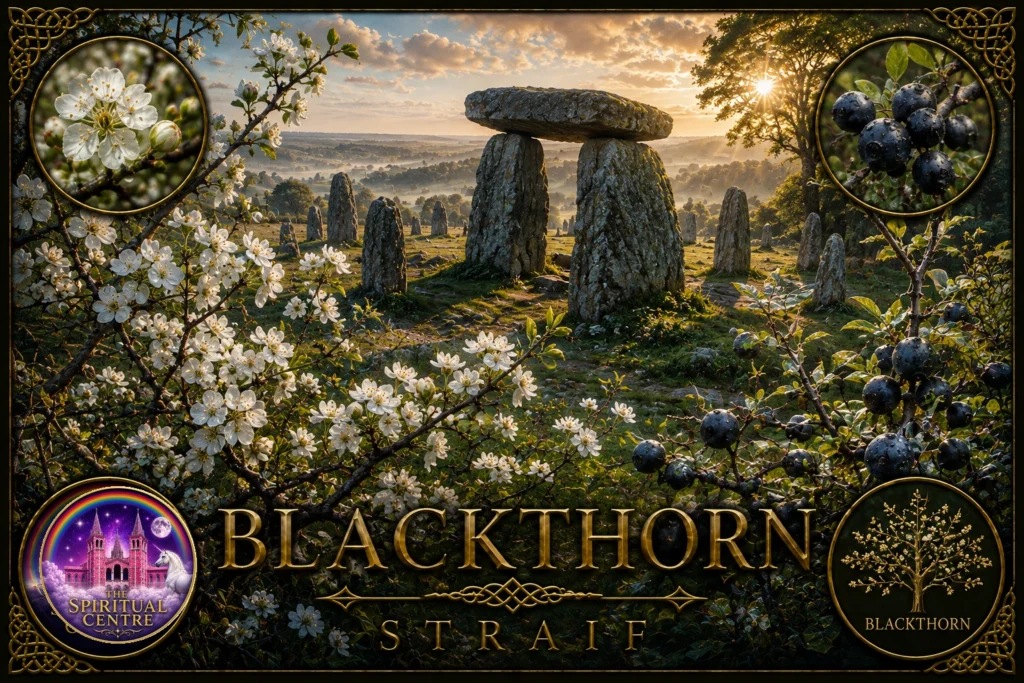
The Blackthorn tree (Prunus spinosa) is an ancient hedgerow tree of striking contrasts: white spring blossom against dark thorny branches, bitter sloes ripening towards winter, and a formidable natural boundary that provides protection and shelter within. Known as Straif within the Ogham tree tradition, Blackthorn has gathered centuries of symbolism, folklore and spiritual meaning around its distinctive character.
Its stories move between Celtic tree lore, mythology, traditional healing and folklore, through witches and hags, gods and deities, animal spirits, the shillelagh, the sloe and the mysterious world of Ogham. Alongside its history and natural qualities, this profile explores Blackthorn through the Secret Harmonies of Strife, Resolve and Finality, revealing a tree concerned not simply with adversity, but with boundaries, consequence, acceptance and the strength to face what cannot be avoided.
Discover the Blackthorn tree in full — its meaning and symbolism, botanical character, healing traditions, folklore, Ogham associations, gods, totems, animal spirits and Secret Harmonies — and meet a tree whose beautiful blossom has never required it to surrender its thorns.
Blackthorn Tree – Ogham Tree Profile
Bruce Clifton
Name: Blackthorn Tree
Ogham: Straif > > > Str ee f ~ str eye f
Letter: S
Lunar: N/A
Season: Autumn / Winter
Element: Water / Earth
Direction: West / North
Moon Phase: New Moon
Moon Name: N/A
Influence: Masculine
Title: Chieftain
Age: 1 Generation (Continuous rebirth)
Element: Water
Aura: Blue
Healing: Anxiety ~ Blood Pressure ~ Diarrhoea ~ Immune System ~ Kidney ~ Oedema ~ Old Hag ~ Sleep Disorder ~ Stress ~ Throat (infections)
Animal Spirit: Fox ~ Magpie ~ Seal ~ Song Thrush
Totems – Entities: Bean Nighe ~ Hedge Witch ~ Joseph of Arimithea ~ Old Hag
Gods – Deities: Cailleach ~ Cassivellaunus ~ Hecate ~ Nemesis ~ Thor
Secret Harmony: Elysium ~ Equilibrium ~ Harmony ~ Mental Health ~ Protection
Festival: (coming Soon)
Cosmos: (coming soon)
Key Words: Straif – Resolve ~ Finality
Essence of the Blackthorn Tree
Bruce Clifton
Blackthorn is a tree of beautiful contradictions. Before its leaves appear, bare dark branches become covered in delicate white blossom. Its thorns create an almost impenetrable boundary, yet within that boundary birds find shelter and protection. Its fruit is notoriously bitter from the branch, yet with patience the sloe becomes something altogether richer. Blackthorn appears severe, but look beyond the thorns and another character begins to emerge.
Within Celtic tree lore and the Ogham, Blackthorn is associated with Straif, a name that has gathered its own mysteries and interpretations through time. Here, its spiritual meaning is explored through Strife, Resolve and Finality — not because Blackthorn represents suffering for suffering’s sake, but because it embodies what happens when something can no longer be avoided. There comes a point when the boundary has been reached, a decision must be made, or circumstances simply have to be faced.
That character runs throughout the Blackthorn profile. Its folklore moves between beauty and danger, witches and hags, protection and warning; its hard wood becomes both walking stick and cudgel; its animal spirits cross boundaries and defend their freedom; while its healing traditions reveal a tree that has been valued for considerably more than its symbolism. Even Blackthorn’s relationship with Hawthorn offers another duality: two white-flowering thorn trees carrying remarkably different personalities.
Perhaps this is why Blackthorn has acquired such a dark reputation. It doesn’t promise that everything will be easy. Instead, it suggests that difficulty can be met, boundaries can protect as well as restrict, and an ending can sometimes be as necessary as a beginning. There is strength in knowing when to persist, when to accept and, eventually, when to say enough.
The Essence of the Blackthorn Tree begins there: among the white blossom and black branches, somewhere between invitation and warning. There are nearly ten thousand words ahead in which to discover its history, healing, folklore, Ogham, gods, animal spirits and Secret Harmonies.
But Blackthorn would probably prefer that you made your own mind up about it.
Healing Lore of the Blackthorn Tree
Bruce Clifton
Blackthorn carries a very different presence within traditional healing practice. Where Reed works gently to restore balance, Blackthorn acts as a force of purification through confrontation, addressing what has been left unresolved within both body and mind. Growing along boundaries and hedgerows, it became associated not only with protection, but with the body’s ability to defend itself, to expel what should not remain, and to restore strength through decisive action.
Historically, the sloes and flowers of Blackthorn were recognised for their distinct qualities. The berries, especially after the first frost, were used to steady the system, ease tension, and support digestive balance, their astringent nature helping to tighten and restore where there had been excess or weakness. The flowers, appearing before the leaves, were observed to carry a lighter influence, traditionally prepared as a tonic to gently stimulate and clear, encouraging movement within the system after periods of stagnation.
Within the broader understanding of the land, Blackthorn became linked with conditions that linger through avoidance. The association with the Old Hag reflects this clearly. Disturbed sleep, restless states, and recurring discomfort were not always seen as purely physical, but as signs of something unresolved. In this context, Blackthorn was not simply taken as a remedy. It was approached as a process, where the individual must first acknowledge the imbalance before relief could follow. The plant’s teaching and its healing were inseparable.
The thoughtful practitioner works with Blackthorn carefully. Its strength lies not in gentle nourishment, but in restoration through correction. Preparations are traditionally modest and considered, often combined with practices that encourage rest, reflection, and the settling of the nervous system. A sprig placed within a room, particularly under moonlight, was believed to encourage calm, steady sleep, not by sedation, but by resolving the agitation that prevents rest.
Healing within this tradition does not rest in isolation. The Druids understood health as the movement of Bnwyfre, the breath of life, flowing freely through all systems. When that flow is obstructed, whether through physical imbalance or unresolved thought, the body reflects it. Blackthorn works at these points of obstruction, not by easing around them, but by bringing them into focus so they may be cleared.
Scope & Notice
The material shared here reflects traditional knowledge, spiritual practice, and lived experience. It is offered for educational and reflective purposes and is not intended as medical advice or a substitute for professional care. If you are unsure or managing a health condition, consult a qualified practitioner.
About the Healing List
The following list of healing associations is not exhaustive. It reflects commonly recorded and observed uses within traditional practice. Remedies may involve the tree itself or companion vegetation that grows alongside it. Preparation methods vary widely and are explored in more detail on the Holistic Healing Remedies page.
Blackthorn Tree – Healing Remedies Oracle
We have alphabetised this list of healing qualities of the blackthorn tree solely for ease of reference; they include but are not limited to:
1) Anxiety
2) Blood Pressure
3) Diarrhoea
4) Digestive Health
5) Immune System
6) Kidney
7) Oedema
8) Old Hag
9) Sleep Disorder
10) Stress
11) Throat (Infections)
Anxiety / Blackthorn Tree
Ingredients:
Sloes (berries)
Blossom (flowers)
Key Properties:
Tannins (astringent compounds)
Flavonoids (antioxidant support)
Mild nervine relaxation
Traditional Actions:
Grounding, stabilising, nervous system support, tension release
Preparation:
Sloes may be steeped in alcohol to produce sloe gin, or gently infused after frost.
Blossom may be prepared as a light tonic infusion.
Traditional Use:
Blackthorn is approached in anxiety not as a soft sedative, but as a grounding and corrective influence. The sloes, traditionally harvested after the first frost, were used in small quantities or infused into gin to relax tension, steady the nerves, and bring the system back into balance. This preparation was valued for easing restlessness and promoting a calmer internal state.
The blossom, lighter in nature, was taken as a tonic to lift stagnation and clear mental heaviness, supporting a more settled and ordered mind. Within traditional understanding, anxiety was often linked to unresolved pressure or avoidance, and Blackthorn was used alongside reflection and rest to help bring that tension into awareness and resolution.
Blood Pressure / Blackthorn Tree
Ingredients:
Sloes (berries)
Blossom (flowers)
Key Properties:
Flavonoids (vascular support)
Tannins (astringent compounds)
Mild circulatory relaxant
Traditional Actions:
Supports circulation, relaxes vascular tension, steadies the system
Preparation:
Sloes may be infused after frost or steeped in alcohol to produce sloe gin.
Blossom may be prepared as a light infusion.
Traditional Use:
Blackthorn was traditionally used to support circulation and ease mild tension within the system. Sloes, particularly when prepared as sloe gin and taken in small quantities, were valued for their ability to relax the body, reduce internal pressure, and encourage smoother blood flow. The blossom offered a lighter support, gently stimulating circulation and restoring balance after periods of stagnation. Within traditional understanding, raised pressure was often linked to tension held within the body, and Blackthorn worked by releasing that tension and restoring steadiness.
Diarrhoea / Blackthorn Tree
Ingredients:
Sloes (berries)
Bark
Key Properties:
Tannins (strong astringent action)
Polyphenols (antioxidant support)
Traditional Actions:
Astringent, binding, restores bowel tone, reduces excess
Preparation:
Sloes may be gently infused or stewed after frost.
Bark may be prepared as a decoction in small, careful quantities.
Traditional Use:
Blackthorn has long been used to address looseness within the digestive system, where excess movement and weakness require restoring. The sloes, rich in tannins, were traditionally taken to tighten and tone the bowels, reducing diarrhoea and supporting recovery. Bark preparations, used with care, offered a stronger astringent action when needed. Within traditional understanding, such conditions were often seen as a loss of control or imbalance, and Blackthorn worked to restore firmness, stability, and containment within the system.
Digestive Health / Blackthorn Tree
Ingredients:
Sloes (berries)
Blossom (flowers)
Leaves
Key Properties:
Tannins (astringent compounds)
Flavonoids (antioxidant support)
Mild bitter and tonic action
Traditional Actions:
Astringent, digestive support, restores balance, stimulates appetite
Preparation:
Sloes may be infused after frost or steeped in alcohol to produce sloe gin.
Blossom and leaves may be prepared as light infusions.
Traditional Use:
Blackthorn has been traditionally used to restore balance within the digestive system, particularly where there is weakness, looseness, or irregular function. The sloes, rich in tannins, help to tighten and tone the digestive tract, supporting proper function and easing discomfort. Taken in small quantities, often as sloe gin, they were also used to stimulate appetite and settle the stomach. The blossom and leaves offer a lighter support, gently encouraging movement and aiding overall digestive harmony. Within traditional understanding, digestive imbalance was often linked to disruption or excess, and Blackthorn works to bring steadiness, containment, and proper rhythm back to the system.
Immune System / Blackthorn Tree
Ingredients:
Sloes (berries)
Blossom (flowers)
Key Properties:
Flavonoids (antioxidant support)
Tannins (astringent compounds)
Vitamin C (nutritive support)
Traditional Actions:
Strengthening, protective, restorative, supports natural defence
Preparation:
Sloes may be infused after frost or steeped in alcohol to produce sloe gin.
Blossom may be prepared as a light tonic infusion.
Traditional Use:
Blackthorn has been traditionally used to strengthen and support the body’s natural defences, particularly during seasonal change and periods of lowered vitality. The sloes, rich in antioxidants and vitamin C, were valued for their ability to build resilience, protect against illness, and restore strength after depletion. Taken in small quantities, often as sloe gin, they were also used to gently warm and fortify the system. The blossom provides a lighter tonic influence, helping to clear stagnation and encourage renewal as the body moves out of heavier states. Within traditional understanding, the immune system was linked to overall strength and balance, and Blackthorn works to reinforce protection, restore vitality, and maintain steady resistance.
Kidney / Blackthorn Tree
Ingredients:
Blossom (flowers)
Leaves
Sloes (berries)
Key Properties:
Flavonoids (antioxidant support)
Mild diuretic action
Tannins (astringent compounds)
Traditional Actions:
Supports kidney function, promotes fluid movement, assists gentle cleansing
Preparation:
Blossom and leaves may be prepared as light infusions.
Sloes may be infused after frost or taken in small quantities.
Traditional Use:
Blackthorn has been traditionally used to support the kidneys and regulate fluid balance, particularly where there is sluggish movement or retention. The blossom and leaves offer a gentle diuretic action, encouraging the body to release excess fluid and maintain healthy flow through the urinary system. The sloes provide a more grounding and stabilising influence, supporting the system once balance begins to return. Within traditional understanding, the kidneys were seen as part of the body’s cleansing process, and Blackthorn works to restore movement, clear stagnation, and maintain steady internal flow.
Oedema / Blackthorn Tree
Ingredients:
Blossom (flowers)
Leaves
Key Properties:
Mild diuretic action
Flavonoids (circulatory support)
Astringent compounds
Traditional Actions:
Promotes fluid movement, reduces retention, supports circulation
Preparation:
Blossom and leaves may be prepared as light infusions.
Traditional Use:
Blackthorn has been traditionally used to support the reduction of fluid retention, particularly where the body holds excess water within the tissues. The blossom and leaves provide a gentle diuretic influence, encouraging the release of retained fluid and supporting the natural movement of the lymphatic and circulatory systems. Within traditional understanding, oedema was seen as a form of stagnation, where flow had slowed or become obstructed, and Blackthorn works to restore movement, reduce heaviness, and return balance to the system.
Old Hag / Blackthorn Tree
Ingredients:
Sloes (berries)
Blossom (flowers)
Sprig of Blackthorn (traditional placement)
Key Properties:
Grounding, astringent, calming influence
Nervous system support
Restorative and stabilising
Traditional Actions:
Settles disturbed sleep, eases restlessness, restores calm and clarity
Preparation:
Sloes may be taken in small quantities or prepared as sloe gin.
Blossom may be infused as a light tonic.
A sprig of Blackthorn may be placed within the room, traditionally under moonlight.
Traditional Use:
Within traditional understanding, the Old Hag is not a condition but a presence, the dryad of the Blackthorn tree, as the Wise Woman is to Elder and Durantia to Fir. She belongs to the thorns and the dark half of the year, and it is through her that the deeper workings of Blackthorn are expressed.
The Old Hag is said to visit in the night, bringing the heaviness of sleep paralysis, holding the body still while the mind remains aware. This was not seen as random, but as a summoning of attention, where something long avoided must be faced. In this way, the thorns of Blackthorn are her domain, sharp, unavoidable, enforcing recognition.
Yet within those same thorns lie the sloes, the remedy she also guards. When the individual acknowledges what has been denied and moves through the strife she presents, the disturbance lifts. Blackthorn was therefore used not simply to ease the symptoms, but to work with the presence itself, through small preparations of sloes, blossom tonics, and the placing of a sprig within the room to invite calm and resolution.
The Old Hag both induces and heals, and through her, Blackthorn teaches that restless nights and disturbed states are not without meaning. When the lesson is met, the body is released, and sleep returns in stillness.
Sleep Disorder / Blackthorn Tree
Ingredients:
Sloes (berries)
Blossom (flowers)
Sprig of Blackthorn (traditional placement)
Key Properties:
Grounding, calming influence
Mild nervine support
Astringent stabilising action
Traditional Actions:
Settles restlessness, supports natural sleep, restores calm and rhythm
Preparation:
Sloes may be taken in small quantities or prepared as sloe gin.
Blossom may be infused as a light evening tonic.
A sprig of Blackthorn may be placed within the room, traditionally under moonlight.
Traditional Use:
Blackthorn has been traditionally used to restore sleep where restlessness, tension, or unresolved disturbance prevents the body from settling. The sloes, often taken in small quantities or as sloe gin, help to relax the system and steady the nerves, while the blossom offers a lighter influence, gently easing the mind toward rest. The placing of a sprig within the room was believed to calm the atmosphere and slow the energy, particularly during the darker months.
Within traditional understanding, disturbed sleep was rarely without cause. It was often linked to unresolved thought, pressure, or avoidance, and Blackthorn works not only to calm the body, but to bring clarity and resolution, allowing the system to release its hold and return to natural rhythm.
Stress / Blackthorn Tree
Ingredients:
Sloes (berries)
Blossom (flowers)
Key Properties:
Tannins (astringent compounds)
Flavonoids (antioxidant support)
Mild nervine relaxation
Traditional Actions:
Grounding, stabilising, relieves tension, restores composure
Preparation:
Sloes may be taken in small quantities or prepared as sloe gin.
Blossom may be infused as a light tonic.
Traditional Use:
Blackthorn has been traditionally used to relieve stress by grounding the system and restoring inner steadiness, particularly where tension has built through pressure, conflict, or unresolved thought. The sloes, often taken in small quantities or as sloe gin, help to relax the body, ease nervous tension, and bring a sense of calm control, while the blossom offers a lighter support, gently lifting mental strain and clearing heaviness.
Within traditional understanding, stress was often seen as the result of held tension or avoidance, where the mind and body remain unsettled. Blackthorn works not only to ease that tension, but to bring clarity and resolution, allowing the system to release pressure and return to balance.
Throat / Blackthorn Tree
Ingredients:
Sloes (berries)
Bark
Key Properties:
Tannins (strong astringent action)
Antimicrobial support
Flavonoids (antioxidant support)
Traditional Actions:
Soothing, tightening, protective, reduces irritation
Preparation:
Sloes may be infused or gently decocted for gargles.
Bark may be prepared as a light decoction for external use.
Traditional Use:
Blackthorn has been traditionally used to soothe and protect the throat, particularly where irritation, soreness, or infection is present. The sloes, rich in tannins, were prepared as gargles to tighten inflamed tissue, reduce discomfort, and support healing, while bark preparations offered a stronger astringent action where needed. Within traditional understanding, throat conditions were often linked to irritation or imbalance within the system, and Blackthorn works to restore firmness, calm inflammation, and protect the throat’s natural integrity.
Celtic Tree Lore of the Blackthorn Tree
Bruce Clifton
Within the Ogham, Blackthorn is Straif – ᚎ, one of the more mysterious characters of the ancient alphabet. Exactly why Blackthorn became associated with Straif is uncertain, but it was a familiar and useful tree: a provider of fruit and hard wood, a formidable hedge and a natural boundary that protected whatever grew within it.
The meaning of Straif is less certain than modern tree lore sometimes suggests. It does not historically translate neatly as strife, although the resemblance is irresistible. Blackthorn certainly knows something about struggle. It grows where conditions can be difficult, holds its ground, produces beautiful white blossom while winter still lingers and protects itself with thorns that make argument rather pointless.
Blackthorn also makes a wonderful counterpart to Hawthorn – Huath. Both are thorn trees with white blossom, yet Hawthorn belongs to the warmth and fertility of the advancing year, while Blackthorn flowers on dark branches when winter may still return. In later symbolism they can almost become two faces of the same character: light and dark, maiden and hag, invitation and boundary.
And then, many centuries after Ogham, the Cockneys accidentally gave Straif the perfect punchline.
Trouble and strife — wife.
Entirely unrelated linguistically, of course, but wonderfully difficult to resist. If Hawthorn represents the romance, perhaps Blackthorn is what happens twenty years later when the maiden has become the Old Hag and knows precisely where she left the cudgel.
Behind the joke lies something rather appropriate. Straif does not need to mean strife for Blackthorn to understand it. This is a tree that survives difficulty, establishes boundaries and refuses to be easily moved. Within the Secret Harmonies, Strife therefore becomes a correspondence rather than a translation — accompanied naturally by Resolve and Finality.
Folklore of the Blackthorn Tree
Bruce Clifton
Blackthorn has always had something of a reputation. Perhaps it is the thorns, perhaps the dark branches and startling white blossom, or perhaps people have simply learned that a hedge capable of stopping a determined cow deserves a certain amount of respect. Whatever the reason, folklore has rarely allowed Blackthorn to be merely a tree. It has become a boundary, a warning, a weapon, a protector and, occasionally, the place where perfectly sensible people begin telling wonderfully improbable stories.
Even in the landscape, Blackthorn seems determined to live up to its character. It spreads through suckers to create dense thickets, while its roots help bind the soil beneath it. On banks and disturbed ground it can quite literally hold its ground, even as the earth around it changes. There is something wonderfully Blackthorn about that stubbornness: when circumstances become difficult, its first response is apparently to grow more Blackthorn.
Then there is the curious relationship between Blackthorn and Hawthorn. Both produce white blossom and both carry formidable thorns, yet their characters could hardly feel more different. Hawthorn belongs to the exuberance of spring and the approach of summer; Blackthorn flowers much earlier, sometimes while winter still has the countryside firmly in its grasp. Its white flowers appear against almost black branches before the leaves have properly arrived. One brings light into the growing year; the other seems to produce light directly from darkness. It is easy to understand why folklore and later spiritual traditions have found opposites, companions and counterparts within these two thorn trees.
Blackthorn also makes a remarkably good stick. Its dense, hard wood became associated particularly with Irish walking sticks and the shillelagh, although the distinction between walking companion and cudgel could occasionally depend upon how the evening was progressing. A good Blackthorn stick could support its owner on the road, establish a boundary when required and, in less peaceful circumstances, make that boundary abundantly clear. Protection and threat occupy the same piece of wood — another contradiction Blackthorn seems perfectly comfortable carrying.
Its darker associations gave Blackthorn a place beside witches, hags and the unexplained terrors of the night. One particularly fascinating survival is the figure of the Old Hag, once used to explain the frightening experience of waking in the night conscious but unable to move, sometimes with the sensation that somebody or something is sitting upon the chest. Today we recognise this experience as sleep paralysis, but before physiology supplied an explanation, folklore supplied a visitor. The Hag came in through the darkness and sat down. Scientifically unnecessary perhaps, but undeniably more memorable.
Blackthorn also has a romantic side, although even its romances tend to come with conditions attached. This is where the Seal and the Selkie find an unexpected correspondence. In the folklore of northern Atlantic communities, the selkie crosses the boundary between sea and shore, shedding its sealskin to assume human form. Selkie stories can be achingly beautiful tales of love, longing and belonging to two worlds, but they frequently contain a warning. Possession is not love, betrayal has consequences, and someone whose freedom has been stolen may eventually reclaim it. The story is soft until it isn’t. Like Blackthorn blossom among the thorns, beauty does not mean defencelessness.
Even the fruit carries a little of this temperament. A ripe sloe may look temptingly like a small plum, but biting enthusiastically into one is an excellent way of discovering the meaning of astringency. Tradition learned patience instead. Sloes were gathered for preserves, wines and liqueurs, and the familiar custom of waiting until after the first frost reflects the belief that cold improves the fruit. Modern freezers may have taken some of the jeopardy out of waiting for Jack Frost, but the old relationship remains: Blackthorn offers its sweetness reluctantly. You have to know what to do with it.
This mixture of attraction and warning runs throughout Blackthorn folklore. The hedge shelters birds while preventing passage. The thorn protects while it wounds. The blossom promises spring while winter remains nearby. The stick supports the traveller but can become a cudgel. The selkie offers romance but refuses ownership. Even the Old Hag eventually gives way to an explanation in the morning light.
Perhaps that is why Blackthorn has gathered so many contradictory stories around itself. It doesn’t fit comfortably into ideas of fortunate or unfortunate, light or dark, benevolent or threatening. Blackthorn simply has boundaries. Treat them with respect and there is blossom, fruit, shelter, romance and protection within them.
Ignore them, and somewhere amongst all that poetry there is still a thorn waiting to remind you.
Animal Spirit of the Blackthorn Tree
Bruce Clifton
Blackthorn does not attract the loudest creatures of the forest. Its companions are altogether more watchful. Fox, Magpie, Seal and Song Thrush each possess an intelligence of their own: one slips quietly through the boundary, another notices everything worth noticing, one moves between land and water, while the last fills the thorny refuge with song.
There is something wonderfully appropriate about finding these four beneath Blackthorn. Fox brings cunning and adaptability, knowing when to advance and when discretion is the wiser choice. Magpie is curious, bold and difficult to ignore, gathering fragments from the world around it. Seal carries us towards the mysterious threshold between two realms, while Song Thrush reminds us that even among thorns there is room for beauty, expression and an unexpectedly glorious voice.
Together, the Animal Spirits of the Blackthorn Tree soften its sterner reputation without diminishing it. They suggest that resolve need not always be grim, that protection can provide sanctuary, and that survival requires intelligence as much as strength. Blackthorn may guard its boundaries fiercely, but within those boundaries life continues — watching, adapting, wandering and, occasionally, singing its heart out.
Blackthorn Tree – Animal Spirit Oracle
Bruce Clifton
For ease of reference the animal spirits associated with blackthorn tree are listed alphabetically; No hierarchy or precedence is intended:
1) Fox
2) Magpie
3) Seal
4) Song Thrush
Fox / Blackthorn Tree
The Fox moves through the landscape of Blackthorn with instinct sharpened by experience, a creature shaped not by ease, but by strife, adaptation, and survival. Where Blackthorn forms its dense, thorned boundaries, the fox does not force its way through blindly. It learns the paths, studies the gaps, and moves with precision. In this way, the fox reflects the deeper teaching of Blackthorn. Not all obstacles are to be confronted head-on. Some must be understood, navigated, and outmanoeuvred.
Within the spirit of Blackthorn, the fox becomes an embodiment of intelligent response to difficulty. It does not avoid challenge, but neither does it waste energy in resistance. It observes, waits, and acts when the moment is right. This mirrors the nature of the sloes themselves, which only become balanced after hardship. The fox teaches that timing, patience, and awareness transform what first appears hostile into something workable.
There is a deeper layer to the fox within Blackthorn. It is a creature that will face strife repeatedly, often learning through trial and error. A young fox may rush, misjudge, or suffer consequence, but an old fox carries earned wisdom. It moves with a quiet authority born of experience. This is the same authority held within Blackthorn, where respect is not given freely, but gained through endurance and understanding.
As an ally, the fox within Blackthorn brings the ability to navigate complex situations without becoming entangled, to recognise when to act and when to hold back, and to move through challenge with clarity rather than reaction. It teaches that survival is not simply strength, but awareness, adaptability, and the willingness to learn from strife.
Magpie / Blackthorn Tree
The Magpie moves through Blackthorn without hesitation, a creature that does not shrink from challenge but meets it directly. Where others may be deterred by the dense, guarded nature of the tree, the magpie enters with confidence, reflecting the boldness and defiance that Blackthorn demands. It does not ask permission to cross boundaries. It simply does.
Magpies are known for their presence, their call, and their refusal to be ignored. Within Blackthorn, this becomes an expression of authority and self-assurance, where voice and action align. The magpie teaches that there are moments where silence no longer serves, where truth must be spoken clearly and without compromise. This mirrors Blackthorn’s nature, cutting through hesitation and enforcing what must be acknowledged.
There is a resilience within the magpie that matches the enduring strength of Blackthorn. It does not retreat easily, and it does not abandon its ground. In the face of adversity, it remains present, alert, and engaged. This reflects the unyielding aspect of Blackthorn, where difficulty is not avoided but faced with composure and determination.
As an ally, the magpie within Blackthorn brings fearlessness, clarity of voice, and unwavering presence. It encourages the individual to stand firm, to speak truth when required, and to move through strife without retreat. In this way, it carries the essence of Blackthorn itself, direct, assertive, and grounded in authority.
Seal / Blackthorn Tree
The Seal within Blackthorn carries the teaching of self love, ease, and mutual appreciation, yet it stands within a tree of strife and decision. Where Blackthorn demands truth and enforces boundaries, the seal reminds you that not all strength is harsh. To stand firm does not mean to harden. Within the thorns, the seal holds softness without weakness, the ability to love, to trust, and to remain open without losing self.
Blackthorn forms boundaries, and the seal shows what those boundaries are for. Family, community, and shared life are its foundation. It does not isolate, it gathers. Within Blackthorn, this becomes the understanding that boundaries are not built to exclude, but to protect what matters most. The seal moves between individuality and belonging, teaching that strength comes from connection as much as from independence.
Where Blackthorn brings pressure, the seal brings ease. It does not rush, it does not force, it lives by a rhythm of eat, rest, play, and trust. This stands in contrast to struggle, reminding you that even within challenge, there must be space for joy, laughter, and release. The seal teaches that working too hard, pushing too far, or proving too much leads away from balance. Within Blackthorn, it restores the human element of living, not just enduring.
The deeper current of the seal within Blackthorn lies in the Selkie, the one who moves between worlds, sea and land, instinct and identity. Like Blackthorn itself, this is a threshold. The selkie carries truth, secrecy, and devotion, revealing itself only when the moment is right. Within Blackthorn, this reflects the inner self that remains hidden until it is safe to emerge, protected by the thorns until trust is earned.
As an ally, the seal within Blackthorn brings self love, trust, community, and quiet confidence. It teaches you to stop proving yourself, to surround yourself with those who value you, and to live within your nature. Within the strife of Blackthorn, the seal reminds you of something essential. Don’t lose yourself in the challenge. Hold your ground, protect what matters, but live, laugh, and be at ease within it.
Song Thrush / Blackthorn Tree
The Song Thrush within Blackthorn carries the message that something must be said, even in the presence of difficulty. Where Blackthorn brings strife, decision, and unavoidable truth, the thrush gives that truth a voice. It does not silence itself within the thorns. Instead, it sings through them, reminding you that even in conflict, expression must rise. There are moments where silence is no longer protection, it becomes avoidance.
The thrush is a herald of change, just as Blackthorn stands before renewal. It sings at dawn after the long night, in the same way that Blackthorn stands before Birch and rebirth. Together they mark the moment where hardship begins to turn, where what has been endured begins to shift. The thrush teaches that change is not always gentle, but it is always moving, and it must be embraced.
Like the thrush that survives the harshest winter, feeding where it must and adapting to circumstance, Blackthorn reflects the same resilience. The sloes do not sweeten until after frost, and the thrush does not stop singing when conditions are difficult. Together they embody endurance, adaptation, and the ability to move through challenge without losing self.
The thrush often sings from concealment, heard before it is seen. Within Blackthorn, this becomes a powerful teaching. You do not need to be visible to be heard. Your voice carries regardless. When the thrush appears within the energy of Blackthorn, it signals that you have been quiet for too long, and it is time to speak clearly, even if your surroundings feel restrictive or guarded.
As an ally, the Song Thrush within Blackthorn brings change, communication, and the courage to express truth within difficulty. It reminds you that after every storm comes a new day, and that your voice is part of that transition. Within the thorns of Blackthorn, the thrush does not fall silent, it sings, and in doing so, it becomes the herald of what comes next.
Totems and Entities of the Blackthorn Tree
Bruce Clifton
Blackthorn has never been particularly fussy about the company it keeps. Among its thorns we encounter Bean Nighe washing at the water’s edge, the Hedge Witch tending her boundaries, Joseph of Arimathea carrying the romance of ancient legend, and the Old Hag waiting somewhere between nightmare and folklore. They are an improbable gathering, perhaps, but Blackthorn has always been rather good at accommodating the strange.
These are figures belonging to story, belief and imagination: some feared, some revered and some transformed repeatedly through centuries of retelling. They lead us away from the ordered world of history and into that much older landscape where a thorn hedge might mark more than the edge of a field, an unexpected encounter might carry a warning, and the darkness beyond the firelight was never entirely empty.
The Totems and Entities of the Blackthorn Tree are therefore best approached with curiosity rather than certainty. Their correspondences lie in the atmosphere they share — mystery, boundaries, protection, forewarning and the uneasy fascination of things not completely understood. Whether encountered as folklore, spiritual presence or simply a wonderful story, each adds another shadow, sparkle or thorn to the character of Blackthorn.
Blackthorn Tree – Totems and Entities Oracle
Bruce Clifton
We have alphabetised this list of totems and entities that harmonise with the blackthorn tree solely for ease of reference, no sense of hierarchy or entitlement is intended or implied:
1) Bean Nighe (Ban-nee-yeh)
2) Hedge Witch
3) Joseph of Arimathea
4) Old Hag
Bean Nighe / Blackthorn Tree
(Ban-nee-yeh) Keeper of the Crossing
The Bean Nighe moves within the field of Blackthorn as a quiet yet unwavering presence, one that does not soften strife, but reveals what must be faced. Where Blackthorn enforces decision and brings truth into focus, the Bean Nighe holds the space where that truth is already set in motion. She does not intervene. She shows that the path has already been chosen.
Within Blackthorn’s dense, guarded nature, the Bean Nighe reflects the moment beyond hesitation, where outcome is no longer shaped by choice, but by consequence. She stands at the crossing, just as Blackthorn stands at the boundary, marking the point where movement must continue forward. Her presence is not forceful, yet it is absolute. What is before you cannot be undone.
Blackthorn teaches that strife must be met directly. The Bean Nighe carries this further. She appears when strife has already taken form, when the decision has passed into reality. In her presence, there is no negotiation, only recognition. She reveals that the thorns have already been entered, and the only path now is through.
There is a stillness within the Bean Nighe that mirrors the deeper nature of Blackthorn. Not resistance, not reaction, but acceptance of what is unfolding. She does not bring fear. She brings clarity. In that clarity, the individual is able to stand, to see, and to move with awareness rather than confusion.
As an ally, the Bean Nighe within Blackthorn brings truth, inevitability, and the strength to face what has already been set in motion. She reminds you that some paths cannot be avoided, only understood. Within her presence, Blackthorn is no longer simply a force of strife, but a threshold of consequence, where clarity replaces uncertainty and the way forward becomes undeniable.
Hedge Witch / Blackthorn Tree
Where Blackthorn forms its dense, protective boundaries, the Hedgewitch walks with familiarity and ease. The hedge is her domain, not as an obstacle, but as a place of knowledge, gathering, and quiet authority. Within these thorned edges she reads the land, understanding what is protected, what may be taken, and what must be left untouched.
Blackthorn defines where one thing ends and another begins. The Hedgewitch does not seek to break that boundary. She works within it, respecting its limits while understanding its purpose. She knows that the thorns are not there to keep her out, but to ensure that entry is made with awareness and intention. In this way, she reflects the deeper teaching of Blackthorn, that boundaries are not barriers, but guides.
The Hedgewitch does not avoid difficulty. She is shaped by it. Where Blackthorn brings strife and necessary decision, she brings the ability to move through it with practical understanding. She knows when to act, when to wait, and when to step back. Her knowledge is not theoretical. It is lived, gathered through seasons, through trial, and through direct relationship with the land.
Within the Blackthorn hedge, the Hedgewitch gathers carefully. She knows that the sloes hold value only when the time is right, that what is harsh may become beneficial through patience. She works with what the tree offers, not forcing, not taking excessively, but drawing only what is needed. This reflects the balance between respect and use, a core principle within both the Hedgewitch and Blackthorn.
Together, Blackthorn and the Hedgewitch form a living expression of boundary, knowledge, and right action. Where Blackthorn holds the line, the Hedgewitch shows how to live alongside it, to work with it, and to move through its challenges without resistance. Within The Spiritual Centre, she stands as the human expression of Blackthorn’s teaching, grounded, observant, and aligned with the land as it is.
Joseph of Arimathea / Blackthorn Tree
The Blackthorn Tree has long been recognised as a tree of endurance, boundaries, sacrifice, protection, resilience, and strength tested through hardship. Where softer trees speak of ease or abundance, Blackthorn stands in rough ground and difficult weather, guarding the edge with thorn and shadow. It teaches that some forms of wisdom are not given lightly, but earned through trial, patience, and the will to endure. For this reason it becomes a fitting companion to Joseph of Arimathea in the harder chapters of Britain’s sacred story.
Within the field of Blackthorn, Joseph is remembered through the planting of his staff at Wearyall Hill, where it rooted and flowered into the Glastonbury Thorn. This is more than a story of origin. It is an expression of Blackthorn’s nature. A staff carried through journey and hardship becomes living root. What has endured the road is not discarded, but planted. Journey becomes legacy. Burden becomes blessing. Authority becomes shelter.
The legend of the Glastonbury Thorn may stand outside academic proof, yet it remains a living historical truth preserved in tradition, ceremony, and the continuing memory of Britain. As the Druids were said to hand down wisdom from generation to generation through the spoken word, so some truths endure not first in books, but in the faithful keeping of a cultural identity across centuries.
Blackthorn does not establish itself where life is easy. It takes hold in boundary places, holding ground where others fail. Joseph reflects the same principle. He does not abandon what he carries. He ensures it takes root even in difficult soil. His presence within Blackthorn is one of measured authority, resolve, continuity, and faithful action under pressure.
Yet Blackthorn also belongs to times of conflict. In the tradition preserved here, during the season of Blackthorn, in the autumn under the new moon, the army of Boudicca came to the waters for blessing before war. There Joseph of Arimathea, Mary Magdalene, Boudicca, and the elders of the company stood beside the river and received the people in solemn purpose.
It is said that 18,000 warriors passed through the waters that day. From dawn until dusk they were led into the river, baptised, blessed, steadied, and prepared for what lay ahead. The rite was not merely for victory. It was for courage, unity, purification, and the facing of fate with soul intact. Blackthorn stands beside such moments, for it knows that not every battle ends in triumph, yet honour may still be won in the way one meets it.
The later defeat of Boudicca does not diminish the meaning of the rite. Blackthorn teaches that loss and glory are not opposites. Seeds are often buried before they rise. What falls in one season may return in another. In this way the baptism of the army becomes a sacrament of resilience, where spirit is strengthened even when history turns harshly.
Blackthorn also carries the mystery of flowering before leaf, beauty appearing amid thorn, and promise emerging before fulfilment is seen. It reminds us that hope may come early, even when the world remains hard around it. Such truths belong naturally to Joseph, whose role is so often to preserve what others think finished.
Within the understanding of the Bnwyfre Spiritual Order, Joseph and Blackthorn reveal the breath of life moving through ordeal, loyalty, sacrifice, steadfast courage, and unwavering purpose. They remind us that sacred power is not always gentle. Sometimes it is the strength to endure, to protect, and to remain rooted when storms have stripped away all else.
Within The Spiritual Centre, Blackthorn and Joseph of Arimathea speak to those seeking strength in adversity, protection in conflict, courage before trial, rooted action, sacred resilience, and trust that even defeat does not end the deeper story.
Old Hag / Blackthorn Tree
Within the field of Blackthorn, the Old Hag is not an abstract figure but a living presence of the thorns, the dryad of the tree itself. She belongs to the dark half of the year, where light withdraws and truth stands closer to the surface. Blackthorn does not hide her. It holds her. In this space of boundary and strife, she emerges as the keeper of what has been avoided, the one who ensures that nothing unresolved remains unseen.
What is often called Old Hag syndrome is recognised within this tradition as her visitation. The body lies still, the breath shallow, the mind awake yet unable to move. This state of sleeplessness and paralysis is not without cause. It arises where tension has built, where truth has been denied, or where something within the individual has been left unacknowledged. The Old Hag does not create this condition. She reveals it, holding the individual in stillness until awareness is brought to what lies beneath.
Within Blackthorn, this disturbance is understood as more than physical. It is a signal of imbalance, where the mind and body are not aligned. The thorns represent the difficulty, sharp and unavoidable, while the night holds the space in which it must be faced. The Old Hag brings this forward not to harm, but to ensure that what has been resisted is finally seen. In this way, the ailment becomes a message rather than a malfunction.
Blackthorn carries its remedy within itself. The sloes, hidden behind the thorns, represent the resolution that follows recognition. Taken in small quantities, or prepared traditionally, they help to steady the nerves, calm the system, and restore balance. The placing of a sprig of Blackthorn within the room, particularly under the light of the moon, was believed to settle the atmosphere and ease disturbed sleep, not by force, but by bringing the energy back into alignment.
The Old Hag both induces and resolves. When the underlying tension is acknowledged and the path through the thorns is accepted, her hold releases. The body softens, the mind settles, and sleep returns. Within The Spiritual Centre, the Old Hag of Blackthorn is recognised as a guardian of truth within the night, ensuring that what must be faced is faced, and that through that recognition, rest, clarity, and balance are restored.
Gods and Deities of the Blackthorn Tree
Bruce Clifton
The gods and deities associated with Blackthorn come from very different traditions, yet each reveals something of the tree’s complex character. Cailleach-Brighde, Cassivellaunus, Hecate, Nemesis and Thor bring together themes of winter and renewal, leadership and resistance, boundaries and crossroads, consequence, protection and the forces that challenge established order.
Blackthorn itself occupies a similarly complicated place within folklore and the natural landscape. Its thorns form formidable boundaries, its white blossom appears while the year can still be bitterly cold, and its dark sloes remain on the branches into autumn and winter. It can protect and obstruct, shelter and wound. These apparent contradictions help explain why Blackthorn can accommodate divine figures concerned with both defence and challenge, judgement and change.
Within the Gods and Deities of the Blackthorn Tree, these figures are not presented as belonging to a single historical tradition or as having shared an ancient association with Blackthorn. Instead, they are brought together through their shared correspondence. Each offers a different way of considering Blackthorn and its qualities of strife, resolve and finality, while the individual entries below explore those relationships in greater depth.
Blackthorn Tree – Gods and Deities Oracle
Bruce Clifton
We have alphabetised this list of gods and deities that harmonise with the Blackthorn tree solely for ease of reference; no sense of hierarchy or entitlement is intended or implied:
1) Cailleach – Brighde
2) Cassivellaunus
3) Hecate
4) Nemesis
5) Thor
Cailleach – Brighde / Blackthorn Tree
The Cailleach stands within the field of Blackthorn as the force of winter, the one who holds the land in hardness, frost, and endurance. She is not gentle, nor is she meant to be. Her presence reflects the testing ground of the soul, where what is weak is stripped back and what remains must stand on truth alone. Within Blackthorn, she is the maker of the conditions, the one who brings the frost that touches the sloes, turning bitterness toward balance. She governs the space where strife is necessary, and where avoidance is no longer possible.
Blackthorn stands fully within the Cailleach’s domain, forming the boundary of the closing cycle. Its thorns reflect her nature, protective, uncompromising, and exacting. Yet within those thorns lies the fruit, hidden, guarded, and only brought into readiness through hardship. In this way, Blackthorn becomes the working ground of the Cailleach’s influence, where the individual must move through challenge with awareness, learning that what is difficult is often what is required.
Where the Cailleach holds the land in stillness, Brighid emerges as the first movement of release. She does not oppose the Cailleach, she follows her. As the light begins to return, Brighid brings renewal, warmth, and gentle awakening, preparing the way for what will come next. Within the Blackthorn cycle, she represents the promise beyond the strife, the understanding that no hardship stands without purpose, and that all endings carry the seed of beginning.
Blackthorn sits between these two presences, not belonging to one alone, but holding the passage from one to the other. Under the Cailleach, it enforces truth, boundary, and endurance. With the approach of Brighid, it begins to soften in meaning, revealing that what has been faced now gives way to change. This is not an abrupt shift, but a measured transition, where the lessons of the dark are carried forward into the light.
Together, the Cailleach, Blackthorn, and Brighid form a continuous movement within the land. Hardship, recognition, and renewal. The Cailleach prepares, Blackthorn reveals, and Brighid restores. Within The Spiritual Centre, this is understood not as separate forces, but as a single unfolding cycle, where each stage is necessary, and where the path through difficulty leads not to loss, but to clarity, strength, and new beginning.
Cassivellaunus / Blackthorn Tree
Cassivellaunus stands within the field of Blackthorn as a figure of defence, strategy, and controlled resistance. Faced with overwhelming force, he did not rush blindly into conflict, nor did he retreat without purpose. Instead, he held the boundary, using the land itself as his ally. This reflects the nature of Blackthorn, where protection is not passive, but deliberate and enforced, and where entry is neither easy nor without consequence.
Blackthorn represents strife and inevitable decision, and Cassivellaunus embodies the ability to move within that strife without collapse. He did not seek battle for its own sake, but neither did he avoid it. His actions were measured, shaped by awareness of timing, terrain, and outcome. In this way, he reflects the deeper teaching of Blackthorn, that challenge must be met with intelligence, not reaction, and that strength lies in knowing how to engage, not simply when.
Within Blackthorn, authority is not given lightly. It is established through presence, action, and the ability to hold ground. Cassivellaunus rose within a time of pressure, not through comfort, but through necessity. He became the figure who stood when standing was required, carrying responsibility without hesitation. This aligns with Blackthorn’s nature as a tree of enforcement, where decision once made must be followed through.
Cassivellaunus did not remove the challenge before him. He shaped how it unfolded. This is central to Blackthorn. Not all forces can be stopped, but they can be understood, navigated, and directed. Through strategy rather than force alone, he altered the course of events, demonstrating that within strife there remains the capacity to influence outcome through awareness and control.
Within The Spiritual Centre, Cassivellaunus stands as a living embodiment of Blackthorn energy, one who defends, endures, and acts with purpose within difficulty. He represents the truth that boundaries must be held, that strife must be faced, and that outcome is shaped not by avoidance, but by measured, grounded action within the moment.
Hecate / Blackthorn Tree
Hecate stands within the field of Blackthorn as the awareness present at the boundary itself. Where Blackthorn forms the hedge, the edge, and the place where movement must be deliberate, Hecate is the one who reveals the paths that lie before it. She does not move the thorns aside. She shows where they lead.
Blackthorn is not an open path. It is a place of decision, strife, and consequence. Within it, Hecate appears as the goddess of the crossroads, holding the moment where direction must be chosen. Her presence aligns with the nature of Straif, where hesitation ends and action must follow. She does not choose the way. She ensures that the choice is made with full awareness.
Where Blackthorn holds density, protection, and the darker half of the cycle, Hecate carries the torch. This is not a soft light, but one that reveals what is otherwise hidden. Within the thorns, where confusion or avoidance may take hold, she brings clarity, allowing the individual to see the structure of what stands before them. In this way, she does not remove difficulty. She illuminates it.
Hecate holds the key to passage, not as control, but as awareness of what crossing means. Blackthorn marks the point where one cannot move forward unchanged. Hecate ensures that this is understood. Together, they form a space where movement becomes conscious, where action carries consequence, and where the individual steps forward knowing what is being entered
Within The Spiritual Centre, Hecate and Blackthorn stand within the same field of boundary, decision, and truth revealed. Blackthorn defines the edge. Hecate reveals the path across it. Together they hold the moment where clarity replaces uncertainty, and where the way forward, though not always easy, becomes unmistakable.
Nemesis / Blackthorn Tree
Nemesis stands within the field of Blackthorn as the force of rightful return, where what has been set in motion finds its equal. Blackthorn marks the boundary where action can no longer be undone, and Nemesis ensures that what has crossed that boundary is brought back into balance. She does not arrive to punish. She arrives because the outcome is already due.
Blackthorn carries strife, decision, and consequence, and Nemesis gives that consequence its exact measure. Where action has exceeded its place, she restores proportion. Where imbalance has taken hold, she corrects it. Within the thorns, there is no excess that can remain unchallenged. Together, they form a space where truth is enforced through balance, not through force
Once within the field of Blackthorn, movement is no longer uncertain. The line has been crossed. Nemesis stands here as the confirmation of that crossing, where cause meets return. She does not create the moment. She completes it. In this way, she reflects the deeper nature of Blackthorn, where every decision carries forward into consequence, and nothing remains unresolved.
Nemesis brings no anger, no judgement, no preference. She is measured, exact, and inevitable. Blackthorn holds the structure, the hedge, the place where entry is defined. Nemesis brings the balance within that structure, ensuring that what unfolds does so in rightful proportion. Together, they express a condition where clarity replaces illusion, and outcome reflects action precisely.
Within The Spiritual Centre, Nemesis and Blackthorn stand together as expressions of balance, boundary, and the return of what is due. Blackthorn defines the edge. Nemesis completes the cycle within it. In their presence, there is no avoidance, only understanding, where what has been set in motion is met fully, and through that meeting, balance is restored.
Thor / Blackthorn Tree
Thor stands within the field of Blackthorn as the force that holds and defends the boundary. Where Blackthorn forms the hedge, dense, protective, and uncompromising, Thor is the strength that ensures it is not breached. He does not soften the thorns. He stands within them, reflecting the same principle, that what must be protected will be held with certainty and without hesitation.
Blackthorn is not passive. It guards, it defines, it enforces. Thor carries this forward as a god of protection and preservation, one who acts when the boundary is tested. His strength is not for dominance, but for defence of what is rightful, ensuring that what stands within the hedge remains intact. In this, he aligns with Blackthorn as a force that does not yield unnecessarily, but holds firm where it matters
Blackthorn brings strife and decision, the moment where something must be faced. Thor represents the action that follows. He does not observe or guide from a distance. He meets the challenge directly, responding with clarity and purpose. Within the thorns, where confusion can arise, Thor brings decisive movement, showing that there are times when awareness must become action.
Together, Thor and Blackthorn form a presence that makes the boundary real and felt. The hedge is not symbolic. It is a line that carries consequence. Thor ensures that this is understood, not through warning, but through presence and strength. What stands within is protected. What approaches must do so with awareness
Within The Spiritual Centre, Thor and Blackthorn stand together as expressions of strength, protection, and enforced truth. Blackthorn defines the edge. Thor defends it. Together they hold the space where what matters is preserved, where strife is met directly, and where the boundary stands firm.
Secret Harmonies of the Blackthorn Tree
Bruce Clifton
Blackthorn is a tree of strife, resolve and finality, yet its Secret Harmonies reach far beyond adversity alone. They are found in the relationship between challenge and acceptance, protection and freedom, consequence and choice. Blackthorn asks what happens when the easier path is no longer available, when circumstances demand an answer, or when a boundary must finally be recognised. Its thorns protect, its winter fruit waits for the frost, and its character reminds us that some of life’s deepest understanding is gained through experience.
The Secret Harmonies of Blackthorn explore these experiences through Elysium, Equilibrium, Harmony, Mental Health and Protection. Each reveals a different aspect of the tree: the peace that may follow struggle, the restoration of balance, the harmony created through rightful measure, the effect of adversity upon the mind, and the protection offered by knowing where our boundaries lie. Together they allow Blackthorn to be understood not simply as a symbol of hardship, but as a tree concerned with how we respond to it.
There are times when harmony requires openness and times when it requires us to stand firm. Blackthorn belongs to the latter. It teaches that acceptance need not mean surrender, that protection need not become isolation, and that finality can sometimes provide the certainty from which something new can eventually emerge. What remains outside the hedge can be as important as what is welcomed within it.
Blackthorn Tree – Secret Harmonies Oracle
Bruce Clifton
We have alphabetised this list of secret harmonies of the blackthorn tree solely for ease of reference; no sense of hierarchy or entitlement is intended or implied:
1) Elysium
2) Equilibrium
3) Harmony
4) Mental Health
5) Protection
Elysium / Blackthorn Tree
Blackthorn does not reveal Elysium easily. It stands at the harsher edge of the path, where the way is narrowed, and the crossing must be earned rather than given. Its thorns mark the boundary, not to deny passage, but to ensure that only what is true may continue.
In relation to Elysium, Blackthorn represents the trial before peace, the tightening of the path before it opens. To travel west beyond the tumultuous seas is not only a journey of distance, but of endurance, and Blackthorn holds that moment where illusion is stripped away and the traveller stands in their own nature.
Where Blackthorn grows, often in tangled hedgerows and wild margins, it forms a natural barrier between one place and another. In this way, it mirrors the threshold to Elysium itself, a crossing that cannot be taken lightly, but must be met with clarity and resolve.
Through Blackthorn, Elysium is not softened. It is approached through challenge, and when the passage is made, the peace that follows is deeper, held with understanding rather than ease.
Equilibrium / Blackthorn Tree
Blackthorn holds equilibrium through tension and release, where pressure is met and balanced rather than avoided. It is a tree of the harder edge, where imbalance is revealed through resistance, and equilibrium is restored through endurance, clarity, and resolve.
Within Blackthorn, equilibrium is not gentle. It is shaped through challenge, where excess is cut back and what is false cannot remain. Its thorns define the boundary, ensuring that balance is not compromised, but held with strength and precision.
Where Blackthorn grows, equilibrium is found not in ease, but in truth held firm. Through Blackthorn, balance is returned by facing what stands in the way, allowing life to move forward in clarity, strength, and grounded alignment.
Harmony / Blackthorn Tree
Harmony within the Blackthorn Tree is not immediate. It is formed where tension is met and brought into balance, where what is excessive is reduced and what is necessary is retained. Blackthorn does not soften the path, but clarifies it, allowing harmony to arise through honesty rather than ease.
Its dense, thorned growth creates natural boundaries, separating what should not merge and protecting what must remain intact. In this way, Blackthorn fosters harmony not through blending, but through discernment, ensuring that balance is held with strength and precision.
Where Blackthorn grows, harmony is found in structure and definition, where limits are understood and respected. Through Blackthorn, harmony is not given freely, but established through clarity, resilience, and right alignment.
Mental Health / Blackthorn Tree
The Blackthorn Tree meets mental health at the point of pressure and resistance, where strain is acknowledged rather than avoided. It reveals where the mind is held too tightly, where thought becomes fixed, and where balance has been disrupted.
Blackthorn does not soften the experience, but brings clarity through challenge, cutting through what is false and holding firm boundaries where they are needed. In this way, it supports the restoration of alignment between mind, body, and spirit, not by easing all tension, but by refining it into strength and understanding.
Through Blackthorn, mental health is steadied through truth, resilience, and clear definition, allowing the mind to move forward with greater stability and grounded awareness.
Protection / Blackthorn Tree
The Blackthorn Tree offers protection through defence, impenetrable boundary, and unwavering definition, forming a living barrier where entry is neither assumed nor easily granted. Its dark thorns create a clear distinction between what is held within and what must remain beyond, ensuring that disruption cannot pass unnoticed or unchallenged.
Blackthorn does not soften its edge or negotiate its boundary. Like the dense winter hedgerows standing firm against cold wind and harsh weather, it holds protection through strength, structure, and refusal of intrusion. Where pressure approaches, Blackthorn meets it directly, containing and resisting what would disturb the harmony of the field.
Where Blackthorn stands, protection is unmistakable. The atmosphere becomes closed, focused, and sharply defined, where awareness remains alert and boundaries remain absolute. Its protection is not based in fear, but in certainty, where what is rightful may pass, and what is harmful finds no opening through which to enter.
Within the deeper harmonies, Blackthorn reveals that protection is not always openness, renewal, or gentle enclosure. Sometimes protection requires firmness, endurance, and the willingness to hold the boundary without compromise. In this way, Blackthorn safeguards through clarity, resilience, and quiet, immovable strength.
Through Blackthorn, protection becomes a harmony of survival, boundary, and enduring presence, sustained through alignment with the deeper resilience moving within Bnwyfre, Breath of Life.