Secrets of the Spindle Tree
The Spindle Tree (Euonymus europaeus)
Volume 22 of 31
Bruce Clifton
Spindle Tree ~ Oir
The Spindle Tree (Euonymus europaeus), known as Oir or Óir within the Ogham tradition, is a remarkable tree of Celtic Tree Lore, autumn colour, folklore and spiritual symbolism. Quiet for much of the year, Oir becomes unforgettable in autumn, when vivid leaves and extraordinary fruit transform the hedgerow.
Within The Spiritual Centre, the Spindle Tree explores Earthly connection, Correspondence, Harmony and Synchronicity, drawing together Ogham tradition, mythology, healing lore, Animal Spirit and Secret Harmonies. Oir is a tree that rewards curiosity, because the closer we look, the more it seems to reveal.
Spindle Tree – Ogham Tree Profile
Bruce Clifton
Group: 5th Aicme ~ Forfeda
Name: Spindle
Ogham: Oir >>> Oy-oh
Letter: OI
Lunar: Universal
Season: Autumn
Element: Earth ~ Fire
Direction: South ~ West ~ North
Moon Phase: Universal
Moon Name: Universal
Influence: Unified
Title: Peasant
Age: 1 Generation + of Human
Aura: Red
Healing: Constipation ~ Digestive Health ~ Nits ~ Oedema ~ Respiratory
Animal Spirit: Badger ~ Butterfly ~ Cow ~ Dragon (Earth) ~ Moth ~ Owl ~ Salamander ~ Salmon ~ Song Thrush ~ Swan ~ Wren
Totems and Entities: Aoife ~ Bicne ~ Hedgewitch ~ Moirai
Gods and Deities: Euonyme ~ Gaia ~ Gwennefoedd
Secret Harmonies: Consequence ~ Correspondence ~ Familiar Knowledge ~ Harmony ~ Innocent Intent ~ Synchronicity
Festival: (coming soon)
Cosmos: (coming soon)
Key Words: Earthly ~ Correspondence ~ Harmony ~ Synchronicity
Essence of the Spindle Tree
Bruce Clifton
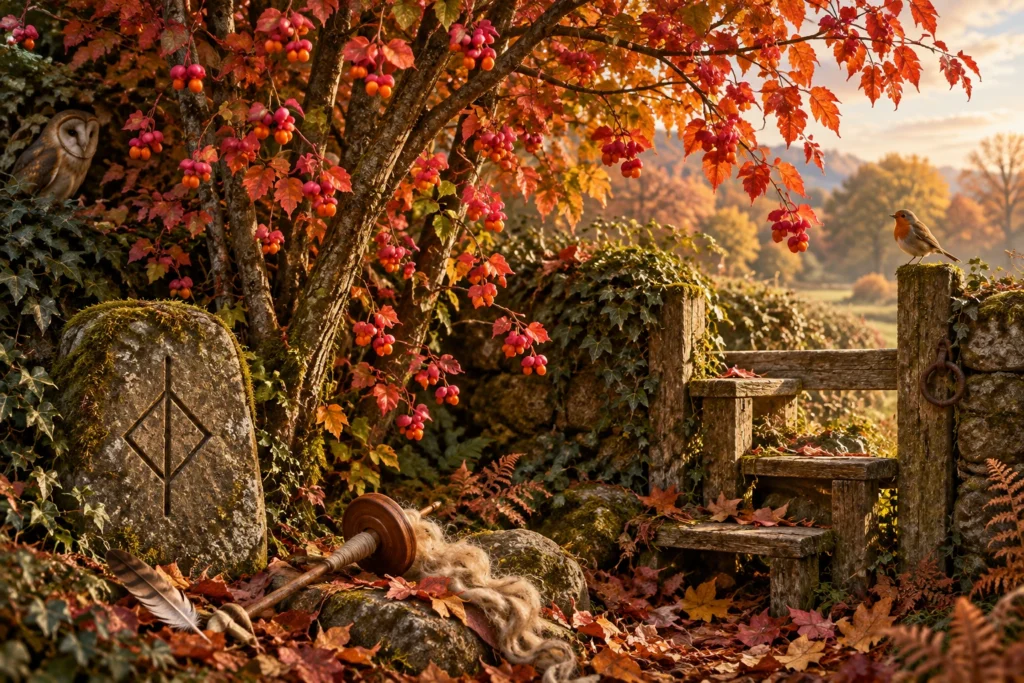
There is a moment towards the end of summer when the Spindle reveals itself. The tree that has spent months sharing the green anonymity of the hedgerow begins to glow with yellow, gold, pink, orange and red. Oir has not suddenly arrived. It has been there all along, participating quietly in the lives around it, waiting for autumn to show us what we had not previously noticed.
Perhaps this is the essence of the Spindle: Earthly ~ Correspondence ~ Harmony ~ Synchronicity. Oir begins with the ordinary. Earth, root, rain and sunlight. A hedgerow shared with insects, birds and animals. Yet from these ordinary relationships something quite extraordinary emerges. One life touches another, one circumstance influences the next, and gradually the landscape becomes a community in which nothing truly exists alone.
The Spindle never appears to force these relationships. The Moth trusts its branches with another generation. Birds accept its fruit and carry its seeds elsewhere. The Hedgewitch and Crone find remedies amongst what the land provides. Swan, Salmon, Badger and Owl share their own stories with the tree, while gods, Druids and ancient mythology discover something familiar beneath its branches. Each remains entirely itself. Oir simply seems remarkably good at making room.
This same character follows the Spindle into human hands. Its pale wood became useful precisely because people recognised what it could become. The spindle gathered individual fibres and allowed them to become thread, and from thread came the possibility of something larger. There is no need to make this a metaphor. Our ancestors had already made it one.
Autumn suits Oir. It is the season when the year begins gathering what it has created. Harvest comes home, fruit ripens, seeds prepare to travel and evenings become places of warmth and company. The western sky takes on the reds and golds appearing within the hedgerow below. Summer has not entirely disappeared and winter has not yet arrived. There is still time. Twilight lingers.
Perhaps that is why the Spindle feels so welcoming. Its energy does not belong to conquest, hierarchy or possession. It belongs to participation. Innocent Intent allows relationships to develop without demanding their outcome. Familiar Knowledge recognises something before explanation arrives. Correspondence notices where relationships exist, Harmony allows them to belong, and occasionally Time, Place and Circumstance come together so beautifully that we call the moment Synchronicity. Whatever happens afterwards becomes Consequence and travels onwards into another life, another season or another story.
To enter the essence of Oir is therefore to enter a remarkably generous little tree. Nothing needs to surrender its identity at the door. The Druid may sit beside the Hedgewitch, Gaia beside Gwennefoedd, folklore beside science, human beside animal, and the known beside everything we have yet to understand.
The Spindle simply invites us into the hedgerow and makes room.
Healing Lore of the Spindle Tree
Bruce Clifton
Long before medicine belonged principally to clinics and pharmacies, healing knowledge lived much closer to home. It belonged to the people who knew their landscape, who gathered what grew around them and learned through experience which plants might comfort, cleanse, stimulate or heal. The Spindle Tree formed part of that old knowledge, although Oir was never a remedy to approach carelessly.
The Hedgewitch and Crone would have understood that contradiction. Spindle could be useful precisely because it was powerful. Bark, root, fruit and seed found their way into traditional remedies, with preparations remembered for digestive complaints, constipation, bronchial conditions and oedema. Beyond the body, powdered or prepared fruits became an old treatment for head lice, while the tree also entered veterinary practice for conditions such as mange.
Such remedies belonged to generations who worked with what was available to them. Knowledge was gathered through observation, repetition and experience, then shared within families and communities. The person preparing the remedy needed to know not only which tree to visit, but which part to gather, how it should be prepared and when its strength became a danger rather than a medicine.
There is something very human within this Healing Lore. The same hedgerow that provided food, wood and shelter also held remedies for those who knew where to look. Someone became unwell, someone else remembered what might help, and knowledge of the Spindle passed quietly from one pair of hands to another.
The remedies that follow preserve something of that relationship. They are not simply recipes from the past, but glimpses of a time when healing began with knowledge of the land and the willingness to share what was known.
Scope & Notice
The information contained herein is for educational and entertainment purposes only. All efforts have been made to present accurate, up-to-date, reliable and complete information; however, no warranties of any kind are stated or implied. Readers should acknowledge that the author is not engaged in the rendering of medical or professional advice. The content herein should not be perceived as a substitute for professional or personal guidance. If in doubt, consult a qualified professional before attempting any techniques outlined.
The appropriate dosage or application of any natural remedy is dependent upon various factors, including age, health status, and individual circumstances. Natural products are not inherently safe, and dosage may be critical. It is best practice to begin with lower amounts and adjust as necessary. Consideration should also be given to timing, as the effectiveness of remedies may vary according to time of day and individual sensitivity.
About the Healing List
This list of ailments is not complete in its entirety; it has been limited to the most popular, with the remedies coming firstly from the tree and then vegetation dependent on the tree. It is worthy of note that there is more than one way to make a cup of tea, and many of the ingredients can be purchased online.
Spindle Tree – Healing Remedies Oracle
We have alphabetised this list of healing qualities of the spindle tree solely for ease of reference; they include but are not limited to:
1) Bronchitis
2) Constipation
3) Digestive Health
4) Nits
5) Oedema
Bronchitis / Spindle Tree
Ingredients:
Spindle bark
Key Properties:
Triterpenoids
Flavonoids
Tannins
Cardenolides
Traditional properties:
Expectorant
Bitter tonic
Purgative
Spindle bark has a recorded place in traditional healing for respiratory and pulmonary complaints, where its expectorant properties were associated with helping to loosen and clear congestion from the chest.
Traditional Actions:
Spindle is traditionally associated with encouraging expectoration and clearing congested airways, helping the body expel accumulated mucus during respiratory illness. Its bitter properties also contributed to its historical reputation as a strengthening tonic during illness.
Preparation:
Traditionally, dried Spindle bark was prepared in water as a decoction, gently heating the bark to extract its active constituents. Historical preparations were used cautiously because of the powerful nature of the plant.
Traditional Use:
Spindle bark was traditionally used for bronchial and respiratory complaints involving chest congestion and difficult expectoration, helping to loosen mucus and encourage its natural clearance from the airways.
Constipation / Spindle Tree
Ingredients:
Spindle bark
Key Properties:
Evonoside
Cardenolides
Triterpenoids
Flavonoids
Tannins
Traditional properties:
Laxative
Purgative
Bitter tonic
Cholagogue
Spindle has a recorded place in traditional herbal medicine for constipation and sluggish bowels, where preparations of the bark were valued particularly for their strong laxative and purgative action.
Traditional Actions:
Spindle is traditionally associated with stimulating bowel activity, encouraging evacuation and supporting sluggish digestion. Its bitter character also gave the bark a traditional association with digestive and biliary stimulation.
Preparation:
Traditionally, dried Spindle bark was prepared in water as a decoction, allowing the constituents of the bark to pass into the liquid. Historical preparations were taken in carefully controlled quantities because of the particularly strong action of the plant.
Traditional Use:
Spindle bark was traditionally used for constipation and sluggish bowels, particularly where a strong purgative action was sought to encourage bowel movement and evacuation.
Digestive Health / Spindle Tree
Ingredients:
Spindle bark
Spindle root bark
Key Properties:
Triterpenoids
Flavonoids
Tannins
Cardenolides
Traditional properties:
Bitter tonic
Digestive stimulant
Cholagogue
Laxative
Spindle has a traditional association with sluggish digestion and digestive discomfort, where preparations of the bark were valued for their bitter qualities and their ability to stimulate digestive and biliary activity.
Traditional Actions:
Spindle is traditionally associated with stimulating digestion, encouraging the flow of bile and supporting sluggish digestive function. Its bitter action was particularly suited to poor digestion, loss of digestive tone and feelings of heaviness after food.
Preparation:
Traditionally, dried Spindle bark or root bark was prepared as a decoction, gently heated in water to extract its bitter constituents. The resulting preparation formed part of historical herbal practice for digestive complaints.
Traditional Use:
Spindle bark was traditionally used for indigestion, sluggish digestion and poor digestive function, encouraging digestive activity and supporting the natural movement of food and waste through the digestive system.
Nits / Spindle Tree
Ingredients:
Spindle fruit
Spindle seeds
Key Properties:
Evonoside
Cardenolides
Triterpenoids
Flavonoids
Traditional properties:
Insecticidal
Antiparasitic
Pediculicidal
Spindle has a particularly strong traditional association with head lice and nits, with the fruit and seeds historically used as an external treatment for infestations. This use contributed to the old folk name “Lousewood.”
Traditional Actions:
Spindle was traditionally used to kill head lice and help clear infestations from the hair and scalp. Preparations made from the fruit or seeds were applied externally, their insecticidal properties making Spindle a recognised folk treatment for lice.
Preparation:
Traditionally, the ripe fruits were baked or dried and ground into a powder. The powdered material was then incorporated into an external preparation and applied to the affected hair and scalp.
Traditional Use:
Spindle preparations were traditionally applied to the hair and scalp for head lice and their nits, helping control the infestation and remove the parasites.
Oedema / Spindle Tree
Ingredients:
Spindle bark
Spindle root bark
Key Properties:
Triterpenoids
Flavonoids
Tannins
Cardenolides
Traditional properties:
Diuretic
Cholagogue
Bitter tonic
Purgative
Spindle has a recorded traditional association with dropsy, now known as oedema, where preparations of the bark were used for the accumulation and retention of excess fluid within the body.
Traditional Actions:
Spindle was traditionally associated with stimulating urination and encouraging the elimination of retained fluid. Its diuretic action was used to support the body’s natural removal of excess water where swelling and fluid retention were present.
Preparation:
Traditionally, dried Spindle bark or root bark was prepared as a decoction, gently heated in water to extract its active constituents. The resulting preparation formed part of historical herbal practice for dropsy and fluid retention.
Traditional Use:
Spindle bark was traditionally used for dropsy, swelling and fluid retention, encouraging increased urinary output and helping the body eliminate accumulated excess fluid.
Celtic Tree Lore of the Spindle Tree
Bruce Clifton
The Spindle Tree belongs comfortably within the Celtic landscape. Euonymus europaeus, known in Irish as Feoras, is native to Ireland and grows amongst hedgerows, scrub and woodland margins, particularly where the ground is rich in limestone. It is not a great forest giant like Oak or Ash. Oir belongs closer to the pathways, field boundaries and edges of woodland, sharing its space with the many smaller lives that make the hedgerow their home.
Its relationship with Ogham comes through the Forfeda, the five additional characters added to the original twenty-letter system. Oir, carrying the sound value OI, became the second of these supplementary characters. Within the medieval arboreal tradition preserved in the Auraicept na n-Éces, Oir is identified with the Spindle Tree, although ivy also appears as an alternative interpretation. This does not tell us that every earlier Ogham practitioner understood Oir in precisely the same way, but it gives the Spindle a genuine place within the surviving medieval Ogham tree tradition.
The living tree would certainly have been familiar within Celtic communities. Archaeological evidence from Ireland has recovered Spindle charcoal from Bronze Age sites, including burnt mounds and structures, and from an Iron Age metalworking site in County Galway. By early medieval Ireland, Spindle was sufficiently valued to appear within the legal classifications of trees as one of the Lower Divisions of the Wood, with penalties imposed for unlawful damage.
Its value was practical as well as cultural. Spindle produces a remarkably hard, pale and finely grained wood, capable of being shaped into small objects requiring strength and precision. It was used for spindles, pegs, skewers and needles, while Irish evidence also connects the wood with harp construction. The common English name remembers perhaps its most familiar purpose: the making of the spindle around which fibre was gathered during spinning.
Yet the tree itself is far more colourful than its pale wood suggests. Through spring and summer it can almost disappear amongst the surrounding greenery. Its flowers are small and greenish, opening during May and June and attracting insects for pollination. Then autumn completely changes its character. The leaves move through rich orange and red, while extraordinary four-lobed fruits ripen into vivid pink before opening to reveal brilliant orange around the dark seeds. Against an Irish hedgerow, the effect can be spectacular.
Those colours give Oir an especially natural place within the Celtic turning year. Green, yellow, gold, orange, pink, crimson and red seem to gather upon one small tree as summer gives itself to autumn. They are colours familiar from hillside and heather, ripening fruit, dying bracken, evening sunlight and the western sky. Our association of Spindle with Autumn and the West is a Spiritual Centre correspondence rather than a claim about an ancient fixed Celtic system, but the living tree makes the relationship remarkably easy to understand.
Autumn is also when the Spindle begins sharing the year’s abundance. Its fruits ripen from September into November, opening as other foods within the landscape are beginning to diminish. Birds and other animals take the fruit and help carry the seeds elsewhere, while its leaves support caterpillars including the Spindle Ermine Moth and Holly Blue Butterfly. Its flowers earlier in the year provide nectar and pollen for insects. Oir may be a modest tree, but an extraordinary amount of life passes through it.
There is another side to that abundance. Spindle is poisonous to humans, despite other creatures being able to make use of its fruits, and historical remedies made careful use of parts of the tree for purposes including head lice and veterinary mange. The same tree could therefore provide wood, colour, shelter, wildlife food and traditional medicine while demanding knowledge and respect from the people using it.
This helps us understand why Oir works so well within the later Ogham tree tradition. The Spindle does not dominate the Celtic landscape. It participates in it. People shaped its wood, animals shared its fruit, insects lived amongst its leaves, healers learned its properties and medieval scholars eventually placed its name beside an Ogham character.
Oir therefore joins Celtic Tree Lore through more than a single medieval association. The Ogham Spindle Tree belongs to a living European species with deep roots in the Irish landscape, archaeological evidence of human use, a place within early Irish tree law and a practical relationship with everyday life. Then autumn arrives, the quiet hedgerow tree changes colour, and all that history suddenly becomes rather difficult to overlook.
Folklore of the Spindle Tree
Bruce Clifton
Folklore seems perfectly at home amongst the branches of the Spindle Tree. Oir is the sort of tree around which stories gather, quietly green for much of the year before autumn dresses the hedgerow in colours that seem borrowed from another world.
Here the old imagination is free to wander. Four enchanted birds carry the kisses of Aongus Óg across the sky, while a Rhyming Druid searches the woodland for the tree that will quieten their song. Aoife moves between woman, Swan and Crane, and somewhere within the old stories feathers become treasures, cloaks become symbols of the Bard, and a simple spindle turns while another thread begins.
The hedgerow has its own enchantments. The Hedgewitch and Crone know paths others overlook, Owl watches from the shadows, Salamander remembers the mysteries of fire, and the white Ermine Moth leaves her children sleeping safely within Oir until spring calls them awake.
Perhaps this is why the Spindle feels so comfortable within folklore. It asks very little of the imagination before the imagination begins giving something back. A bird may once have been a kiss, a feather may carry an old story, and an ordinary hedgerow may contain far more than we noticed when we first walked past.
The folklore of Oir invites us to wander a little more slowly, share in the stories and leave enough room for the possibility that not everything within the hedgerow needs to be explained before it can be enjoyed.
As the year moves towards autumn, the Spindle seems to gather the warmth of the departing Sun and carry it into the hedgerow. Summer yellow deepens into gold, green gives way to orange and crimson, while pink fruits glow amongst the leaves as though Oir has borrowed its colours from the evening sky. These are comforting colours, the colours of hearth and heart, sunset and homecoming. Twilight is approaching, but darkness has not yet arrived. There is still time to gather, to share what has grown and to enjoy the abundance of the year before winter asks the land to rest.
Perhaps this is why the Druid, Hedgewitch and Crone seem so comfortable here. They are the elders because others have learned to depend upon what they know. When somebody is sick, the Hedgewitch remembers the remedy. When the season changes, the Crone knows what should be gathered and what should be left behind. The Druid carries the stories, the Hedgewitch tends the living, and the Crone remembers what experience has taught her.
Around them the grove settles towards evening, remedies hang drying beside the hearth and another generation listens. Their knowledge has different names, but beneath the autumn Spindle they share the same warmth, passing what they know from one life to another before the light finally fades.
Animal Spirit of the Spindle Tree
Bruce Clifton
The Spindle Tree is alive with animal spirit. Some creatures belong amongst its leaves and branches, others arrive through folklore, mythology or the elemental worlds of Earth, Water and Fire. Together they reveal just how much life can gather around a tree growing quietly within the hedgerow.
The Holly Blue Butterfly, Spindle Ermine Moth, Song Thrush and Wren bring romance, transformation, communication and song. Cow and Badger keep us close to the Earth through nourishment, family, responsibility and duty, while Owl and Salmon carry older expressions of wisdom. Salamander and Earth Dragon lead us towards fire, survival and the protective strength of the land.
Then there is Swan, carrying poetry, transformation and the extraordinary Tugen of the Bard. Through these creatures, Oir becomes more than somewhere to feed or shelter. It becomes a meeting place for instinct, mythology and animal spirit, where every creature shares something of its own story with the Spindle Tree.
Spindle Tree – Animal Spirit Oracle
Bruce Clifton
We have alphabetised this list of animal spirit that harmonise with the spindle tree solely for ease of reference; no sense of hierarchy or entitlement is intended or implied:
1) Badger
2)Butterfly
3) Cow
4) Dragon (Earth)
5) Moth
6) Owl
7) Salamander
8) Salmon
9) Song Thrush
10) Swan
11) Wren
Badger / Spindle Tree
Badger understands that freedom carries responsibility and duty. Within the sett, generations live together, sharing shelter, protecting their young and maintaining a home that may endure long after those who first created it have gone. Each enjoys the freedom of belonging because others accept their responsibility towards the whole.
The Spindle knows something of this relationship. Growing amongst the diversity of the hedgerow, Oir does not live alone. Its branches offer shelter, its flowers belong to insects, its leaves become food and its autumn fruits are carried away by birds and animals, spreading seed beyond the tree that produced it. What belongs to one becomes part of the lives of many.
Badger accepts much the same exchange. It will share its sett, stand beside its allies and defend its family when circumstance demands it. Duty is not the loss of freedom, but part of the responsibility that allows freedom to exist.
Perhaps this is where Badger and Spindle find their Harmony. Both belong within communities made stronger by individual contribution, where shelter is shared, life is protected and each generation accepts something from the one before while leaving something for the one that follows.
Butterfly / Spindle Tree
There comes a moment towards the end of summer when the Spindle seems to change almost overnight. An ordinary green hedgerow, passed a hundred times without a second glance, begins to glow. Red creeps through the leaves, the fruits blush pink and orange, and beneath the evening sun the whole tree takes on the colours of sunset.
Those who notice such things know the feeling. The empath, the poet, the romantic, the naturalist and perhaps, long ago, the Druid. The Holly Blue Butterfly seems to notice it too.
The days remain warm, but the evenings are growing longer. Twilight lingers and the fierce heat of summer has softened. The harvest is coming in, food is plentiful and there is time to sit outside as daylight slowly fades. Summer has not quite gone, yet autumn has begun to show herself.
It is a time made for romance.
The Holly Blue takes advantage of these last generous days and can produce a second generation within the same year. While the Spindle ripens its fruit and prepares the seed of another generation, the little blue butterfly does much the same. Perhaps, in its own way, it leads the way.
For people also respond to the seasons. A lingering autumn followed by a softer winter and an early spring promises something important: another autumn of abundance nine months later. Fruit, grain and vegetables are plentiful, the harvest is gathered and the land is better able to provide for a mother and her newborn child.
Nine months after those long evenings beneath the Spindle comes the possibility of a human baby boom, with children arriving at the very time of year when nature’s store cupboard is at its fullest.
The farmer understands the rhythm too. Dairy herds can be managed around autumn calving, bringing the birth of the calf together with a renewed period of milk production. Birth, nourishment and abundance become part of the same seasonal circle.
So perhaps our ancestors did not need a calendar to tell them everything. They watched the hedgerows. They noticed the lengthening sunset, the ripening fruit and the behaviour of the creatures around them. They understood warmth, food, birth and survival.
And somewhere among the red and orange leaves of the Spindle, the Holly Blue Butterfly had already led the way.
Cow / Spindle Tree
The Spindle like the cow understands the transformation as summer begins its surrender to autumn. The hedgerow blushes red, pink and orange, the evenings linger, and romance has had its moment. The Cow carries the consequence of that ancient rhythm within her own body. Like a woman, she carries her young for nine months, turning conception into life through patience, nourishment and time.
The farmer understands the rhythm. Autumn calving brings new life as the harvest fills the stores, while the birth of the calf begins another season of milk. The land feeds the Cow, the Cow feeds her young, and her abundance has fed humanity for thousands of years. Nothing is possessed forever. It passes from one life into another.
Look into the eyes of a Cow and there is a stillness that seems to look back into your soul. Across cultures she has come to embody spiritual femininity, motherhood, fertility and nourishment, the quiet feminine power that creates life and then sustains what she has created.
Perhaps this is why the Cow has become sacred in so many places. There is something extraordinary hidden within something wonderfully ordinary. She takes the grass beneath her feet, the rain that fell upon the field and the warmth of the sun, and somehow turns them into nourishment for another life.
The Spindle performs its own quiet miracle beside her. Summer green becomes autumn crimson, flowers have become fruit and hidden within that fruit is another generation waiting to begin. Birds will come and take what the tree offers, carrying its seed beyond the hedgerow. Nothing announces itself. Nothing asks to be admired. Life simply gives to life.
This is the gentle alchemy shared by Cow and Spindle. Grass becomes milk. Fruit becomes seed. Romance becomes conception. Conception becomes birth. Love becomes nourishment.
Dragon (Earth) / Spindle Tree
The Earth Dragon belongs deep within the living land, amongst root and stone, rich soil and the dark green places where life grows thickly around itself. The Spindle shares that world, forming dense hedgerows and woodland margins where its tangled greenery creates shelter for the creatures living within.
For much of the year Oir wears the deep greens of Gaia, rooted firmly within the Earth and drawing everything it needs from the ground beneath it. Within its protective growth, insects feed, birds find cover and small creatures disappear amongst leaf and branch. Like the Earth Dragon, its strength is not displayed through height or dominance, but through the security of the world it creates around itself.
There is something almost secretive about them both. The Earth Dragon rests beneath the landscape while the Spindle disappears into the summer hedgerow, each becoming part of the Earth they protect. Heather understands a similar relationship, covering the land while sheltering the smaller lives beneath it.
Together they belong to the Earthly, where protection comes through closeness to the land and strength is found within the rich, dark places where life is allowed to gather, shelter and grow.
Moth / Spindle Tree
As evening closes around the Spindle, the brilliant reds and oranges of autumn slowly disappear. The last warmth of sunset leaves the hedgerow and another light begins to fall upon its branches, the softer, silver light of the moon.
From the twilight comes the light of the night attracting the Spindle Ermine Moth, her pure white wings dappled with black dots of the night. She belongs to the Spindle more intimately than most. Her life begins with the romance found in the twilight, she finds her partner here, and here she leaves the beginnings of another generation, entrusting her young to the heart of spindle.
The young hatch before the winter solstice and remain sheltered by the branches of spindle, sheltered through the darkest months until spring calls them into life. Then together they spin silk, drawing great white veils around the Spindle, until branches can disappear beneath their covering. It’s almost a thank you to the spindle for keeping them safe. To the naturalist it is a nursery. To the druid a remedy. To the romantic eye it might be something more.
Perhaps this is why white has so often belonged to the sacred, and why moonlight belongs so naturally to the feminine. Beneath both, the Spindle stands quietly wrapped in silk, carrying another generation towards spring.
The mother leaves her children with the Spindle. The Spindle carries them through the darkness. And when spring returns, they dress their guardian in white.
Owl / Spindle Tree
Owl belongs to the quiet places, watching from shadow and recognising what others may pass without noticing. The Spindle shares something of this nature, spending much of the year hidden amongst the greenery of the hedgerow before autumn reveals the tree that had been there all along.
Within Oir there are many such hidden correspondences. Bicne searched until knowledge led him to the right tree, while the Crone and Hedgewitch recognise what experience has taught them to see. Owl brings the same patient wisdom, knowing that understanding does not always arrive when we first go looking for it.
Sometimes the answer is already present, waiting for the right Time, Place and Circumstance to make itself known. Owl watches quietly until that moment arrives, while Spindle reminds us how easily something remarkable can remain hidden in plain sight.
Salamander / Spindle Tree
For much of the year the Spindle hides amongst the hedgerow, its dense green leaves allowing Oir to disappear into the landscape. Salamander understands the value of remaining unseen, concealed amongst earth, leaf and shadow until circumstance calls it into view. Camouflage is not weakness, but an ancient instinct for survival.
Then autumn changes everything. The quiet green Spindle begins to burn with crimson, scarlet, orange and red, transforming the hidden tree into something resembling fire amongst the woodland edge. What once survived by blending into its surroundings now survives by becoming impossible to ignore.
Salamander carries an equally ancient relationship with fire. Through folklore and alchemy it became the creature believed capable of living amongst the flames, passing through fire without being consumed by it. Beside the autumn Spindle, that old image seems almost to step from mythology into the hedgerow.
Both understand the wisdom of waiting to be seen. There is a time for concealment and a time to reveal yourself, a time to shelter within the green and a time to stand amongst the colours of fire. Survival sometimes asks us to disappear into our surroundings, while circumstance may eventually ask us to blaze within them.
Salmon / Spindle Tree
Salmon comes to the Spindle carrying the wisdom of Water, completing an older harmony in which Owl brought wisdom from the Sky and Badger from the Land. Yet Salmon brings more than knowledge. She carries the experience of Maiden, Mother and Crone, leaving the rivers for the open sea before an ancient instinct eventually calls her home.
Her return belongs to Autumn, when Oir is also coming into its fullness. The Spindle ripens amongst the hedgerow while Salmon journeys inland through river and stream, carrying life towards another generation. One remains rooted to the Earth while the other travels between river and sea, yet both participate in the same old rhythm of return, fertility and renewal.
Salmon does not need to know every turn of the river to find her way home. Something older than memory guides her through changing water towards the place where another generation can begin. Within the Spindle, that ancestral knowing finds familiar company amongst Gaia, the Crone, the Moirai and the many expressions of feminine life already gathered around Oir.
Song Thrush / Spindle Tree
Before the Spindle was a tree within an Oracle, its hard, smooth wood was shaped into the spindle that gave the tree its name. Upon it the thread was gathered, drawn together and wound into something that could be carried, woven and sewn.
Perhaps the Song Thrush does much the same with its song.
As summer surrenders to autumn, the Spindle begins to blaze within the hedgerow. Red, pink and orange appear amongst the green, sunset seems to settle upon its branches and the Song Thrush finds a place amongst its fruit. There is no hiding the Spindle now. Like the Thrush at dawn, it has become a herald, announcing that something is changing and something new is coming.
And the Thrush sings.
It sings because it can. It sings for the love of life. It sings after rain and before the storm, at the ending of one season and the beginning of another. Its song gathers the moments together, just as thread once gathered around the spindle.
Perhaps that is its gift to this tree.
The Holly Blue brought romance. The Cow brought motherhood and nourishment. The Spindle Ermine brought moonlight and silk. Now the Song Thrush takes up that silken thread and sews their stories together with song.
Listen to it from the autumn hedgerow and count your blessings before your woes. If the woes outnumber the blessings, count the blessings again. Look at the Spindle ablaze beside you. Fruit hangs amongst leaves of crimson and gold, the harvest is gathering and another year has given everything it had to give.
There is abundance here if we remember how to see it.
The Song Thrush does not mourn the passing summer. It sings into the change, because tomorrow there will be another dawn, another season, another reason to sing.
The Spindle gathers the thread. The Song Thrush gives it a voice. And somewhere between them, the song of life is sewn together.
Swan / Spindle Tree
Swan enters the world of the Spindle through poetry, transformation and the Bard. Its white feathers belonged to the magnificent Tugen, the ceremonial cloak through which the accomplished poet could be recognised, while the Spindle gave its pale, fine-grained wood to the making of the tool that gathered loose fibres and turned them into thread. Feather, fibre and craftsmanship meet within garments that carried meaning far beyond the material from which they were made.
Yet Swan carries another kind of poetry. Within Celtic tradition it moves easily between worlds and forms, appearing within tales of transformation where human and bird become expressions of the same life. Its haunting song belongs to that mystery, carrying beauty, memory and emotion through the air much as the Bard carried knowledge through poetry.
Oir gathers these threads naturally. Aoife becomes Swan, Swan gives feather, the Tugen clothes the Bard, and the Bard gives voice to memory. Around them the Spindle quietly holds its place, connected not simply by what could be made from its wood, but by the transformation of ordinary things into something capable of carrying identity, knowledge and beauty.
Swan and Spindle therefore share an old understanding of Correspondence. Fibre becomes thread, feather becomes Tugen, experience becomes poetry and poetry becomes memory. What begins in nature is gathered by human hands and imagination until it carries a meaning greater than itself.
Wren / Spindle Tree
The Wren is easily overlooked. Small, brown and happiest amongst the tangled places of the hedgerow, it can disappear between leaf and branch almost as quickly as it arrived. Yet when the male Wren sings, there is nothing small about him. From somewhere unseen comes a voice that could bring a new harmony to the “Ave Maria.”
“In the old Irish Dindshenchas tale of Érerus, Aongus Óg, the youthful one of love, desire and poetry, fashioned four of his kisses into four birds.” They came singing from the east, from the direction of the bright sunrise, and travelled westwards until the magic of the Spindle finally brought their song to rest.
Perhaps four kisses are enough for a year. One for spring, when life awakens. One for summer, when love has warmth enough to linger. One for autumn, when the Spindle reveals its glorious colour. And one for winter, when what has been loved must sometimes be allowed to disappear. East to west. Sunrise to sunset. Spring towards autumn. Coming and going, appearing and disappearing, four kisses carried upon the wings of four little birds.
You may never see the Wren that sings from within the Spindle. You needn’t. Some of the most beautiful things in life announce themselves without ever asking to be seen. A song from the hedgerow. A kiss remembered. A sunset lingering a little longer than expected.
Four kisses. Four birds. Four seasons. One little Wren carrying the song of love through them all.
Totems and Entities of the Spindle Tree
Bruce Clifton
The Spindle Tree gathers some wonderful characters around its branches. Here we meet Bicne, the Rhyming Druid, whose knowledge and poetry lead him into one of Oir’s oldest surviving stories, alongside the Hedgewitch and Crone, whose understanding belongs closer to the land, healing and the wisdom of experience.
Then comes Aoife, whose name wanders through several Irish legends as warrior, lover, mother, enchantress and enchanted. Her stories carry us into transformation, Swan and Crane, and towards some of the stranger treasures of Celtic mythology.
Each approaches the Spindle differently. Some arrive through surviving folklore, others through spiritual tradition and interpretation, but together they bring human character to Oir, allowing us to explore the Druids, wise women, warriors and magical beings whose stories have gathered around the Spindle Tree.
Spindle Tree – Totems and Entities Oracle
Bruce Clifton
We have alphabetised this list of totems and entities that harmonise with the Spindle tree solely for ease of reference; no sense of hierarchy or entitlement is intended or implied:
1) Aoife
2) Bicne
3) Hedgewitch
4) Moirai
Aoife / Spindle Tree
There are names that belong to a single story, and there are names that seem to wander through legend.
Aoife is one of those names.
She walks through the old Irish stories as warrior and ruler, lover and mother, enchantress and enchanted. Sometimes she stands upon the shores of Alba, sometimes beside the lakes of Ireland, and sometimes her story carries her into the realm of Manannán mac Lir, where land gives way to sea and the tide itself keeps secrets.
Follow her for long enough and feathers begin to appear.
Four children become white swans, carrying their human voices beneath their feathers as they journey across the waters of Ireland. Elsewhere another Aoife becomes the crane, living for two hundred years upon the lands of Manannán until, at the ending of her life, something new is created from what remains.
The Crane Bag becomes a vessel of treasures, mystery and power. Its secrets belong to the rhythm of the sea, revealed with the fullness of the tide and hidden again as the waters withdraw.
Perhaps transformation does not always mean that something has been lost.
Sometimes it has simply changed the way in which it wishes to be found.
And somewhere amongst these old stories stands another ancient treasure, the Tugen, the magnificent feathered cloak of the Bard. Tradition dresses it in the plumage of many birds, with thousands upon thousands of white swan feathers gathered into something worthy of poetry, learning and eloquence.
Feather becomes cloak.
But before there can be a cloak, there must be the hand of the maker. Cloth must be fashioned, thread must be drawn, and upon the spindle those wandering fibres are gathered together.
Perhaps this is where Oir has been waiting for us.
The Spindle Tree gives little away for much of the year. It stands quietly amongst the other trees of the hedgerow until autumn comes and suddenly there is colour everywhere. Crimson leaves, pink fruit and flashes of orange appear where something ordinary seemed to stand before.
It too knows something about revelation.
Its pale, hard wood became the spindle in the hand of the spinner, turning loose fibres into thread. The thread passed onwards to the weaver and the tailor, and what began as something almost weightless could eventually become a garment fit for a Bard.
And so the spindle turns.
Aoife becomes Swan.
Aoife becomes Crane.
Crane becomes a vessel of treasures.
Swan feather becomes the cloak of poetry.
Fibre becomes thread, and thread becomes cloth.
Nothing remains quite what it was, yet something of the beginning travels onwards within everything that follows.
Perhaps that is the quiet magic of Aoife.
Her stories do not ask us to choose which woman she truly was. They simply leave us with an ancient name travelling through warriors and mothers, birds and feathers, lakes and seas, magic and transformation.
And Oir asks even less.
The Spindle simply turns.
Give it the loose threads of a story and it will never tell you what they mean. It will only draw them together, and leave you to discover what they become.
Bicne / Spindle Tree
There is something wonderfully appropriate about a Rhyming Druid finding his answer within the Spindle. Bicne had spent a lifetime learning how one thing might speak to another: words to memory, poetry to history, nature to circumstance and intention to outcome. The Spindle seems to understand much the same language.
Oir is an Earthly tree, rooted firmly within the physical world, yet surrounded by curious correspondences. Its wood became the spindle upon which separate fibres were gathered into thread. Its autumn fruit feeds the birds that carry its seed onwards. The Moth leaves its silk amongst its branches, while Swan and Crane bring feathers, transformation and old stories into its mythology. Individually they are simply parts of nature and legend. Bring them together and another pattern begins to appear.
As a Bard he knew the power of words and the importance of the thread that carries knowledge from one generation to another. As an Ovate he understood the less obvious Correspondences within nature, those relationships that become apparent only when we take the time to notice them. As a Druid he brought the two together, seeking Harmony between what could be seen and what could only be understood.
Its season is Autumn, its direction the West, the place towards which the mysterious birds were travelling. Autumn itself is a gathering, when the work of the year comes together and what has grown is harvested, shared and returned to the Earth. It is neither simply an ending nor a beginning, but the moment when one becomes the other.
Synchronicity is Time, Place and Circumstance, but correspondence allows us to recognise it and harmony allows us to work with it. Perhaps that is the real magic within the old story. Not that Bicne commanded the Spindle, but that after a lifetime of learning he recognised the moment when Druid and tree belonged together.
The spinner turns the spindle and separate fibres become a single thread. The Druid gathers knowledge, nature and intention until separate circumstances begin to correspond.
Oir gathers the threads. Bicne understands why they belong together.
Hedgewitch / Spindle Tree
The Hedgewitch belongs to the old knowledge of the land. She may never have carried the title of Druid, yet much of what the Druid understood would have been familiar to her. Herbs and roots, bark and flower, season and circumstance, healing and intuition were not separate subjects to be studied, but parts of the same living world.
The Druid carried knowledge through learning, poetry and tradition. The Hedgewitch carried hers through observation, repetition and experience. Both understand that knowledge becomes valuable only when it can be applied. Time, place and circumstance matters because the correspondence becomes successful.
The Hedgewitch and Crone would know the Spindle long before autumn revealed it. For most of the year Oir lives quietly amongst the diversity of the hedgerow, precisely where she makes her home. They would know its pale wood, its bark and leaves, its old remedies and the places where it chooses to grow.
Come Autumn and the spindle tree announces itself with crimsons, pinks and oranges, fruit ripening amongst branches as the year turns towards the West. For the Hedgewitch this is not simply beauty. It is correspondence: tree, season, harvest and circumstance arriving together.
Spindle wood once gathered loose fibres into thread. The Hedgewitch gathers in much the same way, bringing together plants, experience, intuition and intention until knowledge becomes something that can be used. Neither needs to force the separate parts into belonging together. Harmony already exists within nature; their skill is recognising it.
Hedgewitch, Crone or Druid all three belong to the Earthly world. All three recognise Correspondence. All three understand that innocent intent brings Harmony. And all understand those rare moments of Synchronicity, when Time, Place and Circumstance offer exactly what is needed.
Clotho / Spindle Tree
Long before Oir carried the name of the Spindle Tree, the ancient Greeks placed a spindle into the hand of Clotho, one of the three Moirai. Some mysteries were too great to describe in ordinary words, and the beginning of life was one of them. So they imagined a thread, and a woman whose gentle turning brought that thread into being.
Clotho stands at the beginning, where possibility becomes life and the first breath disturbs the stillness. Beside her are Lachesis and Atropos, three women sharing one eternal mystery, receiving each life as it enters the world, accompanying it through its journey and remaining until its thread is complete.
Across the Celtic world another three women seem to recognise their reflection: Maiden, Mother and Crone, the feminine journey from awakening through fulfilment into wisdom. They are not the Moirai, nor need they be. Their harmony lies within the rhythm they share, where beginning, becoming and completion are never separated from the greater movement of life.
Within that rhythm grows Oir. Rooted within the Earthly world, the Spindle belongs to the turning year, quietly carrying spring and summer towards the richness of autumn before surrendering once more to winter. Nothing within its journey stands alone. Each season carries something of the one before and prepares the way for whatever follows.
Perhaps Clotho would recognise such a tree. Her spindle turns without revealing where the thread will travel, just as Oir accepts each season without knowing what circumstance will bring. There is freedom within the turning, where Correspondence becomes Harmony, and those beautiful moments of Synchronicity allow one life to touch another and change what follows.
The Greeks called them the Moirai. The Celts knew the Maiden, Mother and Crone. Oir simply grows between Earth and sky, while somewhere within the old imagination Clotho continues her gentle turning and another life takes its first breath.
Gods and Deities of the Spindle Tree
Bruce Clifton
The mythology surrounding the Spindle Tree reaches far beyond the Celtic landscape. Oir finds itself amongst ancient Greek creation stories, the mysteries of life and fate, the living Earth and the gods of Irish legend, before travelling onwards into the developing spiritual traditions of The Spiritual Centre.
Here we meet Euonyme, the elusive mother remembered through an extraordinary divine family, and Gaia, the ancient Earth Mother. Clotho and the Moirai bring the mystery of life into being, while Aongus Óg brings love, poetry and four magical kisses transformed into birds. At the western horizon waits Gwennefoedd, belonging to a much younger tradition, yet carrying forward that ancient fascination with the turning year, love and the heavens.
These are very different deities with very different stories. Together they give the Spindle a mythology that moves from the ancient Mediterranean to the Celtic world and into the spirituality of today, inviting us to explore how Oir found its place amongst gods, goddesses and the old stories that still surround them.
Spindle Tree – Gods and Deities Oracle
Bruce Clifton
We have alphabetised this list of gods and deities that harmonise with the Spindle tree solely for ease of reference; no sense of hierarchy or entitlement is intended or implied:
1) Euonyme
2) Gaia
3) Gwennefoedd
Euonyme / Spindle Tree
There is something beautiful about Euonyme finding her way to Oir. (Spindle Tree) Her mythology survives through relationships rather than great adventures, while the Spindle grows quietly within the hedgerow until circumstance reveals the connections gathered around them both.
In one ancient Greek tradition Euonyme is mother to Aphrodite, the Moirai and the Erinyes. (The Furies) Love and attraction, the unfolding thread of life, and the consequences that follow our actions all emerge from the same maternal presence. Elsewhere the Erinyes are born from Gaia, while another old tradition allows the identities of Euonyme and Gaia to touch. Mother, Earth and the mysteries of life begin to correspond. Euonyme belongs naturally here amongst these contradictions, Oir confirms and quietly gathers their correspondence within a single living tree.
Then amongst the hedgerows grows Euonymus europaeus, the Spindle Tree, carrying Euonyme’s name. Oir is equally filled with curious relationships: beautiful yet poisonous fruit, creatures sheltered and nourished within its branches, and autumn colours drawn from the greens, yellows, oranges and reds of the Earth itself.
Euonyme and Spindle need not explain one another. Their stories have travelled far enough to meet, and within that meeting another of Oir’s secrets is revealed.
Gaia / Spindle Tree
There are moments when Gaia seems to reveal herself through colour, and few trees capture that expression quite like the Spindle. Oir spends much of the year quietly amongst the hedgerow, clothed in the familiar greens of the living Earth, before autumn draws something extraordinary from within.
Green moves towards yellow, yellow warms into orange, and amongst them appear crimson leaves and remarkable fruits of pink and fiery orange. These are not colours placed upon the landscape, but colours rising from within it, drawn through root and rain, sunlight and season until the Earth seems almost to illuminate herself.
Gaia has already walked amongst the Rowan, Ash, Oak and Apple, revealing different expressions of the living world through each. With Spindle she arrives at Autumn, when abundance is no longer hidden and the year begins to show everything it has gathered. Fruit ripens, seed prepares for another journey and creatures move through the hedgerow taking what the season provides.
Oir is an Earthly tree in every sense. It belongs amongst soil, root, creature and changing season, yet in autumn it becomes something more: a little celebration of the Earth from which it grew.
Perhaps this is where Gaia and Spindle correspond most beautifully. The Earth does not need to speak when she can change the colour of the leaves.
Gwennefoedd / Spindle Tree
Gwennefoedd belongs to the western horizon, where daylight softens into evening and the sky gathers the colours of sunset. In autumn, Oir seems to answer her from the hedgerow, its summer green surrendering to yellow, orange, crimson and red, while brilliant fruits glow amongst the changing leaves.
There is a natural correspondence between them. The Spindle reaches its greatest beauty as the year turns towards the West, while Gwennefoedd waits where light and darkness meet. Her flame-coloured hair finds its reflection amongst the leaves, and the colours of Earth rise to meet the colours of the evening sky.
Neither autumn nor sunset needs to speak of endings. Both are moments of transformation, when what has been becomes something different and familiar colours briefly become extraordinary. Oir carries fruit and seed within that change, while Gwennefoedd carries the gentle promise that darkness is simply another movement within the turning cycle.
As the autumn sun descends into the West, Gaia colours the Earth below while Gwennefoedd colours the heavens above, and for a little while the Spindle seems to belong to them both.
Secret Harmonies of the Spindle Tree
Bruce Clifton
The deeper we wander into the (Oir) Spindle, the more relationships seem to appear, not because we have gone looking for them, but because one quietly leads towards another.
Within its Secret Harmonies, Familiar Knowledge recognises what somehow feels already known, while Correspondence allows seemingly separate things to discover their relationship. Innocent Intent leaves those relationships free to develop without control, and from that freedom Harmony can emerge. Occasionally everything arrives together within Synchronicity because of the right Time, Place and Circumstance. What follows becomes Consequence, understanding the moment and carrying it onwards into circumstances yet unknown.
This is where the Spindle reveals something of its deeper nature. Oir does not command the relationships gathered around it. It simply allows them to happen. One connection touches another, circumstances cooperate, and correspondence, a something greater begins to emerge from seemingly unrelated parts.
The Secret Harmonies of the Spindle invite us to notice those moments within our own lives. Not everything needs to be understood or explained. Sometimes it is enough to recognise when things seem to belong together and allow the relationship to find its own way forward.
Spindle Tree – Secret Harmonies Oracle
Bruce Clifton
We have alphabetised this list of secret harmonies of the Spindle tree solely for ease of reference; no sense of hierarchy or entitlement is intended or implied:
1) Consequence
2) Correspondence
3) Familiar Knowledge
4) Harmony
5) Intent (Innocent)
6) Synchronicity
Consequence / Spindle Tree
Nothing within the Spindle exists in isolation. A flower invites the insect, fruit attracts the bird, the bird carries the seed and somewhere beyond the shelter of the parent tree another Oir may begin. One circumstance becomes part of another, often carrying its influence far beyond the moment in which it began.
Bicne discovered the same relationship. For three hundred and fifty nights the mysterious birds continued their song until Druid, Spindle and circumstance finally came together. His words carried intention, the tree answered, and what had endured for almost a year was changed. Synchronicity created the moment, but Consequence determined what followed.
Through Euonyme, the Erinyes bring another understanding. Consequence need not be punishment, but neither can it always be avoided. Words spoken, choices made and intentions acted upon enter the lives of others, becoming circumstances from which further circumstances grow.
Oir reminds us that consequence can also be wonderfully gentle. A seed carried, a creature sheltered, a relationship begun or knowledge shared may continue long after the original moment has passed. Innocent Intent cannot determine everything that follows, but it can influence what we place into the world.
Within the Spindle, Consequence is simply the continuation of relationship. What begins with one life may become part of another, and what happens today quietly helps to shape the circumstances of tomorrow.
Correspondence / Spindle Tree
The Spindle seems to gather Correspondence naturally. For much of the year Oir remains quietly within the hedgerow, yet look more closely and relationships begin to appear. Its flowers invite insects, its leaves feed the Moth, its branches offer shelter and its autumn fruit becomes food before birds carry its seeds onwards. Each life remains separate, yet each becomes part of another.
Its human relationships follow much the same pattern. Spindle wood gathered loose fibres into thread, while thread became clothing, craft and identity. Bicne brought poetry, knowledge and intention to the tree. Clotho brought the mystery of life through the turning spindle. Swan brought feather and the Tugen, while the Bard carried memory onwards through poetry and song.
Even the season corresponds. Oir reaches its brilliance in Autumn, as the year turns towards the West. Gaia colours the Earth in green, yellow, orange and crimson while Gwennefoedd carries those colours towards the western horizon. Earth and sky remain separate, yet for a moment they appear to answer one another.
This is the Correspondence of the Spindle. Nothing needs to become something else in order to belong. Tree, creature, season, mythology and human experience simply begin to recognise one another, revealing relationships that were always there, waiting to be noticed.
Familiar Knowledge / Spindle Tree
Sometimes we discover something new and wonder why it feels so familiar. There is no memory we can place, no lesson we remember learning, yet something within us quietly recognises it.
Oir carries this feeling beautifully. The Spindle does not ask us to understand every relationship gathered around it. Sometimes it is enough to notice that something feels right, that one thought seems to belong beside another, or that an unfamiliar story awakens something strangely familiar within us.
Perhaps Familiar Knowledge begins in those moments. Not with remembering where we learned something, but with the gentle realisation that somewhere, somehow, we already know.
Harmony / Spindle Tree
Harmony comes easily to Oir because the Spindle does not ask everything around it to become the same. Each relationship keeps its own nature, yet something between them allows one to sit comfortably beside another.
This is the harmony Bicne discovered when knowledge, intention and circumstance finally found the tree that could answer them. It is present again wherever seemingly unrelated lives, stories and traditions meet within Oir and find that none needs to surrender its identity for the relationship to feel complete.
Perhaps this is why Correspondence sits so naturally beside Harmony within the Spindle. Correspondence allows the relationship to be recognised; Harmony is the moment when that relationship settles into place.
Nothing has been forced together. Nothing has been made to agree. The separate parts simply cease to feel separate.
Within Oir, Harmony is the quiet sense that everything present has found where it belongs.
Intent (Innocent) / Spindle Tree
There is something wonderfully innocent about Oir. The Spindle does not set out to create the relationships gathered around it. It simply grows, flowers, fruits and offers what it has to the lives that find their way into its branches.
Yet from that simple intention comes something remarkable. Creatures are fed and sheltered, seeds travel, relationships form and circumstances begin to correspond. Nothing is demanded and nothing is controlled. Innocent Intent gives Correspondence the freedom to cooperate, allowing Harmony to emerge naturally and Synchronicity to arrive when Time, Place and Circumstance are ready.
Perhaps this is the quiet magic of the Spindle. It does not chase the extraordinary. It simply participates with an open hand, and somehow the extraordinary gathers around it.
Synchronicity / Spindle Tree
Synchronicity gathers around Oir when Time, Place and Circumstance unexpectedly come together. As autumn arrives, the Spindle ripens just as birds and animals seek its abundance, carrying its seeds onwards while the changing season prepares the hedgerow for what comes next.
None of these lives arranged the meeting, yet each arrives within the same moment and something becomes possible because they did. Innocent Intent encourages Correspondence, Correspondence finds Harmony, and somewhere amongst them Synchronicity simply happens.
The Spindle reminds us that some of life’s most meaningful encounters are not planned. We simply find ourselves in the right place, at the right time, amongst exactly the circumstances that allow something new to begin.