
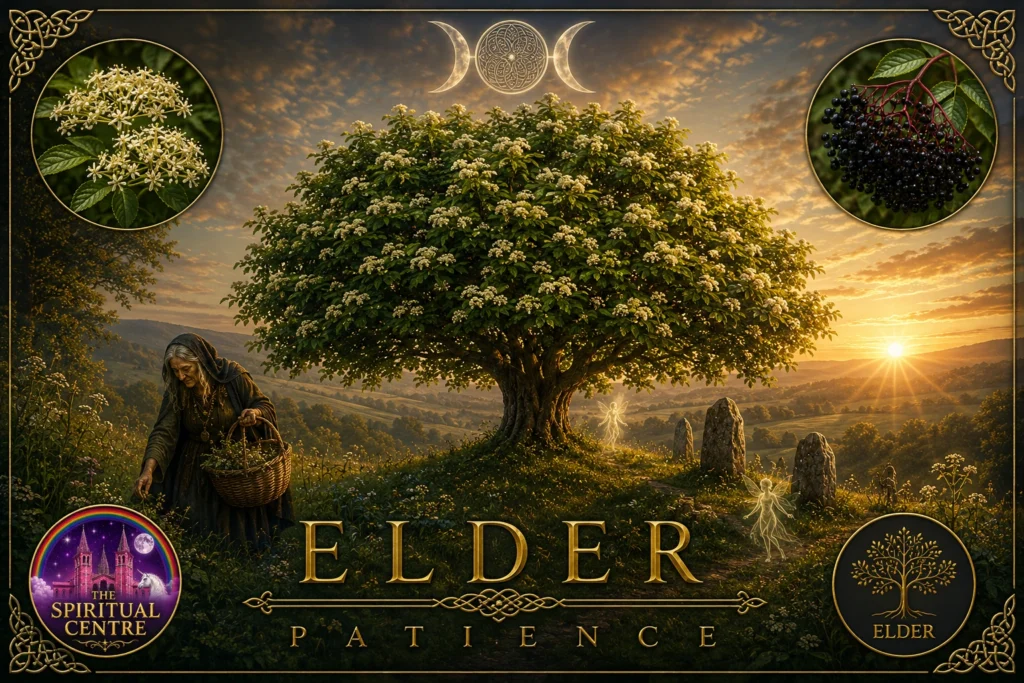
Secrets of the Elder Tree
The Elder Tree (Sambucus nigra)
Volume 15 of 31
Bruce Clifton
Elder Tree – (Ruis)
The Elder tree (Sambucus nigra) is a tree of wisdom, healing and ancient folklore, long associated with protection, the turning of the seasons and the mysteries that surround life, death and renewal. Familiar in hedgerows and beside old homes, Elder has provided flowers, berries and traditional remedies while gathering a remarkable collection of stories, customs and spiritual beliefs around her.
Within Celtic and Ogham tree lore, Elder is associated with Ruis, maturity and the closing of one cycle before another begins. Her connections with Samhain, the thirteenth moon, the Crone and the ancestral world place her at one of the great thresholds of the natural year, while her healing lore reveals a gentler relationship built upon patience, experience and generations of country wisdom.
This Elder Tree Guide explores her meaning and symbolism, Ogham and Celtic tree lore, folklore, healing traditions, animal spirits, deities and spiritual correspondences, bringing together the many relationships that have made Elder one of the most intriguing trees within British and Celtic tradition.
Elder Tree – Ogham Tree Profile
Bruce Clifton
Name: Elder Tree
Ogham: Ruis >>> Roo ish ~ Roo ich ~ Ru eesh
Letter: R
Lunar: 13th Moon (Samhain)
Season: Autumn
Element: Air/Wind
Direction: West
Moon Phase: New Moon ~ Full Moon
Moon Name: Dark ~ Snow ~ Tree Moon
Influence: Feminine
Title: Shrub
Age: 1 Generation
Aura: Green ~ Pink
Healing: Arthritis ~ Colds ~ Fevers ~ Hay Fever ~ Kidney ~ Water Retention
Animal Spirit: Badger ~ Hare ~ Turtle/Tortoise ~ White Fawn
Totems – Entities: Arianrhod ~ Crone ~ Druantia ~ Moirai
Gods – Deities: Bran ~ Branwen ~ Cailleach ~ Gwennefoedd
Secret Harmony: Akashic Records ~ Death ~ Elysium
Festival: (coming soon)
Cosmos: (coming soon)
Key Words: Patience ~ Maturity ~ Grandmotherly
Essence of the Elder Tree
Bruce Clifton
There comes a point when knowledge becomes wisdom. Facts have been tested by experience, mistakes have taught their lessons, and the urgency to have every answer has softened into the patience to let understanding arrive in its own time. This is the essence of the Elder tree.
Elder carries the wisdom of maturity. She has travelled through flowering and fruiting, abundance and loss, and understands each as part of the same continuing cycle. Her strength comes from experience rather than resistance. She knows when to hold on, when to let go, when to offer guidance and when to allow another to discover the answer for themselves.
There is something distinctly grandmotherly about this wisdom. It is warm without being sentimental, protective without preventing experience, and patient enough to listen before speaking. Elder has stories to tell, remedies gathered over generations and memories stretching further back than our own, yet her greatest lesson may be the quiet confidence that comes from having seen life change many times before.
This is why Elder belongs so naturally at the turning of the year. As Ruis, she stands with the thirteenth moon and Samhain, where one cycle reaches maturity and another begins to gather beneath the surface. Summer has given, autumn has gathered, and winter begins its patient preparation for spring. Elder understands that rhythm because she embodies it.
Her associations with the Crone, death, the ancestors and the unseen world deepen the same story. Death within Elder lore is part of nature’s movement: the fallen leaf feeds the soil, the berry carries the seed, and what has completed its purpose becomes nourishment for what follows. The Akashic Records echo her relationship with accumulated memory, while Elysium carries the possibility that completion may lead somewhere beyond what can presently be seen.
Perhaps this is why Elder has gathered such contradictory folklore around herself. People have approached her for healing and protection while treating her with caution and respect. She gives flowers and berries freely, shelters wildlife within her branches and has lived beside human homes for generations, yet tradition still advises us to approach her politely. Elder may be generous, but she is never quite ordinary.
To spend time with Elder is to encounter a different measure of life. She has little interest in haste. Growth has its season, fruit ripens when it is ready, leaves fall when their work is finished, and winter prepares quietly for everything that will return.
Patience. Maturity. Grandmotherly.
Three simple words for a tree whose wisdom has been gathered across a lifetime. Elder reminds us that growing older can mean growing deeper: carrying what experience has taught us, releasing what has completed its purpose, and trusting that we already possess much of the wisdom needed for whatever comes next.
Healing Lore of the Elder Tree
Bruce Clifton
The Elder is the tree of wisdom, renewal and the quiet understanding that comes only with time. Unlike the youthful energy of the Birch or the protective strength of the Blackthorn, the Elder heals through patience, reflection and experience. She reminds us that many ailments are not simply conditions of the body but burdens carried by the mind and spirit, and that true healing often begins long before the first remedy is prepared.
The old Druids understood that every tree possessed its own character, and that this character formed part of the healing itself. They did not gather simply flowers, berries or bark. They gathered from a living tree whose roots, companions, surroundings and seasons all influenced its gifts. An Elder growing beside a quiet stream would not be regarded in quite the same way as one standing alone upon an exposed hillside. Every grove, every meadow and every woodland edge carried its own wisdom, and the healer learned to recognise these subtle differences.
The Elder teaches us to slow down. To sit beneath her branches. To observe rather than hurry. It is in these quieter moments that tension begins to ease, breathing becomes gentler and the body is given the opportunity to restore its own natural rhythm. Her blossoms, berries and bark have long held an honoured place within traditional remedies, yet the greatest gift of the Elder may simply be the calm she brings to those willing to spend time in her company.
The wise healer understands that no tree exists in isolation. Mosses, lichens, fungi, birds, insects and the wildflowers growing beneath the Elder all become part of its living community. Together they form the grove, each contributing something to the greater harmony of the landscape. The Druid did not separate these relationships but understood them as parts of one complete living system, where the tree and its companions worked together to support both the land and the people who lived upon it.
The healing traditions recorded here reflect that older understanding. They are not intended to replace modern medicine but to preserve the country wisdom passed quietly from one generation to the next. They remind us that healing is found not only within the remedy itself, but within our relationship with the tree, the land and the seasons that shape our lives.
Scope & Notice
The information contained herein is for educational and entertainment purposes only. All efforts have been made to present accurate, up-to-date, reliable and complete information; however, no warranties of any kind are stated or implied. As readers, please acknowledge the author is not engaging in the rendering of medical or professional advice. The content herein should not be perceived as a substitute for professional or personal guidance. If in doubt, consult a professional before attempting any techniques outlined herein.
The appropriate dosage is contingent upon various factors, including the user’s age, health status, and additional conditions. It is important to remember that natural products are not necessarily safe, and dosages may be critical. It is always best practice to start with a lower dose and increase as necessary. Another important element is the time of day when the remedies are taken.
About the Healing List
This list of ailments is not complete in its entirety; it has been limited to the most popular, with the remedies coming firstly from the tree and then vegetation dependent upon the tree. Every tree exists within its own living community, where mosses, lichens, fungi, insects, birds and companion plants contribute to the greater harmony of the grove. It is worthy of note that there is more than one way to prepare many traditional remedies, and many of the ingredients may also be purchased online.
Elder Tree Healing Remedies Oracle
We have alphabetised this list of healing qualities of the elder tree solely for ease of reference; they include but are not limited to:
1) Arthritis
2) Colds
3) Fevers
4) Hay Fever
5) Kidney
6) Water Retention
Arthritis / Elder Tree
Ingredients:
Elderflower
Elder Berry
Elder Leaf (external traditional use only)
Elder Oil
Key Properties:
Flavonoids – Anthocyanins – Polyphenols – Antioxidant compounds – Natural anti-inflammatory constituents
Traditional Actions:
Easing joint stiffness, supporting circulation, reducing inflammatory discomfort, encouraging mobility, supporting natural recovery
Preparation:
Elderflowers may be infused in hot water to produce a fragrant herbal tea, while ripe elderberries are traditionally cooked before being prepared as a syrup, cordial or warming decoction. Elderflower-infused oil may be blended with a suitable carrier oil and gently massaged into stiff or aching joints.
For external use, cooled elderflower infusions or carefully prepared traditional elder leaf preparations have historically been applied as warm compresses to areas of discomfort. (Modern herbal practice generally advises caution with elder leaves because of their naturally occurring constituents.)
Traditional Use:
Elder has long been valued where joints have become stiff, swollen or less responsive through age, wear or long-standing discomfort. Rather than acting quickly, the Elder has traditionally been regarded as a tree of gentle restoration, encouraging the body to recover its natural ease of movement over time.
Its blossoms were often associated with cooling and comfort, while the berries were valued for their nourishing qualities during periods of recovery and seasonal weakness. Together they reflect the Elder’s enduring character: not forcing change, but patiently supporting the body’s own rhythms of renewal.
Within the flow of Bnwyfre, breath of life, the Elder encourages resilience rather than resistance. Like the tree itself, which returns season after season despite hardship, it has traditionally been seen as supporting flexibility, endurance and the quiet restoration of balance.
Colds / Elder Tree
Ingredients:
Elderflower
Elder Berry
Key Properties:
Flavonoids – Anthocyanins – Polyphenols – Antioxidants – Natural Plant Compounds
Traditional Actions:
Supporting The Immune System – Encouraging Perspiration – Easing Congestion – Soothing The Respiratory System – Supporting Natural Recovery
Preparation:
Elderflower may be infused in hot water to produce a fragrant herbal tea, often sweetened with a little honey. Ripe Elder berries are traditionally cooked before being made into a syrup, cordial or warming drink. Taken warm, these preparations have long been enjoyed during the colder months of the year when coughs, colds and winter chills begin to appear.
The rising steam from a freshly prepared infusion was also valued, allowing the warmth and aroma of the Elder to gently comfort the airways while the body settled into rest.
Traditional Use:
For countless generations, the Elder has been one of the countryside’s best-loved winter remedies. As autumn gives way to winter and the nights grow longer, the Elder quietly offers her berries and blossoms to help the body through the darker months. Rather than forcing the body to recover, she has traditionally been regarded as encouraging the body’s own natural healing, gently supporting warmth, comfort and renewal.
The Elder carries the quiet wisdom of the Crone. She does not hurry the process, nor promise instant relief. Instead, she reminds us that healing often comes through rest, warmth and allowing nature to follow its own course. Like the Elder herself, recovery unfolds in its own time.
Within the flow of Bnwyfre, Breath Of Life, the Elder has long been associated with renewal after illness, helping the body regain its strength as winter slowly gives way to spring.
Fevers / Elder Tree
Ingredients:
Elderflower
Elder Berry
Key Properties:
Flavonoids – Anthocyanins – Polyphenols – Antioxidants – Natural Plant Compounds
Traditional Actions:
Encouraging Perspiration – Supporting The Body’s Natural Cooling – Easing Restlessness – Supporting Natural Recovery – Restoring Balance
Preparation:
Elderflower has traditionally been infused in hot water to produce a light, fragrant tea, usually taken warm and in small amounts throughout the day. The flowers were often gathered during early summer and carefully dried so they would be available during the winter months when fevers were more common.
Ripe Elder berries were cooked before use and prepared as a warming syrup or cordial, offering gentle nourishment as strength gradually returned. Together, the flowers and berries were valued as companions through periods of illness, bringing comfort while the body found its own rhythm once more.
Traditional Use:
For generations, Elder has been one of the countryside’s trusted companions whenever fever accompanied coughs, colds and winter ailments. Rather than being valued for suppressing the body’s natural response, Elder was traditionally used to support it, encouraging gentle perspiration while helping the body settle into its own process of recovery.
There is a quiet patience about the Elder. Like the Crone, she understands that healing cannot be hurried. Warmth, rest and time have always been part of her medicine, allowing the body to release what no longer serves it before gradually returning to strength.
Within the flow of Bnwyfre, Breath Of Life, the Elder has long been associated with renewal. As the fever passes and vitality slowly returns, the Elder reminds us that recovery is not a battle to be won, but a natural cycle to be honoured, just as winter quietly yields to the first signs of spring.
Hay Fever / Elder Tree
Ingredients:
Elderflower
Elder Berry
Key Properties:
Flavonoids – Polyphenols – Antioxidants – Aromatic Plant Compounds – Natural Bioactive Constituents
Traditional Actions:
Easing Seasonal Discomfort – Soothing Irritated Airways – Supporting The Respiratory System – Encouraging Comfort During Pollen Season – Restoring Seasonal Harmony
Preparation:
Elderflower is gathered when the blossom is fully open, usually on a warm, dry day during early summer. The flower heads are carefully dried and stored until needed, then steeped in hot water to produce a delicate infusion. Fully ripe Elder berries are gathered later in the season, always cooked before use, and traditionally prepared as a syrup or cordial to be enjoyed throughout the winter months.
Traditional Use:
For as long as people have gathered from the hedgerow, the Elder has been one of the countryside’s trusted companions during the changing seasons. When the grasses flowered, the pollen drifted on the breeze and the eyes and nose began to suffer, many country people naturally turned to the Elder growing close to home.
The old belief was that every landscape provides what its people need. The Elder rooted in the same soil, nourished by the same rain and flowering beneath the same skies was thought to understand that place better than any remedy brought from elsewhere. An Elder growing a hundred miles away belonged to another countryside, another climate and another rhythm of the seasons. It was the local tree that had shared the same winds, the same pollen and the same summer air.
Whether gathered from the edge of a meadow, an old hedgerow or beside a village lane, the Elder became part of the yearly rhythm of country life. She was not called upon to fight the season, but to help people live comfortably alongside it, accepting that spring and summer each bring their own gifts and their own challenges.
The Elder reminds us that healing begins by knowing the land beneath our feet. The closer our relationship with the natural world around us, the more readily we recognise that nature has long provided for those who take the time to understand her quiet ways.
Kidneys / Elder Tree
Ingredients:
Elderflower
Elder Berry
Elder Bark
Key Properties:
Flavonoids – Polyphenols – Mineral Salts – Natural Plant Compounds – Traditional Cleansing Constituents
Traditional Actions:
Supporting The Kidneys – Encouraging The Natural Movement Of Fluids – Easing Emotional Burden – Promoting Calm – Supporting Renewal
Preparation:
Elderflower may be gathered during the warmth of early summer and infused to produce a gentle herbal tea. Ripe Elder berries are traditionally cooked before use and prepared as a warming syrup or nourishing drink. Where a stronger preparation was required, experienced country herbalists sometimes added a small shaving of bark from the lower trunk, believing the older wood carried a deeper character than the younger branches or twigs.
Gathering was never simply about taking from the tree. Time was spent in its company, observing the season, the weather, the birds, the insects and the life that surrounded it. The remedy began long before the water reached the boil.
Traditional Use:
The Elder has long been associated with the kidneys, not simply because of the preparations made from her blossom, berries or bark, but because of the quiet wisdom she represents. In the old traditions, the kidneys were often seen as carrying the weight of life’s burdens. Long periods of worry, grief or constant pressure were thought to settle deeply within the body, gradually disturbing its natural harmony.
The Elder does not meet such burdens with force. She meets them with patience. As the Crone of the woodland, she encourages us to slow down, to breathe, to reflect and to release what no longer needs to be carried. Her healing begins with the mind and the spirit, allowing the body to follow in its own time.
For generations, people have sat beneath an Elder not only to gather her gifts but to seek her company. Her presence reminds us that wisdom grows where haste fades, and that many of life’s burdens become lighter when viewed through older, calmer eyes. As tension eases, the body itself is believed to find a gentler rhythm, supporting the kidneys as part of the whole person rather than as an isolated organ.
The Elder teaches that true healing comes from understanding the whole tree. Its blossom, berries and bark each have their place, but its greatest gift is the quiet wisdom it offers to those prepared to stop, listen and become part of the grove. In that stillness, the body, the mind and the spirit begin to find their way back to one another.
Water Retention / Elder Tree
Ingredients:
Elderflower
Elder Berry
Elder Bark
Key Properties:
Flavonoids – Polyphenols – Mineral Salts – Natural Plant Compounds – Traditional Cleansing Constituents
Traditional Actions:
Supporting The Natural Movement Of Fluids – Encouraging Gentle Release – Promoting Rest And Relaxation – Supporting Circulation – Easing Feelings Of Heaviness
Preparation:
Elderflower may be gathered in early summer and prepared as a gentle infusion, while ripe Elder berries are traditionally cooked before use and enjoyed as a warming syrup or cordial. Where a stronger preparation was desired, experienced country herbalists sometimes added a small shaving of bark from the lower trunk, believing the older wood carried a deeper strength than the younger growth.
As with many traditional remedies, the preparation was only part of the practice. Time was often spent sitting quietly beneath the Elder, allowing both the body and the mind to settle before the remedy was taken.
Traditional Use:
The Elder has long been associated with helping the body release what it no longer needs to carry. In country tradition, water retention was often seen as more than the gathering of excess fluid. It reflected a body that had become tired, overburdened or unable to find its natural rhythm.
The Elder offers no urgency. She teaches us to slow down. To sit quietly. To raise our feet after a day’s work. To allow the body to recover in its own time rather than constantly asking more of it.
Watch an Elder when the breeze passes through her branches. She does not tremble like the Birch, whose leaves dance with youthful energy, nor does she whisper endlessly like the Willow. The Elder moves with quiet dignity. Her branches sway gently, almost imperceptibly, as though every movement has purpose and every pause has meaning. She reminds us that strength is not always found in activity. Sometimes it is found in stillness.
For generations, people sought the Elder not only for her blossom, berries and bark, but for the peace found in her company. She became the grandmother of the grove, encouraging reflection instead of haste and wisdom instead of worry. As the mind became calmer, the body was believed to follow, gradually releasing the burdens it had quietly carried for too long.
The Elder teaches that not everything is solved by doing more. Sometimes the greatest healing begins by doing less, trusting the rhythm of nature, and allowing both body and spirit to move as gently as the branches of the Elder upon a summer breeze.
Celtic Tree Lore of the Elder Tree
Bruce Clifton
Within Celtic tree lore, Elder stands at the meeting place between completion and renewal. Known as Ruis in the Ogham tradition, it carries the letter R and belongs to the ancient Ogham alphabet. Medieval Irish tree lore places Ruis with the Elder, while the older meaning of its name reaches towards redness and reddening — the flush of colour, emotion and life itself.
This gives Ruis a richer character than age alone might suggest. Elder reaches the mature end of the cycle still filled with vitality. She flowers generously, fruits abundantly and gives freely before the year turns. Her wisdom comes from experience: from having travelled through the seasons and knowing what each one brings.
Elder also holds a special relationship with the thirteenth moon. Twelve lunar cycles fall short of the solar year, and so an additional moon periodically restores the relationship between lunar time and the seasons. Ancient Celtic timekeeping understood this need for adjustment; the Coligny Calendar made room for additional months so that the movements of the Moon remained connected with the seasonal year.
The Metonic cycle gives us another way of understanding this celestial rhythm. Across nineteen solar years there are 235 lunar months, creating seven years in which a thirteenth moon is needed. The Sun carries the seasons while the Moon keeps her own time, and every so often another moon is required to bring their rhythms together again.
Within Druidic tree lore, this is the moon of Elder. The thirteenth moon completes the lunar reckoning and prepares the calendar for another cycle. Elder has done much the same upon the land: she has flowered, fruited and given her harvest. The experience of the year has been gathered.
Then comes Samhain, the great turning into the Druid New Year.
The length and form of ancient Samhain celebrations have travelled to us through fragments of history and lore. Some traditions remember days of gathering and feasting around Samhain, while other understandings allow its observance to move with the Moon. Its precise boundaries have softened with time, but its place within the seasonal cycle remains powerful: the harvest has been gathered, summer has completed its work, and the land enters winter.
Winter begins the preparation for everything that follows.
Seeds rest within the earth. Fallen leaves return their goodness to the soil. Roots conserve their strength and trees draw their energy inward. Buds wait upon apparently bare branches. The landscape becomes quieter as life gathers itself for another season.
The Druid New Year follows this same natural rhythm. After Samhain comes the first new moon of the year, hidden from sight as the new lunar cycle begins. Then comes the first slender crescent — the first returning light of the Moon and the visible beginning of her journey through another year.
This is where Elder belongs.
She stands between the harvest that has been gathered and the year waiting to unfold. Her maturity carries the experience of the old cycle forward, while winter transforms what has been gathered into the foundations of what will grow.
The thirteenth moon expresses the same wisdom. It gives the calendar the time it needs to restore its relationship with the seasons. There is no hurry to reach the beginning. Completion has its own purpose, and preparation has its own season.
Summer gives. Autumn gathers. Winter prepares. Spring renews.
At the turning of the Druid year stands Ruis, the Elder — patient, mature and experienced, carrying the wisdom of one cycle into the first light of the next.
Folklore of the Elder Tree
Bruce Clifton
Few trees have gathered such wonderfully contradictory folklore as the Elder. She has been a healer and a witch’s tree, a guardian of the home and a doorway to the unseen, a source of food and medicine that people welcomed beside their houses, yet a tree whose wood many would not burn without good reason. Elder folklore rarely asks us to choose between the sacred and the practical. It happily keeps both.
Across northern Europe, one of the best-known figures associated with the tree is the Elder Mother, remembered in Scandinavian tradition as Hyldemoer or Hylde-Moer — literally the Elder Mother. She was understood as the spirit or guardian of the tree, and permission was traditionally sought before cutting its branches or taking its wood. In Britain and elsewhere in Europe, similar customs survived without always retaining the same name: respect the Elder, ask before taking, and think carefully before bringing harm to a tree that had been generous to the household.
That generosity made Elder an extraordinarily useful neighbour. Its flowers and berries became drinks, preserves and traditional remedies; its hollow stems became whistles, pipes and other simple instruments. Across European folk traditions, however, usefulness did not make the tree ordinary. Elder planted near a house could be regarded as protective, while damaging one could invite misfortune. In some traditions spirits sheltered beneath it; in others witches were associated with it. Christianity added further stories, including later legends connecting Elder with the Crucifixion and with Judas Iscariot. The stories disagree with one another — which is precisely what living folklore tends to do.
The Elder also belongs naturally to the darker half of the year. Its berries ripen as summer declines, its leaves fall as winter approaches, and from apparently lifeless wood new shoots readily return. In Britain and Ireland this fitted comfortably beside traditions of Samhain, remembrance and the closeness of the ancestral world. Elsewhere in Europe, the names and customs changed, but Elder repeatedly appeared around boundaries: between home and wild land, health and illness, good fortune and danger, life and death.
As European peoples travelled, Elder traditions travelled with them. In North America, introduced European elders encountered a landscape already containing native Sambucus species with their own Indigenous histories and uses. These traditions should not be collapsed into a single universal mythology: different peoples understood different plants within their own cultures, landscapes and relationships. What they demonstrate instead is something much broader — wherever Elder and its relatives became familiar companions, people noticed their usefulness, resilience and remarkable ability to live close beside human settlement.
Perhaps that is why Elder folklore remains so rich. She could stand outside the cottage as medicine chest, pantry, protector and slightly unnerving neighbour all at once. People harvested her flowers, cooked her berries, told their children stories about her and still thought it prudent to ask before cutting a branch.
For a tree associated with grandmotherly wisdom, that seems rather fitting: she may give you exactly what you need, but good manners are still expected.
Animal Spirit of the Elder Tree
Bruce Clifton
The animal spirits of the Elder tree bring its character into the living world. Through behaviour, instinct and temperament, they express qualities that can otherwise remain hidden within symbolism, allowing us to recognise something of the Elder in the creatures that share its landscape.
The White Fawn carries gentleness and vulnerability, the Hare brings awareness and instinct, while the Badger embodies patience, determination and quiet strength. None seeks attention, yet each possesses an intelligence shaped by experience, knowing when to remain still, when to retreat and when to stand its ground.
Together, they reveal a softer side of Elder’s wisdom — observant, protective and deeply instinctive. It is a wisdom that does not need to announce itself; it simply knows.
Elder Tree Animal Spirit Oracle
Bruce Clifton
We have alphabetised this list of animal spirit that harmonise with the elder tree solely for ease of reference; no sense of hierarchy or entitlement is intended or implied:
1) Badger
2) Hare
3) Turtle/Tortoise
4) White Fawn
Badger / Elder Tree
Badger is the wise one, the calming influence, the constant that does not change. Slow and steady and keeping pace, a sense of duty and always hospitable to all that are respectful. Badger rests beneath the Elder and becomes the sentinel recognised by all that harmony is maintained and this is a place of calm.
When the Badger appears alongside the Elder, he reminds us that healing often begins by returning to the simple things we have neglected. Rest when the body is weary. Reflect before making important decisions. Honour the wisdom of those who came before, and leave something of value for those who will follow. Like the Elder herself, the Badger teaches that life is not a race but a journey best travelled with patience, resilience and quiet confidence.
Both understand the importance of home. The Badger returns faithfully to the same sett, maintaining and extending it over many years until it becomes a living inheritance for future generations. The Elder, too, often remains where she first takes root, quietly watching families come and go while continuing to offer blossom, berries and shelter to all who live around her. Neither measures wealth by possessions. Their richness is found in belonging.
Together they become guardians of the old ways, showing us that true wisdom grows slowly, rooted deeply within the land, nurtured by time, and shared generously with those willing to listen.
Hare / Elder Tree
The Hare and the Elder meet where the old ways and the changing seasons quietly touch. Both are creatures of transition, appearing when one chapter of life gently gives way to another. Neither forces change. Instead, they remind us that every ending carries within it the promise of renewal.
The Hare has long been recognised as one of the countryside’s most watchful animals. Alert to the slightest movement, she pauses before every decision, listening to the land before choosing her next path. Her wisdom is found not in strength but in awareness, knowing when to remain still and when the moment has come to move.
The Elder carries that same quiet understanding. Like the Crone, she teaches that there is no need to rush through life. Experience brings perspective, and perspective brings peace. Together, the Hare and the Elder encourage us to trust the natural rhythm of our own journey rather than measuring ourselves against the pace of others.
Both belong to the open edges of the grove, where meadow meets hedgerow and the familiar world gives way to the unknown. The Hare knows every track across the fields, while the Elder stands patiently beside the ancient paths, watching the seasons return again and again. Each understands that the land remembers those who walk it with respect.
When the Hare appears beside the Elder, she reminds us that renewal often begins with a single quiet step. We cannot return to yesterday, but neither should we fear tomorrow. Like the rare Thirteenth Moon, some moments arrive only when the time is right, bringing opportunities that cannot be hurried or repeated.
Together, the Hare and the Elder teach that wisdom is not found by standing still forever, nor by racing endlessly ahead. It grows through knowing when to pause, when to reflect and when to continue the journey. They invite us to walk gently through the landscape, trusting that every season, every path and every ending has its rightful place within the greater cycle of life.
Turtle – Tortoise / Elder Tree
The turtle represents the impermanence of everything and how the ever-changing tides of life are to be appreciated. As it moves across the sand it leaves behind a network of footprints, impressions, mandalas, with every one as unique as the last. A fingerprint of what was will never be again.
With a foot in each direction, just as the spirit world has no time, the tortoise teaches us that there is only now, the present and it is this moment that counts. The tortoise moves from the dark into the light, on its left is the East with sunrise each morning. Ahead and above is the South and midday with the glory that each day brings. On its right is the West and sunset bringing the calm serenity of nightfall. The North is the night and where tortoise travels from.
Look for a fresh perspective to a current situation, a new beginning, a realisation that as time turns with each season life moves on, new life, this life and life after life. Appreciate the divine feminine, the females around you. Every emotion, every sense, every sensual feeling is there to be explored.
The Elder Tree with the Crone, is a woman beyond child bearing years who has accumulated the wisdom of life. Just as the Crone will reveal the future through tea leaves, the Elder Tree will cast her flowers to the ground for all to see, the turtle will create a mandala in the path it leaves behind, its shell is a mandala revealed to those that can see.
White Fawn / Elder Tree
The White Fawn teaches us that true sight belongs not to the eyes alone but to the heart. Those who seek her through haste will never find her. Those who sit quietly beneath the Elder, listening without expectation, may one day discover that she has been walking beside them all along, carrying the memory of the ancestors, the wisdom of the Crone and the eternal song of the land.
There are moments, in the twilight hour in the stillness of dawn or the quiet of evening, when the woodland holds its breath. A leaf falls without sound. A branch stirs though no wind is felt. In those moments, many have sensed a quiet voice that seems to rise from the land itself. It is heard by all, yet recognised by only a few. The Ancient Druids understood this as the voice of the grove, carried gently upon the presence of the Elder Tree and whispered with the White Fawn.
The old ones believed that memory is woven into the landscape itself. Every tree, every stream, every standing stone carries echoes of those who have walked before. The White Fawn moves effortlessly through these unseen pathways, touching what some have called the Akashic Records, where ancestral memory, present understanding and future possibility exist together. To encounter her is not to receive answers, but to remember what the soul has always known.
Totems and Entities of the Elder Tree
Bruce Clifton
The totems and entities associated with the Elder tree form part of a much older relationship between the natural world and human understanding. Across folklore, mythology and spiritual tradition, certain beings became connected with particular trees because their presence carried meanings that people recognised and remembered.
Within Elder lore, these associations add another layer to the tree’s identity. They are not simply creatures placed alongside the Elder, but figures through which generations have explored its character, its place within the landscape and the mysteries that surround it.
Their individual stories reveal why these connections endured and what each has come to represent within the wider symbolism of the Elder tree.
Elder Tree Totems and Entities Oracle
Bruce Clifton
We have alphabetised this list of totems and entities that harmonise with the elder tree solely for ease of reference, no sense of hierarchy or entitlement is intended or implied:
1) Arianrhod
2) Crone
3) Druantia
4) Moirai
Arianrhod / Elder Tree
Within the Elder Tree, Arianrhod is recognised as the Keeper of the Silver Wheel, whose endless turning brings the heavens, the seasons and the rare Thirteenth Moon into harmony. The Druids understood that the Metonic cycle was more than a method of measuring time. It revealed the greater rhythm through which the Moon returns, the Elder appears, and the wheel begins another sacred revolution. Gwennefoedd breathes warmth and harmony through this celestial order, reminding us that every turning carries both continuity and renewal.
Like the ancient Moirai, who spin, measure and eventually release the thread of every life, Arianrhod governs not the individual thread but the greater Wheel upon which all threads are woven. She does not determine destiny. She preserves the rhythm of life, death and rebirth, allowing each to return in its proper season. Beneath the Elder, these mysteries become visible not as doctrine, but as living patterns found throughout the grove and the turning heavens alike.
Even the Turtle, leaving its fleeting mandala upon the Welsh shore before the tide gently washes it away, echoes the same eternal truth. Every pattern is unique. Every life leaves its impression. Yet the Wheel continues to turn. Through Arianrhod and the Elder, we are reminded that nothing stands alone. The heavens, the seasons, the grove and the soul all move together in quiet harmony.
Crone / Elder Tree
The Crone is the eternal grandmother of the grove, the keeper of memory whose wisdom has been gathered through countless seasons beneath the turning heavens. She is not the end of life but its fullest expression, where experience has ripened into understanding, compassion and quiet certainty. Throughout Europe she has been known by many names: the Wise Woman, the Hedge Mother, the Herb Keeper and, in the old northern traditions, Hylde-Moer, the protective spirit of the Elder Tree. To gather from the Elder without first asking permission was to forget that healing begins with respect, gratitude and a relationship with the living world.
No tree reflects the Crone more completely than the Elder. From the first blossom of summer to the dark berries of autumn, the Elder reminds us that everything has its season and every stage of life carries its own purpose. The Crone does not ask us to fear growing older. She teaches that wisdom is life’s greatest harvest, earned through love, loss, joy and hardship, and the quiet understanding that only time can bring. She strips away illusion, leaving only what truly matters.
Within the Bnwyfre Spiritual Order, the Crone watches over the Elder and the rare Thirteenth Moon of the Metonic cycle, where endings and beginnings meet upon the same turning wheel. She reminds us that nothing in nature is wasted, no experience is without value and no soul ever stops learning. Like the Elder herself, she stands patiently at the edge of the grove, welcoming those who arrive with open hearts and leave carrying a little more wisdom than when they first entered.
Druantia / Elder Tree
Druantia walks beside the Elder as the Druid’s year draws gently towards Samhain, where harvest has been gathered, leaves return to the earth and the veil between worlds grows thin. Here she stands not as ruler alone, but as guardian of every sacred grove, watching as one cycle quietly gives way to another. Beside the Crone, she honours all that has ripened through the passing seasons, preserving the wisdom of the old year before the first breath of the new begins.
The Elder marks the rare Thirteenth Moon within the turning of the Metonic cycle, reminding us that time moves not in straight lines but in eternal return. Like the sacred figure of eight, every ending folds naturally into another beginning. The heavens mirror this rhythm as Mars traces its great cycle through the night sky, returning again to stand in quiet relationship with the Moon. So too does the Elder return with each completed wheel, carrying memory forward rather than leaving it behind. Druantia governs this harmony, ensuring that nothing truly lived is ever lost, only transformed.
Within the Bnwyfre Spiritual Order, Druantia and the Crone stand together beneath the Elder at Samhain, one preserving the ancient wisdom of the grove, the other preparing its renewal. Around them the Dryads keep silent watch, the ancestors draw near and the woodland holds its breath between one heartbeat and the next. It is a season not of endings, but of continuity, where the living, the departed and those yet to come are united within the eternal turning of the Wheel, held in perfect balance through the quiet presence of Druantia.
Moirai / Elder Tree
The Moirai stand quietly beside the Elder, not as judges of fate, but as weavers of life’s eternal thread. They understand that every beginning carries an ending and every ending prepares another beginning. Beneath the Elder, where blossom gives way to berry and autumn slowly yields to winter, they remind us that every season has its purpose and every soul follows its own unique path through the great tapestry of life. The Elder does not resist their weaving. She honours it, preserving the memory of every thread that has passed beneath her branches.
As evening twilight softens the landscape and Venus appears low upon the western horizon, the ancient rhythm of the Moirai becomes easier to recognise. Friday, long associated with beauty, harmony and the sacred feminine, carries their quieter influence. It is a time for reflection rather than labour, for looking back with gratitude and forward with hope. The Elder stands silently within the grove as daylight fades, witnessing the thread of one day being gently woven into the next, reminding us that every ending is simply another strand within the greater design.
Within the Bnwyfre Spiritual Order, the Moirai do not stand apart from Arianrhod or Gwennefoedd. Together they reveal different expressions of the same eternal mystery. Arianrhod turns the Silver Wheel, Gwennefoedd fills its turning with harmony and gentle radiance, while the Moirai weave each individual life into that ever-moving pattern. Beneath the Elder, where memory, ancestry and renewal meet, their work becomes visible to those who have learned to see that no thread is ever truly broken; it simply continues its journey through the endless weaving of life.
Gods and Deities of the Elder Tree
Bruce Clifton
The Elder tree stands at the threshold between endings and beginnings, and the deities associated with it reflect this liminal nature. They are figures of sovereignty, transformation and the turning of the seasons, each revealing something of Elder’s ancient relationship with death, renewal and the unseen world.
Druantia embodies the Elder as guardian and sacred presence, while Arianrhod draws us towards the mysteries of fate, rebirth and the turning celestial wheel. Through them, Elder becomes more than a tree of endings. It is a tree of transition — reminding us that what appears to be an ending may simply be the moment when one form of existence gives way to another.
Together, these deities reveal the deeper mythology of the Elder tree: old, protective and quietly powerful, standing at the boundary between what has been and what is yet to come.
Elder Tree – Gods and Deities Oracle
Bruce Clifton
We have alphabetised this list of Gods and Deities that harmonise with the elder tree solely for ease of reference, no sense of hierarchy or entitlement is intended or implied:
1) Bran
2) Branwen
3) Cailleach
4) Gwennefoedd
Bran the Blessed / Elder Tree
Bran the Blessed stands beside the Elder where the western sky meets the sea at the close of day, where Samhain draws the living and the departed into quiet remembrance. Here he is recognised not as the warrior crossing rivers, but as the guardian of memory, watching over the ancestors and preserving the wisdom gathered by each passing generation. Like the Elder herself, Bran reminds us that death is not an ending, but a doorway through which knowledge continues its journey.
The Raven has long been Bran’s faithful companion, moving effortlessly between earth and sky, battlefield and woodland, carrying messages from one world to the next. As the Elder berries darken beneath the shortening days of autumn, the ravens return to feast among her branches, scattering seed across the landscape and ensuring that new Elders will rise long after the old have fallen. In this simple act, Bran reveals one of nature’s oldest truths: remembrance itself becomes renewal.
At twilight, as the sun sinks beyond Anglesey and the western horizon burns with the last fire of the day, Bran watches over the sacred threshold where earth, sea and sky become one. Here, beneath the Elder and beside the turning wheel of Arianrhod, he stands as guardian of continuity, ensuring that nothing truly loved, nothing truly learned and nothing freely given is ever lost. Like the Raven circling home before nightfall, all things eventually return to the grove from which they first began.
Branwen / Elder Tree
Branwen walks quietly beneath the Elder where the western sea meets the land of Anglesey and the last light of day softens into twilight. She is no longer remembered for the sorrow she endured, but for the compassion it awakened within her. Having known loneliness, separation and loss, she offers sanctuary to those carrying burdens too heavy to speak aloud. Like the Elder herself, she teaches that healing begins not by forgetting the past, but by allowing it to become wisdom.
The Elder flowers with quiet beauty before offering her dark autumn berries, reminding us that sweetness and sorrow often belong to the same journey. Branwen understands this rhythm better than most. Her faithful Starling, once carrying a message of desperate hope across the sea to Bran the Blessed, becomes a symbol of remembrance, proving that even the smallest voice may bridge the greatest distance. Around the Elder gather birds, ancestors and gentle memories, each carrying something of the love that time itself cannot diminish.
At Samhain, when the western horizon glows with the last fire of the setting sun and the veil grows thin, Branwen is recognised as a gentle presence among the Elder’s branches. She comforts the grieving, restores hope to the weary and reminds us that kindness leaves a longer memory than suffering. Beneath the Elder, where earth, sea and sky meet upon the edge of the Blessed Realm, Branwen teaches that the heart, once broken, may become the strongest sanctuary of all.
Cailleach / Elder Tree
Cailleach walks naturally beneath the Elder as Samhain draws the Druid’s year towards its quiet conclusion. She is the ancient grandmother of mountain, stone and winter sky, carrying the stillness that follows harvest when the last Elder berries hang dark against the fading light. Here, upon the western edge of the land, where Anglesey meets the sea and the fire of the setting sun yields gently to evening twilight, she keeps watch over the sacred threshold between one turning of the Wheel and the next.
Like the Elder herself, Cailleach understands that age is not decline but fulfilment. Every season has added to her wisdom, every winter to her endurance and every farewell to her compassion. Beneath her gaze the woodland grows quiet, the birds seek shelter and the grove gathers itself inward, not in sorrow but in preparation. She teaches that nature never fears rest. It withdraws only to return renewed when the time is right. The Elder, standing patiently beside her, bears witness to this eternal rhythm through the rare Thirteenth Moon of the Metonic cycle, reminding us that time is measured not by endings but by return.
Within the Bnwyfre Spiritual Order, Cailleach and the Elder honour the sacred mystery of remembrance. They invite us to give thanks for the harvest of another year, to cherish the wisdom gained through experience and to release with grace all that has completed its purpose. As Venus shines gently above the western horizon and the first stars awaken beyond the twilight, the old grandmother turns once more towards the mountains, leaving the grove wrapped in quiet knowing until the Wheel calls another season into being.
Gwennefoedd / Elder Tree
As the Elder draws the Druid’s year towards Samhain, Gwennefoedd walks quietly across the western horizon, where the mountains of Snowdon give way to the sea surrounding Anglesey and the last fire of the setting sun lingers upon the waters. Here, between earth, sea and sky, she reveals the Blessed Realm, not as a distant heaven, but as a living presence resting gently upon the land. In the hush of evening twilight, when Venus begins to shine and the first stars awaken, the Elder becomes one of her sacred companions, standing peacefully where the seen and unseen worlds meet.
The dark clusters of Elder berries ripen beneath her autumn sky, carrying the quiet harvest of another turning year. Around them gather ravens, starlings and migrating birds, each preparing for the journey ahead while the grove itself settles into reflection. Gwennefoedd asks for nothing to be hurried. She reminds us that every season has fulfilled its purpose and that the beauty of the world is found not only in its beginnings, but also in its graceful completion. Even the rare Thirteenth Moon returns in its own perfect time, moving with the great harmony that binds the heavens to the earth.
Within the Bnwyfre Spiritual Order, Gwennefoedd is recognised as the gentle radiance that embraces the Elder at the close of the old year. Her presence softens the threshold between this world and the Blessed Realm, allowing memory, love and ancestral wisdom to move quietly between them. As Venus glows above the western sea on a Friday evening and the last colours fade into the night, Gwennefoedd reminds us that nothing truly beautiful is ever lost. Like the Elder herself, it simply returns when the Wheel has completed another sacred turning.
Secret Harmonies of the Elder Tree
Bruce Clifton
The Elder reveals her harmonies slowly. Unlike the brighter energies of spring that readily announce themselves, the Elder waits for the patient observer, rewarding those who return through changing seasons, watch the berries darken, listen to the quiet of evening and recognise the subtle relationships woven throughout the grove. Her wisdom is never hidden through secrecy, only through the gentle truth that some things can be understood only when their time has come.
Around the Elder gathers a living community of relationships rather than isolated symbols. The White Fawn, the Hare and the Badger, the Crone and Druantia, Arianrhod and the turning Wheel, the western horizon beyond Anglesey, Samhain, Venus at evening twilight and the rare Thirteenth Moon each reveal a different thread within the same greater tapestry. Standing alone they are beautiful; woven together they reveal the quiet continuity that flows through the whole of creation.
Within the Bnwyfre Spiritual Order, these Secret Harmonies remind us that nothing exists in isolation. Every tree, every creature, every season, every star and every soul participates in the same living current of Bnwyfre, the Breath of Life. The Elder simply allows us to recognise these relationships more clearly, revealing that the deepest wisdom is found not in individual things, but in the harmony that quietly binds them all together.
Elder Tree – Secret Harmonies Oracle
Bruce Clifton
We have alphabetised this information purely for ease of reference no hierarchy or entitlement is intended or implied.
1) Akashic Records
2) Death
3) Elysium
Akashic Records / Elder Tree
The Elder has long stood at the edge of the known world, where the visible landscape meets the unseen. Beneath her branches, generations have gathered, departed and returned, leaving their lives woven quietly into the living fabric of the grove. The Akashic Records are not hidden within the Elder, yet her presence encourages us to recognise that every tree, every season and every life contributes to a greater field of awareness that is never truly forgotten.
As the Elder flowers in summer and her dark berries ripen towards Samhain, she reminds us that every ending enriches what follows. Her roots touch the hidden networks beneath the woodland floor, while her branches reach towards the turning heavens above. Between them flows the quiet continuity of life itself, where experience is not lost but shared, just as the mycelial web carries nourishment from tree to tree and generation to generation. The Elder becomes a living witness, standing through decades and centuries while human lives pass gently beneath her canopy.
Within the Bnwyfre Spiritual Order, the Elder is recognised as one of the quiet gateways through which the Akashic field may be contemplated. The White Fawn walks here, the Crone keeps her silent watch, and at evening twilight the western sky beyond Anglesey reminds us that every soul leaves its own pattern within the greater design. Like the rare Thirteenth Moon returning through the Metonic cycle, the Records reveal that nothing of value is ever lost. It simply waits to be recognised when the heart, the land and the turning Wheel are once again in harmony.
Death / Elder Tree
The Elder has long stood beside the threshold where one journey quietly becomes another. From the first blossom of summer to the dark berries of autumn, she reminds us that every season fulfils its purpose before yielding naturally to the next. Death, like winter, is not an ending but a continuation within a greater cycle, where nothing of value is ever lost and every life returns to the living current from which it first emerged.
As Samhain approaches and evening twilight settles across the western sea beyond Anglesey, the Elder becomes a place of quiet remembrance. Here the veil between worlds seems softer, allowing the living to reflect upon those who have gone before, not with fear or sorrow, but with gratitude for the lives they shared. The Crone waits beneath her branches, the White Fawn moves silently through the grove, and the ancestors remain part of the landscape itself, carried forward within the turning Wheel of Life. Like the rare Thirteenth Moon returning through the Metonic cycle, every soul continues its own journey, changing form while remaining part of the eternal whole.
Within the Bnwyfre Spiritual Order, the Elder teaches that death is neither darkness nor separation. It is the gentle passing of one state into another, as natural as sunset giving way to the stars and dawn returning with the morning light. Beneath the Elder there is no final farewell, only the quiet reassurance that love, wisdom and the Breath of Life continue beyond the limits of physical existence, forever moving through the sacred continuity of Bnwyfre.
Elysium / Elder Tree
As the Elder carries the Druid’s year gently towards Samhain, she invites us to look beyond endings and recognise the peace that follows a life well lived. The ancient Greeks called this place Elysium, the Blessed Realm beyond the western sea, where struggle gives way to harmony and the soul continues its journey in quiet companionship with those who have gone before. Standing beneath the Elder at evening twilight, with the sun sinking beyond Anglesey and Venus awakening in the western sky, it is easy to understand why so many traditions have looked towards the west when speaking of eternity.
The Elder does not promise immortality. She reminds us that life has always moved in cycles, where blossom becomes berry, berry returns to earth and new life quietly emerges in its own season. Elysium reflects this same understanding. It is not a distant paradise separated from the living world, but a continuation within it, where love, memory and presence remain woven into the landscape itself. The ancestors are not absent. They simply walk a little further along the path.
Within the Bnwyfre Spiritual Order, the Elder and Elysium together reveal that the Blessed Realm is never far away. It rests beyond fear, beyond separation and beyond the illusion that death is the end of the journey. Like the rare Thirteenth Moon returning with the Metonic cycle, the soul follows its own eternal rhythm, forever held within the greater harmony of Bnwyfre, where every farewell becomes another homecoming.