Secrets of the Honeysuckle Tree
Honeysuckle Tree (Lonicera periclymenum)
Volume 23 of 31
Bruce Clifton
Honeysuckle Tree ~ Uilleann
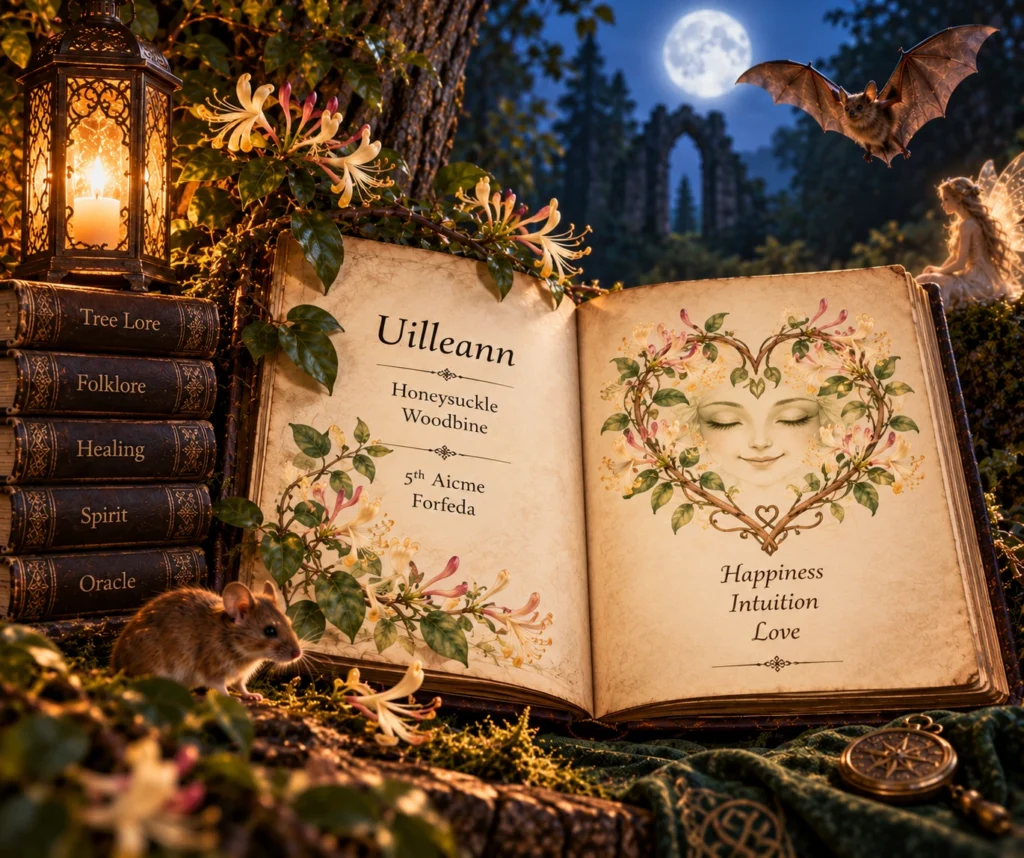
The Honeysuckle Tree, known as Woodbine and represented within Ogham Tree Lore by Uilleann, is a tree of love, happiness, intuition and connection. Belonging to the later Forfeda of the Ogham, Honeysuckle brings something wonderfully different to Celtic Tree Lore. Rather than standing alone, it reaches outward, entwining itself amongst the trees and hedgerows that support its journey towards the light.
Its character changes as evening approaches. Fragrant flowers release their perfume into the summer air, drawing moths and other night visitors towards their nectar while the tangled stems provide food, shelter and opportunity for the creatures living around them. This relationship with the woodland lies at the heart of Honeysuckle: one life flourishing through its connection with another.
Across folklore, mythology and spiritual tradition, that natural embrace becomes something richer. Lovers find themselves reflected within its entwining stems, ancient medicine remembers its healing possibilities, while Áine, Aphrodite and Freya reveal different expressions of belonging, attraction and sensitivity. Fair Folk and elemental beings lead Honeysuckle towards the unseen, while its Secret Harmonies explore Love, Correspondence and Asclepian Therapies.
This Honeysuckle Ogham Tree profile follows Uilleann through its Celtic Tree Lore, folklore, healing remedies, Animal Spirit, Gods and Deities, Totems and Entities and Secret Harmonies. Beneath them all is the same gentle invitation: to follow what attracts us, trust what we intuitively recognise and discover the happiness that can arise when we allow our lives to become meaningfully entwined with the world around us.
Honeysuckle Tree – Ogham Tree Profile
Bruce Clifton
Group: 5th Aicme ~ Forfeda
Name: Honeysuckle / Woodbine
Ogham: Uilleann >>> Ull-yun ~ Ull-endth
Letter: UI-Pe
Lunar: Universal
Season: Summer ~ Autumn
Element: Fire ~ Spirit
Direction: South
Moon Phase: Universal
Moon Name: Universal
Influence: Unified
Title: Shrub
Age: Half a generation
Aura: Yellow ~ Blue
Healing: Anti-inflammatory ~ Arthritis ~ Asthma ~ Bronchitis ~ Colds ~ Coughs ~ Headaches ~ Liver ~ Mouth Ulcers ~ Skin Rashes
Animal Spirit: Bat ~ Bee ~ Butterfly ~ Moth ~ Mouse
Totems – Entities: ArchAngel Raphael ~ Elementals ~ Ellyllon ~ Faeries ~ Sylphs
Gods – Deities: Aine ~ Aphrodite ~ Freya
Secret Harmonies: Asclepian Therapies ~ Correspondence ~ Love*
Festival: (coming soon)
Cosmos: (coming soon)
Key Words: Happiness ~ Intuition ~ Love
Essence of the Honeysuckle Tree
Bruce Clifton
The essence of the Honeysuckle Tree is connection. It is the instinct to reach towards another life, the happiness found in companionship and the quiet intuition that tells us where we belong. Honeysuckle does not grow by standing apart from the woodland. It reaches outward, finds something beside which it can flourish and begins to entwine.
There is romance within this way of growing. Honeysuckle does not overpower the tree that supports it, nor does it lose itself within the embrace. Its own stems continue upwards, its own leaves seek the light and its flowers eventually open amongst branches that belong to another. Two lives share the same space while remaining themselves. This is perhaps why lovers have recognised their own stories within Woodbine for centuries.
Yet Honeysuckle speaks of far more than romantic love. Love exists between partners, parents and children, friends and families; it appears in our affection for animals, landscape, Spirit and life itself. Honeysuckle allows these expressions to remain different while recognising the same movement within them — something within one life reaching towards another and discovering that closeness can enrich them both.
Its flowers bring another dimension to this relationship. As evening settles, Honeysuckle releases its fragrance into the cooling air. The flower may remain hidden amongst the leaves while its presence travels far beyond it, sensed before its source is found. Here intuition becomes important. We do not always understand what draws us towards a person, place or possibility. Sometimes we feel the invitation before we can explain it.
This twilight personality opens Honeysuckle towards another world. Moths arrive in answer to its evening fragrance; Fair Folk gather within its folklore; Sylphs belong to the movement of scented air; while Raphael brings healing into the same living atmosphere. The visible and unseen are not separated sharply beneath Honeysuckle. They mingle amongst leaf, perfume, instinct and imagination, allowing an ordinary summer evening to become something altogether more enchanted.
Healing belongs naturally within this essence. Honeysuckle has travelled through old medicinal traditions as well as folklore, carrying remembered relationships with the body, childbirth and wellbeing. Its Healing Remedies Oracle continues that history carefully, while Asclepian Therapies introduces the quieter possibility of healing through rest, dream and receptive consciousness. Healing here is not isolated from living; it belongs amongst nourishment, sleep, affection, fragrance and the conditions that allow life to flourish.
This is also why Correspondence finds such a natural home within Honeysuckle. Lovers and Woodbine, flower and Moth, fragrance and attraction, Brigid and healing, Aphrodite and desire, Freya and sensitivity, Áine and belonging — one relationship begins to echo another until the tree becomes a meeting place for stories that arose in very different worlds. They need not have a common historical origin to reveal a harmony when brought together.
Uilleann itself seems to share this character. Belonging to the Forfeda, it came into the written Ogham tradition beyond the original twenty letters, finding a place amongst an order that already existed. Like Woodbine entering an established woodland, it did not need everything around it to change before it could belong. It found somewhere to grow.
Within Bnwyfre, Honeysuckle expresses the Life Force through relationship. Fire brings warmth, attraction and the fullness of summer; Spirit allows that connection to extend beyond what can be touched or seen. Its season moves from Summer towards Autumn, carrying abundance towards maturity without losing the sweetness from which it began.
Honeysuckle therefore asks very little of us. It does not demand that love be defined, intuition explained or happiness justified. It simply invites us to participate — to notice what draws us closer, recognise what allows us to flourish and remain open to the lives with which our own has become entwined.
Happiness ~ Intuition ~ Love.
Healing Lore of the Honeysuckle Tree
Bruce Clifton
Honeysuckle carries a long relationship with healing. Its flowers, leaves and climbing stems found their way into traditional medicine across different cultures, while the ancient Mediterranean world knew a Honeysuckle as periklymenon, recording its place amongst the medicinal plants used by generations before us.
The Healing Remedies Oracle explores this gentler relationship between Honeysuckle and wellbeing. Here, old remedies meet the living character of the plant: fragrant flowers gathered in season, simple preparations made with care, and traditional knowledge remembered without pretending that every ancient remedy belongs in modern medicine.
Honeysuckle encourages us to think of healing as something broader than treating illness. Rest, warmth, nourishment, fragrance and the simple act of caring for ourselves can all become part of recovery. Its remedies invite us to work with the plant respectfully, allowing an old tradition of healing to find a thoughtful place within life today.
Scope & Notice
The information contained herein is for educational and entertainment purposes only. All efforts have been made to present accurate, up-to-date, reliable and complete information; however, no warranties of any kind are stated or implied. Readers should acknowledge that the author is not engaged in the rendering of medical or professional advice. The content herein should not be perceived as a substitute for professional or personal guidance. If in doubt, consult a qualified professional before attempting any techniques outlined.
The appropriate dosage or application of any natural remedy is dependent upon various factors, including age, health status, and individual circumstances. Natural products are not inherently safe, and dosage may be critical. It is best practice to begin with lower amounts and adjust as necessary. Consideration should also be given to timing, as the effectiveness of remedies may vary according to time of day and individual sensitivity.
About the Healing List
This list of ailments is not complete in its entirety; it has been limited to the most popular, with the remedies coming firstly from the tree and then vegetation dependent on the tree. It is worthy of note that there is more than one way to make a cup of tea, and many of the ingredients can be purchased online.
Honeysuckle Tree – Healing Remedies Oracle
We have alphabetised this list of healing qualities of the honeysuckle tree solely for ease of reference; they include but are not limited to:
1) Anti-inflammatory
2) Arthritis
3) Asthma
4) Bronchitis
5) Colds
6) Coughs
7) Headaches
8) Liver
9) Mouth Ulcers
10) Skin Rashes
Anti-inflammatory / Honeysuckle Tree
Ingredients
Fresh honeysuckle flowers
Fresh honeysuckle leaves
A few young honeysuckle stems
Key Properties
Traditionally used to cool, soothe and settle areas of inflammation, particularly where the skin or tissues feel hot, swollen, tender or irritated.
Traditional properties:
Anti-inflammatory
Astringent
Analgesic
Soothing
Vulnerary
Preparation
Gather a good handful of honeysuckle flowers and leaves with a few young stems. Bruise them between the hands and steep them in a bowlful of hot water, leaving everything to infuse as the water cools.
For swollen hands or feet, soak them in the warm Honeysuckle water. Knees, elbows, shoulders and aching muscles can be bathed with it or wrapped in a soft cloth soaked in the infusion. If the inflammation feels hot or the skin is irritated, leave the water to cool completely and use it as a soothing wash instead.
To make a quick Honeysuckle salve, put a handful of chopped flowers and leaves into a small pan with enough olive oil to cover them. Warm very gently for around half an hour, without frying the plant, then strain out the Honeysuckle. Return the infused oil to a gentle heat and add a small shaving of beeswax. Once the wax has melted, take it from the heat and leave it to cool. It will settle into a soft ointment that can be rubbed onto sore or troublesome areas.
If it sets harder than you would like, warm it again and add a little more oil. If it remains too runny, add another shaving of beeswax. There’s no need to turn it into a chemistry lesson — you’re simply looking for something soft enough to scoop with a fingertip and rub comfortably into the skin.
Traditional Use
Honeysuckle has traditionally been valued for soothing inflammation and irritated tissues, and this is a remedy that can change according to what is troubling you. Soak swollen fingers or feet, bathe an aching knee, cool hot and irritated skin, or wrap a warm Honeysuckle cloth around a stiff and uncomfortable joint.
The salve gives you something to keep for another day. Rub a little into aching joints, tired muscles or areas prone to soreness when making a fresh bowlful isn’t convenient. The Honeysuckle-infused oil carries the plant onto the skin, while the beeswax simply turns that oil into something easier to apply and keep.
Warm when warmth feels good, cool when the area feels hot and angry, and salve when you want something ready to hand.
Arthritis / Honeysuckle Tree
Ingredients
Fresh honeysuckle flowers
Fresh honeysuckle leaves
A few young honeysuckle stems
Key Properties
Traditionally used for rheumatic and arthritic complaints, particularly where the joints have become stiff, swollen, aching or troublesome to move.
Traditional properties:
Anti-inflammatory
Analgesic
Astringent
Soothing
Vulnerary
Preparation
Gather a good handful of honeysuckle flowers and leaves, together with a few of the softer young stems. Bruise them well and steep them in a bowlful of hot water, leaving the Honeysuckle in the water as it cools to a comfortable warmth.
For aching hands and fingers, simply put the hands into the bowl and gently move the fingers beneath the water. Arthritic feet can be treated in much the same way with a larger bowl or foot bath. Give them time to soak; part of the comfort comes from allowing the warmth to work into stiff little joints rather than hurrying the process.
Knees, elbows, wrists and other troublesome joints can be bathed generously with the warm Honeysuckle water. Where soaking isn’t practical, soak a soft cloth in the preparation, wrap it around the aching joint and leave it there while the warmth remains.
If you have a Honeysuckle salve, rub a little into the joint afterwards. This is particularly useful for fingers, knuckles, wrists, knees and feet, where a gentle massage can accompany the application.
Traditional Use
Honeysuckle has a long association with soothing inflammation and rheumatic aches. A warm bath or soak makes particularly good sense for arthritic hands and feet because the preparation can surround several painful joints at once, while bathing or wrapping allows the same remedy to be used elsewhere on the body.
It is an uncomplicated household remedy: something to reach for when the fingers have stiffened, the knees are complaining or tired feet have become sore and difficult. The warmth brings its own comfort, while Honeysuckle lends its traditional anti-inflammatory, analgesic and soothing properties to the aching joint.
Asthma / Honeysuckle Tree
Ingredients
Fresh honeysuckle flowers
A few young honeysuckle leaves
Honey
Key Properties
Traditionally used to soothe the throat and chest, ease troublesome coughing and bring comfort when breathing feels tight or irritated.
Traditional properties:
Expectorant
Antispasmodic
Anti-inflammatory
Soothing
Preparation
Gather a small handful of fresh honeysuckle flowers with a few of the younger leaves. Bruise them lightly between the fingers and place them in a cup or small pot. Pour over hot water and leave them to steep until the flowers have softened and their fragrance has passed into the water.
Strain, add a spoonful of honey and drink while pleasantly warm. Sip it slowly rather than drinking it quickly, allowing the warmth and honey to soothe the throat and chest.
Traditional Use
Honeysuckle has an old folk association with asthma and troublesome breathing. A warm flower tea was taken when the chest felt tight, irritated or burdened by coughing, particularly where mucus made breathing feel heavier.
The flowers bring the gentler, soothing side of Honeysuckle to the remedy, while the young leaves add some of the plant’s traditional astringent qualities. Honey rounds it off into the sort of simple household preparation that could be made whenever Honeysuckle was flowering in the hedgerows.
Bronchitis / Honeysuckle Tree
Ingredients
Fresh honeysuckle flowers
Fresh honeysuckle leaves
Honey
Key Properties
Traditionally used to soothe a troublesome chest, loosen congestion and calm the persistent cough that often accompanies bronchitis.
Traditional properties:
Expectorant
Anti-inflammatory
Antispasmodic
Soothing
Preparation
Gather a good handful of fresh honeysuckle flowers and a few young leaves. Bruise them lightly and simmer gently in a little water until the flowers have softened and the liquid has taken on their fragrance.
Strain while still warm, pressing the flowers and leaves to recover their juices. Stir enough honey into the honeysuckle liquid to make a light syrup, then leave it to cool.
Take a spoonful when the chest feels troublesome or the cough becomes persistent. The syrup can also be stirred into a cupful of warm water and sipped slowly.
Traditional Use
A comforting household remedy for a heavy, congested chest. Honeysuckle was traditionally valued for helping to loosen stubborn mucus and soothe irritated airways, while honey coats and comforts a throat made sore by repeated coughing. Taken by the spoonful or warmed into a drink, it offers a gentler way of using Honeysuckle when bronchitis has left the chest feeling tight, sore and weary.
Colds / Honeysuckle Tree
Ingredients
Fresh honeysuckle flowers
Fresh honeysuckle leaves
A spoonful of honey
Key Properties
Traditionally used to ease a stuffy head, soothe the throat and bring comfort during a heavy cold.
Traditional properties:
Expectorant
Diaphoretic
Febrifuge
Soothing
Preparation
Gather a small handful of honeysuckle flowers and leaves, bruise them lightly and add them to a bowlful of hot water. Allow the flowers and leaves to steep for a few minutes, breathing in the warm honeysuckle steam as the fragrance rises.
When the water has cooled and the steam has faded, strain a cupful of the honeysuckle water and stir in a spoonful of honey. Sip it warm to soothe a dry or irritated throat.
Traditional Use
A simple household remedy for those miserable, stuffy days when a cold has settled around the nose, throat and head. The warm steam helps loosen the heaviness and congestion, while the honeysuckle and honey make a soothing drink for the throat afterwards.
The same preparation gives the plant two uses rather than wasting what remains after the steam — first breathed in while hot, then enjoyed as a warm drink once cooled.
Coughs / Honeysuckle Tree
Ingredients
Fresh honeysuckle flowers
Fresh honeysuckle leaves
Honey
A little lemon, if you have one
Key Properties
Traditionally used to settle troublesome coughing, soothe a throat made sore from coughing and help loosen mucus when the chest feels congested.
Traditional properties:
Expectorant
Antitussive
Antispasmodic
Anti-inflammatory
Soothing
Preparation
Gather a small handful of honeysuckle flowers and a few young leaves. Bruise them lightly and put them into a cup or small pot, then pour over hot water and leave them to steep until the water becomes fragrant.
Strain the Honeysuckle water while it is still warm and stir in a generous spoonful of honey. A squeeze of lemon can be added if there is one in the kitchen.
Sip it slowly when the cough is troublesome. Don’t rush the cup; the warm Honeysuckle and honey are as much about soothing the throat as drinking the remedy itself.
For a cough that becomes particularly irritating at night, make the drink a little stronger and use less water, leaving it somewhere close by. A few warm mouthfuls can be taken when coughing starts rather than drinking another whole cup.
If you’d rather have something you can take by the spoonful, make a stronger Honeysuckle infusion, stir in plenty of honey while it is warm and allow it to cool. It becomes a simple Honeysuckle cough syrup without turning the remedy into anything complicated.
Traditional Use
Honeysuckle has a long folk association with coughs and congested respiratory complaints. Its flowers were valued for their expectorant and soothing qualities, particularly when coughing came with mucus, irritation or a tight and uncomfortable chest.
This is very much a cupboard remedy. Honeysuckle from the hedgerow, honey from the kitchen and lemon if there’s one about. Drink it warm during the day, keep some beside the bed when a cough is disturbing sleep, or make it stronger and take it by the spoonful.
Sometimes the simplest remedy is the easiest one to remember — Honeysuckle, honey and warmth for a troublesome cough.
Headaches / Honeysuckle Tree
Ingredients
Fresh honeysuckle flowers
Fresh honeysuckle leaves
A little honeysuckle root
Key Properties
Traditionally used for headaches, particularly where the head feels hot, heavy, tense or weary.
Traditional properties:
Cooling
Anti-inflammatory
Analgesic
Astringent
Soothing
Preparation
Gather a few fresh honeysuckle flowers and leaves. If the plant is plentiful and established, a small shaving of root can be added, although the flowers and leaves are quite enough on their own.
Bruise the Honeysuckle lightly and steep it in a cupful of hot water. Leave it for a while, allowing the flowers and leaves to soften and the water to take on their fragrance.
For a hot or heavy head, let the Honeysuckle water cool, soak a soft cloth in it and lay it across the forehead and temples. The softened flowers and leaves can be folded inside the cloth so that nothing from the preparation is wasted.
There is another, simpler way to use it. A traditional Honeysuckle infusion was also taken for headache, so the flowers and leaves can be strained away and the water sipped warm instead. If the headache has come at the end of a long or tiring day, there is no reason the two cannot be combined — drink a little of the infusion and use the remainder to cool the forehead.
Traditional Use
Honeysuckle appears in British folk tradition as a remedy for headache, including the old practice of drinking an infusion when the head was troublesome.
As a household remedy, it lends itself particularly well to those headaches described simply as a hot head, heavy head or tired head. A cool Honeysuckle cloth across the brow gives the remedy an immediate comforting use, while the infusion offers the older internal preparation.
It doesn’t need to be complicated: a little Honeysuckle, a cupful of water and somewhere quiet to sit until the head settles.
Liver / Honeysuckle Tree
Ingredients
Fresh honeysuckle leaves
A few young honeysuckle stems
Key Properties
Honeysuckle leaves have traditionally been used in preparations associated with the liver, particularly as a gentle cleansing and diuretic herb where the body was thought to need a little help clearing itself.
Traditional properties:
Hepatic
Depurative
Diuretic
Astringent
Tonic
Preparation
Gather a handful of fresh honeysuckle leaves with a few of the softer young stems. Tear or bruise them and put them into a small pan of water. Bring the water up to a gentle simmer and leave the Honeysuckle bubbling quietly for ten or fifteen minutes, making a stronger decoction than the flower teas used for coughs and colds.
Strain it into a cup and drink warm. If the taste is a little too green or bitter, a spoonful of honey can be stirred through it.
Another old-fashioned way of approaching a cleansing remedy is simply to make enough for the day. Keep the remaining decoction covered and take a small cupful later rather than making each one from scratch.
Traditional Use
The leaves of Honeysuckle have a history of being prepared as a decoction for complaints of the liver and spleen. This is where the leaves come into their own rather than the sweetly scented flowers: simmering draws out a stronger, greener preparation suited to the plant’s traditional cleansing and diuretic reputation.
It is the sort of remedy that would once have been described simply as “something to clear you out and get things moving again” — a bitterish cup taken when someone felt sluggish, heavy or generally in need of a spring clean.
Mouth Ulcers / Honeysuckle Tree
Ingredients
Fresh honeysuckle leaves
Fresh honeysuckle flowers
Key Properties
Traditionally used as a soothing and astringent mouthwash for sore gums, tender mouths and small ulcers, helping to calm irritation while gently tightening the tissues around the affected area.
Traditional properties:
Astringent
Anti-inflammatory
Antiseptic
Soothing
Vulnerary
Preparation
Gather a small handful of fresh honeysuckle leaves and flowers and bruise them lightly. Put them into a cup or small pot, pour over hot water and leave them to steep until the water has cooled.
Strain well and use the Honeysuckle water as a mouthwash. Take a mouthful, gently move it around the sore part of the mouth and then spit it out. This can be repeated several times from the same cupful.
If an ulcer is tucked away somewhere awkward — against the gum, inside the cheek or beneath the tongue — hold a little of the Honeysuckle water over that spot for a few moments before spitting it out.
The same preparation can also be used as a gargle when soreness has spread towards the back of the mouth or throat.
Traditional Use
Preparations of its leaves and flowers were used as washes and gargles for inflammations of the mouth, and this traditional use extended to sore mouths and thrush.
It makes an uncomplicated household remedy: pick a little Honeysuckle, steep it, let it cool and rinse the troublesome mouth with the resulting water. The astringent quality of the plant suits swollen or tender tissues, while its soothing character makes it useful when eating, drinking or simply moving the mouth has made an ulcer uncomfortable.
And don’t throw the remainder away — keep it covered for another rinse later in the day.
Skin Rashes / Honeysuckle Tree
Ingredients
Fresh honeysuckle leaves
Fresh honeysuckle flowers
A few young honeysuckle stems
Key Properties
Traditionally used externally to cool and soothe irritated skin, particularly where a rash feels hot, itchy, tender or uncomfortable.
Traditional properties:
Anti-inflammatory
Astringent
Antiseptic
Soothing
Vulnerary
Preparation
Gather a good handful of honeysuckle leaves and flowers with a few of the softer young stems. Bruise them lightly and steep them in a bowlful of hot water. Leave everything in the bowl until the water has cooled completely.
For a small rash, bathe the skin generously with the cool Honeysuckle water and allow it to dry naturally. If the irritation covers a larger area, make a bigger bowlful and use it as a cooling wash, gently pouring or sponging the preparation over the skin.
For itchy arms, hands or feet, the affected area can simply be soaked in the cooled infusion. And if the rash is somewhere awkward, soak a soft cloth in the Honeysuckle water and lay it over the skin for a while.
The softened leaves and flowers can also be lightly crushed together and wrapped within the cloth, making a simple Honeysuckle poultice for a particularly troublesome patch.
For a fresh Honeysuckle skin paste, put a small handful of fresh flowers and young leaves into a blender with a spoonful of Manuka honey. Add just enough of the cooled Honeysuckle infusion to help the blades turn, then blend until the leaves and flowers have broken down into a soft, spreadable paste. Smooth a little over the irritated area, leave it for a short while, then rinse away with cool Honeysuckle water.
Traditional Use
Honeysuckle has a long folk association with external washes and lotions for inflamed and irritated skin. Its cooling, astringent character makes this a particularly simple remedy when the skin feels hot, itchy or generally unhappy.
There is no need to make every rash fit the same treatment. Wash it, soak it or cool it, depending upon where the irritation appears. A hand or foot can go straight into the bowl; an arm or leg can be bathed; and a troublesome patch can have the Honeysuckle laid directly over it.
It is the sort of remedy that makes use of what is growing in the hedge: gather the Honeysuckle, bruise it, steep it, let it cool and give the irritated skin a little relief.
For something richer, blend the fresh flowers and leaves with a spoonful of Manuka honey and a splash of Honeysuckle water. This makes a soft green paste that can be spread over a small troublesome area before being washed away. The honey gives the preparation a soothing, slightly protective quality and stops the crushed plant material from simply falling away.
Celtic Tree Lore of the Honeysuckle Tree
Bruce Clifton
Honeysuckle enters Ogham differently from many of the great trees that stand before it. It is not one of the original twenty letters carved across the earliest surviving Ogham stones, but belongs amongst the later Forfeda, additional characters through which the written tradition continued to develop. Uilleann therefore arrives almost as an afterthought — and somehow that seems entirely appropriate for a plant that rarely stands in the centre of the woodland, preferring instead to weave itself through the lives already growing there. CELT
Yet its place within the medieval Ogham tradition is wonderfully clear. The Auraicept na n-Éces, the Scholar’s Primer, identifies Uilleann as Woodbine and Honeysuckle, preserving the old description Tutmur fid uilleann — “juicy wood is Woodbine.” The surviving text even explains that Woodbine was given to the Ogham because it was a name for Honeysuckle. Whatever mysteries surround the Forfeda, somebody within that old scholarly tradition looked at Uilleann and recognised Honeysuckle. CELT
There is something rather beautiful about Honeysuckle finding its way into Ogham in this manner. Ogham had already been created, its great trees had already taken their places, and still there was room for another voice. Uilleann did not need to displace Oak, Hazel or Yew. Like the living plant, it simply found somewhere amongst them to grow.
The old name Woodbine helps us understand why it deserved to remain. Honeysuckle does not build its life through a great solitary trunk. It reaches outward. A young stem searches until it finds something it can grow beside, then begins the characteristic turning and entwining that carries it upwards towards light and flower. Its strength comes not from standing apart from the woodland, but from becoming involved with it.
For Celtic Tree Lore, that creates a very different kind of tree wisdom. Oak may demonstrate strength through stature and Hazel may conceal wisdom within the nut, but Honeysuckle expresses itself through relationship. One life encounters another; support is accepted; growth continues; eventually flowers appear somewhere neither could have reached in quite the same way alone.
And then comes the fragrance. During the day Honeysuckle can almost disappear amongst the greenery supporting it, but towards evening its presence becomes impossible to ignore. The flower releases itself into the air as perfume, travelling beyond leaf and stem into the surrounding woodland. Uilleann therefore carries something that cannot easily be carved upon stone: presence extending beyond the visible self.
Perhaps this is where the old description “juicy wood” becomes particularly evocative for modern Ogham Tree Lore. The historical words need no invented translation into love, attraction or spirituality; they already describe something living and abundant. Honeysuckle is not dry symbolism. It flowers, feeds, perfumes, entwines and participates in the lives around it. CELT
Within The Spiritual Centre, Uilleann has consequently grown into the Ogham of relationship, love and the hidden connections between living things. That is our interpretation rather than a meaning claimed from antiquity, but it grows from the character of the plant and from the old tradition that chose Woodbine for Uilleann in the first place.
There is romance in that history. Somewhere between the first Ogham inscriptions and the medieval scholars who preserved and expanded their knowledge, Honeysuckle was invited into the alphabet. Centuries later it is still there, entwined amongst the great trees — exactly where Woodbine seems happiest.
Folklore of the Honeysuckle Tree
Bruce Clifton
Honeysuckle carries one of those old names that tells us exactly how people experienced the plant. Woodbine is the wood-binder, the climbing stem that winds itself around the branches of another tree. Yet its other name remembers something altogether sweeter. Generations of children discovered the nectar hidden at the base of its flowers and sucked the blossom for its honeyed taste. In Ireland this sweetness survives in names such as bainne gamhna, calves’ milk, and lus na meala, the herb of honey. West Cork People
That Irish name bainne gamhna also carries Honeysuckle into an old May song celebrating the arrival of summer: Samhradh, samhradh, bainne na ngamhna… Thugamar féin an samhradh linn — summer has come and “we brought the summer with us.” The song belonged to Maytime festivities of flowers, garlands, singing and dancing. Here Honeysuckle is not merely growing during summer; it becomes part of the celebration of summer’s return, abundance and pleasure.
Across Britain and Europe, Honeysuckle acquired an equally intimate place in everyday folklore. Its flowers invited children to pull apart the blossom and taste the tiny drop of nectar hidden within, an experience remembered in the very name Honeysuckle. Unlike plants whose folklore grew principally from fear, ceremony or distant mythology, much of Honeysuckle’s magic began with something wonderfully ordinary: people encountered it personally. They smelled it on summer evenings, tasted its sweetness and watched it curl around the trees and hedgerows beside them.
The plant’s winding habit naturally encouraged another family of beliefs surrounding love, affection and enduring bonds. Honeysuckle came to be associated with lovers and the happiness of the home, while its clinging stems provided an obvious living image for attachment. This was not simply symbolism invented afterwards; anyone who has tried to separate mature Woodbine from the branches through which it has grown can understand why generations saw relationship written into the plant itself.
Its fragrance added another layer to the folklore. Honeysuckle can announce itself before it is seen, particularly on warm summer evenings when its perfume becomes stronger after dusk. In later flower lore this sweetness became associated with affection, generosity and the attraction of love. The experience is wonderfully characteristic of Honeysuckle: we can walk through twilight, catch its perfume upon the air and begin looking for a flower still hidden somewhere amongst the leaves.
And Honeysuckle belongs naturally to the enchanted woodland. Its tangled growth creates little hidden spaces amongst hedgerows and trees, while its flowers remain fragrant into the hours when daylight begins surrendering to night. British and Celtic fairy tradition repeatedly places encounters with the Otherworld around precisely these margins — old woodland, flowering hedges, twilight and places where the cultivated landscape meets the wild. We do not need to turn Honeysuckle into an invented universal “fairy plant” to recognise why Woodbine feels at home there.
Perhaps that is the folklore of Honeysuckle at its most convincing. Love became entwined around its stems, sweetness was discovered inside its flowers, perfume wandered through summer evenings and imagination followed it into the woodland. Different cultures gave those experiences different stories, but the living Honeysuckle remained at their centre.
Animal Spirit of the Honeysuckle Tree
Bruce Clifton
Honeysuckle shares its life generously with the creatures of the woodland. Dormice disappear amongst its tangled stems and gather strips of bark for their nests, birds find shelter amongst its leaves and later feast upon its berries, while its flowers hold their sweetest invitation until evening begins to fall.
As daylight fades, Honeysuckle changes. Its fragrance strengthens and drifts through the cooling air, calling to the creatures of twilight without sound or movement. Here, Animal Spirit becomes something instinctive: an invitation sensed, answered and understood without explanation.
The Animal Spirit of Honeysuckle invites us into this hidden exchange, where shelter, nourishment, fragrance and instinct bring different lives together. Amongst its entwining branches, the woodland is not simply somewhere animals visit; it is a community in which Honeysuckle quietly participates.
Honeysuckle Tree – Animal Spirit Oracle
Bruce Clifton
We have alphabetised this list of animal spirit that harmonise with the honeysuckle tree solely for ease of reference; no sense of hierarchy or entitlement is intended or implied:
1) Bat
2) Bee
3) Butterfly
4) Moth
5) Mouse
Bat / Honeysuckle Tree
Honeysuckle and Bat meet naturally at twilight. As daylight fades, Honeysuckle releases its strongest fragrance into the evening air, attracting the moths and other night-flying insects upon which bats feed. What begins with the flower’s unseen perfume becomes part of the movement and abundance of the night.
Honeysuckle climbs by feeling its way around whatever supports it, twisting and reaching until it finds somewhere to grow. Bat carries a similar wisdom. It does not wait for the darkness to disappear before moving forward; it understands its surroundings through senses perfectly suited to the unseen world.
When Honeysuckle and Bat appear together, trust what you are beginning to sense. Something may be drawing you towards a person, place, idea or new direction before you fully understand why. Pay attention to the quieter signals. What appears uncertain may simply be something you have not learned to recognise yet.
Bee / Honeysuckle Tree
The Bee comes to Honeysuckle in search of nectar, moving amongst its flowers and carrying pollen onwards as it works. Honeysuckle provides nourishment while Bee contributes to the wider life of the hedgerow, creating a natural relationship built upon exchange, cooperation and shared purpose.
Bee brings Dedication, Community and Haven to Honeysuckle. The climbing plant creates shelter amongst tangled branches and woodland edges, while its flowers offer sweetness to those that visit. Both remind us that a haven is not simply somewhere to retreat from the world; it is something living, created through contribution, nourishment and the willingness to share what we have.
When Bee and Honeysuckle appear together, look towards the community around you. Consider what you receive from it as well as what you contribute. There is no need to carry everything alone or exhaust yourself trying to provide for everyone. Bee knows the value of working together, while Honeysuckle reminds us that support allows us to climb further than we could alone.
Butterfly / Honeysuckle Tree
Butterfly comes to Honeysuckle for its nectar, resting upon the flowers as it moves through the warmth of the day. The climbing Honeysuckle provides both nourishment and shelter, while Butterfly carries pollen onwards, quietly contributing to the continuing life of the plant and the landscape around it.
Honeysuckle strengthens Butterfly’s association with transformation and the freedom to become something new. The vine climbs by embracing what surrounds it, adapting its path as it grows, while Butterfly reminds us that change sometimes requires leaving behind the form in which we once felt secure. Neither transformation is forced; each unfolds naturally when the time is right.
When Butterfly and Honeysuckle appear together, allow yourself to grow beyond old expectations without forgetting the people and experiences that helped you reach where you are. Change does not always mean abandoning what came before. Sometimes it means carrying its nourishment with you as you discover what you are becoming.
Moth / Honeysuckle Tree
As evening settles, Honeysuckle becomes a different plant. Its fragrance strengthens in the cooling air, sending an invitation into the twilight that Moth follows without knowing why. While much of the garden becomes quiet, the romance is only just beginning.
Drawn towards light yet belonging to the darkness, Moth finds another kind of beacon in Honeysuckle. The magnificent Elephant Hawk-moth, dressed in its rose-pink and olive-green tuxedo, seems made for the soft creams, pinks and living greens of the flowers. Beneath the moon, Honeysuckle becomes a natural ballroom, offering sweetness amongst a tangle of leaves and blossom where Moth can feed, disappear and emerge again into the summer night.
Moth follows Honeysuckle through scent, instinct and attraction. The flower calls without words and Moth answers, carrying its pollen onwards in return for nectar. Their exchange is intimate and effortless; neither asks anything of the other beyond what each already has to give.
There is something beautifully simple in their relationship. Honeysuckle does not chase its visitor; it flowers, releases its perfume and waits. Moth does not need to understand the attraction before responding to it. Sometimes we are drawn towards a person, a place or a path in much the same way. We sense something before we understand it, and only by moving closer do we discover whether we have found nourishment, protection, belonging — or perhaps simply somewhere beautiful to dance for a while.
Mouse / Honeysuckle Tree
Honeysuckle offers Mouse something precious: a place where the small things matter. Beneath its twisting stems and tangled growth there is shelter, food, nesting material and somewhere to raise a family beyond the gaze of the wider world. For the tiny Mouse, resourcefulness turns what others might overlook into everything a family needs.
There is romance here too. Mouse spends spring gathering, preparing and creating a home, but by the long days of summer the work begins to bear fruit. Surrounded by family and abundance, life becomes less about searching and more about enjoying what has been created. Honeysuckle climbs around this little world, flowering above it, sweetening the air and turning an ordinary corner of the hedgerow into somewhere worth belonging.
Within Bnwyfre, the Breath of Life, nothing is insignificant. A fallen leaf becomes bedding, a seed becomes supper, a strand of Honeysuckle bark becomes part of a nest, and the smallest creature becomes the centre of an entire family. Mouse reminds us that abundance is not measured by how much we possess, but by recognising the value of what is already around us and sharing it with those we love.
Honeysuckle and Mouse ask very little from life: somewhere safe to belong, something to share, someone to share it with — and enough curiosity to see what tomorrow brings.
Totems and Entities of the Honeysuckle Tree
Bruce Clifton
Honeysuckle creates a world in which the boundaries between lives seem to soften. Its stems weave through hedgerows and woodland, its flowers open towards the evening, and its fragrance travels beyond anything we can see or touch. It is easy to imagine another world beginning somewhere amongst its leaves.
The Totems and Entities of Honeysuckle emerge through this atmosphere of shelter, invitation and quiet enchantment. They encourage us to notice the life around us differently, recognising that companionship does not always require words and presence does not always need to be seen.
Within Honeysuckle, the ordinary woodland becomes a little less ordinary. What lives beside us, moves around us or quietly shares our path may have something of its own to offer, if we become still enough to notice.
Honeysuckle Tree – Totems and Entities Oracle
Bruce Clifton
We have alphabetised this list of totems and entities that harmonise with the Honeysuckle tree solely for ease of reference; no sense of hierarchy or entitlement is intended or implied:
1) ArchAngel Raphael
2) Elementals
3) Ellyllon
4) Fairies
5) Sylphs
ArchAngel Raphael / Honeysuckle Tree
Raphael arrives with the East wind, carried upon the first gentle breaths of Spring. As a Sylph of Air, she moves through the awakening landscape unseen, stirring new leaves, carrying fragrance and breathing life into places that have rested through the winter. Honeysuckle responds naturally to her presence, sending out fresh growth before opening its flowers to the warmth and light of the returning year.
There is healing in this meeting. Raphael does not force Honeysuckle to grow; she surrounds it with the conditions in which growth becomes possible. Air moves between its leaves, Spring brings renewal and the climbing stems reach naturally towards the light. Her healing works in much the same way, gently enveloping rather than commanding, allowing something within us to awaken in its own time.
Within Bnwyfre ~ Breath of Life ~ Life Force Energy, Raphael and Honeysuckle share the language of the breath. Honeysuckle releases its fragrance into the air and Raphael carries it upon the breeze, allowing the presence of the flower to travel far beyond the place where it grows.
When Raphael appears with Honeysuckle, breathe deeply. Something is stirring. Spring has returned, the East wind is moving, and healing may already be closer than you realise.
Elementals / Honeysuckle Tree
Honeysuckle creates a living world within a world. Its roots disappear beneath the earth, twisting stems climb through neighbouring trees, flowers open to sunlight and rain, and their perfume drifts into the evening air. Within this small tangle of life, the Elementals find everything they need.
They are the unseen spirits of nature, present wherever the forces of Earth, Air, Fire and Water come together to create and sustain life. Honeysuckle gives them an especially rich meeting place: constantly growing, climbing, flowering, sheltering and feeding the creatures around it. What appears to us as a single plant becomes an entire community when viewed through their eyes.
Within Bnwyfre, Breath of Life, the Elementals remind us that Honeysuckle never grows alone. Everything around it participates in its existence, and everything that visits becomes part of its story.
Ellyllon / Honeysuckle Tree
Honeysuckle creates the kind of places in which the Ellyllon might choose to linger. Its twisting stems climb through the woodland edge, weaving amongst branches and creating hidden spaces beneath leaves and flowers. As evening approaches, its fragrance strengthens and the grove begins to change. Daylight creatures grow quiet, moths emerge, shadows deepen and another world seems to awaken within the same landscape.
Bnwyfre, Breath of Life, is the attraction to them. Honeysuckle breathes its perfume into the evening air and the Ellyllon follow, moving through the tangled growth as silently as the fragrance itself. They need neither disturb the leaves nor reveal themselves to let us know that something else shares the grove.
When Honeysuckle and the Ellyllon appear together, become aware of the quieter world around you. Walk slowly, listen and allow yourself to notice those little moments that cannot always be explained. You may never see the Ellyll walking beside you, but occasionally the woodland has a way of making you wonder whether you were ever truly alone.
Fairies / Honeysuckle Tree
There are few places more inviting to the Fairies than Honeysuckle in flower. It creates its own secret world of twisting pathways, leafy chambers and fragrant blossoms, offering shelter beneath its growth while moths, bees and butterflies move amongst the flowers above.
As daylight fades, Honeysuckle becomes more mysterious. Its perfume grows stronger, shadows gather between the leaves and the familiar garden or woodland edge begins to feel different. This is fairy time: that uncertain space between day and night when imagination awakens and the boundaries between our world and the Otherworld become a little less certain.
Within Bnwyfre, the Breath of Life, Fairies bring enchantment to Honeysuckle. They remind us that magic need not be somewhere distant or extraordinary; sometimes it is already growing around the garden gate, waiting for evening to fall and for someone curious enough to notice it.
Sylphs / Honeysuckle Tree
Honeysuckle speaks the language of the Sylphs. Its flowers may remain rooted to the woodland edge, but their fragrance travels far beyond them, carried invisibly upon the evening air. This is the world of the Sylph: breeze, breath, scent and movement — something felt before it is seen.
As Spring awakens the Honeysuckle, the Sylphs move amongst its new leaves and climbing stems, carrying the warmth of the East and the promise of the returning year. Later, when the flowers open and their perfume strengthens towards evening, Air becomes Honeysuckle’s messenger, carrying its invitation through the woodland to moths and other night visitors.
Within Bnwyfre ~ Breath of Life ~ Life Force Energy, Honeysuckle and the Sylphs remind us that we do not need to see something for it to touch us. A breeze against the skin, the sudden fragrance of a flower or a breath drawn deeply into the body can connect us with something beyond ourselves.
The Sylphs give Honeysuckle wings without ever asking it to leave the earth.
Gods and Deities of the Honeysuckle Tree
Bruce Clifton
Honeysuckle draws its deities close through love, healing, sensitivity and belonging. Áine, Aphrodite, Brigid and Freya each discover something different amongst its entwining stems and fragrant flowers, yet all recognise the gentle invitation that seems to surround the tree.
Áine finds belonging within the landscape; Aphrodite follows fragrance into attraction and desire; Brigid brings healing, nourishment and the warmth of home; while Freya reveals the sensitivity and tenderness of an open heart. Their traditions are different, but Honeysuckle allows their stories to meet without asking them to become the same.
Together, these Gods and Deities reveal a tree whose strength is found within relationship. Honeysuckle reaches towards another life, entwines without losing itself and fills the surrounding air with something it cannot keep. Through them, we begin to understand its invitation to love, nurture, trust and grow alongside one another.
Honeysuckle Tree – Gods and Deities Oracle
Bruce Clifton
We have alphabetised this list of gods and deities that harmonise with the Honeysuckle tree solely for ease of reference; no sense of hierarchy or entitlement is intended or implied:
1) Aine
2) Aphrodite
3) Brigid
4) Freya
Aine / Honeysuckle Tree
Honeysuckle and Áine belong naturally to the Irish summer. Woodbine tumbles through hedgerows and woodland edges as the landscape reaches towards its fullness, while Áine belongs to Cnoc Áine, the hill that has carried her name and her presence through generations of Irish tradition. Both seem inseparable from the places in which they live.
Honeysuckle does not stand apart from its surroundings. It climbs, entwines and becomes part of the trees and hedgerows that support it. Áine possesses something of this same intimacy with the land. Her story belongs to a particular hill, yet through the telling of it she became part of something much larger — summer, abundance, the Fair Folk and the mysterious relationship between people and place.
Together they speak of belonging. Of becoming so entwined with a place, a person or a life that our stories begin to grow together. Honeysuckle flowers amongst the branches that hold it; Áine remains upon the hill that remembers her.
Home is where we have taken root, entwined ourselves with life and begun to flower. Aine and Honeysuckle encourage home to be a place where love grows and where Bnwyfre can flourish.
Aphrodite / Honeysuckle Tree
Honeysuckle and Aphrodite share the art of attraction. As evening settles across the woodland, Honeysuckle releases its fragrance into the air. It simply opens releasing its perfume, until the fragrance fills the night air allowing the laws of attraction to do the rest. Aphrodite possesses much the same power. She is the ancient Greek goddess of love, beauty, desire and the mysterious force that draws one living being towards another.
Their relationship reaches deeper than resemblance. Ancient Greek medicine knew a Honeysuckle as periklymenon, and within the names preserved by Dioscorides is one associated with Aphrodite. The same medicinal tradition connected the plant with childbirth and generation, while elsewhere in the Roman world Honeysuckle was known as Mother of the Wood. Across those old traditions, the climbing plant had already entered a world of fertility, medicine and the continuation of life.
Aphrodite brings another sense to Honeysuckle: fragrance. The ancient world understood perfume as part of attraction, beauty and intimacy. Scent could travel beyond the body, announcing a presence before its source was seen. Honeysuckle performs this ancient seduction naturally. Rooted amongst the trees, it sends something of itself into the evening air until another living creature answers.
Yet Aphrodite reminds us that attraction is not necessarily love. Desire can begin a relationship, but it cannot tell us what that relationship will become. Honeysuckle seems to understand this distinction. Its stems entwine themselves around another, relying upon support without surrendering their own identity. Attraction brings two lives together; what happens afterwards depends upon how they learn to grow.
Within Bnwyfre ~ Breath of Life ~ Life Force Energy, Aphrodite and Honeysuckle allow attraction to travel upon the breath. Fragrance moves through the air, pollen passes between flowers and life continues. What begins as an invisible invitation becomes a correspondence between living things.
Aphrodite asks us to recognise the things that attract us without immediately needing to possess them. Sometimes the invitation is simply to move closer, breathe deeply and discover what is waiting amongst the flowers.
Brigid / Honeysuckle Tree
Honeysuckle welcomes Brigid into the shelter of the home. It climbs around the places where people and woodland meet, softening boundaries with leaf and flower, offering fragrance in summer and an old tradition of medicine gathered from the living landscape. Brigid belongs naturally within this world. She is the healer beside the hearth, the keeper of nourishment and the presence who protects the wellbeing of the household, its animals and the life growing around it. CELT
There is generosity within them both. Honeysuckle does not keep its sweetness hidden within the flower; its fragrance drifts freely into the evening air. In the early stories of Brigid, food and milk become abundant beneath her care and are repeatedly shared with those who need them. What comes into her hands is not gathered simply to possess, but transformed into nourishment, healing and kindness. CELT
Their medicine belongs to this same spirit. Honeysuckle carries centuries of remembered remedies within its leaves and flowers, while Brigid carries the healing hand that understands medicine as more than the treatment of illness. To heal is also to shelter, feed, comfort and restore the conditions in which life can begin to flourish again.
Within Bnwyfre, Brigid and Honeysuckle create a place where life is encouraged to entwine rather than stand alone. The hearth gives warmth, the plant gives fragrance and the home becomes more than walls around us. It becomes somewhere we are nourished, protected and allowed to grow — somewhere healing can quietly become part of everyday life.
Freya / Honeysuckle Tree
Honeysuckle receives Freya gently. Beneath its leaves there is shelter, amongst its flowers there is sweetness, and as evening settles its fragrance drifts quietly into the air. Nothing about the moment needs to be hurried. Freya brings the same softness, allowing affection to emerge naturally and giving the heart time to recognise what it is feeling.
There is vulnerability within Honeysuckle. Its slender stems cannot stand alone, yet they do not become weaker by reaching towards another. They entwine, finding support while continuing to grow as themselves. Freya understands this kind of closeness. Sensitivity does not require us to surrender who we are; sometimes it simply means trusting another life enough to lean a little closer.
Honeysuckle’s fragrance seems particularly suited to her. It cannot be held in the hand or asked to remain, yet it can awaken memory, longing and affection before we fully understand why. Freya inhabits these quieter movements of the heart — the feelings that arrive before words, the tenderness we sometimes hide, and the affection that asks to be acknowledged rather than explained.
Within Bnwyfre, Freya and Honeysuckle allow sensitivity to become a form of strength. To feel deeply is to remain open to the living world and to everything within it that can touch us. Honeysuckle offers its fragrance without knowing who will receive it; Freya reminds us that the heart, too, must sometimes be brave enough to remain open.
Secret Harmonies of the Honeysuckle Tree
Bruce Clifton
Honeysuckle reveals its Secret Harmonies quietly. They are found in the fragrance that strengthens as evening falls, in stems that reach towards another life and become entwined, and in the subtle moment when something outside ourselves awakens a feeling, memory or understanding within.
Within these harmonies, Asclepian Therapies leads Honeysuckle towards sacred sleep and the healing possibilities of dreams. Correspondence reveals the unseen threads through which nature, folklore, Spirit and human experience begin to echo one another, while Love reaches beyond any single definition, embracing affection, family, companionship, intimacy and our relationship with life itself.
The Honeysuckle Tree Secret Harmonies Oracle invites us to become sensitive to these quieter connections. We do not need to search for them or force them into meaning. Sometimes we need only allow the mind to soften, follow the fragrance, and notice what has gently entwined itself with our own story.
Honeysuckle Tree – Secret Harmonies Oracle
Bruce Clifton
We have alphabetised this list of secret harmonies of the Honeysuckle tree solely for ease of reference, no sense of hierarchy or entitlement is intended or implied:
1) Asclepian Therapies
2) Correspondence
3) Love
Asclepian Therapies / Honeysuckle Tree
As evening settles, Honeysuckle prepares the woodland for sleep. Its fragrance strengthens as daylight fades, drifting through the cooling air while the world around it becomes quieter. This natural movement from waking into rest creates a beautiful harmony with Asclepian Incubation, the ancient practice of entering sacred sleep in the hope that healing, guidance or understanding might be received through dreams.
Honeysuckle asks for no effort during this transition. Its perfume cannot be followed through thought; it is breathed, experienced and allowed to work upon the senses. As the body relaxes and the conscious mind loosens its hold, we enter that quieter place where dreams, memory and intuition can begin to speak differently.
Within Asclepian Incubation, sleep becomes more than an ending to the day. It becomes a place of possibility. Honeysuckle stands gently at its entrance, reminding us that sometimes healing begins when we stop searching for the answer and allow ourselves to become quiet enough to receive it.
Correspondence / Honeysuckle Tree
There are moments when the world seems to whisper the same story in different ways. Honeysuckle releases its fragrance into the evening and lovers appear; its stems reach towards another tree and the two become entwined; lovers, healers, deities and the Fair Folk gather within its folklore until connections begin appearing where none were expected.
This is the quiet magic of Correspondence. One thing reminds us of another, an old story suddenly resembles something happening today, or a pattern within nature seems to echo something we have felt within ourselves. Honeysuckle invites us to follow these threads without needing to know where they will lead.
This is why so many different stories have found their way into its energies. Honeysuckle does not explain the pattern; it simply grows through it, reminding us that sometimes the most beautiful correspondences have been flowering and supporting us all along.
Love / Honeysuckle Tree
Love is almost too large an emotion to place within a single word. It can be the first tenderness between lovers, the instinctive love of a parent for a child, the companionship of lives shared together, or simply the overwhelming affection we sometimes feel for being alive. Honeysuckle does not try to separate these feelings. It gathers them together, allowing love to be experienced in whatever form it chooses to arrive.
Perhaps this is why Honeysuckle entwines rather than stands alone. It reaches towards another life, wraps itself amongst its branches and grows beside it, yet neither is required to become the other. There is closeness without possession, support without surrender and intimacy without the loss of self. Its flowers add sweetness and its fragrance travels beyond the embrace, allowing something born between two lives to touch the world around them.
Within Bnwyfre, Honeysuckle allows love to remain expansive. It does not ask who deserves it, what form it should take or whether it will be returned. It simply reminds us that love can move between people, creatures, trees, Spirit and the living world in ways that language will never completely contain. Perhaps we do not need to define every expression of love. Sometimes it is enough to recognise when we are within it.