
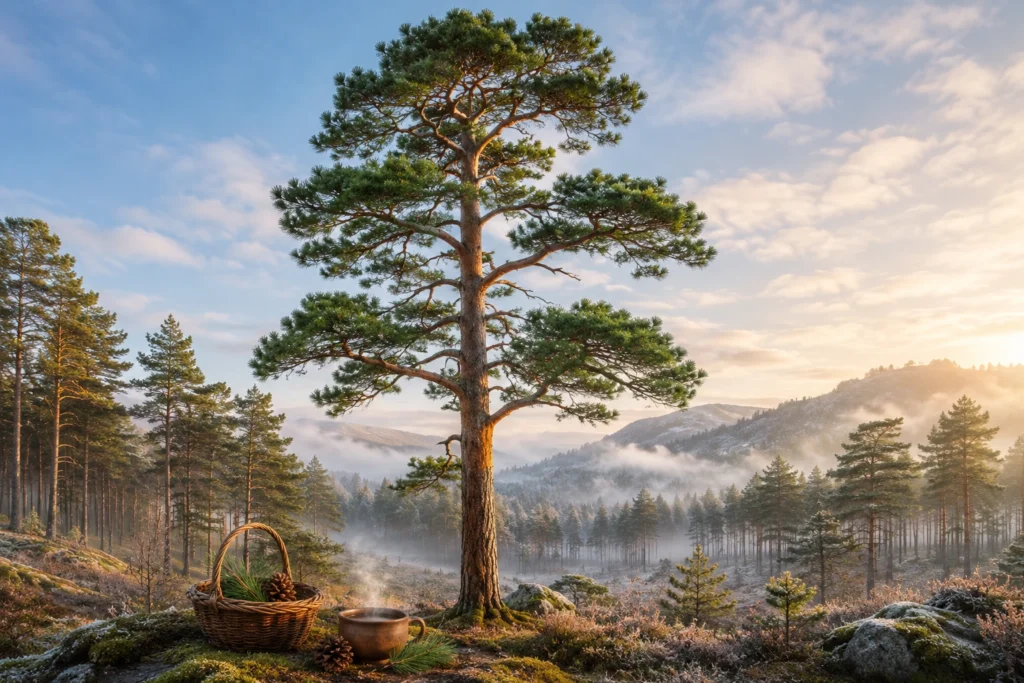
Secrets of the Fir Tree
The Fir Tree (Pinus syvestris)
Volume 16 of 31
Bruce Clifton
Fir Tree – (Ailim)
The Fir Tree stands tall and evergreen, rising above the forest as a symbol of endurance, vision and the continuance of life through darkness. Deeply rooted in Earth while reaching towards the heavens, it has become a tree of protection, purification and renewal — holding its green vitality through winter and reminding us that even in the darkest season, life remains.
Within Celtic Tree Lore and Ogham Tree Lore, the Fir is associated with Ailm or Ailim, while the old Irish tradition also gives us Ifra, a name connected with the Fir and its place among the sacred trees. These ancient associations lead us into a much wider story, where evergreen life, height, fragrance and resilience become expressions of the Fir Tree’s spiritual character.
The Fir is a tree of extraordinary contrasts. It is firmly rooted yet reaches towards the sky; enduring yet transformative; solitary in its great height yet inseparable from the forest around it. Its fragrant needles and resin have a long history within healing lore, cleansing and sacred smoke, while its evergreen presence has carried powerful symbolism through changing cultures, from ancient tree traditions to the Winter Solstice and Christmas tree.
Throughout this exploration of the spiritual meaning of the Fir Tree, we will follow those connections through Celtic and Ogham Tree Lore, folklore, healing, Animal Spirits, Totems and Entities, Gods and Deities, and finally into its Secret Harmonies. Together they reveal a tree whose deepest mystery is continuance — the ability to remain rooted, preserve the living essence within, and keep reaching towards the returning light.
Fir Tree – Ogham Tree Profile
Bruce Clifton
Name: Fir Tree
Ogham: Ailm – Ailim – Ah leem – Alleem
Letter: A
Lunar: Full Moon
Season: Winter
Element: Wind
Direction: North
Moon Phase: N/A
Moon Name: N/A
Influence: Feminine
Title: Shrub
Age: 5 Generation
Aura: Blue
Healing: Aches and Pains ~ Arthritis ~ Asthma ~ Bronchitis ~ Colds ~ Depression ~ Emotional Healing ~ Fatigue ~ Wound
Animal Spirit: Eagle ~ Robin Redbreast
Totems and Entities: ArchAngel Uriel ~ Druantia ~ Hildegard of Bingen ~ Holly Queen
Gods and Deities: Cailleach ~ Hermes Trismegistus ~ Lha
Secret Harmony: Love* ~ Saining ~ Sang
Festival: Winter Solstice (coming soon)
Cosmos: (coming soon)
Key Words: Progression ~ Insight ~ Correspondence
Essence of the Fir Tree
Bruce Clifton
The essence of the Fir Tree is continuance. Through the darkness and stillness of winter, when much of the forest has withdrawn into dormancy, the Fir remains green. It does not resist the season, nor does it escape it. Instead, it carries the living principle quietly within itself, reminding us that life may continue even when growth can no longer be seen.
Rooted deeply within Earth and rising high above the surrounding forest, the Fir unites endurance with vision. Its roots hold firmly to what is, while its crown looks beyond the immediate landscape towards what is yet to come. It teaches us that true endurance is not simply surviving difficulty, but retaining the ability to see beyond it.
At the Winter Solstice, this mystery reaches its fullest expression. The Fir stands evergreen at the darkest point of the year, just as the Sun begins its return. Darkness is neither denied nor feared; it becomes part of a greater cycle in which ending already contains the beginning of renewal. The Fir therefore carries a particular kind of hope — not the promise that darkness will never come, but the knowledge that darkness cannot extinguish the life held within.
Its fragrant needles and resin reveal another aspect of this essence. Through fire, what was held within the tree is released as fragrance and smoke, changing its form while preserving its nature. In this way, the Fir speaks of transformation without loss of self, of remaining true to our essence even as circumstances require us to change.
The Fir Tree therefore asks us to remain rooted, preserve what is living within us, and keep our sight upon the returning light. Its wisdom is not merely that we can survive the winter, but that something sacred can be carried through it — held, protected and continued until the season turns and life is ready to emerge once more.
Healing Lore of the Fir Tree
Bruce Clifton
The Healing Lore of the Fir Tree begins with the same quality that defines the tree itself: its ability to endure. Remaining green through winter, surviving cold and darkness, and filling the air with its distinctive resinous fragrance, the Fir has long suggested vitality, resilience and the preservation of life when the natural world appears to have withdrawn.
Its needles, resin, bark and aromatic oils have all found places within traditional healing practices, while the cleansing fragrance of the tree connects physical healing with purification of the space around us. Breath, warmth, protection and restoration become recurring themes, reflecting the Fir’s own capacity to remain alive and active throughout the winter months.
Yet the healing symbolism of the Fir reaches beyond the physical. Its evergreen nature reminds us that healing does not always mean returning to what we were before. Sometimes it is the quiet preservation of the life within us — enduring, adapting and holding our strength until the season changes and renewal can begin.
Scope & Notice
The information contained herein is for educational and entertainment purposes only. All efforts have been made to present accurate, up-to-date, reliable and complete information; however, no warranties of any kind are stated or implied. As readers, please acknowledge the author is not engaging in the rendering of medical or professional advice. The content herein should not be perceived as a substitute for professional or personal guidance. If in doubt, consult a professional before attempting any techniques outlined herein.
The appropriate dosage is contingent upon various factors, including the user’s age, health status, and additional conditions. It is important to remember that natural products are not necessarily safe, and dosages may be critical. It is always best practice to start with a lower dose and increase as necessary. Another important element is the time of day when the remedies are taken.
About the Healing List
This list of ailments is not complete in its entirety; it has been limited to the most popular, with the remedies coming firstly from the tree and then vegetation dependent on the tree. It is worthy of note that there is more than one way to make a cup of tea, and many of the ingredients can be purchased online.
Fir Tree – Healing Remedies Oracle
We have alphabetised this list of healing qualities of the fir tree solely for ease of reference, they include but are not limited to:
1) Aches and Pains
2) Arthritis
3) Asthma
4) Bronchitis
5) Colds
6) Depression
7) Emotional Healing
8) Fatigue
9) Wound
Aches and Pains / Fir Tree
Ingredients:
Fir Bark
Key Properties:
Antioxidant – Anti-inflammatory – Astringent
Traditional Actions:
Warming, easing muscular aches and stiffness, soothing inflammation, stimulating circulation, restorative support
Preparation:
Fir bark may be dried, broken into small pieces and gently simmered in water to make a traditional decoction. The strained liquid can then be added to a warm bath or used with a warm cloth over tired, aching muscles and joints. The warmth of the preparation, together with the natural aromatic qualities of the pine, has traditionally made this a simple remedy for easing stiffness and everyday aches and pains.
Traditional Use:
Fir has traditionally been valued as a warming and restorative tree, particularly during the colder months when aching muscles, stiff joints and tired limbs were part of everyday life. The bark was prepared in warm washes, compresses and baths, where the combination of heat and the aromatic character of the pine was used to ease stiffness, encourage movement and bring comfort back to an overworked body.
There is also something naturally invigorating about Fir. Its clean, unmistakable scent brings the freshness of the forest into the preparation, making it as much about reviving and restoring as soothing an ache. In traditional use, Fir therefore sits comfortably alongside warmth, rest and recovery — a simple woodland remedy for the ordinary aches and pains that come from work, weather and life.
Arthritis / Fir Tree
Ingredients:
Fir Bark
Fir Needles
Key Properties:
Antioxidant – Anti-inflammatory – Astringent – Aromatic
Traditional Actions:
Warming, soothing stiff and aching joints, supporting comfortable movement, encouraging circulation, restorative support
Preparation:
Fir bark and needles may be dried and gently simmered in water to make a traditional aromatic decoction. The strained liquid can be added to a warm bath or used with a warm cloth over stiff and troublesome joints. Fresh or dried needles may also be added directly to bath water, allowing their natural pine aroma to rise with the warmth and steam.
Traditional Use:
Fir has traditionally been associated with warmth, movement and relief from stiffness, making preparations from the bark and needles particularly suited to joints troubled by cold, damp weather or long periods of inactivity. Warm baths, washes and compresses brought together the heat of the water and the aromatic character of the pine, traditionally used to soothe stiffness, encourage circulation and make movement feel easier.
The needles bring another dimension to the remedy. As their familiar fragrance is released into warm water and steam, Fir becomes both warming and invigorating, bringing the freshness of the forest into a tired and uncomfortable body. Within traditional practice, Fir was therefore less about forcing pain away and more about restoring warmth and movement — supporting the body when stiffness has made it feel reluctant to move.
Asthma / Fir Tree
Ingredients:
Fir Needles
Key Properties:
Expectorant – Decongestant – Anti-inflammatory
Traditional Actions:
Opening and clearing, loosening congestion, supporting easier breathing, soothing irritated airways, refreshing and invigorating
Preparation:
Fir needles may be gently infused in hot water, allowing their natural aromatic oils to release with the warmth. Traditionally, the preparation was enjoyed for its fresh pine character, while the rising aroma was associated with clearing and opening the breath. The needles could also be added to warm bath water, where their fragrance was gradually released into the surrounding air.
Traditional Use:
Fir has traditionally been valued where breathing felt heavy, congested or restricted, particularly during the colder months. The needles release their familiar aromatic character when warmed, and preparations were traditionally used to clear congestion, loosen the chest and support freer breathing. Its fresh scent also gave Fir a reputation for clearing stale air and bringing a feeling of openness back into the body.
Fir’s fragrance is fresh, exhilarating and unmistakable, carrying something of the pine forest into the preparation — clean air, open space and that instinctive desire to breathe deeply after rain. When the chest felt heavy or burdened, the warmth and aromatic nature of the needles were traditionally used to bring freshness, clearing and release.
Breath enters, breath leaves, and with every breath there is movement and renewal. This is Bnwyfre, the Breath of Life, moving through us as naturally as the wind moves through the pine. Fir reminds us of something the forest has always known: to breathe is to feel life moving through us.
Bronchitis / Fir Tree
Ingredients:
Fir Needles
Fir Shoots
Key Properties:
Aromatic – Expectorant – Anti-inflammatory – Antimicrobial
Traditional Actions:
Warming and clearing, loosening congestion, encouraging expectoration, soothing a heavy chest, refreshing the breath
Preparation:
Fir needles or young shoots may be gently infused in hot water, allowing their aromatic qualities to release into the preparation. Traditionally this could be taken as a warm infusion, while the rising pine-scented steam was also appreciated when the chest felt heavy or congested. The needles may also be added to warm bath water, where their fragrance gradually fills the surrounding air.
Traditional Use:
Fir needles and young shoots have traditionally been used during the cold, damp months, particularly when coughs lingered and the chest became heavy with congestion. Warm pine preparations were valued for helping to loosen and clear phlegm, while their unmistakable fragrance brought freshness to breathing and warmth to a body worn down by winter illness.
There is something wonderfully simple about Fir in this respect. Warmth, steam and the scent of pine belong naturally together. As the needles release their fragrance, the preparation carries something of the rain-washed forest with it — fresh, clean and invigorating. With every clearing breath comes a little more movement, a little more ease, and the familiar rhythm of Bnwyfre, the Breath of Life.
Colds / Fir Tree
Ingredients:
Fir Needles
Young Fir Shoots
Key Properties:
Decongestant – Antimicrobial – Antioxidant
Traditional Actions:
Warming and clearing, easing stuffiness, loosening congestion, refreshing the breath, supporting recovery
Preparation:
Fir needles or young shoots may be gently infused in hot water, releasing their fresh pine fragrance into the warmth and steam. Traditionally the infusion was enjoyed warm during the colder months, particularly when the nose and chest felt stuffy or congested. The needles may also be added to a warm bath, surrounding the body with their familiar aromatic scent while providing warmth, rest and comfort.
Traditional Use:
Fir has long belonged to the cold days of winter, remaining green and aromatic when much of the woodland has fallen quiet. The needles and young shoots were traditionally gathered for warming preparations when colds brought stuffiness, congestion and that heavy, tired feeling that makes us want to retreat from the world for a while. Their strong pine fragrance was valued for clearing the senses and refreshing the breath, while a warm infusion offered simple comfort from within.
There is something reassuring about bringing the scent of an evergreen forest into the home during winter. Fir does not hurry the body; it accompanies the natural need for warmth, rest and recovery. As the fragrance rises with the steam and the senses begin to clear, Fir brings a little of the outside world back in — fresh air, green life and the promise that winter will eventually pass.
Depression / Fir Tree
Ingredients:
Fir Needles
Young Fir Shoots
Key Properties:
Aromatic – Stimulating – Restorative – Antioxidant
Traditional Actions:
Uplifting, awakening the senses, clearing mental heaviness, restoring vitality, encouraging renewed movement
Preparation:
Fir needles or young shoots may be gently infused in hot water, releasing their fresh aromatic character into the preparation. The infusion may be enjoyed warm, or the needles added to a warm bath, where their fragrance rises naturally with the steam. Simply crushing a few fresh needles between the fingers releases that unmistakable pine scent, bringing the freshness of the forest immediately to the senses.
Traditional Use:
Fir has traditionally carried a sense of renewal, vitality and life continuing through darkness. Evergreen throughout winter, it remains fresh and strongly scented when much of the woodland has withdrawn. Its needles are valued for their bright, invigorating fragrance, particularly during the darker months when energy could become low and the spirit heavy. Warm preparations brought scent, warmth and greenery into the home, helping to awaken the senses and lift stagnation.
There is something about walking amongst pine after rain that reaches beyond the fragrance alone. The air feels cleaner, the senses become sharper and attention returns naturally to the world immediately around us. Fir carries that same quality into traditional practice — not asking us to deny darkness, but reminding us that life remains within it. Like the Winter Solstice itself, Fir holds the promise that however long the night has become, the light has already begun its return.
Emotional Healing / Fir Tree
Ingredients:
Fir Needles
Fir Bark
Key Properties:
Aromatic – Restorative – Grounding – Cleansing
Traditional Actions:
Clearing emotional heaviness, restoring balance, encouraging reflection, releasing stagnation, supporting renewed direction
Preparation:
Fir needles may be gently infused in hot water, allowing their fresh fragrance to rise naturally with the warmth. The infusion may be enjoyed quietly or added to a warm bath, while a little dried bark may be simmered separately when a deeper, earthier preparation is wanted. Fir also lends itself naturally to meditation, where its scent, warmth and stillness create space for reflection and emotional release.
Traditional Use:
The needles may also be gathered, dried and lightly crushed, then allowed to smoulder as a traditional cleansing incense. Used in much the same way as sage and other cleansing herbs, the aromatic smoke can be carried through the home to freshen the atmosphere, clear stagnant energy and prepare a space for meditation, healing or spiritual work. Fir lends itself naturally to this practice, bringing the unmistakable scent and presence of the forest indoors.
This is where Druantia, Queen of the Dryads, becomes part of Fir’s deeper character. She is associated with insight for progression — recognising our mistakes, understanding the paths that brought us here and finding the courage to continue towards our dreams and aspirations. Fir does not ask us to forget yesterday or ignore tomorrow. She brings us back to the power of now, where healing, choice and movement can actually begin.
Fatigue / Fir Tree
Ingredients:
Fir Needles
Young Fir Shoots
Key Properties:
Aromatic – Stimulating – Restorative – Antioxidant
Traditional Actions:
Invigorating, awakening the senses, restoring vitality, clearing sluggishness, encouraging renewed energy
Preparation:
Fir needles or young shoots may be gently infused in hot water, releasing their fresh aromatic character into a warming drink. The needles may also be added to a warm bath, where the rising pine fragrance surrounds the body and awakens the senses. Fresh needles can be lightly crushed between the fingers to release their scent, making Fir particularly suited to those quiet moments when energy feels low and the body simply wants to wake up again.
Traditional Use:
Fir has traditionally been valued for its fresh, invigorating and restorative character, particularly through the long winter months when energy naturally begins to slow. Its evergreen needles remain vibrant when much of the surrounding woodland has withdrawn, and their unmistakable fragrance has long brought a sense of freshness and renewed vitality into the home.
Fir does not demand energy when there is none to give. There are times when tiredness simply asks for warmth, nourishment and rest, and Fir sits comfortably within that space. As strength begins to return, its bright woodland scent helps awaken the senses and encourages us gently back into movement. Like the first lengthening days after the Winter Solstice, renewal begins quietly — and then, almost without noticing, life starts moving again.
Wound / Fir Tree
Ingredients:
Fir Resin
Fir Bark
Fir Cones
Key Properties:
Astringent – Antimicrobial – Anti-inflammatory – Protective
Traditional Actions:
Cleansing, protecting damaged skin, soothing irritation, encouraging closure, supporting natural repair
Preparation:
Fir resin was traditionally collected from the tree and gently warmed until it became soft enough to work with. It could then be combined with a simple carrier such as oil or fat to make a protective salve or balm for the skin. Bark could also be dried and gently simmered in water, with the cooled and strained preparation used as a traditional cleansing wash around minor cuts, grazes and damaged skin.
Traditional Use:
Fir resin has a long association with protection, preservation and repair. Sticky and naturally protective on the tree itself, resin was traditionally gathered and worked into simple balms and salves for minor cuts, grazes, cracked skin and everyday damage. Bark preparations offered another approach, valued for their astringent and cleansing character when the skin needed looking after.
There is a lovely simplicity to the old understanding of resin: when the tree is wounded, it produces something that helps protect the wound. Our ancestors observed this and found their own uses for what the tree provided. Fir therefore carries protection in a very physical sense as well as a spiritual one — offering its resin as a natural barrier while the slow work of repair and renewal takes place beneath it.
Celtic Tree Lore of the Fir Tree
Bruce Clifton
The story of the Fir within Celtic Tree Lore belongs particularly to the northern landscape, where the Scots Pine once formed vast forests across the Highlands. Remnants of the ancient Caledonian Forest still survive today, preserving descendants of a woodland that covered much greater areas of Scotland thousands of years ago. For the people who lived and travelled among these forests, Pine was more than an evergreen presence. Its timber provided building material and fuel, its resin and fragrant needles were useful within everyday life, and its great age allowed individual trees to become familiar landmarks within mountain and glen.
Within the Ogham tradition, the Fir and Pine became associated with Ailm, the letter A and the first letter of the fourth aicme of the original twenty Ogham letters. The historical written name Ailm was pronounced and expanded as Ailim within later Gaelic and tree-lore traditions, the form preserved within the Ogham Tree Lore of The Spiritual Centre. Its precise botanical identity has never been entirely settled, yet the association with Pine and Fir has endured. Particularly evocative is an early Irish poetic reference to Pines making music, recalling the unmistakable voice created when wind moves through their needles and high branches.
The Pine also became woven into the customs and folklore of the Scottish Highlands. Evergreen branches, aromatic foliage, fire and smoke belonged to traditions of cleansing, blessing and Saining, while Pine remained green through the hardest months of the year. Old trees could become gathering places, boundary markers and keepers of local memory, acquiring stories that survived long after the people associated with them had disappeared. The famous Fairy Tree of Aberfoyle, a Scots Pine connected with the seventeenth-century minister and folklorist Robert Kirk, is one later example of the Pine becoming a meeting place between human history and the Celtic Fairy tradition.
The Scots Pine also carries the memory of the people themselves. Trees were preserved or planted around significant places, while Highland clans developed strong associations with particular plants and trees, including the Pine. Such traditions reveal something easily lost when Celtic Tree Lore is reduced simply to lists of symbolic meanings: these were trees encountered within lived landscapes. They provided shelter, warmth and materials, marked familiar places and accumulated generations of story around their roots.
Within Celtic Tree Lore, the Fir therefore carries the memory of the old northern forest. It belongs to Highland and Gaelic landscape, to the music of Pine branches, to Saining and fragrant woodland custom, to Fairy lore and to generations who lived beneath its evergreen crown. Long before its meanings were gathered onto the written page, the Scots Pine was already telling its story within the forests of the Celtic lands.
Folklore of the Fir Tree
Bruce Clifton
Fir belongs to the old forests of the north, rising tall above the woodland and remaining green through the hardest months of winter. In Celtic lands, particularly amongst the ancient pinewoods of Scotland, these trees became part of a landscape where human life, animal life and the spiritual world existed alongside one another. Generations could pass beneath an old Fir while the tree remained, watching people enter this world, live their lives and eventually leave it again.
Within the forest dwells Druantia, Queen of the Dryads, guardian of the trees and the knowledge held within them. Dryads know the lives that unfold beneath their branches; there are few secrets that can be kept from a forest that has watched generations come and go. Druantia may be approached for insight and progression, helping us recognise mistakes, understand what they have taught us and avoid carrying the same patterns endlessly forward. Around her gather the Dryads, Fae and Gnomi, and when the winter wind moves through the branches, Fir becomes their music. As Beech sings in summer and Poplar in autumn, Fir sings through the winter.
That song did not remain solely within the forest. Fir and pine woods became prized for their resonance and ability to carry sound, finding their way into musical instruments where the voice of the tree could continue beneath human hands. There is something wonderfully fitting in the old Fir singing first with the wind and then, when fashioned into an instrument, being given another voice.
In Scotland the strength and straight growth of pine also found expression in the Highland caber. A great trunk, stripped of its branches and prepared for tossing, became the centre of one of the most recognisable Highland tests of strength and judgement. Tossing the caber is not simply about throwing something heavy; the caber must be balanced, lifted and turned so that it falls correctly. The tree that once stood upright within the forest becomes a measure of strength, balance, skill and determination.
Fir also carried harmony into the home. Evergreen branches and garlands were brought inside during the darkness of winter, keeping something green and living close while the landscape outside slept. Needles could be dried and allowed to smoulder, their aromatic smoke carried through a room to cleanse the atmosphere and clear unwanted or stagnant energy. Resin, bark, needles and wood all found their uses, reinforcing the old understanding that a generous tree should not be wasted.
The animals of the pinewood belong to its folklore as surely as the tree itself. Deer and Stag move beneath its branches, while birds look to the canopy and smaller creatures disappear into the protection of its needles and bark. Eagle carries the far sight of the upper branches, seeing across the landscape from a place few others can reach. Ladybird, sheltered deep within the tree through winter, carries her own association with protection and good fortune. Fir becomes not merely a tree but a sanctuary, offering different worlds at its roots, within its trunk and high amongst its branches.
This harmonising character becomes particularly powerful around midwinter and the Winter Solstice. When the Sun reaches its lowest point and the longest night arrives, Fir remains green. The darkness may be at its greatest, yet within the evergreen there is no suggestion that life has ended. The tree carries the old promise that the wheel will turn, the days will lengthen and life will rise again.
Beneath all of this lies another forest, unseen beneath our feet. Roots reach into the earth amongst the threads of mycelium, while Bnwyfre, the Breath of Life, moves through the forest above and below. Fir stands between these worlds: roots buried within darkness, trunk occupying the land of the living and branches reaching upwards into Air and sky.
Perhaps this is why the Fir carries so many stories. She is shelter, music, strength, protection and witness. Druantia and her Dryads know what has passed beneath these trees and what has been whispered amongst them. Walk through an old pine forest in the rain and the fragrance rises while the branches begin to move overhead. Stay there long enough and the distinction between wind and song becomes less certain.
The old belief is simple enough: when the Fir begins to sing, have the wisdom to listen.
Animal Spirit of the Fir Tree
Bruce Clifton
The Animal Spirits of the Fir Tree reveal two very different perspectives upon its enduring nature. Rising above the surrounding forest, the Fir becomes a place of height, vision and watchfulness. From its crown, the landscape opens and distant things become visible, creating a natural correspondence with creatures whose gifts are sight, awareness and the ability to recognise what lies beyond the immediate horizon.
The Eagle carries this elevated vision. Far-sighted and purposeful, it sees both the wider landscape and the distant target, bringing qualities of clarity, direction and psychic sight to the Fir. Its perspective reminds us that seeing clearly sometimes requires us to rise above what surrounds us, while remaining aware of where we are rooted.
Closer to Earth, the Robin carries another aspect of the Fir’s story. Its familiar presence in winter and its enduring place within Christmas tradition connect it with the evergreen tree, the Christian festival and the persistence of life through the darkest season. Where the Eagle looks outward from the Fir’s highest branches, the Robin remains close to its winter heart.
Together, these Animal Spirits express vision and continuance. One looks beyond the present towards what may yet be; the other remains through winter as a small but persistent sign of life. Within the Fir, they remind us both to see what lies ahead and to preserve what must endure.
Fir Tree – Animal Spirit Oracle
Bruce Clifton
We have alphabetised this list of animal spirit that harmonise with the fir tree solely for ease of reference; no sense of hierarchy or entitlement is intended or implied:
1) Eagle
2) Robin Redbreast
Eagle / Fir Tree
High amongst the branches of the Fir, Eagle takes the higher ground, watching the land below with patience and extraordinary sight. Within the tree’s folklore, Eagle brings wisdom, protection and knowledge of territory — knowing what belongs within our world and recognising what does not. Fir provides the strong, enduring place from which Eagle can observe, while Eagle reminds us to rise above confusion, protect what matters and see the wider path ahead. Together they carry the qualities of strength, ancestral wisdom and clear sight, joining the rooted knowledge of the ancient tree with the freedom of the open sky.
Robin Redbreast / Fir Tree
Amongst the evergreen branches of the Fir Tree, Robin Redbreast arrives as a messenger from Spirit. His bright red breast against the deep green needles is a reminder that those we love remain close, even when they have passed beyond our sight. Fir carries endurance and the continuation of life through the darkness, while Robin brings reassurance, guidance and the promise of new beginnings. When Robin chooses the shelter of the Fir, listen for what is being said — Spirit is close, love remains, and something new is waiting to begin.
Totems and Entities of the Fir Tree
Bruce Clifton
The Totems and Entities of the Fir Tree gather around one of its deepest mysteries: the power of life to continue. Rooted within Earth yet remaining green through the darkness of winter, the Fir becomes a living symbol of endurance, renewal and the unseen forces that sustain life when the outer world appears still.
Within these correspondences, Earth provides foundation and strength, while the living presence within the tree reveals a spirit that reaches beyond its physical form. Greenery and evergreen life become expressions of vitality itself — a reminder that beneath winter’s silence, the current of life has never disappeared. At the turning of the Winter Solstice, this mystery becomes especially powerful, as darkness reaches its fullness and the returning light begins.
The Totems and Entities associated with the Fir therefore reveal different aspects of the same enduring principle. They lead us towards the sacred Earth beneath its roots, the Spirit dwelling within the tree, the greening force flowing through its being and the ancient turning of darkness into light. Through them, the Fir becomes more than a survivor of winter: it becomes a guardian of continuance, holding life within itself until the world is ready to grow again.
Fir Tree – Totems and Entities Oracle
Bruce Clifton
We have alphabetised this list of totems and entities that harmonise with the fir tree solely for ease of reference; No sense of hierarchy or entitlement is intended or implied:
1) ArchAngel Uriel
2) Druantia
3) Hildegard of Bingen
4) Holly Queen
ArchAngel Uriel / Fir Tree
Archangel Uriel walks with the fir through the stillness of winter, when the forest rests beneath snow and the strength of the evergreen becomes most apparent. Uriel is of the North, Winter and Earth, while the fir rises from that frozen Earth and reaches towards the heavens, remaining green when much of the surrounding woodland has fallen dormant.
The fir becomes a meeting place between Earth and Air, its roots anchored within the realm of the Gnomi while its towering crown moves amongst the winds. Through this union, Uriel brings stability, wisdom and illumination, encouraging us to remain grounded while allowing thought and spirit to rise beyond the limitations of the physical world.
At the Winter Solstice, when darkness reaches its greatest extent and the returning light is born, the presence of Uriel within the fir becomes particularly powerful. The evergreen reminds us that life has never disappeared beneath the winter landscape. It waits, breathes and gathers strength. Uriel carries the divine light through that darkness, revealing renewal already forming within the silence.
To encounter Archangel Uriel through the spirit of the fir is therefore to encounter endurance, illumination and the quiet certainty of continuation. The tree stands steadfast within the North, while Uriel reminds us that even within the deepest winter, light, wisdom and life remain present.
Druantia / Fir Tree
Among the ancient Fir forests, where evergreen branches rise above a floor of moss, stone and fallen needles, Druantia walks as Queen of the Dryads. The individual tree may shelter its own spirit, but Druantia belongs to the woodland itself, moving through root, branch and the hidden pathways beneath the earth. Within the Fir forest, her presence is not confined to a single trunk. She is felt throughout the living community of trees.
The Fir reflects Druantia’s sovereignty through its strength, endurance and evergreen nature. When winter strips the woodland bare, the Fir remains clothed in green, carrying life through the darkest part of the year. At the Winter Solstice, when daylight reaches its shortest span, the forest becomes her sanctuary. Wind moves through the high branches, the scent of pine fills the cold air, and beneath the ground the roots remain joined through the great web of the woodland.
Here Bnwyfre, the Breath of Life, continues to flow even when the outer world appears still. Druantia governs this unseen exchange, moving between the Dryads, the Gnomi, the Fae and the countless intelligences that inhabit the forest. She reminds us that no tree truly stands alone. Beneath our feet lies an ancient community of root and mycelium, exchanging nourishment, carrying messages and sustaining the greater woodland.
To enter the Fir forest of Druantia is therefore to enter a realm of living sovereignty. She teaches us to stand tall without becoming rigid, to endure without closing ourselves to change, and to recognise the invisible relationships that sustain all life. Beneath the evergreen canopy, Druantia reminds us that the forest is not simply a collection of trees. It is one living presence, breathing through many forms.
Hildegard of Bingen / Fir Tree
There is something profoundly Hildegardian about the Fir Tree in winter. When the woodland has surrendered its leaves and the earth appears to sleep beneath frost and snow, the Fir refuses to relinquish its green. Its needles remain alive against the grey winter sky, carrying colour through the darkest months as though guarding a secret flame. Hildegard of Bingen gave a name to this living power: viriditas, the greening life force, the divine vitality she perceived moving through plants, people and the whole body of creation.
For Hildegard, greenness was far more than colour. Viriditas was the visible expression of an invisible vitality, the power through which life rises, heals, flowers and renews itself. Beneath the Fir this becomes wonderfully tangible. Crush a needle between the fingers and its fragrance is immediately released; touch its evergreen branches in midwinter and there is still softness, scent and life. The tree appears to whisper what Hildegard understood centuries ago: life does not disappear simply because the season has grown dark.
Yet Hildegard sometimes found that the language available to her could not adequately express the world she experienced. She therefore created her extraordinary Lingua Ignota, the “Unknown Language”, developing hundreds of her own words and even an accompanying alphabet. It was a language uniquely hers, born from a desire to give expression to realities for which ordinary speech seemed insufficient. She was not simply searching for different words, but reaching beyond the boundaries of familiar language towards something capable of carrying the richness of her visionary understanding. In this she stands remarkably close to Bnwyfre, where language becomes more than description and begins to give voice to the subtle realities moving between the seen and unseen worlds.
Within the Fir forest, viriditas and Bnwyfre meet. Hildegard’s greening vitality and Bnwyfre, the Breath of Life, speak of the same profound recognition that creation is not inert, but alive with movement, relationship and unseen energy. The Fir carries that truth through winter. Beneath the soil, roots remain connected; within the evergreen needles life continues; through the branches the winter wind sings. What appears silent is not empty. The forest is still breathing.
Perhaps this is why Hildegard belongs so naturally beneath the Fir. She listened for the language hidden within creation and spent her life trying to give that language a human voice. Among the evergreens, where green life survives the longest night and the fragrance of Fir rises into the cold air, her vision becomes almost tangible. Viriditas is no longer merely a word. It is the green Fir standing in winter, quietly proclaiming that the Breath of Life has never left the forest.
Holly Queen / Fir Tree
Within the deep green of the Fir forest, the Holly Queen finds a natural companion. Both belong to the evergreen world, carrying colour and vitality through the season when much of the woodland has withdrawn into sleep. As frost settles upon the earth and the days shorten towards the Winter Solstice, the Fir remains steadfast beneath her gaze, its needles holding their green against the cold and its ancient roots keeping faith with the sleeping land.
The Holly Queen governs the darker half of the year, yet hers is not a darkness of death or emptiness. It is the fertile darkness in which renewal is quietly prepared. The Fir understands this mystery. Even upon the shortest day, when the sun hangs low and winter appears to have claimed the forest, life continues within root, bark and evergreen needle. Bnwyfre, the Breath of Life, has not departed; it has simply drawn inward, gathering itself before the return of light.
At the Winter Solstice, the relationship between Queen and tree becomes especially beautiful. This is the threshold at which darkness reaches its fullness and begins to yield. The Holly Queen prepares to relinquish her crown as the returning sun strengthens, while the Fir stands between the departing darkness and the approaching light. Its branches rise through the winter air like great green clouds, sheltering the life beneath them and carrying the fragrance of the forest into the cold.
To encounter the Holly Queen through the Fir is therefore to understand evergreen sovereignty: the strength to remain alive without demanding that life must always flower. She teaches that there are seasons for brightness and seasons for stillness, and that neither exists without the other. Beneath the Fir, her wisdom is held in living green, reminding us that within the longest night, the returning light has already begun its journey home.
Gods and Deities of the Fir Tree
Bruce Clifton
The sacred character of the Fir reaches beyond the tree itself and into the presence of Gods and Deities whose stories reflect its deeper mysteries. Across different traditions, these divine figures embody qualities already encountered within the Fir: endurance through darkness, transformation, protection, purification, the turning of the seasons and the passage between Earth and the realms of Spirit.
Some associations arise through ancient landscape and tradition, while others reveal themselves through correspondence. The evergreen nature of the Fir, its fragrant resin and cleansing smoke, its strength through winter and its upward-reaching form all provide points of connection with divine beings whose influence moves between the earthly and the unseen.
These relationships should not be understood as suggesting that every culture formally dedicated the Fir to a particular deity. Rather, they invite us to recognise recurring spiritual patterns. Just as the Fir remains rooted in Earth while reaching towards heaven, the Gods and Deities associated with it can become bridges through which its mysteries are explored, experienced and understood.
Fir Tree – Gods and Deities Oracle
Bruce Clifton
We have alphabetised this list of gods and deities that harmonise with the fir tree solely for ease of reference; No sense of hierarchy or entitlement is intended or implied:
1) Cailleach
2) Hermes Trismegistus
3) Lha (Tibetan Mountain Deities)
Cailleach / Fir Tree
High among the mountains, where winter settles upon the land and the wind moves freely across stone and forest, Cailleach walks among the ancient Scots Pines. She is the ancient Gaelic figure of winter, mountain, storm and frozen earth, belonging to the wild places where the landscape seems almost untouched by time. Here the Fir rises naturally within her realm, its roots holding the mountain while its evergreen crown reaches into the cold and restless sky.
When the deciduous woodland has surrendered its leaves, the Scots Pine remains green beneath the winter snows. Frost may whiten its branches and darkness may linger across the mountains, yet the tree continues to breathe. At the Winter Solstice, when the night reaches its greatest depth, the Pine carries a quiet promise within its needles. Beneath bark and root, Bnwyfre, the Breath of Life, has never departed; it rests within the forest, waiting for the returning light.
There is something of Cailleach herself within these old trees. Generations of wind have twisted their trunks and opened their great branches into strange, cloud-like crowns, suspended between mountain and heaven. They have learned neither to conquer the storm nor flee from it, but to become shaped by its passing. Earth holds their roots, Air sings through their branches, and above them clouds gather and dissolve as though the forest and sky are breathing together.
Perhaps this is where the deeper mystery of the Fir begins. Its roots disappear into darkness while its branches wander among the clouds; its fragrant needles carry the memory of summer through winter and, when touched by fire, surrender themselves as perfume and rising smoke. Earth becomes tree, tree becomes fragrance, fragrance becomes Air, and what was held within the forest begins its journey towards the heavens.
Across distant traditions this same movement appears again and again, whispered through alchemy, sacred smoke and the mysteries of above and below, revealing deeper connections within the Secret Harmonies of the Fir Tree.
Hermes Trismegistus / Fir Tree
Beneath the ancient Fir, the teachings attributed to Hermes Trismegistus seem almost to take physical form. “As above, so below” is written into the tree itself: roots descend unseen into the darkness of Earth while the trunk rises towards the heavens, carrying life between the two. High above, the mature Scots Pine divides into great irregular branches, forming islands of foliage that resemble clouds suspended around a central axis. In their pattern we may glimpse an echo of the Kabbalistic Tree of Life, where different expressions of divine energy remain connected as parts of a greater whole.
The Fir does not merely stand within the elements; it is continually transformed by them. Earth anchors its roots, Water rises through its trunk, Air moves through its needles and Fire releases the fragrance held within its resin and wood. The Scots Pine grows with the prevailing wind, bending, twisting and strengthening beneath forces that might otherwise break it. Its eventual form becomes a record of everything that has moved through it. What appears to be resistance is something subtler: the tree receives energy, yields to it, redirects it and makes it part of itself.
Here the Fir becomes an image of alchemy. Transformation does not require one energy to disappear before another can begin. Water becomes sap; sap feeds needle and branch; wood becomes flame; fragrant resin becomes smoke; smoke passes into Air. One state reaches its completion as another is born from it, each flowing into the next without ever truly becoming separate. Within this movement we may recognise Bnwyfre, the Breath of Life, passing continually between visible and invisible expression.
Hermes Trismegistus therefore invites us to look beyond the physical shape of the Fir and recognise the living correspondence between above and below, matter and spirit, ending and beginning. Root, trunk, branch, cloud, flame and rising smoke become stages within a single movement of transformation. The Fir does not simply teach us to withstand change; it reveals how one force may become another, how an ending may already contain its beginning, and how the energies of Earth, Water, Air and Fire continually meet, separate and return to the whole. These correspondences lead naturally towards the deeper alchemy explored within the Secret Harmonies of the Fir Tree.
Lha / Fir Tree
High upon the Tibetan Plateau, among mountains that seem to rise directly into the heavens, the Lha belong to a world in which landscape and spirit remain intimately entwined. Lha are not a single god or goddess, but divine beings and deities within Tibetan tradition, associated with the celestial realm, sacred mountains and the spiritual forces surrounding human life. Between the mountain below and the open sky above, fragrant evergreen smoke provides one means through which the earthly and divine may approach one another.
Within Lha Sang, aromatic evergreen material, most characteristically juniper, is offered to fire so that its fragrant smoke may rise into the air. Sang carries the meaning of cleansing and purification, while Lha Sang directs this sanctifying offering towards the Lha. What begins as physical vegetation is transformed by flame into fragrance and curling smoke, drifting upwards until it resembles the clouds themselves. The offering is no longer something that can be held within the hand; it has passed from plant to fire, fire to smoke, and smoke into Air.
Thousands of miles to the west, an intriguing echo can be found within British and Celtic traditions surrounding the Pine, where dried aromatic needles have likewise been burned for cleansing, blessing and prosperity. These distant peoples need never have met for such similarities to arise. Both inhabited landscapes in which evergreen conifers released their distinctive fragrance when touched by fire, and perhaps each independently recognised the same simple mystery: fragrant evergreen meets flame, cleansing smoke rises, and human intention follows it towards the heavens.
The mature Scots Pine seems almost to embody this journey before a single needle is burned. Its roots disappear into Earth while its trunk climbs towards the sky, eventually opening into great irregular branches whose foliage can resemble clouds suspended around the tree. Wind passes freely between them, carrying scent through the forest. The tree itself appears to trace a pathway from earth towards heaven, while its burning needles repeat that ascent in another form: Tree becomes fragrance, fragrance becomes smoke, and smoke becomes cloud.
Whether such correspondences arose through distant cultural exchange or simply through different peoples listening to the same natural world remains an open and fascinating question. Perhaps neither tradition needed to teach the other; perhaps the evergreen itself was the teacher. Across mountain, forest and immense distance, the same relationship between plant, Fire, Air, purification and the heavens could be discovered again and again, revealing one of the deeper patterns explored within the Secret Harmonies of the Fir Tree.
Secret Harmonies of the Fir Tree
Bruce Clifton
The Secret Harmonies of the Fir Tree begin with correspondence. Rooted within Earth yet reaching high into Air, the ancient Scots Pine gathers the Elements around itself and allows each to shape what it becomes. Water rises through its living body, wind forms its branches, Fire releases the fragrance concealed within its needles, while Bnwyfre as Life Force Energy moves through the whole. Nothing exists alone. Root corresponds with crown, Earth with heaven, tree with forest, and one expression of energy continually gives way to another.
Within these correspondences we begin to encounter the alchemy of the Fir. Transformation is not destruction, but continuation in another form. Needle becomes fragrance, fragrance becomes smoke, smoke becomes cloud; darkness reaches the Winter Solstice and begins its return towards light. The Fir bends beneath the wind without surrendering its nature, teaching that change need not require the loss of self. One energy completes while another begins, and for a moment both belong to the same transformation.
This same harmony appears within spiritual traditions separated by immense distance. Scottish Saining and Tibetan Sang each recognise sacred meaning within cleansing, fragrant smoke and spiritual correspondence. The forest reveals the same principle in another form: tree, root, mycelium, creature, Element and Spirit remain distinct, yet participate within something greater. Perhaps this is one of the deeper meanings of Love: not sameness, possession or surrender of identity, but the ability to remain completely oneself while belonging completely to the whole.
The Secret Harmonies of the Fir therefore invite us to look beyond individual symbols and recognise the relationships between them. Earth and heaven, matter and Spirit, individual and collective, ending and beginning are not necessarily opposites. Beneath the ancient crown of the Scots Pine, they become correspondences within the same living harmony, inviting us not merely to understand the sacred, but to recognise our own place within it.
Fir Tree – Secret Harmonies Oracle
Bruce Clifton
We have alphabetised this list of secret harmonies of the fir tree solely for ease of reference; No sense of hierarchy or entitlement is intended or implied:
1) Love*
2) Saining
3) Sang (Tibetan)
Love* / Fir Tree
The Fir Tree teaches Love through belonging. Within the forest, no tree is required to surrender its individuality in order to become part of the whole. Fir remains Fir, Birch remains Birch, Oak remains Oak, while beneath them roots, fungi, soil, water and countless forms of life enter into correspondence. Difference remains, but separation softens. The forest becomes a collective precisely because each life is permitted to be what it is.
This is the deeper expression of unconditional Love. It does not ask another being to change before relationship becomes possible, nor does it demand agreement, similarity or possession. It is the release of resistance that allows harmony to arise between differences. The Fir demonstrates this beautifully in winter, standing among neighbouring trees, enduring wind, frost and darkness without withdrawing from the greater woodland to which it belongs.
Through Bnwyfre as Life Force Energy, this correspondence becomes movement. Energy passes through root and mycelium, Water and soil, branch and Air, creature and tree. Nothing exists entirely for itself, yet nothing needs to lose itself within the collective. Individuality and unity are not opposites. They are participants within the same living harmony, each giving something of itself while remaining completely itself.
Perhaps this is why Sang and Saining lead us naturally towards Love. To open ourselves to the Elements, Totems, Entities, Gods, Deities and the greater collective of Spirit is to release the need to determine beforehand what Spirit must look like or how it must answer. Beneath the Fir, Love becomes something greater than affection: the acceptance of difference without separation, the surrender of resistance without surrendering the self, and the recognition that we already belong to something greater than ourselves.
Sang (Tibetan) / Fir Tree
Sang is the opening of a spiritual correspondence. Within Tibetan tradition, fragrant evergreen, most characteristically juniper, is offered to Fire so that its cleansing smoke may rise towards the heavens. Within Lha Sang, this correspondence reaches towards the Lha, the collective of divine beings and deities, inviting relationship between humanity, nature and Spirit. Yet the smoke is more than an offering carried upwards. It cleanses the sacred space, prepares the mind and spirit, and creates a moment in which we may open ourselves to Totems, Entities, Gods, Deities and the greater collective of Spirit, inviting those who come with protection, guidance, healing and wisdom to draw close.
Within the Secret Harmonies of the Fir Tree, dried Fir or Pine needles may become part of this same spiritual correspondence. Allowed to smoulder safely upon a suitable heat source, their fragrance slowly fills the space while the smoke begins its ascent. We may acknowledge Earth, Air, Fire and Water, calling upon the spiritual beings and Totems who correspond with each Element before opening the invitation more widely to Spirit. There is no need to know every name, nor to decide beforehand who should answer. This is not a command to Spirit, but an act of recognition: we honour your presence, we welcome your protection, and we open ourselves to the guidance that walks with us.
And within that moment lies the romance of alchemy. The Fir has gathered Earth through its roots, received Water into its living body and allowed Air to shape its branches throughout a lifetime. Now Fire touches the needle and releases what was concealed within. The solid becomes fragrance; fragrance becomes smoke; smoke becomes cloud. Nothing simply ends; it changes its expression. One energy reaches fulfilment as another begins, and between them flows Bnwyfre as Life Force Energy, continually moving, transforming and finding another form through which to live.
The Scots Pine carries this correspondence within its very shape. Its roots descend into the darkness of Earth while its trunk rises towards the heavens, opening eventually into those ancient, irregular crowns that resemble clouds resting amongst its branches. Below corresponds with above; root answers crown; Earth answers Heaven. When its aromatic needles meet Fire, the correspondence begins again, only now we participate within it. Tree becomes smoke, smoke joins Air, intention accompanies fragrance, and the physical and spiritual worlds are brought into relationship. As above, so below; as within, so without.
Perhaps this is why similar sacred-smoke traditions could arise among peoples separated by mountains and continents. They need not have taught one another. Nature may have revealed the correspondence to them both. Within the philosophy of the Bnwyfre Spiritual Order, Sang therefore becomes more than purification and more than invocation. It becomes a moment of communion, an alchemy of Element, Life Force Energy, humanity and Spirit, in which we cease merely to observe the sacred and allow ourselves, for a little while, to become part of its correspondence.
Saining / Fir Tree
Within the old landscapes of Scotland, Saining belongs to the art of restoring harmony. Through fire, water, fragrant plants, spoken blessing and ritual movement, people, animals and places could be cleansed and brought once more into spiritual correspondence. The practice belongs naturally beside the Scots Pine, an ancient evergreen that carries its fragrance through winter and stands between Earth and sky, gathering the Elements within its living form.
The Fir understands Saining because it understands relationship rather than resistance. Its roots correspond with Earth, Water rises through its trunk, Air moves continually amongst its needles and Fire releases the fragrance held within its resinous wood and foliage. Even the Highland wind becomes part of the tree. The Scots Pine does not simply fight against it; over generations it bends, twists and grows within its movement, allowing one energy to meet another until the shape of the tree becomes a record of their correspondence.
Within Saining, aromatic evergreen may be offered to Fire and allowed to smoulder, releasing fragrant smoke into the surrounding Air. The purpose is not to drive away an evil spiritual presence, but to cleanse incompatibility and restore harmony. As the fragrance moves around a person, animal, home or sacred space, we may acknowledge the four directions and their correspondence with Earth, Air, Fire and Water, opening ourselves to the Totems, Entities, Gods, Deities and collective of Spirit who walk within the greater harmony of nature.
There is a quiet alchemy within this act. What was held within the tree is surrendered to Fire and given another existence. Needle becomes fragrance, fragrance becomes smoke and smoke enters Air, while Bnwyfre as Life Force Energy continues through every change. Nothing has simply vanished; one expression has completed itself and another has begun. Saining becomes an act of realignment, allowing human, tree, Element and Spirit to find their correspondence once more.
And here the Fir reveals one of its most beautiful Secret Harmonies. Far beyond the Celtic lands, Tibetan Sang discovered its own spiritual relationship with aromatic evergreen, Fire, cleansing and rising smoke. Neither tradition needs to have borrowed from the other. Perhaps both simply listened to nature and discovered the same correspondence: when the Elements are brought together with spiritual intention, the smoke does more than rise; it gathers Earth, nature, humanity and Spirit into harmony.