
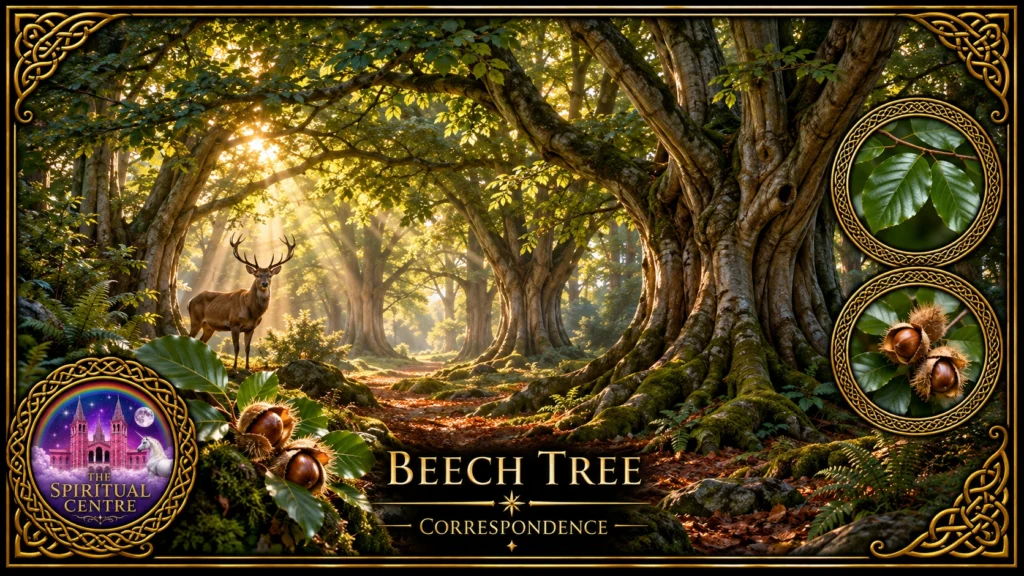
Secrets of the Beech Tree
Beech Tree (Fagus sylvatica)
Volume 24 of 31
Bruce Clifton
Beech Tree ~ Phagus
Within Celtic Tree Lore, The Beech Tree is known as Phagus, the Chieftain, carrying the qualities of Correspondence, Harmony, Memory and Wisdom. Its place amongst the later Forfeda of the Ogham Tree Lore is surrounded by intrigue, arriving from beyond the landscape of the original Irish Ogham and bringing with it the sacred Beech groves, folklore and spiritual traditions of a much wider European woodland.
The spiritual meaning of The Beech Tree grows from this extraordinary relationship between life and time. Its wisdom is not distant or solemn, but accumulated through experience: animals beneath its canopy, spirits amongst the trees, people returning to familiar places and one generation leaving something for the next. Beech reminds us that wisdom does not require us to know everything. Sometimes it begins by remaining curious enough to discover what is already waiting beneath the trees.
Beech Tree – Ogham Tree Profile
Bruce Clifton
Group: 5th Aicme ~ Forfeda
Name: Beech
Ogham: Phagus >>> Fay-gus ~ Fay-gos
Letter: PH
Lunar: Universal
Season: Summer ~
Element: Earth ~ Air ~ Spirit
Direction: South
Moon Phase: Universal
Moon Name: Universal
Influence: Unified
Title: Chieftain
Age: Six Generations
Aura: Blue ~ Indigo ~ White
Healing: Aches & Pains ~ Acne ~ Diarrhoea ~ Fevers ~ Haemorrhoids ~ Inflammation ~ Toothache ~ Wound
Animal Spirit: Crow ~ Mouse ~ Squirrel ~ Stag
Totems – Entities: Arch-Angel Gabriel ~ Druantia ~ Dryads ~ Fagus ~ Hildegard of Bingen ~ Merlin ~ Silvani
Gods – Deities: Cronos ~ Diana ~ Gaia ~ Jupiter
Secret Harmonies: Afterlife Awareness ~ Elysium ~ Familiar Knowledge ~ Harmony ~ Hermeticism ~ Living Memory ~ Synchronicity ~ Universal Knowledge
Festival: (coming soon)
Cosmos: (coming soon)
Key Words: Correspondence ~ Harmony ~ Memory ~ Wisdom
Essence of the Beech Tree
Bruce Clifton
There is a quiet confidence within an ancient Beech wood. Beneath the great canopy, smooth silver-grey trunks rise like pillars and the outside world seems to become distant. Light filters through thousands of leaves, footsteps soften upon the woodland floor and everything carries the unmistakable presence of somewhere that has existed for a very long time.
The essence of Beech is found within that longevity. A mature tree may share its lifetime with several generations of people, watching children become parents and grandparents while seasons repeatedly transform the woodland around them. This is Living Memory: not simply remembering what has passed, but allowing experience to remain part of what continues.
With time comes Correspondence. Roots meet soil and mycelium, branches become shelter, mast becomes food, animals establish familiar pathways and generations of people discover the same shade beneath the canopy. None of these relationships needs to surrender its individuality. Their lives simply overlap, and through that familiarity emerges the Harmony that belongs so naturally to Beech.
This gives the tree its distinctive character of quiet, humble and confident strength. There is no need for wisdom to announce itself when it has been gathered through centuries of experience. Beech carries the presence of the elder, teacher, diplomat and Chieftain: able to listen, observe and recognise patterns because so much has already been witnessed.
Its relationship with knowledge extends naturally into human history. Beech became associated with writing, books and the preservation of words, while ancient groves acquired sacred meaning across different European cultures. Knowledge was spoken beneath trees, carved into wood, written upon tablets, carried between generations and continually interpreted anew. The Beech became not merely a symbol of knowledge, but a beautiful correspondence for the way knowledge itself survives.
Through the woodland flows Bnwyfre, connecting root, leaf, animal, spirit and human presence within the same living landscape. Every encounter adds something without erasing what came before. Memory deepens, relationships develop and understanding grows through experience.
This is the essence of the Beech Tree: Correspondence, Harmony, Memory and Wisdom — not separate qualities, but stages of the same unfolding relationship. Correspondence creates connection; connection allows Harmony; Harmony preserves Memory; and through the accumulation of Memory, Wisdom quietly grows.
Healing Lore of the Beech Tree
Bruce Clifton
Scope & Notice
The information contained herein is for educational and entertainment purposes only. All efforts have been made to present accurate, up-to-date, reliable and complete information; however, no warranties of any kind are stated or implied. Readers should acknowledge that the author is not engaged in the rendering of medical or professional advice. The content herein should not be perceived as a substitute for professional or personal guidance. If in doubt, consult a qualified professional before attempting any techniques outlined.
The appropriate dosage or application of any natural remedy is dependent upon various factors, including age, health status, and individual circumstances. Natural products are not inherently safe, and dosage may be critical. It is best practice to begin with lower amounts and adjust as necessary. Consideration should also be given to timing, as the effectiveness of remedies may vary according to time of day and individual sensitivity.
About the Healing List
This list of ailments is not complete in its entirety; it has been limited to the most popular, with the remedies coming firstly from the tree and then vegetation dependent on the tree. It is worthy of note that there is more than one way to make a cup of tea, and many of the ingredients can be purchased online.
Beech Tree – Healing Remedies Oracle
We have alphabetised this list of healing qualities of the Beech tree solely for ease of reference; they include but are not limited to:
1) Aches and Pains
2) Acne
3) Diarrhoea
4) Fevers
5) Haemorrhoids
6) Inflammation
7) Toothache
8) Wound
Aches and Pains / Beech Tree
Ingredients:
Fresh Beech leaves
Key Properties:
Tannins
Flavonoids
Phenolic compounds
Traditional Properties:
Anti-inflammatory
Astringent
Soothing
Beech leaves have a documented history as an external folk remedy. Traditionally, the leaves were boiled and made into a poultice for swollen and uncomfortable areas. Beech has also historically been associated with rheumatic aches and joint discomfort.
Traditional Actions:
The warm Beech leaf poultice was traditionally used to soothe swelling, stiffness and discomfort around aching muscles and joints.
Preparation:
Gently boil a handful of fresh Beech leaves in water until softened. Remove the leaves and allow them to cool until comfortably warm. Place the softened leaves in a clean cloth and fold to form a poultice.
Traditional Use:
Apply the warm poultice externally to the aching or swollen area and leave in place until cool. Repeat with freshly prepared leaves when required. Do not apply to broken or irritated skin.
Acne / Beech Tree
Ingredients:
Beech twigs and small branches
Beech bark
Animal fat or lard
Key Properties:
Astringent
Cleansing
Drying
Soothing
Traditional Properties:
Antiseptic
Anti-inflammatory
Skin cleansing
Beech was an old folk remedy for troublesome skin, including boils, spots and other eruptions. The bark itself was valued for its astringency, while tar produced from Beech wood and branches became a traditional treatment for skin complaints and was incorporated into ointments and salves. Historical accounts of tree-tar medicine specifically include acne amongst its uses.
Traditional Actions:
The old remedy used the dark tar released from heated Beech wood as a cleansing application for greasy, inflamed and spot-prone skin. Mixed into fat, it formed a simple salve which could be applied externally rather than using the concentrated tar by itself. Historical preparations commonly incorporated wood tar into ointments, pastes and other topical preparations.
Preparation:
Cut the Beech twigs and small branches into short pieces and shred or break up the bark to expose more of the woody material. Traditionally, this material was packed tightly into a covered vessel and heated slowly with very little air. As the wood heated, its oils and vapours were driven out and condensed into a dark, strongly scented liquid known as Beech tar. This traditional process is essentially the same principle as charcoal burning: the wood is heated rather than openly burnt. Historical sources describe Beech tar as the product of the dry distillation of Beech wood.
For the old skin preparation, a small amount of the resulting tar was blended into softened animal fat or lard to make a dark salve. This reflects the historical practice of incorporating Beech and other wood tars into fatty ointment bases rather than treating the tar as something obtained naturally from the living tree.
Traditional Use:
The Beech tar salve was traditionally dabbed externally onto troublesome areas of the skin. Its old reputation was as a cleansing and drying preparation for spots, eruptions and oily or inflamed skin. It was an external remedy, not something to be eaten or drunk as part of this acne treatment. Because wood tar can irritate or sensitise skin, historical use shouldn’t be taken to mean that concentrated homemade tar is harmless.
Diarrhoea / Beech Tree
Ingredients:
Beech bark
Key Properties:
Tannins
Astringent compounds
Bitter principles
Traditional Properties:
Astringent
Tonic
Settling
Binding
Beech bark has a long-standing place in European herbal tradition as an astringent. An old remedy for diarrhoea and the “fluxes” was a strong tea or decoction made from the bark, the astringency being believed to tighten and settle an overactive bowel.
Traditional Actions:
The bark tea was drunk in small amounts to help bind loose stools, calm digestive upset and restore tone to the bowel. Older herbal traditions particularly valued stronger, more mature bark when a more astringent preparation was wanted.
Preparation:
Shave or finely chop a small quantity of Beech bark and place it in cold water. Bring slowly to the boil, then simmer gently until the water has taken on the colour and bitterness of the bark. Strain away the pieces of bark and allow the resulting decoction to cool until comfortably warm.
Traditional Use:
The strained bark decoction was traditionally taken as a bitter herbal drink for short-term diarrhoea and what older herbals called the fluxes. Its noticeably dry, puckering character was regarded as part of the remedy—the stronger the astringency, the more highly the bark was valued for this particular complaint.
Fevers / Beech Tree
Ingredients:
Inner Beech bark
Beech leaves
Beech mast
Key Properties:
Astringent
Bitter
Nourishing
Restorative
Traditional Properties:
Febrifuge
Cooling
Tonic
Strengthening
Beech was traditionally turned to during feverish illness in several ways. The inner bark was valued as an old fever remedy, while the leaves could be steeped as a lighter tea. Beech mast provided another part of the household remedy, being crushed, ground or otherwise prepared when nourishment and strength were needed during illness.
Traditional Actions:
The bark and leaves were used to make warming or cooling drinks intended to ease fever and support the body through a period of weakness. The mast could be crushed and prepared alongside them, giving the sufferer nourishment when ordinary food was difficult to manage.
Another old approach was to crush or mulch the mast and add it to steaming water, allowing the warm Beech vapour to be inhaled while the sufferer rested beneath a cloth or covering. This belonged to the old practice of using warmth, steam and the tree together during feverish illness.
Preparation:
Shave away the smooth outer surface of a piece of Beech bark and finely shred some of the softer inner bark. Simmer this gently in water to produce a bitter decoction. Beech leaves may also be added or steeped separately for a lighter preparation.
For the mast preparation, remove the nuts from their husks and crush or pound them into a coarse mulch. The mast could be added to hot water as part of a steam preparation, or prepared separately as nourishment. Traditionally there was no single Beech recipe: bark, leaves and mast could be prepared according to what was available and how the fever presented itself.
Traditional Use:
The bark decoction or leaf tea was traditionally taken during feverish illness, particularly lingering fevers accompanied by tiredness and weakness. Crushed Beech mast could provide nourishment, while a steaming preparation of mulched mast was inhaled as an old household treatment intended to encourage warmth, perspiration and relief during fever.
Beech mast was generally prepared rather than eaten freely in its raw state; roasting, heating, crushing and pressing were all traditional ways of working with the nuts.
Haemorrhoids / Beech Tree
Ingredients:
Fresh Beech buds
Young Beech leaves
Key Properties:
Astringent
Soothing
Cooling
Toning
Traditional Properties:
Astringent
Anti-inflammatory
Soothing
Restorative
An old Gloucestershire folk remedy used an infusion of Beech buds for piles or haemorrhoids. The tender spring growth of the Beech was gathered while the buds were fresh, making this very much a seasonal household remedy rather than something prepared from dried bark throughout the year.
Traditional Actions:
The Beech infusion was traditionally taken to soothe piles and the irritation associated with them. Young leaves also belonged to the gentler side of Beech medicine and were traditionally used in preparations intended to soothe painful swellings.
Preparation:
Gather a small handful of fresh Beech buds, preferably as they are beginning to swell and open into their young leaves. Lightly bruise or crush them, place them in a cup or small pot and pour over hot water. Cover and leave the buds to steep before straining the liquid.
For an external preparation, the softened buds and young leaves can be retained after steeping, wrapped in a clean soft cloth and allowed to cool. This produces a simple Beech compress using the same plant material rather than discarding it.
Traditional Use:
The strained Beech-bud infusion was traditionally drunk as the old Gloucestershire remedy for piles. The cooled, damp bundle of softened buds and young leaves may also be used externally as a soothing compress around the affected area, drawing upon the wider traditional use of Beech leaves for painful swellings.
Inflammation / Beech Tree
Ingredients:
Fresh young Beech leaves
Fresh Beech buds
Key Properties:
Astringent
Cooling
Soothing
Toning
Traditional Properties:
Anti-inflammatory
Astringent
Soothing
Cooling
Young Beech leaves were traditionally used for swollen and inflamed areas of the body. The fresh spring growth was softened in hot water and applied directly as a poultice, using the warmth initially to relax the affected area and the cooling leaves afterwards to soothe heat, tenderness and swelling.
Traditional Actions:
The softened leaves and buds were laid against inflamed tissue to calm discomfort and reduce the feeling of heat and tightness. As the poultice cooled, it became a cool, moist dressing, while the naturally astringent character of the leaves made them particularly suited to swollen areas.
Preparation:
Gather a generous handful of young Beech leaves and fresh buds. Lightly bruise them between the fingers or crush them with the back of a spoon, then place them in hot water until thoroughly softened. Drain away the excess water and either use the leaves directly or wrap them loosely in a clean cloth to form a poultice.
For a cooler preparation, allow the softened leaves to cool completely before applying them. The same batch could therefore begin as a warm poultice and remain in place as it gradually cooled.
Traditional Use:
Apply the Beech-leaf poultice externally over swollen, aching or inflamed areas and leave it in place until the leaves have cooled or begun to dry. Fresh leaves could be prepared and reapplied when required.
This simple old remedy made use of Beech’s tender spring growth for inflammation, swellings, stiffness and local discomfort.
Toothache / Beech Tree
Ingredients:
Beech wood
Beech twigs
Beech bark
Key Properties:
Warming
Cleansing
Astringent
Aromatic
Traditional Properties:
Antiseptic
Soothing
Pain relieving
Cleansing
Beech was traditionally associated with toothache through the dark, aromatic tar obtained by slowly heating its wood, twigs and bark with very little air. This produced the strongly scented wood tar from which Beechwood creosote was later refined, and both acquired an old reputation for easing painful teeth.
Traditional Actions:
The Beech preparation was used locally rather than swallowed as a medicine. A very small amount of the prepared tar or its refined creosote was traditionally placed against the troublesome tooth, where its warming, numbing and cleansing qualities were believed to quiet the pain.
Preparation:
Small pieces of Beech wood, twigs and shredded bark were packed into a covered vessel and slowly heated with restricted air. As the woody material heated rather than openly burned, its vapours condensed into a dark liquid or tar.
In later herbal and apothecary practice, this crude Beech tar was further distilled and refined to produce Beechwood creosote. The refined preparation, rather than pieces of bark or wood themselves, became particularly associated with toothache.
Traditional Use:
Traditionally, a tiny quantity of the prepared Beech tar or Beechwood creosote was placed onto cotton or another small absorbent material and held against the aching tooth or cavity. It was used externally and locally for temporary relief rather than drunk or swallowed.
This is one of those remedies where the traditional use is worth preserving but not reproducing literally with homemade tar today: concentrated wood tar and creosote can irritate or burn the mouth, and toothache can indicate decay or infection.
Wound / Beech Tree
Ingredients:
Fresh Beech leaves
Beech bark
Key Properties:
Astringent
Cleansing
Cooling
Protective
Traditional Properties:
Wound cleansing
Astringent
Soothing
Healing
Beech leaves and bark were traditionally valued for treating minor wounds, grazes and damaged skin. The bark could be made into a strong astringent wash, while fresh leaves could be bruised and softened to form a simple woodland poultice placed over the affected area.
Traditional Actions:
The bark wash was used to cleanse the wound and tighten the surrounding tissue. Bruised Beech leaves were then laid over the area as a cool protective dressing, traditionally believed to soothe soreness, calm swelling and encourage the skin to heal.
Preparation:
Shave or finely chop a little Beech bark and simmer it in water to make a strong decoction. Strain thoroughly and allow it to cool.
Meanwhile, gather several clean fresh Beech leaves, lightly bruise or crush them to soften the fibres, then dip them briefly into hot water. Allow them to cool before laying them together to make a simple leaf dressing.
Traditional Use:
Traditionally, the cooled bark decoction was used to bathe a minor wound or graze. The softened leaves were then laid over the cleaned area and secured loosely with a clean cloth, forming a simple Beech poultice that could be replaced with fresh leaves as required.
Celtic Tree Lore of the Beech Tree
Bruce Clifton
There is something wonderfully mysterious about the position of Beech within the Ogham Tree Lore. It stands almost at the very end, within the later Forfeda, after the great procession of trees that begins with Birch. By the time we reach Beech, we have travelled through woodland, thorn, fruit, flower, healing, death, renewal and ancient wisdom. Beyond it lies only Mor — the Sea.
Yet Beech was not one of the trees that naturally dominated the landscape in which early Irish Ogham developed. The great European Beech forests lay principally elsewhere, and even within Britain the tree’s natural stronghold was towards the south. In Ireland its history is more complicated, having failed to naturally re-establish after the last Ice Age and becoming widespread much later. The mystery of Beech may therefore begin simply with geography: the people who first shaped Ogham may not have lived amongst the great Beech woods at all.
The Forfeda themselves add another layer. Ogham originally contained twenty letters arranged within four aicmí; additional characters appeared later as language, scholarship and the written tradition developed. Their meanings and tree correspondences shifted with time. Beech therefore belongs to a part of Ogham where certainty begins to soften and interpretation, scholarship and later tradition become part of the story.
Was Beech eventually recognised as something that had been overlooked? We cannot know. There is no surviving scribe telling us that the great tree had finally demanded its place. But it is an irresistible thought.
For elsewhere in Europe, Beech had certainly not gone unnoticed.
Ancient people encountered immense Beech groves and gave them sacred meaning. The Pyrenees preserve dedications to Fagus, the divine Beech, alongside the mysterious Six Arbores. Rome remembered the Beech through the Fagutal and Jupiter Fagutalis, while another ancient Beech grove belonged to Diana. Different cultures, separated by landscape and tradition, repeatedly discovered something significant beneath the same smooth grey trunks.
That makes the late arrival of Beech within Tree Lore strangely appropriate. It resembles knowledge arriving from beyond the familiar landscape. The Irish tradition knew its own woods intimately; elsewhere, other peoples were developing their own relationships with trees unknown or uncommon in Ireland. As those worlds widened through travel, trade, migration, scholarship and storytelling, the forest of human knowledge widened with them.
Beech itself seems almost designed for such a role. It can become one of the great presences of a mature woodland, rising into an immense canopy beneath which the light changes and the outside world seems to quieten. A single old Beech commands attention; a grove of them can create the impression of entering an entirely different place. Their smooth trunks stand like pillars, their crowns join overhead, and generations of life accumulate beneath them.
This gives meaning to the Six Generations within the Beech profile. It is not a precise measurement of the tree’s lifespan, but an expression of human time measured against tree time. An ancient Beech may remain while six generations of a family are born, grow old and pass beneath its canopy — sometimes fewer, sometimes many more. Each leaves something within the Living Memory of the woodland while the tree continues into another spring.
Then there is the extraordinary association between Beech and the written word. Across the Germanic languages, Beech and book share an ancient linguistic relationship traditionally associated with writing upon Beechwood tablets. Whether every part of that old explanation survives modern linguistic scrutiny matters less to the Tree Lore than the correspondence itself: the tree of accumulated wisdom became associated with the preservation of knowledge.
And this is where its position near the end becomes especially beautiful.
Birch begins the journey with youth and renewal. Between Birch and Beech lies an entire woodland of experience. By the time Beech is reached, experience has become Memory; Memory has become Wisdom; Wisdom has discovered Harmony; and through Correspondence the apparently separate parts of the journey begin to reveal their relationships.
Beech therefore need not be ancient Ogham in order to belong profoundly within Celtic Tree Lore. Traditions are living things. They travel, encounter other traditions, acquire new correspondences and continue to grow. The mystery surrounding Beech is part of its attraction: we can see where history ends, where later tradition begins and where spiritual interpretation continues the journey.
Even the missing Larch helps us understand this. Today we associate Larch strongly with northern and Scottish landscapes, yet those forests are comparatively recent. European Larch arrived in Britain many centuries after Ogham had ceased to function as an everyday inscriptional script. Its absence is therefore unsurprising. Beech is different: geographically distant from Ogham’s Irish heartland, yet ancient within the wider European landscape and surrounded by enough sacred history to keep drawing later tree traditions towards it.
Beech may never have been forgotten at all. It belonged to another woodland, beyond the geographical horizon of those who first shaped Ogham, entering the developing Tree Lore as knowledge, landscape and tradition continued to expand.
Within the Tree Lore it now carries the character of the Chieftain, gathering Living Memory, Familiar Knowledge, old wisdom and generations of correspondence beneath its canopy. Its position near the end is not a conclusion, but another moment within an evolving tradition — inherited, explored and reinterpreted by each generation that encounters it.
Folklore of the Beech Tree
Bruce Clifton
The folklore of the Beech does not belong comfortably to one country, one century or even one tradition. Its roots wander through Celtic lands, the Pyrenees, ancient Rome, classical mythology and European woodland folklore, repeatedly returning to the same curious idea: where Beeches grow old together, mankind begins to sense that something more than trees inhabits the grove.
Perhaps the most intriguing trail leads into the Pyrenees. Here ancient votive stones remember Fagus, the divine Beech, while nearby another mysterious name survives in stone: the Six Arbores — the Six Trees. No story survives explaining exactly what those six trees were, how they stood or what ceremonies surrounded them. Archaeology gives us the dedication and then falls tantalisingly silent. Folklore is allowed to walk a little further.
Within our tree lore, the Six Arbores become six ancient Beeches standing together within a sacred grove, their arrangement forming a natural sanctuary beneath the mountain woodland. Around them gather the Silvani, the old spirits of the forest: not the trees themselves and not quite the Dryads who belong so intimately to individual trees, but presences of the greater woodland. Dryads inhabit the living trees; Silvani belong to the wild forest around them. Somewhere between the two stands the human visitor, wondering whether the strange atmosphere beneath an ancient canopy is imagination, memory or recognition.
And the Pyrenees were not alone.
Ancient Rome remembered the Fagutal, a place whose very name came from its Beeches and where Jupiter was worshipped as Jupiter Fagutalis. Elsewhere, a grove of Beeches was sacred to Diana. One ancient Roman, Passienus Crispus, became so devoted to a particular Beech within Diana’s grove that he embraced and kissed it, rested beneath its branches and poured wine around its roots. Two thousand years later his behaviour sounds surprisingly familiar to anyone who has ever found one particular tree inexplicably comforting.
Across different cultures the same pattern appears: the grove becomes more than the sum of its trees.
This may help explain why Beech accumulated such a strong relationship with knowledge and writing. Its smooth bark invited marks, while Beechwood became associated with tablets, letters and the preservation of words. Eventually the tree acquired another kind of folklore altogether. Lovers carved hearts and initials into its pale bark, trusting the tree to remember promises long after the moment had passed. Children carved names. Travellers left dates. Generations quite literally wrote themselves into the Living Memory of the tree.
There is something wonderfully Beech-like about the old custom of making a wish upon Beechwood. Later tree lore advises writing or scratching the wish onto a piece of Beech and returning it to the Earth. Whether magic, sympathetic ritual or simple human hope, the symbolism is beautiful: the thought becomes a word, the word enters the wood, and the wood returns the intention to Gaia.
The Beech grove therefore becomes a natural home for stories of Dryads, Silvani and unseen woodland presences. Walk through an old grove at dusk and its smooth grey trunks can resemble pillars disappearing into a green roof high overhead. Sounds travel strangely. A Crow calls somewhere beyond sight. Something moves through the leaves. A Stag may appear between the trunks and disappear almost as quickly. With enough imagination — or perhaps enough attention — the woodland begins to feel inhabited in ways that have little to do with the number of animals we can see.
This is where folklore earns its place. It does not require us to decide whether every ancient story is literally true. It preserves the fact that people repeatedly experienced something beneath these trees and found stories with which to describe it.
For Beech, those stories developed independently but gathered around remarkably similar ideas: sacred groves, woodland spirits, divine presence, knowledge, writing, memory, wishes and love. A Roman pours wine beneath a Beech. A Pyrenean leaves an altar to Fagus. Another remembers Six Trees. Lovers carve their names into smooth bark. Later generations enter ancient woodland and still describe the peculiar tranquillity found beneath its canopy.
Perhaps that is the real folklore of Beech. Not one surviving legend, but centuries of correspondence accumulating around the same tree, until history, spirituality, human affection and woodland mystery become almost impossible to separate.
Animal Spirit of the Beech Tree
Bruce Clifton
A Beech wood is never inhabited by trees alone. Listen beneath the canopy and there is scratching amongst the fallen leaves, movement through the branches, birds calling overhead and the occasional glimpse of something larger disappearing between the trunks. Animal Spirit is already present because animal life belongs to the Beech woodland.
The autumn mast creates a particular abundance. Mouse searches amongst the leaf litter, Squirrel gathers and stores what it can, while Crow observes the woodland from above. Stag moves through an altogether different part of this world, carrying the quiet presence of a large animal perfectly at home beneath trees that may have stood there for centuries. Their lives repeatedly cross the life of the Beech, creating relationships that are practical, ecological and spiritual at the same time.
From those relationships emerge the correspondences of curiosity, family, resourcefulness, fun, mischief, independence, leadership, positivity, communication and wisdom. They have not been imposed upon the woodland; they have grown from observing the character of the animals themselves and recognising where those qualities meet the essence of Beech.
Across generations, their pathways, nesting places, feeding grounds and encounters become part of the Living Memory of the grove. The Beech provides abundance and sanctuary, while its animals bring movement, character and continuing life to the woodland around it.
Beech Tree – Animal Spirit Oracle
Bruce Clifton
We have alphabetised this list of animal spirit that harmonise with the Beech tree solely for ease of reference; no sense of hierarchy or entitlement is intended or implied:
1) Crow
2) Mouse
3) Squirrel
4) Stag
Crow / Beech Tree
The Crow sits comfortably within the character of the Beech: intelligent, observant and quietly authoritative. Beneath the great canopy, the Crow becomes a watcher and a keeper of what the woodland remembers. Beech mast provides food for woodland birds, while the height and broad branches of a mature Beech offer the Crow a commanding place from which to observe the world below.
Within folklore, the Crow frequently inhabits the boundary between the ordinary and Otherworld, carrying associations with prophecy, hidden knowledge, transformation and messages that are not immediately understood. This complements the Beech as a tree of old knowledge, wisdom, communication and the preservation of memory.
Together, Crow and Beech speak of knowledge gained through observation rather than noise. The Crow watches, remembers and learns; the Beech stands, records and endures. Their message is to look beyond appearances, listen before speaking and trust the wisdom accumulated through experience.
Crow brings intelligence, observation, hidden knowledge, communication and transformation to the Beech, strengthening its connection with ancestral wisdom and the ability to recognise what others overlook.
Mouse / Beech Tree
Beneath the great canopy of the Beech, Mouse discovers abundance in the smallest of things. As autumn scatters Beech nuts across the woodland floor, Mouse gathers what it needs, storing food for the leaner months ahead and making careful use of everything the tree provides.
Within the Animal Spirit Oracle, Mouse brings Curiosity, Family and Resourcefulness to the ancient wisdom of the Beech. Where Beech represents knowledge gathered through age and experience, Mouse reminds us that wisdom also lies in recognising opportunity, paying attention to the smallest details and knowing how to use what is already around us.
Together, Beech and Mouse teach us to work smart rather than hard. Abundance does not always arrive as something grand; sometimes it is scattered quietly at our feet, waiting for us to notice its value.
Squirrel / Beech Tree
When autumn comes to the Beech woodland, Squirrel gathers amongst the fallen mast, choosing each nut before carrying it away to some secret place beneath root, leaf or soil. Some will sustain the Squirrel through winter; others will remain forgotten, their hiding place becoming the birthplace of another tree.
There is a quiet harmony between them. The ancient Beech gives freely from the knowledge and abundance accumulated through the years, while Squirrel knows instinctively that a gift has little value if we fail to recognise and use it. Fun, Mischievous and Resourceful, Squirrel prepares for tomorrow without forgetting to live today.
Together they remind us that wisdom is not simply something to possess. Like the forgotten Beech nut beneath the woodland floor, what we gather today may become something far greater when we allow it to take root.
Stag / Beech Tree
Within the deep shade of the mature Beech woodland, the Stag carries the quiet authority of one who has survived many seasons. He does not need to announce his strength; his presence is enough. Like the great Beech, maturity has brought experience, confidence and the wisdom to know when to stand firm and when simply to observe.
The Stag browses amongst the woodland and takes advantage of the abundance beneath the trees, including the mast that falls in autumn. Yet their deeper harmony lies within character. The Beech holds old knowledge accumulated through generations, while the older Stag carries the experience of the herd and the instinctive understanding of the land upon which it depends.
Within the Animal Spirit Oracle, Stag brings Independence, Leadership and Positivity to the wisdom of the Beech. Together they represent leadership without unnecessary dominance—the iron inside the velvet glove—reminding us that true authority often becomes quieter as experience grows.
Totems and Entities of the Beech Tree
Bruce Clifton
The Totems and Entities of the Beech Tree gather within the living atmosphere of ancient woodland, where centuries of relationship have allowed tree, animal, spirit and human presence to become deeply familiar with one another. The Beech carries old knowledge and Living Memory, but that memory is not held by the tree alone; it belongs to the entire woodland community and the countless lives that have shared its presence.
Dryads embody the spirit within the trees, while Druantia, Queen of the Dryads, carries the greater consciousness and balance of the forest. Around them move the Silvani, ancient woodland spirits whose presence becomes particularly evocative beside the Six Arbores and the old Beech groves of the Pyrenees. These are not isolated beings occupying separate worlds, but different expressions of an unseen woodland community sharing the same landscape and Bnwyfre.
Merlin brings the wisdom of the woodland sage, carrying prophecy, poetry and knowledge across generations, while Hildegard of Bingen recognised a similar living vitality within nature through viriditas, the greening power flowing throughout creation. Alongside them, Crow watches from the canopy, Mouse and Squirrel gather the mast and Stag moves quietly beneath the branches, each adding its own character and Living Memory to the woodland.
The Totems and Entities surrounding Beech therefore reflect its essence of old knowledge, quiet confidence, harmony and accumulated wisdom. The longer the woodland remains, the richer these correspondences become, until the ancient Beech grove carries not simply the presence of individual trees, but the atmosphere of generations of life and spirit that have belonged there.
Beech Tree – Totems and Entities Oracle
Bruce Clifton
We have alphabetised this list of totems and entities that harmonise with the Beech tree solely for ease of reference; no sense of hierarchy or entitlement is intended or implied:
1) Archangel Gabriel
2) Druantia
3) Dryads
4) Fagus
5) Hildegard of Bingen
6) Merlin
7) Silvani ~ Six Arbores
Archangel Gabriel / Beech Tree
Beneath an ancient Beech, Archangel Gabriel becomes the messenger of everything the tree has remembered. The Beech gathers knowledge slowly, carrying the passing of generations within its rings, while Gabriel brings the moment when something long held becomes ready to be heard.
Gabriel belongs to intuition, prophecy, communication and revelation, speaking through dream, omen, feeling and inner knowing. The Beech speaks in much the same quiet language. Its wisdom does not demand attention; we have to become still enough to recognise it. Beneath its canopy, Gabriel becomes the whisper amongst the leaves, the sudden understanding and the answer that seems to arrive from somewhere considerably older than ourselves.
Their relationship becomes particularly beautiful in Autumn, Gabriel’s season. The mature Beech releases its mast onto the woodland floor, where Mouse and Squirrel gather its abundance and another generation waits within the fallen seed. What appears to be an ending already carries a beginning within it. Gabriel stands at precisely these thresholds: birth and death, arrival and departure, endings becoming beginnings.
There is a remarkable harmony between Gabriel and Diana beneath the Beech. Their traditions were born in different worlds, yet both stand close to fertility, childbirth, protection, intuition and the mysteries surrounding new life. Diana understands these mysteries through the instinctive rhythms of the woodland, while Gabriel approaches them through message, revelation and divine announcement. Diana listens to the language of nature; Gabriel gives voice to what has been heard. Beneath the ancient Beech they meet as two very different guardians of life’s thresholds, where an ending becomes a beginning and something unseen prepares to enter the world.
Around them the Beech woodland continues living. Stag moves through the shadows, Crow watches from the canopy, Mouse and Squirrel gather amongst the fallen leaves, while Dryads and Silvani inhabit the unseen forest. Gabriel does not stand apart from this community. The message travels through it.
Through root, trunk, branch, animal and spirit flows Bnwyfre, carrying the memory of what has been and the possibility of what may follow. Hildegard might recognise the same living vitality through her understanding of viriditas. The ancient Beech receives, remembers and continues; Gabriel brings the moment when its accumulated wisdom becomes revelation.
Within the Beech Tree Oracle, Archangel Gabriel brings intuition, prophecy, communication, transition and new beginnings. Together, Gabriel and Beech remind us that wisdom is more than possessing knowledge. It is recognising when something old has become relevant again, when an ending is already carrying its beginning, and when the message that has travelled through generations has finally reached someone willing to listen.
Druantia / Beech Tree
There are forests through which Druantia passes, and there are ancient trees beneath which even the Queen of the Dryads might choose to remain.
The Beech is such a tree.
Six generations may pass beneath its spreading canopy while the great tree quietly gathers their stories. Crow watches from its branches, Mouse and Stag move through the shadows below, Dryads breathe within the woodland and the Silvani gather amongst the ancient Beeches, guardians of a forest whose sacred life began long before mankind arrived to recognise it. Here Druantia does not stand apart as a distant queen; she belongs amongst them, sovereign presence within a woodland already alive with spirit.
Through root, trunk and silver-grey branch moves Bnwyfre, the breath of life. Hildegard would recognise its greening vitality as viriditas, while the nymphs know the same current through the living waters that nourish root and earth. Different traditions give different names to the mystery, yet beneath the Beech they meet within the same living forest: earth, water, animal, tree and spirit sustained by one continuous life force.
Beech suits Druantia because neither needs to demonstrate authority. The old tree has survived storm, winter, drought and generations of human change simply by continuing to stand. Druantia carries the same quiet sovereignty. Around her the Dryads tend their trees, the Silvani keep their woodland, animals follow pathways older than memory and another generation of Beech mast falls upon the earth to begin the forest again.
Within the Beech Tree Oracle, Druantia becomes the keeper of its accumulated wisdom — the sovereign who remembers that a forest is never merely the trees standing there today. It is every root beneath them, every creature sheltered by them, every spirit moving amongst them and every generation that came before.
Beneath the ancient Beech, Druantia does not simply rule the forest. She remembers the paths through it.
Dryads / Beech Tree
Walk deeply enough into an ancient Beech wood and the distinction between tree, animal, spirit and mankind begins to soften. The great silver-grey trunks rise through the shadows, roots touch beneath the earth, Crow calls somewhere beyond the canopy, Mouse moves amongst the fallen mast, Squirrel disappears along a branch and the Stag watches silently between the trees. Everything belongs to the same living woodland.
This is the world of the Dryads.
They are not visitors to the Beech wood. They are part of its breath, its memory and its life-force: the unseen presence within a forest already crowded with life. Hildegard of Bingen would recognise that vitality as viriditas, the greening power moving through creation. It rises through root and trunk, opens the leaves, feeds the mast, nourishes the animals and returns through death and decay to the woodland floor. Nothing stands entirely alone.
Amongst the Beech, the Dryads find companionship in the Silvani, those ancient woodland spirits whose presence gathers around the sacred Six Arbores of the Pyrenees. Here there is no need to divide one spirit from another. Dryad, Silvani, animal, tree and unseen presence inhabit different layers of the same forest, while the ancient Beeches stand quietly amongst them, holding centuries of memory beneath their branches.
Merlin would understand this woodland. The wild prophet disappears into the forest and returns carrying wisdom. Hildegard listens to creation and hears its living language. Crow observes from above; Mouse and Squirrel gather the abundance below; Stag carries his quiet authority through the shadows. Each encounters the Beech differently, yet each draws something from the same ancient source.
The Dryads remind us that the spirit of a tree does not end at its bark. It moves outward into everything that lives beneath its canopy and inward through roots joining the hidden world below. The Beech becomes more than an individual tree; it becomes a community of visible and invisible life, each presence contributing something to the character of the whole.
Stand quietly beneath an old Beech and there may come a moment when the woodland seems to notice you in return.
That is where the Dryads begin.
Fagus / Beech Tree
Fagus and the Beech are inseparable: the deity and the living tree carrying the same ancient name. Amongst the wooded valleys of the Pyrenees, the Beech was recognised as something worthy of reverence, its great age, spreading canopy and enduring presence giving physical form to the divinity remembered as Fagus.
Where an ancient Beech gathers centuries within its rings, Fagus carries the spiritual memory of the tree. He represents the wisdom held within the forest long before mankind attempted to record it—the knowledge of root and season, survival and renewal, and the quiet strength that comes from remaining while generations pass beneath the branches.
Within the Beech Tree Oracle, Fagus brings sacred memory, longevity, old knowledge and enduring wisdom. He reminds us that the Beech does not simply symbolise the ancient forest; it remembers it.
Hildegard of Bingen / Beech Tree
There is something wonderfully natural about imagining Hildegard of Bingen beneath an ancient Beech. Visionary, healer, herbalist, poet, composer, scholar and creator of her own mysterious language, Hildegard spent much of her extraordinary life surrounded by the wooded landscapes of the Rhine. She listened to nature as though it were speaking, finding within plants, trees, stones and the changing seasons a living wisdom waiting to be understood.
The Beech would have been a worthy companion. Quiet and unassuming, it gathers centuries of knowledge without demanding attention, much as Hildegard herself quietly gathered knowledge within the walls of religious life before her remarkable voice travelled far beyond them. Beech has its own ancient relationship with the written word, making it easy to imagine Hildegard beneath its canopy, contemplating a vision, composing a verse or carrying another fragment of wisdom back to be recorded.
Hildegard called the living vitality within creation viriditas — the greening power. She understood that the natural and spiritual worlds were not separate, but expressions of the same living creation. The old Beech understands this language perfectly: roots disappearing into darkness, branches reaching towards light, and generations of human life passing beneath while the tree continues quietly growing.
Within the Beech Tree Oracle, Hildegard brings vision, healing, knowledge, intuition and the courage to give wisdom a voice. Hildegard and Beech belong together as two quiet teachers — neither needing to shout, both reminding us that some of the greatest knowledge is discovered simply by becoming still enough to listen.
Merlin / Beech Tree
Merlin and the Beech share an unusual relationship with time. A great Beech may stand for centuries, watching generations pass beneath its branches while quietly carrying its own history forward. Merlin moves through legend in much the same way. His name changes, his story changes and centuries gather around him, yet the old woodland prophet remains.
The Beech has long been associated with knowledge, writing and the preservation of memory. Its smooth bark invited names and symbols to be carved upon it, while its wood became associated with writing tablets and the keeping of records. Even the relationship between Beech and the written word survives within the linguistic ancestry of words such as book. Merlin belongs naturally within this landscape: prophet, bard, counsellor and keeper of old knowledge, carrying wisdom from one generation into another.
There is also something wonderfully appropriate in imagining Merlin beneath an ancient Beech. Both possess a quiet authority that does not need announcing. The tree gathers its wisdom through centuries of standing and observing; Merlin gathers his through wandering, experience, solitude and his relationship with the natural world. Both become witnesses to histories that younger generations can only inherit.
Within the Beech Tree Oracle, Merlin brings longevity, old knowledge, prophecy and enduring wisdom. The Beech becomes his living library: root holding memory, trunk carrying the present and branches reaching towards generations still to come.
Merlin crosses the centuries as the Beech crosses generations. Neither needs to explain how old it is; the wisdom lies in everything it has witnessed.
Silvani ~ Six Arbores / Beech Tree
The Silvani and Six Arbores take us deep into the wooded foothills of the central Pyrenees, where six ancient Beech trees stand together in a natural horseshoe, forming a sanctuary of root, branch and canopy. Long before mankind recognised the grove as sacred, the Silvani were already there, moving amongst the trees as spirits and guardians of the surrounding woodland.
The Six Arbores became a meeting place between the seen and unseen worlds. The Silvani recognised the presence of the ancient Beeches, while generations of local people came to sense the same tranquillity and quiet authority, eventually adopting the grove as a sacred place of their own.
Together, the Silvani and Six Arbores reflect the character of the Beech: old knowledge, aged wisdom, quiet strength and enduring presence. They remind us that mankind does not create the sacred simply by naming it. Sometimes we enter an ancient woodland and discover that others recognised its spirit long before we arrived.
Gods and Deities of the Beech Tree
Bruce Clifton
The Gods and Deities associated with the Beech reveal something remarkable about spiritual correspondence across cultures. Their traditions arise from different lands, different peoples and different periods of history, yet each finds a relationship with the ancient tree through qualities such as Earth, woodland, time, wisdom, fertility, protection, transition and sacred knowledge.
Fagus, the ancient Pyrenean deity of the Beech, provides the most direct divine relationship, while Jupiter Fagutalis remembers the sacred Beech grove of ancient Rome. Diana carries the wild spirit of woodland and its animals; Gaia represents the living Earth from which the Beech rises; and her son Cronos brings the passage of the ages, the Golden Age and the continuation of existence within Elysium. Archangel Gabriel adds another tradition entirely, bringing intuition, prophecy, fertility, transition and new beginnings.
Their presence together reflects the movement of people, belief and knowledge across the ancient world. Greek and Roman traditions travelled widely, while Roman expansion brought Mediterranean gods into Celtic landscapes where indigenous and imported beliefs could exist beside one another, influence each other and occasionally become intertwined.
The Beech therefore becomes a meeting place for international and intercultural correspondence, rather than belonging exclusively to any single tradition. Gods and spiritual beings may arrive from very different origins, but when their qualities resonate with the same tree, their individual paths can meet beneath the same canopy. Future discoveries about ancient traditions may reveal further relationships, allowing these correspondences to continue growing as our understanding of the Beech deepens.
Beech Tree – Gods and Deities Oracle
Bruce Clifton
We have alphabetised this list of Gods and Deities that harmonise with the Beech tree solely for ease of reference; no sense of hierarchy or entitlement is intended or implied:
1) Cronos
2) Diana
3) Gaia
4) Jupiter
Cronos / Beech Tree
Beneath an ancient Beech, Cronos feels remarkably close. Not the defeated Titan disappearing into the mythology of younger gods, but the old sovereign who remembers a world that existed before them.
Cronos ruled the Golden Age, an older order in which mankind, nature and the divine were remembered as living more closely together. The earth gave generously, life moved at a gentler rhythm and human existence belonged more naturally within the greater harmony surrounding it. Beech carries something of that forgotten world within its immense longevity. Generations are born, grow old and disappear beneath its branches while the tree remains, quietly adding another ring to everything it has witnessed.
This is where Cronos and Beech meet most beautifully: through time and memory.
The Beech has become a keeper of knowledge. Words have been cut into its smooth bark, writing has long gathered around its name, and the ancient tree itself becomes a living record — not simply remembering one human lifetime, but carrying experience from century into century. Cronos understands such measurements. His time is not counted by clocks, but by ages.
Through his Roman counterpart Saturn, the relationship becomes stronger still. Later herbal and astrological tradition placed the Beech beneath Saturn, bringing the tree into the planetary current of age, endurance, structure, reflection and the slow accumulation of wisdom. The old Titan and the old tree begin to resemble one another: neither hurried by the passing moment, both belonging to the much greater rhythm through which one generation gives way to another.
Yet Beech does not speak only of what has passed. Every autumn its mast falls amongst Mouse, Squirrel, Crow and Stag; another generation of woodland life feeds beneath the same canopy, and somewhere amongst the fallen leaves another Beech may begin. Time becomes continuity rather than ending.
Bnwyfre still rises through the ancient roots. The Dryads and Silvani remain amongst the trees. Druantia remembers the living forest. Merlin carries its old knowledge and Hildegard recognises its viriditas. Cronos brings something different to their woodland: the immensity of time through which all of them move.
Cronos and Beech therefore ask us to look beyond the urgency of a single lifetime. Wisdom does not always arrive as revelation. Sometimes it accumulates quietly — season upon season, experience upon experience, generation upon generation — until knowledge becomes something deeper.
Cronos counts the ages. The Beech remembers them.
Diana / Beech Tree
Diana belongs naturally beneath the canopy of the Beech. Long before temples attempted to contain the gods within stone, Diana was worshipped amongst the sacred groves of ancient Italy, where woodland itself could become sanctuary and an individual tree could carry the presence of the divine.
One remarkable tradition brings Diana and the Beech particularly close. Pliny records an ancient Beech within a sacred grove of Diana in the Alban Hills, revered with extraordinary affection. The Roman consul Passienus Crispus would embrace and kiss the tree, lie beneath its branches and pour wine upon its trunk. The account gives us something wonderfully intimate: not simply a tree dedicated to a goddess, but a living Beech treated as though something sacred dwelt within it.
Beech suits Diana beautifully. Beneath its great canopy, Stag moves through the shadows, Crow watches from the branches, Mouse and Squirrel gather the fallen mast, while Dryads and Silvani inhabit the unseen woodland around them. Diana enters this community as huntress and guardian, understanding the delicate relationship between animal, tree, predator, prey, birth, death and renewal.
There is a remarkable harmony between Diana and Archangel Gabriel beneath the Beech. Both stand close to fertility, childbirth, protection, intuition and the mysteries of new life, yet they approach them differently. Diana listens through the instinctive rhythms of nature, while Gabriel carries the message through revelation and inner knowing. Diana listens to the language of the woodland; Gabriel gives voice to what has been heard, bringing two very different traditions together beneath the ancient Beech.
Through the roots and branches moves Bnwyfre, the life-force of the woodland. Diana does not command that energy from somewhere beyond the forest; she stands within it. Like Hildegard’s viriditas, it reminds us that woodland is alive through countless relationships, each dependent upon the others.
There is also a quiet independence shared by Diana and the Beech. Neither requires grandeur to establish authority. Diana can find her temple beneath the trees, while an ancient Beech needs no monument to proclaim the centuries it has witnessed.
Within the Beech Tree Oracle, Diana brings independence, instinct, protection and the sacredness of the living woodland. She reminds us that mankind does not make a forest sacred by building a temple within it.
Gaia / Beech Tree
Stand beneath an ancient Beech and Gaia is everywhere.
She is beneath our feet in the dark earth surrounding its roots, rising through the trunk as Bnwyfre, opening within the green canopy and returning again through leaf, mast and fallen branch to the woodland floor. Nothing within the Beech wood exists independently. Crow watches from above, Mouse and Squirrel gather amongst the fallen mast, Stag moves between the great silver trunks, while Dryads and Silvani inhabit the unseen woodland. Each belongs to the same living community; each becomes another expression of Gaia.
This is where the Beech reveals something particularly beautiful about the Earth Mother. A forest is not simply a collection of trees. Beneath the ground, around the roots and throughout the canopy exists an extraordinary conversation between soil, fungi, water, animal, insect, tree and atmosphere. Life receives from life and eventually returns to it. The ancient Beech stands amongst this exchange for centuries, gathering memory while generations rise and disappear around it.
Hildegard of Bingen recognised something similar through viriditas, the greening vitality moving throughout creation. Within our own understanding, Bnwyfre carries that living current. Gaia is the greater body through which it moves: not distant from the tree, animal or human being, but present within their relationship with one another.
Around the Beech, other divine presences reveal different aspects of Gaia’s living world. Diana walks within the sacred woodland as guardian of animal, instinct, fertility and birth, while Archangel Gabriel carries intuition, revelation and the mystery through which one ending prepares another beginning. Their similarities become especially beautiful here: Diana listens to the instinctive language of nature while Gabriel gives voice to what has been heard.
Cronos, Gaia’s son, brings the immense passage of time. Generations disappear beneath the Beech while Gaia continues and the tree remembers. His Golden Age recalls an older harmony in which mankind lived closer to the rhythms of the Earth, while the longevity of the Beech allows something of that ancient memory to remain amongst us.
And then there is Jupiter. Ancient Roman tradition gives him a remarkable relationship with the Beech itself. The tree was counted amongst those consecrated to him, while Rome remembered Jupiter Fagutalis and the old Beech grove from which the Fagutal took its name. Here sky and Earth meet beautifully: Gaia holds the roots within the soil while Jupiter’s realm opens beyond the highest branches.
None of them diminishes Gaia. They demonstrate her immensity.
Diana moves through her woodland. Gabriel carries messages through her living rhythms. Cronos measures the ages passing across her. Jupiter reaches towards her from the heavens. Animals feed beneath her trees, spirits inhabit her forests and mankind walks briefly amongst them all.
Through the Beech, Gaia becomes ancient earth-consciousness, memory, nourishment and belonging. She reminds us that we do not stand outside nature observing it. We are another participant within an immeasurably older community of life.
Jupiter / Beech Tree
The relationship between Jupiter and the Beech reaches back into the sacred landscape of ancient Rome. On the Esquiline stood the Fagutal, a place whose very name remembered the Beech trees that once grew there. Amongst them Jupiter was worshipped as Jupiter Fagutalis, preserving an ancient relationship between the great Sky Father and the Beech.
It is an intriguing partnership. Jupiter belongs to sky, thunder, lightning, rain, sovereignty and divine authority, while the Beech rises from the darkness of the earth towards his heavens. Gaia holds its roots; Jupiter receives its crown. Between them stands the great trunk, carrying Bnwyfre upwards through generations of growth.
Jupiter’s better-known sacred tree is the mighty Oak, yet the Beech reveals another side to him. Here his authority becomes quieter. An ancient Beech does not dominate the woodland through violence or spectacle; it acquires presence through age, stature and endurance. Generations gather beneath its canopy while the tree continues to stand, carrying an authority that has been earned simply through survival.
As Rome expanded, Jupiter travelled far beyond Italy and entered the old Celtic landscapes of Britain and continental Europe. Altars dedicated to him survive across Roman Britain, from settlements and forts to the northern frontier. Soldiers from Gaul and other parts of the Empire worshipped him here, while Jupiter encountered older indigenous traditions of sky, thunder and the sacred landscape. The result was not the disappearance of one spiritual world beneath another, but a complicated meeting of cultures in which Roman and local beliefs could stand beside one another and sometimes become entwined.
Beneath the Beech, Jupiter also finds himself amongst familiar company. Gaia carries the living Earth beneath him; Cronos, his divine ancestor through the Greek-Roman family of myths, carries the passage of ages; Diana inhabits the sacred woodland; and Gabriel brings intuition, message and revelation. Around them Stag, Crow, Mouse and Squirrel move through the visible forest while Dryads and Silvani inhabit its unseen life.
The Beech therefore becomes a meeting place between Earth and Sky. Its roots descend into Gaia while its branches reach towards Jupiter, and between the two flows the living energy of the tree.
Within the Beech Tree Oracle, Jupiter brings authority, protection, expansion, endurance and the power of the heavens, while the ancient Beech reminds that true authority need not always announce itself with thunder.
Secret Harmonies of the Beech Tree
Bruce Clifton
The Secret Harmonies of the Beech Tree gather through time, experience and accumulated wisdom. As the final tree within the Ogham Tree Lore, Beech arrives after a long journey through woodland, mythology, animal spirit and spiritual correspondence, carrying the quiet maturity of something that has remained long enough to recognise how seemingly separate experiences belong together.
Within an ancient Beech grove, these relationships have had centuries to deepen. Generations of people and animals have passed beneath the canopy, seasons have returned countless times, stories have been told and knowledge preserved, while the living woodland continues to gather its own memory. Through Living Memory and Familiar Knowledge, experience becomes recognition; through Harmony and Hermeticism, relationships reveal their underlying order; and through Synchronicity, Time, Place and Circumstance occasionally bring those relationships together with remarkable clarity.
The deeper harmonies of Beech also reach beyond the limits of a single lifetime. Afterlife Awareness and Elysium carry continuity beyond physical existence, while Universal Knowledge allows individual understanding to become part of a much greater field of wisdom. Running through them all is Bnwyfre, connecting what has been experienced, remembered, recognised and shared.
There is something fitting in finding these harmonies beneath the final tree. Beech does not complete the Ogham Tree Lore by closing it. Its ancient presence gathers what has been encountered along the way and allows those correspondences to settle into old knowledge, quiet confidence and aged wisdom, ready to accompany us beyond the trees and towards the Sea.
Beech Tree – Secret Harmonies Oracle
Bruce Clifton
We have alphabetised this list of secret harmonies of the Beech tree solely for ease of reference, no sense of hierarchy or entitlement is intended or implied:
1) Afterlife Awareness
2) Elysium
3) Familiar Knowledge
4) Harmony
5) Hermeticism
6) Living Memory
7) Synchronicity
8) Universal Knowledge
Afterlife Awareness / Beech Tree
The Beech approaches Afterlife Awareness through continuity, carrying life beyond the boundaries of a single physical existence. Rooted within Gaia, the tree belongs to the living Earth, while Cronos, Gaia’s son, carries its story beyond ordinary human time and into the greater passage of the ages.
Under Cronos, the ancient Golden Race were remembered as passing from mortal life almost as though overcome by sleep, continuing afterwards as spirits upon the Earth. Cronos himself later becomes ruler of the Islands of the Blessed, the paradisal realm associated with Elysium where the heroic dead continue beyond mortal existence. Death therefore becomes a transition of state rather than the disappearance of awareness. Perseus Digital Library
The ancient Beech reflects this continuity. Bnwyfre, the Breath of Life, rises through Gaia into root, trunk and canopy; leaves and mast return to the Earth, new life emerges and the current continues. What changes is its expression, not the life-force from which it came.
Where Birch approaches the afterlife through renewal, and Alder through the crossing between states, Beech brings the wisdom of continuation through the ages. Gaia holds life within the Earth, while Cronos carries awareness towards Elysium, allowing the Beech to stand between them as an ancient witness to the understanding that physical death need not represent the end of existence.
Elysium / Beech Tree
The Beech approaches Elysium through Cronos and the memory of the Golden Age. Beneath its ancient canopy, the passage of centuries seems less important than the continuity running through them, and the great tree becomes a natural companion to the old ruler whose story reaches beyond mortal time.
Cronos once presided over the Golden Age, remembered as a time of abundance when mankind lived without the hardship and striving that would characterise later ages. Gaia provided freely, the Earth was fruitful and existence moved within a gentler relationship between humanity and the natural world. Later tradition carries Cronos beyond his overthrow and into the Islands of the Blessed, where he reigns over those who have passed into a peaceful existence beyond ordinary mortal life.
Gaia strengthens the relationship. She is both the living Earth and mother of Cronos, providing the abundance associated with his Golden Age. The Beech rises directly from her, carrying Bnwyfre through root, trunk and canopy while its mast falls back to the Earth and feeds another generation of woodland life. What leaves one form continues within another.
Around the tree, other correspondences gather naturally. Diana belongs to the sacred woodland and its living creatures; Gabriel stands beside transition and the movement from ending into beginning; while Cronos carries the greater passage beyond ordinary human time. Together they allow the Beech woodland to resemble something of Elysium itself: peaceful, abundant, inhabited and alive beyond the limits of a single existence.
Where Rowan guards the way to Elysium, Blackthorn marks the trial before it, Elder understands the homecoming and White Poplar carries its ancient mythology, Beech remembers its peace.
Through Cronos, Gaia and the Golden Age, Beech carries the harmony of a world in which life is no longer measured by struggle or urgency, but by continuity, abundance and belonging. Elysium becomes not a distant reward at the end of existence, but the recognition that beyond the boundaries of mortal life, the greater current of Bnwyfre continues.
Familiar Knowledge / Beech Tree
There are moments beneath an ancient Beech when knowledge seems to arrive not as discovery, but as recognition. Something within the tree, the woodland or an old story feels strangely familiar, although we have no memory of ever learning it. Familiar Knowledge begins with that quiet response: I know this.
Beech has carried an extraordinary relationship with knowledge for centuries. Its name belongs to the same ancient linguistic family associated with books and writing, while tradition remembers Beechwood tablets as surfaces upon which words and symbols were recorded. The connection is beautifully appropriate: the tree associated with preserving knowledge also becomes a place where knowledge may feel remembered rather than newly acquired.
This is where Merlin and Hildegard of Bingen sit naturally beside the Beech. Merlin carries the sense of knowledge reaching across generations, while Hildegard listened beyond conventional learning to an understanding discovered through vision, nature and intuition. Neither diminishes learned knowledge; they suggest that sometimes understanding also begins with recognition.
Through Bnwyfre, Familiar Knowledge becomes relational memory. The ancient woodland does not need to explain itself before we recognise something within it. Dryad, Silvani, animal, tree and human belong to the same living current, and occasionally that relationship produces the peculiar certainty that what stands before us is not entirely new.
Beech therefore brings a distinctive quality to Familiar Knowledge: the remembrance of old knowledge without remembering where we learned it.
Harmony / Beech Tree
Within the Beech is an essence of tranquillity, balance and quiet confidence, an etheric stillness created through strength without aggression and wisdom without dominance. It is Bnwyfre that carries the steady energy of something deeply rooted and completely at ease within itself.
This creates a natural correspondence with Harmony, where opposing energies are neither suppressed nor forced into agreement, but allowed to settle into balance. The Beech carries calmness, diplomacy and peaceful resolution, softening discord while preserving individuality.
Its harmony is the equilibrium found when strength and gentleness, wisdom and humility, individuality and unity exist comfortably beside one another.
Hermeticism / Beech Tree
Within the ancient Beech lies an essence of observation, accumulated wisdom and the recognition of hidden patterns. Its long association with books and the written word reflects knowledge preserved across generations, while its longevity allows experience to gather slowly into understanding.
This creates a natural correspondence with Hermeticism, where wisdom emerges through recognising the relationships between things. Earth and sky, root and canopy, matter and spirit, the visible and unseen are not isolated states, but expressions of a greater order whose patterns repeat throughout existence.
The Beech does not represent the acquisition of this knowledge so much as its recognition. This is where Hermeticism meets Familiar Knowledge: understanding can arrive with the strange certainty that the pattern was already there, waiting to be noticed.
Through Bnwyfre, these correspondences become part of the same living current. The smallest movement within the woodland may echo something much greater, allowing the Beech to reflect the Hermetic understanding that wisdom is revealed when the relationships between things become visible.
Living Memory / Beech Tree
Within the Beech lies an extraordinary depth of Living Memory, gathered slowly through the experience of a long and abundant life. Each spring awakening, summer canopy, autumn mast and winter stillness becomes part of a lifetime measured not in years, but often in centuries.
Its memory is also filled with companionship. Generations of Crow, Mouse, Squirrel and Stag have lived beneath and amongst its branches; Dryads and Silvani belong to its woodland presence, while countless human lives have passed through its shade. Seasons of blossom and birdsong, courtship and nesting, abundance and renewal become woven into the atmosphere of the ancient woodland.
This accumulated experience reflects the Beech’s essence of old knowledge, quiet confidence and aged wisdom. Through Bnwyfre, every season adds something to what already exists, allowing experience to deepen into familiarity and familiarity into understanding.
Living Memory within the Beech is therefore not simply a record of the past. It is the richness of a life still being lived, where everything experienced before remains part of the living presence that continues to grow.
Synchronicity / Beech Tree
Within the ancient Beech, Synchronicity gathers through Time, Place and Circumstance. A tree that has occupied the same woodland for centuries experiences an extraordinary accumulation of relationships: seasons return, generations come and go, animals follow familiar pathways, seeds fall, people return and the wider woodland continually changes around it.
Within this longevity, correspondence has time to deepen. Crow arrives amongst the branches, Mouse and Squirrel gather the mast, Stag moves beneath the canopy and human lives repeatedly enter the same ancient landscape. Each follows its own purpose, yet occasionally their presence, timing and circumstance come together in a way that carries meaning beyond the individual event.
The Beech therefore holds a particularly gentle expression of Synchronicity. There is no need to manufacture the moment or search constantly for signs. Innocent Intent allows experience to unfold naturally, while Living Memory and Familiar Knowledge help us recognise a correspondence when it appears. Something encountered within the woodland may suddenly belong perfectly with a thought, feeling, question or circumstance already present within ourselves.
Through Bnwyfre, the inner experience and the outer landscape briefly find harmony. Nothing has necessarily caused the other; they have simply arrived together at the right Time, in the right Place, within the right Circumstance — and we recognise that the meeting has meaning as natural correspondence is recognised.
Universal Knowledge / Beech Tree
Within the ancient Beech, Universal Knowledge is reflected through the accumulation and sharing of wisdom. A tree may stand for centuries, yet its knowledge is never gathered in isolation; it develops through continual correspondence with the Earth, seasons, weather, animals, neighbouring trees and the generations of life surrounding it.
The Beech carries a particularly beautiful relationship with the preservation of knowledge through its ancient associations with books, writing and recorded thought. What one generation discovers can be preserved, shared and recognised by another, allowing individual experience to become part of something much greater than a single lifetime.
This same principle exists throughout the woodland. Living Memory gathers experience, Familiar Knowledge recognises what already feels known, while Synchronicity reveals unexpected correspondence between apparently separate experiences. Through Bnwyfre, these individual threads become part of a much wider pattern of relationship and understanding.
The essence of Beech therefore reflects Universal Knowledge not as an endless collection of facts, but as wisdom discovered through connection. The longer we observe the relationships between ourselves, nature, spirit and the wider universe, the more clearly the patterns linking one form of knowledge with another begin to emerge.