Secrets of the Reed
The Reed (Phragmites australis)
Volume 13 of 31
Bruce Clifton
Reed – Ngetal (as in Petal)
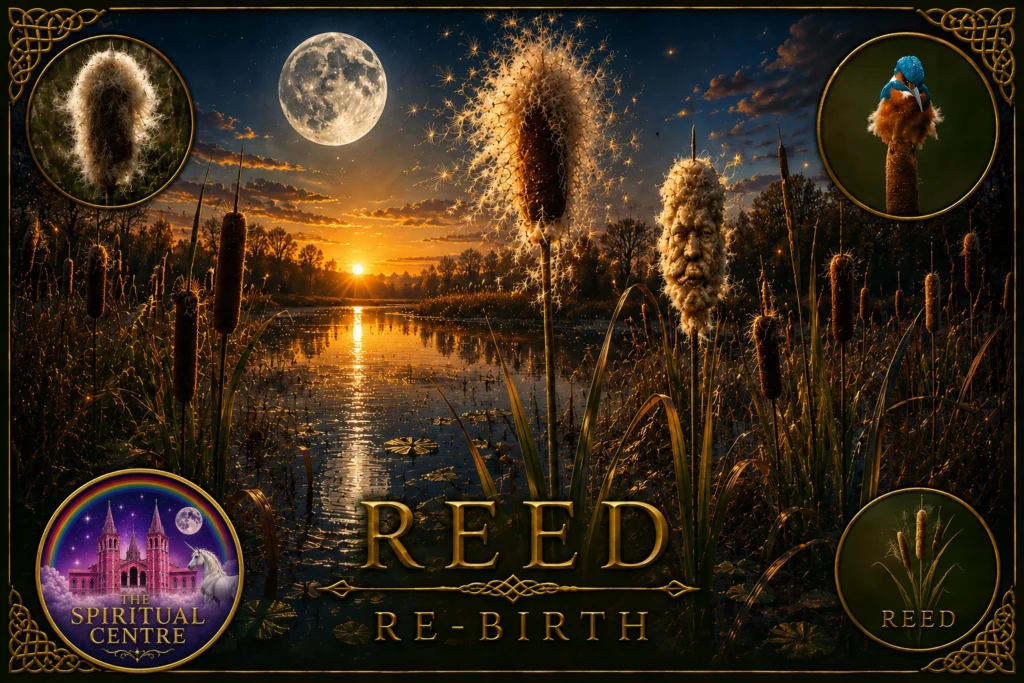
Reed stands where land meets water, rooted in the quiet margins of lakes, rivers, and marshlands. It is a plant of the threshold, neither fully of the earth nor entirely of the waters, but balanced between the two. In the ogham tradition this place of balance reflects Reed’s deeper quality: the ability to rise above emotion and see the wider movement of life. Where other forces become lost in the tide of feeling, Reed lifts awareness, allowing clarity and perspective to return.
Across the ancient world the reed has travelled alongside humanity, establishing itself wherever water and soil meet. Its quiet usefulness secured its place within early Celtic life, offering nourishment through its roots and shoots when other plants lay dormant. In landscapes shaped by seasonal hardship, Reed stood as a dependable ally, providing food, shelter, and materials that carried both breath and direction. From arrows and vessels to simple pipes shaped by wind, the reed reveals its nature as both support and passage, a plant that serves without imposing.
Yet Reed offers more than sustenance. Its hollow stems carry breath, sound, and movement without obstruction, becoming a natural channel through which air and intention can pass. It bends with wind and current yet rarely breaks, embodying adaptability without loss of direction. Within the reed beds, where Kingfisher strikes with precision, Salmon moves with ancient knowing, and Frog calls the return of life, the same quiet intelligence is revealed. Reed does not resist the current. It rises above it.
Within the ogham current of Ngetal, Reed therefore represents perspective, resilience, and quiet direction. It is the plant that stands between worlds, listening to water, wind, and sky. From this place of balance it offers a simple teaching: when emotion swells like the tide, lift the mind gently above it, and the path forward will reveal itself.
Reed – Ogham Tree Profile
Bruce Clifton
Name: Reed
Ogham: Ngetal
Letter: Ng
Lunar: 12th Moon of the Celtic tree Calendar (Oct 10th – 8th November 2026)
Season: Autumn
Moon Phase: Waxing Gibbous – Full Moon
Moon Name: Harvest – Blood – Hunters
Influence: Feminine – Androgynous
Title: Shrub
Age: Continuing Re-Birth
Element: Water
Aura: Orange – Blue
Healing: Anti-inflammatory – Anxiety – Bronchitis – Detoxification – Digestive Health – Emotional Healing – Fatigue – Mental Health – Nervous Conditions – Skin Rashes – Urinary Tract (see bladder)
Animal Spirit: Frog – Kingfisher – Salmon
Totems – Entities: Faunus – Naiads (Fresh Water) – Nodens – Nymphs – Pan – Sulis – Well Maidens
Gods – Deities: Brigid – Cerridwen – Rhiannon – Venus / Aphrodite (Greek)
Secret Harmony: Altered States (Threshold Awareness) – Breath Alignment – Communicating with Entities – Day Dreaming (Soft Focus) – Inner Peace – Trance (Channelled Expression)
Key Words: Re-birth –
Essence of the Reed Tree
Bruce Clifton
When to Call on Reed
When emotion begins to rise and obscure clear seeing
When decisions require calm observation rather than reaction
During times of inner turbulence where balance between thought and feeling must be restored
When direction, focus, or mental clarity needs to return
Signs of Reed Presence
A quiet sense of emotional distance that allows clearer understanding
Heightened awareness of the wider picture beyond immediate feeling
A renewed ability to act with precision and purpose
A calm, observant state of mind that rises above confusion
Reed in the Inner Landscape
Reed works within the inner landscape by lifting awareness above the immediate tide of emotion. Where feelings surge and threaten to overwhelm perception, Reed encourages a gentle rise of consciousness, much like the tall stems that lift their feathery crowns above the water’s surface. From that higher vantage point the currents below can be seen more clearly, allowing reaction to soften into understanding.
Those who work with Reed often experience a gradual shift from emotional immersion toward calm observation. It does not suppress feeling, nor does it dismiss its importance. Instead, Reed creates space around emotion, allowing the mind to see the wider field in which those feelings arise. In this way Reed restores perspective, reminding the seeker that clarity often comes when we step slightly above the waters that carry us.
Healing Lore of the Reed
Bruce Clifton
In addition to its place within ogham symbolism and wetland ecology, Reed has also held a quiet position within traditional healing practice. Growing where water meets land, the plant became associated with purification, balance, and the gentle regulation of bodily rhythms. Wetland plants were often viewed by early herbalists as natural mediators between elements, drawing nourishment from both soil and water, and Reed was therefore linked with restoring equilibrium within the body.
Historically the plant offered both practical and subtle forms of support. The roots and young shoots were recognised as nourishing, containing starches that could sustain people through lean seasons. In herbal observation, reeds growing in marshland environments were often connected with cleansing and drainage within the body, particularly in relation to the kidneys, bladder, and fluid balance. These associations emerged gradually through practical experience rather than formal theory, shaped by generations who lived close to the rhythms of the land.
The thoughtful practitioner approaches such plants with patience and discernment. Traditional preparations of wetland plants varied widely and were used with care, often alongside broader restorative practices designed to calm the nervous system, support digestion, and maintain internal balance. Reed itself rarely stood as a dramatic remedy. Instead it belonged to the quieter tradition of nourishment, gentle cleansing, and gradual strengthening.
Healing rarely rests within a single remedy. The Druids worked within a broad understanding of nature’s interwoven systems, drawing from what today might be recognised as herbalism, naturopathy, feng shui, homoeopathy, and related traditions. To them these were not separate disciplines but expressions of the same natural principles of balance, purification, and renewal, guided by the movement of Bnwyfre, the breath of life, flowing through the living world.
Scope & Notice
The material shared here reflects traditional knowledge, spiritual practice, and lived experience. It is offered for educational and reflective purposes and is not intended as medical advice or a substitute for professional care. If you are unsure or managing a health condition, consult a qualified practitioner.
About the Healing List
The following list of healing associations is not exhaustive. It reflects commonly recorded and observed uses within traditional practice. Remedies may involve the tree itself or companion vegetation that grows alongside it. Preparation methods vary widely and are explored in more detail on the Holistic Healing Remedies page.
Reed – Healing Remedies Oracle
We have alphabetised this list of healing qualities of the reed solely for ease of reference, they include but are not limited to:
1. Anti-inflammatory
2. Anxiety
3. Bronchitis
4. Detoxification
5. Digestive Health
6. Emotional Healing
7. Fatigue
8. Mental Health
9. Nervous Conditions
10. Skin Rashes
11. Urinary Tract
Anti-inflammatory / Reed
Ingredients:
New young leaf
Key Properties:
Flavonoids – Polyphenols
Traditional Actions:
Mild antioxidant, cooling, anti-inflammatory support
Preparation:
Leaves may be dried for light infusions, or prepared fresh as poultices and warm compresses.
Traditional Use:
Where the body had grown inflamed or overworked, those who lived close to the Reed tree turned to its younger growth for gentle support. The fresh leaves, prepared as poultices or warm compresses, were used to soothe tired muscles and calm irritation within the joints. Reed was not approached as a forceful remedy, but as a quiet cooling presence, supporting the body’s natural ability to settle inflammation and restore balance over time, reflecting the healing properties of Reed.
Anxiety / Reed
Ingredients:
Young Reed Leaf (Phragmites australis)
Reed Shoot (Phragmites australis)
Reed Rhizome / Root (Phragmites australis)
Key Properties:
Mineral salts – Polyphenols – Mild antioxidants – Nourishing starches
Traditional Actions:
Calming support for the nervous system, gentle grounding, restoring balance where tension and fatigue accompany emotional strain
Preparation:
Young reed leaves may be gathered during the growing season and dried for light infusions. A small handful of dried leaves can be steeped in freshly boiled water to produce a mild herbal infusion intended to calm agitation and encourage relaxation.
The young spring shoots may also be gently cooked and added to broths or simple foods. Within traditional plant practice, nourishing foods were often valued where anxiety was linked with fatigue, depletion, or general weakness.
Reed rhizomes may be cleaned, sliced, and gently dried before storage. When simmered in water they produce a mild decoction sometimes associated with restoring strength and supporting internal balance.
Traditional Use:
In times of anxiety and nervous strain, those who lived close to the Reed tree turned to its quiet, restorative nature. Growing where water meets land, Reed was understood as holding a natural balance between elements, and preparations from the leaf, shoot, or root were used where tension arose from fatigue or emotional depletion. Rather than forcing calm, Reed was approached as a gentle support, encouraging steadiness within the body and allowing the mind to return to emotional balance through gradual restoration.
Bronchitis / Reed
Ingredients:
Young reed leaf, reed rhizome
Key Properties:
Flavonoids, polyphenols, nutritional starches, trace minerals
Traditional Actions:
Mild expectorant support, soothing, cooling, restorative nourishment
Preparation:
Leaves may be dried for light infusions, or simmered gently to prepare warm inhalation steam. Rhizomes may be cleaned, sliced, and slowly simmered to produce a warming decoction.
Traditional Use:
When the chest had grown heavy and breathing became laboured, those who worked with the Reed tree turned to its gentle, soothing qualities. Light infusions of the leaves and warm vapours from simmered preparations were used to ease irritation within the airways and support clearer breathing. Reed was valued not as a forceful intervention, but as a steady presence, helping the body to settle congestion and restore comfort over time, reflecting the healing properties of Reed.
Detoxification / Reed
Ingredients:
Young Reed Leaf (Phragmites australis)
Reed Seed (Phragmites australis)
Key Properties:
Flavonoids – Polyphenols – Nutritional starches – Trace minerals
Traditional Actions:
Mild diuretic support, cleansing support, antioxidant activity, nutritional restoration
Preparation:
Young reed leaves may be gathered during the growing season and dried carefully in a shaded, well-ventilated space. Once dried they can be steeped in freshly boiled water to create a light infusion traditionally associated with supporting the body’s natural cleansing processes.
Reed seeds may be collected once mature, dried thoroughly, and ground into flour. This flour has historically been incorporated into breads, cakes, or simple porridge, providing a nourishing food that supports recovery and strength during periods when the body is undergoing cleansing or restoration.
Traditional Use:
Where the body required cleansing and renewal, those who lived close to the Reed tree recognised its role in supporting natural balance. Light infusions of the leaves were taken to encourage the gentle movement of fluids, while the seeds, prepared as nourishing foods, helped restore strength during periods of recovery. Reed was understood as both cleansing and sustaining, supporting the body’s natural processes without strain, reflecting the healing properties of Reed.
Digestive Health / Reed
Ingredients:
Young Reed Leaf (Phragmites australis)
Reed Rhizome (Phragmites australis)
Reed Seed (Phragmites australis)
Key Properties:
Flavonoids – Polyphenols – Nutritional starches – Trace minerals
Traditional Actions:
Digestive support, gentle nourishment, mild cleansing, antioxidant support
Preparation:
Young reed leaves may be gathered during the growing season and dried in a shaded, well-ventilated place. Once dried, they may be steeped in freshly boiled water to produce a light infusion traditionally associated with settling digestive discomfort.
Reed rhizomes may be carefully cleaned, sliced, and simmered slowly in water to produce a strengthening decoction. The rhizome is rich in natural starches and was often valued as a sustaining food during periods when digestion felt weak or unsettled.
Reed seeds may be gathered once mature, dried thoroughly, and ground into flour. The flour can be incorporated into simple breads, cakes, or porridge, providing easily digestible nourishment.
Traditional Use:
When digestion had become unsettled or weakened, those who lived close to the Reed tree turned to its nourishing and stabilising qualities. Light infusions of the leaves were taken to calm discomfort, while the rhizome and seeds provided simple, sustaining foods that supported recovery. Reed was understood as a gentle support for the digestive system, helping restore rhythm and ease through natural digestive balance rather than force.
Emotional Healing / Reed
Ingredients:
Young Reed Leaf (Phragmites australis)
Young Reed Shoots (Phragmites australis)
Key Properties:
Flavonoids – Polyphenols – Trace minerals
Traditional Actions:
Calming influence, emotional balance, nervous system support, antioxidant support
Preparation:
Young reed leaves may be gathered during the growing season and dried in a shaded, well-ventilated space. Once dried they can be steeped in freshly boiled water to produce a light infusion traditionally associated with calming the mind and settling emotional tension.
Young spring shoots may be gathered while still tender and gently cooked or steeped in warm water to produce a mild restorative tonic. These preparations were often taken simply, allowing the body to absorb nourishment without placing strain on the digestive system.
Traditional Use:
During periods of grief, strain, or emotional disturbance, those who lived close to the Reed turned to its quiet and steadying nature. Light infusions of the leaves and gentle nourishment from the young shoots were used where the body and mind had become unsettled. Reed was understood as a calming presence, helping to soften emotional intensity and restore emotional balance and inner steadiness over time.
Fatigue / Reed
Ingredients:
Reed Rhizome (Phragmites australis)
Reed Seed (Phragmites australis)
Young Reed Shoots (Phragmites australis)
Key Properties:
Nutritional starches – Natural sugars – Trace minerals
Traditional Actions:
Restorative nourishment, energy support, strengthening, recovery support
Preparation:
Reed rhizomes may be gathered from the wetland soil, cleaned carefully, and sliced before being simmered slowly in water to produce a nourishing decoction. The rhizome itself may also be cooked and eaten as a sustaining root.
Reed seeds may be collected once mature, dried thoroughly, and ground into flour. This flour can be incorporated into simple breads, cakes, or porridge, providing steady nourishment when the body requires rebuilding.
Young reed shoots emerging in spring may be harvested and lightly cooked as a seasonal vegetable, often added to broths or simple meals.
Traditional Use:
When strength had been diminished and the body felt depleted, those who lived close to the Reed tree turned to its nourishing qualities for gradual recovery. The rhizome, seeds, and young shoots were prepared as simple foods, offering steady energy and gentle support during periods of weakness. Reed was valued not for immediate stimulation, but for its ability to restore vitality over time, supporting natural energy recovery and sustained strength.
Mental Health / Reed
Ingredients:
Young Reed Leaf (Phragmites australis)
Reed Rhizome (Phragmites australis)
Key Properties:
Flavonoids – Polyphenols – Trace minerals
Traditional Actions:
Calming support, mental clarity, nervous system balance, antioxidant support
Preparation:
Young reed leaves may be gathered during the growing season and dried carefully in a shaded, well-ventilated space. Once dried, they may be steeped in freshly boiled water to prepare a light infusion traditionally associated with calming the mind and settling nervous tension.
Reed rhizomes may be cleaned, sliced, and gently simmered in water to produce a mild restorative decoction. The slow preparation allows the nourishing compounds within the root to release gradually, creating a simple preparation traditionally associated with restoring strength during periods of mental or emotional strain.
Traditional Use:
Within traditional wetland plant practice, reed has often been associated with quiet balance and steady restoration. Light infusions made from the young leaves were sometimes taken to calm the mind and encourage mental clarity when strain, worry, or overexertion disturbed the natural rhythm of thought.
At the same time, decoctions made from the rhizome provided gentle nourishment that supported the body when emotional stress or mental fatigue had weakened physical strength. Together these preparations were understood to encourage steadiness within the nervous system, helping the mind regain focus, composure, and balance.
Nervous Conditions / Reed
Ingredients:
Young Reed Leaf (Phragmites australis)
Reed Rhizome (Phragmites australis)
Young Reed Shoots (Phragmites australis)
Key Properties:
Flavonoids – Polyphenols – Nutritional starches – Trace minerals
Traditional Actions:
Nervine support, calming influence, restorative nourishment, antioxidant support
Preparation:
Young reed leaves may be gathered during the growing season and dried in a shaded, well-ventilated place. Once dried, they can be steeped in freshly boiled water to prepare a light infusion traditionally associated with calming agitation and settling nervous tension.
Reed rhizomes may be cleaned thoroughly, sliced, and simmered slowly in water to produce a mild restorative decoction. The slow preparation allows the nourishing compounds within the root to release gradually, creating a strengthening preparation traditionally associated with recovery from prolonged nervous strain.
Young reed shoots may be harvested in spring and lightly cooked or steeped in warm water to create a gentle tonic preparation.
Traditional Use:
Within traditional wetland plant practice, reed has often been regarded as a plant of quiet restoration. Light infusions made from the leaves were sometimes taken during periods of nervous agitation or mental strain, helping to steady the mind and encourage calmness within the nervous system.
At the same time, decoctions prepared from the rhizome provided sustaining nourishment when prolonged nervous tension had weakened physical strength. The tender spring shoots were occasionally prepared as a restorative seasonal food during times of recovery.
Together these preparations were associated with calming the nervous system, restoring internal balance, and supporting gradual recovery from conditions rooted in nervous exhaustion.
Skin Rashes / Reed
Ingredients:
Young Reed Leaf (Phragmites australis)
Reed Rhizome (Phragmites australis)
Key Properties:
Flavonoids – Polyphenols – Trace minerals
Traditional Actions:
Soothing, cooling, mild anti-inflammatory support, skin-calming
Preparation:
Young reed leaves may be gathered during the growing season and gently rinsed before being simmered slowly in water. The resulting liquid forms a mild herbal wash that can be allowed to cool and then applied to the skin as a compress or rinse.
Reed rhizomes may be cleaned thoroughly, sliced, and simmered to produce a light decoction. Once cooled, this preparation can be used externally as a gentle skin wash or cleansing rinse for irritated areas.
Traditional Use:
Within traditional wetland plant practice, reed has often been associated with calming irritation and restoring balance to sensitive skin. Light preparations made from the leaves were sometimes used as cooling washes where rashes, redness, or environmental irritation affected the skin.
Rhizome decoctions were occasionally used as cleansing rinses that supported the skin’s natural recovery while gently reducing inflammation. These simple preparations were valued for their mild and soothing nature, helping to calm discomfort and restore steadiness to troubled skin.
Urinary Tract / Reed
(see also: Bladder)
Ingredients:
Young Reed Leaf (Phragmites australis)
Reed Rhizome (Phragmites australis)
Key Properties:
Flavonoids – Polyphenols – Trace minerals
Traditional Actions:
Mild diuretic support, cleansing, soothing support for the urinary passages, antioxidant activity
Preparation:
Young reed leaves may be gathered during the growing season and dried carefully in a shaded, well-ventilated place. Once dried, the leaves can be steeped in freshly boiled water to prepare a light infusion.
Reed rhizomes may be cleaned thoroughly, sliced, and simmered slowly in water to produce a mild decoction traditionally associated with gentle cleansing and restorative nourishment.
Traditional Use:
Within traditional wetland plant practice reed has often been associated with the movement and balance of water within the body. Light infusions made from the leaves were sometimes taken to support the natural function of the kidneys and bladder, encouraging the gentle movement of fluids.
At the same time, decoctions prepared from the rhizome provided strengthening nourishment when urinary discomfort or imbalance had weakened the body. These preparations were traditionally understood to soothe irritation within the urinary passages while supporting the body’s natural processes of cleansing and balance.
Celtic Tree Lore of the Reed
Bruce Clifton
Watcher of the Marshlands and Water’s Edge
The reed does not grow in the deep forest or upon the high hills. It stands where land and water meet, rooted in the margins between worlds. Found beside rivers, lakes, marshes, and wetlands, the reed bends with the wind yet rarely breaks. It survives storms not through strength alone but through flexibility, teaching that resilience often comes through adaptation rather than resistance.
Its slender stems rise in great numbers, creating hidden sanctuaries for birds, insects, and small creatures. The reed forms living boundaries, marking the places where one landscape becomes another. In Celtic understanding, such places were often regarded as thresholds, locations where the visible and unseen worlds drew closer together.
Voice of the Wind and Messenger of Secrets
When the wind moves through a reed bed, it creates whispers, songs, and soft murmurs that seem to carry messages from distant places. Ancient people often sat quietly beside rivers and marshes, listening to these sounds and reflecting upon their own thoughts and dreams.
The reed became associated with communication, inspiration, and the spoken word. Its hollow stems symbolised the channels through which wisdom flows. Like the wind moving through the reed, knowledge passes through those willing to listen. The reed reminds us that understanding often arrives quietly rather than through force.
Craft, Music, and Sacred Utility
Throughout history, reeds have provided practical materials for everyday life. They were woven into mats, roofing, screens, baskets, and shelters. Their hollow stems were fashioned into pipes and simple musical instruments, carrying melodies across water and meadow alike.
The transformation of reed into music held particular significance. A simple stem could become a flute, turning breath into song. This connection between breath, sound, and spirit gave the reed a place within traditions of storytelling, celebration, and remembrance. The reed taught that ordinary materials could become vessels for beauty and meaning.
Guardian of Boundaries and Hidden Paths
The dense reed beds that line rivers and lakes often conceal pathways invisible to the casual observer. In folklore, these places were thought to hide entrances to secret realms, sacred pools, and forgotten wisdom. Travellers approaching such places were encouraged to proceed with care and respect.
Because it grows between water and earth, the reed came to symbolise balance between emotion and reason, instinct and understanding. It stands at the edge of change, guiding those who find themselves between one stage of life and another.
Autumn Reflection and Inner Truth
As summer fades and autumn approaches, the reed reaches its fullest height. Its feathery heads catch the golden light, swaying gently above the waters below. This season of maturity and reflection mirrors the lessons of the reed itself.
The reed asks us to listen more deeply, speak more carefully, and observe what lies beneath the surface of events. Its wisdom is not loud or dramatic. Instead, it encourages patience, observation, and thoughtful action.
To walk beside a reed bed at dusk is to enter a world of soft voices, moving water, and hidden possibilities. The reed reminds us that true strength is found not in rigidity but in the ability to bend, adapt, and remain rooted through life’s changing seasons.
Folklore of the Reed
Bruce Clifton
Between Land and Water
Reeds grow upon the shifting boundary between land and water, occupying places that have long been regarded as liminal spaces between the familiar and the unseen. Reed beds conceal what lies within them, their constant movement and whispering creating an atmosphere of mystery. In Celtic tradition, such thresholds were places where the boundaries between worlds might become thin, giving the reed associations with intuition, transition and the unseen realms.
The Voice of the Reed
Wind passing through a reed bed creates a natural chorus of whistles, sighs and murmurs. Hollow reeds have been fashioned into pipes and flutes since antiquity, transforming invisible breath into audible sound. Folklore consequently connected the reed with inspiration, communication and giving voice to the unseen. Filled with Bnwyfre, the Breath of Life, the reed becomes an instrument through which something invisible may find expression.
Secrets and Hidden Truths
Reeds frequently appear in folklore as carriers of secrets and revelation. European tales tell of hidden truths whispered into the earth, only to be revealed when reeds growing upon that place are fashioned into musical pipes. What was buried eventually finds a voice. Through such stories, the reed became associated with hidden knowledge, truth and messages that refuse to remain silent.
Bending Without Breaking
The reed’s slender appearance disguises remarkable resilience. Rather than resisting the wind, it bends beneath it and rises again when the storm has passed. Even when cut down, its underground rhizomes allow new growth to emerge. The reed therefore embodies adaptability, resilience and renewal, teaching that strength does not always mean standing rigid against adversity. Sometimes survival belongs to those who know when to bend and when to rise again.
Animal Spirit of the Reed
Bruce Clifton
Animal Spirits and the Water’s Edge
Animal spirits are often recognised where land gives way to water, where stillness deepens and life gathers quietly beneath the surface. In such places animals move with patience and awareness, sensing currents unseen by the human eye. Their presence reflects the subtle rhythms of water, emotion, and transformation.
When the animal spirits of Reed appear repeatedly, they do not call for force or resistance. They speak instead of movement, adaptation, and the natural flow of life through changing conditions. In the wetlands and riverbanks where Reed grows, animals teach us how to listen to the quieter currents beneath the surface of experience.
Reed as Keeper of Threshold Waters
Reed grows where earth softens and water rises, marking the quiet margins of ponds, rivers, and marshlands. These are places of transition, where life shifts between states and where the boundary between elements is never fixed.
The animals drawn to Reed are creatures who move comfortably within these changing environments. They pass between water and air, depth and surface, silence and sudden movement. Their presence reflects Reed’s own nature as a guardian of thresholds, holding space where transformation unfolds gently and without haste.
Flow, Change, and Quiet Awareness
Together Reed’s animal spirits reveal a way of moving through life that honours patience and emotional awareness. They remind us that change rarely arrives with force. More often it moves like water itself, shaping the landscape gradually and finding its path through persistence rather than struggle.
These companions of the wetlands guide those who are navigating emotional tides, personal transformation, or moments of uncertainty. Through watchfulness and quiet movement they demonstrate that the greatest changes often begin beneath the surface, long before they are visible.
Water, Breath, and Living Currents
Within the field of Bnwyfre, Reed gathers the living breath of water and air. Here the currents of emotion, instinct, and renewal move freely between worlds. The animals who dwell among the reeds carry this same sensitivity, responding to shifts in season, tide, and atmosphere.
In their presence we are reminded that life is not fixed but flowing. What seems still may already be changing beneath the surface.
Reed – Animal Spirit Oracle
Bruce Clifton
For ease of reference the animal spirits associated with Reed are listed alphabetically. No hierarchy or precedence is intended:
1. Frog
2. Kingfisher
3. Salmon
Frog / Reed
Among the reeds the frog is rarely seen before it is heard. As winter loosens its grip and the first warmth touches the marshlands, the frogs begin their evening chorus. Their voices rise from hidden pools and channels, echoing through the reed beds as the waters awaken.
The frog belongs to the threshold between worlds. Born in water yet moving upon the land, it lives within the same shifting margin that Reed calls home. In Celtic imagination such creatures were recognised as keepers of transition, companions of the seasons who announce the turning of life from one state into another.
Where the frog sings, the waters are alive and the land is renewing itself. Its presence reflects the gentle rhythm of transformation that moves through the marsh each spring. Beneath the reeds, life stirs quietly before it rises into voice.
For this reason the frog has long been heard as a herald of renewal. Its call does not demand attention, yet it carries across the wetlands like a reminder that change has already begun.
With the warming nights of spring the solitary note of the frog becomes a gathering call across the wetlands. One voice becomes many as companions answer from hidden pools among the reeds. Life returns to the marsh in chorus, the quiet romance of nature unfolding beneath the evening sky.
In these fertile waters Reed stands tall, sheltering the small worlds that flourish at the water’s edge. Here the frog reminds us that renewal is not only change but union, the joining of life that ensures the marsh will sing again with each returning spring.
Beyond the reed beds the deeper waters continue their ancient journey. From the open seas the salmon returns each year, pressing steadily upstream toward the quiet channels where reeds soften the riverbanks.
In these sheltered margins the life of the wetlands gathers once more, reminding us that renewal moves not only through the voice of the frog but through the long returning journeys of the river itself.
(See: Frog / Animal Spirit Oracle)
Kingfisher / Reed
Among the quiet reeds the kingfisher appears like a sudden spark of colour. One moment the river lies still beneath the arching stems, the next a streak of blue and copper crosses the water and vanishes again into the reeds. The kingfisher is a creature of the margins, moving along the same sheltered waterways where Reed stands rooted between earth and water.
Patient and watchful, the kingfisher waits above the slow current. Then with perfect timing it dives, breaking the surface for only a heartbeat before rising again with its prize. In this way the kingfisher reminds us that life often reveals itself in brief moments of clarity, where awareness and action meet without hesitation.
Where the kingfisher hunts, the waters must run clean and alive. Its presence signals balance within the wetlands, where fish, insects, reeds, and flowing water all belong to the same living rhythm. In Celtic imagination such creatures were often seen as guardians of the water’s brightness, revealing the hidden vitality of river and marsh.
Among the reeds the kingfisher teaches the art of stillness before movement. It does not waste energy nor chase blindly. Instead it waits, observes, and strikes only when the moment is right. In this quiet mastery the kingfisher reflects the clarity that arises when mind and instinct move together.
Beyond the reed beds the river continues its long journey toward deeper channels and open water. Here another traveller moves within the same living current. The salmon, returning from the distant seas, presses steadily upstream toward the rivers of its birth.
Where reeds soften the banks and the waters deepen, the paths of river creatures meet once more, each following the ancient rhythm of the returning waters.
(See: Kingfisher / Animal Spirit Oracle)
Salmon / Reed
In the quiet channels beyond the reeds the salmon passes unseen, moving through deeper currents that have travelled far beyond the marsh. Born in fresh water, carried to the open sea, and guided once more toward the rivers of its beginning, the salmon lives within one of nature’s oldest journeys. Its path speaks of memory held within the living waters, a knowing that endures long after the tide has turned.
When the time comes the salmon turns toward home. It presses against the current, rising through narrow channels and rushing streams with patient determination. In Celtic imagination the salmon has long been honoured as a bearer of wisdom, a creature whose long journey gathers the knowledge of sea, river, and season. Among the reeds this quiet endurance reminds us that true wisdom is often carried through persistence, guided by instinct and the memory of where we began.
Where the river widens and the reeds soften the banks, the returning salmon completes its ancient cycle. Here the waters of marsh, stream, and distant sea are joined once more. In this meeting of currents the life of the wetlands is renewed, reminding us that every journey, no matter how long, is part of a greater rhythm that returns again to its source.
Totems and Entities of the Reed
Bruce Clifton
Guardians of the Waters and Voices of the Wind
Reed and the Boundary Lands
The Reed stands where land and water meet, rooted in the margins of rivers, marshes and quiet wetlands. In these liminal landscapes the natural world feels different. The air carries the sound of wind moving through hollow stems, water flows slowly beneath the reeds, and the boundary between worlds appears thin. Because of this, Reed has long been associated with presences that dwell close to the waters and guide hidden knowledge.
Spirits of Water and Place
Within Celtic tradition such places were never considered empty. Springs, rivers and tidal edges were believed to carry their own consciousness, and many were honoured as the homes of guardians, spirits and deities of water and healing. Some appear in myth as great gods of sacred rivers and wells. Others remain quieter presences remembered only through folklore, dream and intuition.
Guardians of Healing and Inspiration
The Reed therefore attracts entities connected with water, breath, inspiration and restoration. Figures such as Nodens, guardian of healing waters, along with the subtle spirits of springs and sacred wells, belong naturally within the landscapes where reeds grow. Their presence reflects the same qualities carried by the Reed itself: purification, quiet reflection and the slow arrival of understanding.
Bnwyfre / Breath of Life
When the wind passes through the reed beds it produces a soft music, a reminder that even the simplest plant can become a channel for something greater. In this way Reed becomes a meeting place between the visible and the unseen, where the currents of nature, spirit and imagination move together through Bnwyfre, the breath of life and life force energy that flows through all living things.
Reed – Totems and Entities Oracle .
Bruce Clifton
We have alphabetised this list of totems and entities that harmonise with the reed tree solely for ease of reference, no sense of hierarchy or entitlement is intended or implied:
1) Faunus
2) Naiads (Fresh Water)
3) Nodens
4) Nymphs
5) Pan
6) Sulis
7) Well Maidens
Faunus / Reed
Faunus, the ancient woodland spirit of early Italy, belongs to the quiet landscapes where wild nature, animals, flowing waters, and untamed life meet. Though his origins lie in the rural traditions of the Italian countryside, his presence resonates naturally wherever reeds gather beside riverbanks, marshlands, pools, and wet meadows. These threshold places between water and earth carry the same rustic vitality that Faunus was believed to protect: landscapes where creatures gather, waters move slowly, and the deeper rhythms of nature remain undisturbed.
Within the world of the Reed, Faunus reflects the instinctive intelligence of the wetland environment. Creatures such as the Salmon, travelling ancient waterways with purpose, and the Frog, moving freely between land and water among the reeds, embody the same vitality and adaptability that Faunus represents. In these living ecosystems, earth, water, and animal life do not compete. They move together in quiet harmony, watched over by the unseen guardians of the natural world.
Older traditions also linked Faunus with dreams, intuition, prophecy, and the subtle voice of nature. It was believed that in secluded groves and waterside sanctuaries he spoke through signs rather than speech: the movement of animals, the sudden hush of a place, the turning of wind, and the music carried through the landscape itself. In the reed beds, wind moving through hollow stems creates a soft whispering tone, recalling the ancient pipe music later associated with Pan and the language of the wild.
For this reason the Reed landscape becomes a place of quiet healing, restoration, and reflection, where the mind softens and the body returns to balance through the calming union of water, wind, and open space. Here, healing need not be forced. It may arise through listening. In such places the presence of Faunus reminds us that the living world still knows how to restore us.
Through river, reed, creature, and current flows Bnwyfre, the breath of life and life force energy moving through all living things, sustaining the gentle harmony of wetland and soul alike.
(See: Faunus / Celtic Totems and Entities)
Naiads / Reed
Naiads are the spirits of freshwater, guardians of springs, rivers, wells and quiet streams where life gathers and renews itself. In ancient tradition every source of freshwater was believed to carry its own living presence. These spirits did not belong to the sea or the vast oceans, but to the inland waters that nourish the land, the clear springs, flowing brooks and hidden currents that move quietly beneath root and soil.
Where the Reed grows along riverbanks and marshlands, the Naiads are thought to dwell nearby. Reed beds mark the gentle meeting place between water and earth, creating a natural sanctuary where freshwater slows, settles and breathes. In these calm margins the Naiads are imagined as keepers of purity and balance, ensuring that the waters remain life-giving for the plants, animals and people who depend upon them.
Throughout European folklore these spirits were honoured wherever healing waters emerged. Sacred wells, bubbling springs and clear streams were approached with respect, for it was believed the Naiad of the place guarded the vitality within the water itself. When the water flowed clean and bright, the spirit was said to be present and content. When the water grew troubled or polluted, the spirit was thought to withdraw.
Within the Reed’s spiritual landscape, Naiads represent the quiet intelligence of freshwater. They embody the calm rhythm of wetlands, the slow movement of streams through reeds, and the hidden vitality that sustains the surrounding land. Their presence reflects the deeper qualities of the Reed itself, purification, renewal and the gentle restoration that comes when the waters of life are allowed to move freely once more through Bnwyfre, the breath of life and life force energy flowing through all living things.
(See: Naiads / Totems and Entities)
Nodens / Reed
Where the Reed rises from riverbank and marsh, the landscape becomes a place of quiet transition. Water slows, wind moves softly through hollow stems, and the land settles into stillness. In such places the presence of Nodens, guardian of healing waters, is easily imagined. His influence belongs to the gentle rhythms of rivers and springs, where restoration arrives not through force but through patience, reflection and the natural intelligence of flowing water.
The Reed has long been associated with purification, calm and emotional balance, drawing nourishment from waters that move slowly through the earth. Nodens reflects this same restorative quality. In ancient sanctuaries people sought his guidance through dream and rest beside sacred waters, trusting that healing would arise from quiet awareness. Reed landscapes carry this same atmosphere, encouraging the mind to soften and the body to return gradually to harmony.
Animals drawn to the waters of the Reed share in this peaceful field. The Salmon, keeper of ancient wisdom, travels the rivers where reeds grow thick along the banks. The Otter, playful guardian of freshwater currents, moves easily through these same channels. Together they represent the intelligence and vitality of water that Nodens protects, reminding us that life within the river is guided by unseen balance.
The Reed itself becomes a voice of the landscape, bending with the wind yet never breaking. Its hollow stem carries breath and sound, echoing the quiet music of water moving through the land. Within this living environment the presence of Nodens feels natural, a watchful guardian of the waters that nourish root, animal and spirit alike.
In this meeting place of water, wind and living earth, the Reed reveals its deeper character. Healing unfolds slowly, wisdom moves through the currents of the river, and the landscape breathes with a gentle vitality. Through these waters flows Bnwyfre, the breath of life and life force energy, sustaining the delicate harmony between river, reed and the unseen guardians who dwell within them.
(See: Nodens / Totems and Entities)
Nymphs / Reed
Where the Reed grows along rivers, marshes and quiet wetlands, the landscape becomes a place of soft movement and hidden life. Water flows slowly beneath the reeds, wind passes through hollow stems, and the air carries a gentle rhythm that has long been associated with the presence of water spirits. In many traditions these spirits are known as nymphs, the living consciousness of springs, streams and pools where the vitality of the land gathers.
Within the world of the Reed these nymphs belong to the freshwater family of water spirits, often recognised as Naiads who dwell in rivers and sacred wells. Their presence reflects the natural character of the Reed itself. Reed thrives where water is calm and balanced, drawing nourishment from the quiet currents beneath the soil. In this way the nymphs are seen as guardians of purity and renewal, ensuring that the waters feeding the reeds remain clear and life-giving.
The creatures that move through reed beds share this gentle harmony. The Salmon, keeper of ancient wisdom, travels the rivers where reeds line the banks, while the Frog moves between water and land among the reeds. These animals reflect the intelligence and vitality of freshwater ecosystems, reminding us that the life of the river is guided by rhythms far older than human memory.
Reed has long been associated with purification, emotional balance and quiet healing, qualities that mirror the calming influence of freshwater nymphs. The sound of water flowing through reeds, the movement of wind across the wetland, and the stillness of shaded pools all encourage reflection and restoration. Such landscapes invite the body and mind to slow down, allowing healing to unfold gently.
In this meeting place of water, wind and living earth, the presence of the nymphs becomes part of the wider harmony of the Reed. Springs nourish root and soil, rivers carry wisdom through the land, and the reed beds whisper with the movement of unseen life. Through these waters moves Bnwyfre, the breath of life and life force energy, sustaining the delicate balance between river, reed and the spirits that dwell among them.
(See: Nymphs / Totems and Entities)
Pan / Reed
Where Reed grows along riverbanks and wetlands, the landscape becomes a place of soft wind and quiet water, a setting that naturally echoes the spirit of Pan, the ancient god of wild nature and living landscapes. Pan belongs to the hills, forests and watersides where animals move freely and the rhythms of nature remain undisturbed. In such places the presence of the wild feels close, carried in the movement of wind through grass and reeds.
Pan is remembered as the creator of the reed pipes, an instrument formed from hollow reeds whose sound arises when breath passes through them. This story gives Pan a natural connection with reed beds, for the wind moving through their hollow stems produces the same gentle music. In this way the Reed becomes a voice of the landscape, carrying breath, sound and inspiration through the living world.
Animals that share the reed lands reflect the same vitality Pan embodies. The Salmon, travelling the rivers with ancient purpose, and the Frog, moving between water and land among the reeds, express the instinctive life of wetlands where nature flows freely. These creatures remind us that the river and its surrounding reeds form a living community guided by the quiet intelligence of the natural world.
Within the symbolic field of the Reed, Pan represents instinct, inspiration and the untamed breath of nature. The whispering of wind through reeds, the movement of water along the riverbank and the presence of wildlife all carry the same subtle vitality. In such places the landscape itself becomes a source of calm and creativity, where the natural harmony of river, reed and wildlife flows through Bnwyfre, the breath of life and life force energy moving through all living things.
(See: Pan / Totems and Entities)
Sulis / Reed
Sulis, the ancient goddess of sacred springs and healing waters, is naturally at home in the quiet landscapes where Reed grows along rivers, marshes and mineral-rich springs. Her presence was most famously honoured at the warm waters of Bath, where people travelled seeking restoration, yet her deeper symbolism belongs to the living springs that rise from beneath the earth. These waters nourish the land gently, just as reed beds soften the edges of rivers and wetlands.
Within the world of the Reed, Sulis represents the calm intelligence of water that heals through stillness and immersion. Where reeds gather beside pools and slow-moving streams, the landscape becomes a place of reflection and renewal. The Salmon, travelling the river with ancient purpose, and the Frog, moving between water and land among the reeds, reflect the same living vitality that flows through these sacred waters.
Reed has long been associated with purification, emotional balance and gentle restoration, qualities that mirror the healing nature of Sulis. The quiet movement of water through wetlands allows life to settle and renew itself, reminding us that true healing often comes through patience rather than force.
In these reed-filled waters the presence of Sulis becomes part of the wider harmony of the landscape, where river, spring and wildlife share a delicate balance sustained by Bnwyfre, the breath of life and life force energy flowing through all living things.
(See: Sulis / Totems and Entities)
Well Maidens / Reed
Well Maidens are remembered in Celtic tradition as the spirits who guard sacred wells and freshwater springs, quiet presences believed to dwell where clear water rises from the earth. In landscapes where Reed grows along marshes, riverbanks and sheltered pools, these living waters nourish the land gently, creating places of calm reflection and renewal. Such waters were long believed to carry awareness, and the Well Maiden represents the guardian spirit of the spring itself, protecting its purity and balance.
Within the world of the Reed, these spirits reflect the same qualities of purification, emotional balance and gentle restoration that wetlands naturally offer. Creatures of the water such as the Salmon, travelling the rivers with ancient purpose, and the Frog, moving between water and land among the reeds, share this living environment, reminding us that the quiet waters feeding the reeds sustain an entire community of life.
In this way the Well Maiden becomes a symbolic presence of the living spring within the reed landscape, where water rises, settles and nourishes the surrounding land. Through these quiet waters flows Bnwyfre, the breath of life and life force energy, sustaining the delicate harmony between spring, reed and the unseen guardians who dwell among them.
Gods and Deities of the Reed
Bruce Clifton
Reed stands at the threshold, where land meets water and sound moves through air, and in this place of crossing it draws together those deities who govern transition, voice, and inner knowing. These are not distant figures, but presences that move within the same field as Reed itself, shaping awareness through rhythm, intuition, and quiet transformation.
Brigid is felt in the breath and in the spoken word, where inspiration arises without force and expression flows with clarity. She carries the living flame within the stillness of Reed, where voice becomes a channel rather than a construct. Cerridwen moves within the deeper current, holding the cauldron of change where knowledge is not learned, but revealed through inner transformation. In her presence, Reed becomes a place of quiet becoming, where awareness ripens beneath the surface.
Rhiannon carries the movement between worlds, the steady crossing of thresholds where time and distance do not hold the same form. Through her, Reed becomes a pathway of perception, where what is distant can be felt as near, and where awareness travels without losing its centre. Venus brings the softening of perception, the gentle opening of the senses where harmony, beauty, and relationship emerge. In her presence, Reed becomes receptive, allowing connection to form without resistance.
Together, these deities do not impose themselves upon the tree. They move within it, as part of the same living field shaped by Bnwyfre, where breath, awareness, and presence meet. Reed does not call them in. It reveals the space in which they are already known.
Reed – Gods and Deities Oracle
Bruce Clifton
We have alphabetised this list of gods and deities that harmonise with the reed solely for ease of reference no sense of hierarchy or entitlement is intended or implied:
1) Brigid
2) Cerridwen
3) Rhiannon
4) Venus
Brigid / Reed
Brigid’s presence is often felt where water gathers quietly within the land, among the wells, springs, marshes and river margins where reed and rush grow freely. These wetland places have long been regarded as sacred thresholds within Celtic tradition, locations where healing waters rise and the unseen draws close. In such landscapes, Reed becomes a natural companion to Brigid, standing rooted within the living waters long dedicated to her presence.
Reed beds commonly grow beside holy wells and flowing springs, and many wells devoted to Brigid across Ireland and Britain were surrounded by rush and reed. These waters were visited by those seeking healing, protection for livestock and blessing for the turning seasons. Within these quiet margins, Reed forms a living boundary between land and water, a fitting reflection of Brigid’s healing presence as guardian of sacred wells and renewing waters.
At Imbolc, when the first subtle movements of spring begin stirring beneath winter ground, Brigid’s Crosses were traditionally woven from rushes and reeds gathered from the wetlands. Hung above hearths, doorways and barns, they carried symbols of protection, blessing and continuity into the home. Through reed and rush, the stillness of the marsh became joined to the warmth of the household fire.
Within the living current of the Bnwyfre Spiritual Order, Reed reflects the quiet awakening of Life Force Energy moving once more through water, root, breath and living earth alike. Around the sacred wells and reed beds, the old traditions speak softly of elemental presences, subtle consciousness and the unseen life moving gently through these listening places where land and water meet.
Reed also carries the symbolism of breath and sacred voice, its hollow stems long shaped into pipes and whistles through which air becomes sound. In this way, Reed naturally echoes Brigid’s relationship with poetry, inspiration and sacred speech, where breath becomes word and word becomes wisdom. Healing and inspiration rise quietly together through the still places where the land itself listens.
Within the reed beds where water softens the earth, Brigid’s qualities of renewal, healing and inspiration move gently together. Rooted in water yet rising toward light, Reed reflects the same harmony between sacred well and sacred flame that Brigid brings into the living world.
(See: Brigid / Gods and Deities)
Cerridwen / Reed
Cerridwen’s presence within the Reed belongs to the quiet margins where water gathers and the unseen begins to speak. Reed grows in marshland, along river edges, and beside still waters, landscapes long associated with reflection and inner awareness. These threshold places mirror Cerridwen’s role in Welsh tradition as a keeper of hidden wisdom, the guardian of the Cauldron of Awen where knowledge and inspiration are slowly brewed beneath the surface.
Within the reed beds the world grows quieter. Sound softens, wind moves gently through the hollow stems, and the water beneath remains dark and reflective. This atmosphere reflects Cerridwen’s deeper nature as a guide through inner transformation, where understanding is not forced into the mind but emerges gradually through patience, listening, and reflection. Like the slow brewing within her cauldron, wisdom ripens in stillness.
Reed itself carries a symbolism of breath, voice, and expression, its hollow stems historically used for simple pipes and whistles shaped by wind and air. In this way the plant mirrors the moment when Cerridwen’s hidden wisdom finally finds expression. What begins as silent contemplation beneath the waters becomes voice, poetry, and inspired thought once it rises into the open air.
The reed beds also represent the meeting of worlds, where land, water, and wind move together in quiet balance. Cerridwen’s mythology is deeply rooted in these liminal places, where transformation unfolds and new understanding is born. Just as the reeds sway with the shifting currents while remaining rooted in the water, the wisdom she represents moves between the unseen and the spoken.
Within the presence of the reed, Cerridwen may therefore be understood as the awakening of insight from stillness. The plant stands as a natural emblem of her cauldron’s work: knowledge gathering quietly beneath the surface until the moment arrives for it to rise, take breath, and become inspiration.
(See: Cerridwen / Gods and Deities)
Rhiannon / Reed
Rhiannon’s presence within the Reed reflects the quiet dignity and inner sovereignty that define both the goddess and the landscape where reed grows. Reed thrives where land meets water, in marshes, riverbanks, and wetlands where sound softens and reflection deepens. These liminal places mirror Rhiannon’s nature within Welsh mythology, where she appears not with force or urgency but with calm authority, moving steadily through events with patience and composure.
In the stories of the Mabinogi, Rhiannon is remembered for her remarkable endurance, maintaining grace and dignity even when faced with false accusation and hardship. This quiet strength echoes the nature of the reed itself, a plant that bends with wind and water yet remains firmly rooted, adapting to shifting currents without losing its place. Through this symbolism the reed reflects the kind of sovereignty Rhiannon embodies, a power grounded not in domination but in resilience, balance, and unwavering presence.
Reed beds are places of listening and observation, where movement is subtle and the rhythms of water guide the landscape. Within such spaces Rhiannon can be understood as a guardian of stillness and reflection, encouraging patience when life moves through uncertainty. Her mythology reminds us that wisdom often unfolds slowly, just as the reed grows quietly through the wetlands while the deeper waters beneath remain unseen.
The reed also marks the threshold between worlds, standing where earth, water, and wind meet in quiet harmony. Rhiannon herself carries this same sense of passage, a figure who moves between realms and whose presence often signals a turning point within the story. In the reed’s gentle movement and steadfast root, her influence appears as a reminder that true sovereignty arises through steadiness, grace, and the patience to allow truth to emerge in its own time.
(See: Rhiannon / Gods and Deities)
Venus / Reed
Venus finds her natural expression within the Reed, where water, light, and atmosphere meet in quiet harmony. Reed grows in wetlands, river margins, and marshes, places that hold the soft reflections of the sky, where dawn and dusk linger upon the water’s surface. It is within these twilight hours that Venus appears most clearly as the Morning Star and Evening Star, a presence that belongs not to the height of day but to the thresholds between light and dark. In this landscape the reed becomes a living mirror of her nature, rooted in water while rising into air, holding the meeting point of worlds.
The reed beds carry a gentle movement, shaped by wind, water, and subtle currents rather than force. This reflects the deeper influence of Venus as a power of attraction, harmony, and connection, drawing life together through quiet alignment rather than command. Just as reeds gather along the edges of water and create natural boundaries that are soft yet defined, Venus moves through the world as a binding force, bringing relationship, beauty, and cohesion into the flow of life.
Water plays a central role in both reed and Venus symbolism. The reed thrives where water is present, drawing nourishment from it while allowing it to pass freely through the landscape. Venus, appearing beside the moon in the early morning or evening sky, reflects this same fluid, reflective quality, where emotion, intuition, and sensitivity are heightened. In this way the reed becomes a natural vessel for the expression of Venus, holding the stillness in which feeling and connection can deepen.
The hollow structure of the reed introduces another layer of meaning. As a plant associated with breath, sound, and subtle vibration, it reflects the way Venus operates through unseen influence, shaping mood, atmosphere, and the space between people. What is not spoken is often as powerful as what is expressed, and within the reed beds the air itself seems to carry a quiet communication, echoing Venus’s role in guiding relationship and understanding.
Within the meeting of reed and twilight, Venus can be understood as the gentle force that moves through the thresholds of life, guiding transition, connection, and the soft unfolding of beauty. The reed stands as her earthly counterpart, a plant that does not dominate the landscape but transforms it through presence, reminding us that some of the most powerful forces in life are those that move quietly, shaping the world through attraction rather than force.
Secret Harmonies of the Reed
Bruce Clifton
The Reed does not impose itself upon the world. It grows at the edge, where land meets water, where movement meets stillness, where one state gives way to another. Within this quiet boundary, it reveals a set of harmonies that are not forced, but recognised through subtle shifts in awareness. These are not abilities to be acquired, but states that arise when attention softens and aligns with the flow of Bnwyfre, Breath of Life or Life Force Energy.
The harmonies associated with Reed belong to threshold experience. They emerge where perception loosens from fixed form and becomes receptive to what moves beneath it. In Reed, awareness is not directed outward in effort, but allowed to open, to listen, and to participate. What is discovered is not separate from the self, but part of a shared field in which human, elemental, and natural presence meet without division.
Each harmony reflects a different way in which consciousness can move beyond its usual boundaries while remaining grounded. Some open the field, others stabilise it, and others deepen relationship within it. Together, they form a coherent pattern of recognition, where awareness is not limited to a single point, but moves across layers with increasing clarity.
Reed – Secret Harmonies Oracle.
Bruce Clifton
We have alphabetised this list of secret harmonies of the reed solely for ease of reference, no sense of hierarchy or entitlement is intended or implied:
1) Altered States (Threshold Awareness)
2) Breath Alignment
3) Communicating with Entities
4) Daydreaming (Soft Focus)
5) Inner Peace
6) Trance (Channelled Expression)
Altered States of Consciousness / Reed
Reed does not stand in one place. It lives where the world is already changing, where water meets land, where stillness meets movement, where one state of being gives way to another without resistance. In this quiet place of crossing, Reed mirrors the movement of altered states of consciousness, not as something unusual, but as something already known.
There are moments when awareness begins to loosen, when the weight of the physical softens and something wider begins to open. Time shifts, perception deepens, and the boundary between self and world becomes less certain. These are not dramatic moments. They are subtle, often unnoticed, yet deeply familiar. Reed holds these moments gently, without force, without interruption.
Within its presence, the transition is not something to be controlled. It is something to be felt. Awareness is allowed to move, to drift, to settle into another layer while still remaining here. In this movement, Bnwyfre, breath of life and life force energy, is sensed more clearly, not as an idea, but as a living current moving through both states at once.
Reed does not take you into altered states of consciousness. It reminds you that you are already moving within them. It steadies the crossing, softens the edges, and allows the shift to be recognised as it happens. What was once fleeting becomes held, and what was once unnoticed becomes known.
(See Altered States of Consciousness / Secret Harmony)
Breath Alignment / Reed
Reed moves with breath, with wind, with the quiet rhythm of air passing through and around it. It does not resist, and it does not hold. In this, it reflects the nature of breath alignment, where awareness settles into the natural flow of inhalation and exhalation without control or force. The movement is subtle, yet continuous, and within that continuity something begins to steady.
In the presence of Reed, breath is not something to be managed. It is something to be noticed. As attention rests gently within it, the inner field begins to soften and align. Thought loses its urgency, reaction falls away, and awareness becomes more receptive. Through Bnwyfre, breath of life and life force energy, the rhythm of breath reveals itself as a living current moving through both body and perception.
Reed supports this alignment by holding a space of quiet permeability. Breath and awareness begin to move together, not as separate processes, but as one continuous flow. In this state, the boundary between inner and outer begins to loosen, and a wider field of perception becomes accessible without strain.
To work with Reed in breath alignment is to remain simple. Attention rests with the breath, not to change it, but to remain with it. Over time, breath steadies, awareness follows, and the field of Bnwyfre becomes more clearly felt. In this alignment, harmony is not created, but recognised within the natural rhythm that was already present.
(See Breath Alignment / Secret Harmony)
Communicating with Entities / Reed
Reed stands at the edge of perception, where presence is felt before it is understood. It does not impose voice or form, but creates a space in which subtle awareness can be recognised. In this quiet field, communication with entities is not an act of calling something in, but the realisation that connection already exists within the shared movement of Bnwyfre.
Within the presence of Reed, communication does not arrive through words. It is sensed through impression, feeling, image, and a quiet knowing that forms without effort. The boundary between self and other softens, and awareness becomes receptive rather than directive. What is perceived is not constructed or imagined, but recognised within a field of shared presence.
Reed supports this harmony by holding a state of gentle permeability. It neither blocks nor defines what is encountered, but allows awareness to meet what is present without interference. In this meeting, communication becomes an exchange within the same field, where human and non-human awareness exist without separation or hierarchy.
To work with Reed in this way, nothing is summoned and nothing is pursued. Breath settles, attention softens, and awareness remains open without expectation. In that openness, communication becomes possible, not as an event, but as a natural extension of being within a shared and living field.
(See: Communicating with Entities / Secret Harmony)
Day Dreaming / Reed
Reed lives at the edge of movement, where water passes and wind carries sound, and in this it reflects the nature of daydreaming as a gentle shift in awareness rather than a loss of it. Attention softens, and perception begins to move beyond the immediate without breaking from it. The body remains present, yet awareness drifts into another layer, not as escape, but as expansion.
Within the presence of Reed, this movement is held without disruption. Thoughts, images, and impressions begin to flow more freely, and the boundary between inner and outer becomes less defined. Through Bnwyfre, Breath of Life, this state is not separate from reality, but part of a wider field in which awareness can move across layers without losing its centre.
Reed supports daydreaming by allowing it to become conscious. What is often unnoticed can be recognised as it happens. Awareness rests both within the movement and quietly observing it, and in that recognition, the state becomes stable rather than fleeting. This is where daydreaming shifts from passive drifting into something held and usable.
To work with Reed in this way is simple. Breath settles, attention softens, and awareness is allowed to move without force. In remaining present within the daydream, perception opens without losing grounding, and what was once dismissed becomes a clear expression of expanded consciousness.
(See: Day Dreaming / Secret Harmony)
Inner Peace / Reed
Reed stands where movement is constant, where water passes and wind moves through without resistance, and in this it reflects inner peace not as stillness without life, but as steadiness within it. It does not withdraw from motion, it remains undisturbed by it. In its presence, awareness begins to settle, not by force, but by release.
Within the field of Reed, tension softens and reaction falls away. Thought loses its urgency, and awareness is no longer pulled in multiple directions. What remains is a quiet continuity, where presence is steady and unbroken. Through Bnwyfre, breath of life, this state is felt as a gentle rhythm moving through both body and perception, not something created, but something recognised.
Reed teaches that inner peace is not found by removing oneself from the world, but by no longer resisting it. Movement continues, sound continues, life continues, yet within it there is no disturbance. Awareness rests within itself, responsive but not reactive.
To work with Reed is to allow that settling to happen. Breath softens, attention releases its grip, and awareness remains with what is present. In this, inner peace is not achieved, but uncovered, steady, quiet, and already there within the flow.
(See: Inner Peace / Secret Harmony)
Trance (Channelled Expression)
Reed moves with rhythm, with wind, with the quiet repetition of water passing through its stems, and in this it reflects trance as a state formed through continuity rather than force. It does not impose stillness. It settles into flow. In its presence, attention begins to gather, not by narrowing sharply, but by remaining with a single movement until awareness and rhythm become one.
Within this field, thought loses its fragmentation and begins to move in a continuous stream. Distraction falls away, and awareness is no longer pulled outward. Instead, it rests within the rhythm it follows, whether breath, sound, or subtle movement. Through Bnwyfre, this state is felt as an unbroken current, where perception remains steady without effort.
Reed supports trance by holding a space of gentle repetition. The movement is simple, but constant, and within that constancy awareness begins to settle deeper. The boundary between observer and experience softens, and what remains is a sustained presence within the flow.
To work with Reed is to remain with that rhythm. Breath steadies, attention does not wander, and awareness is allowed to rest within the movement without interruption. In this, trance is not entered through control, but recognised as the natural result of continuous, undisturbed attention.