Celtic Totems and Entities
Explore the Celtic totems, spiritual entities, nature spirits, and sacred beings
associated with the Ogham trees and ancient Celtic tradition.
Presences of the Living Landscape
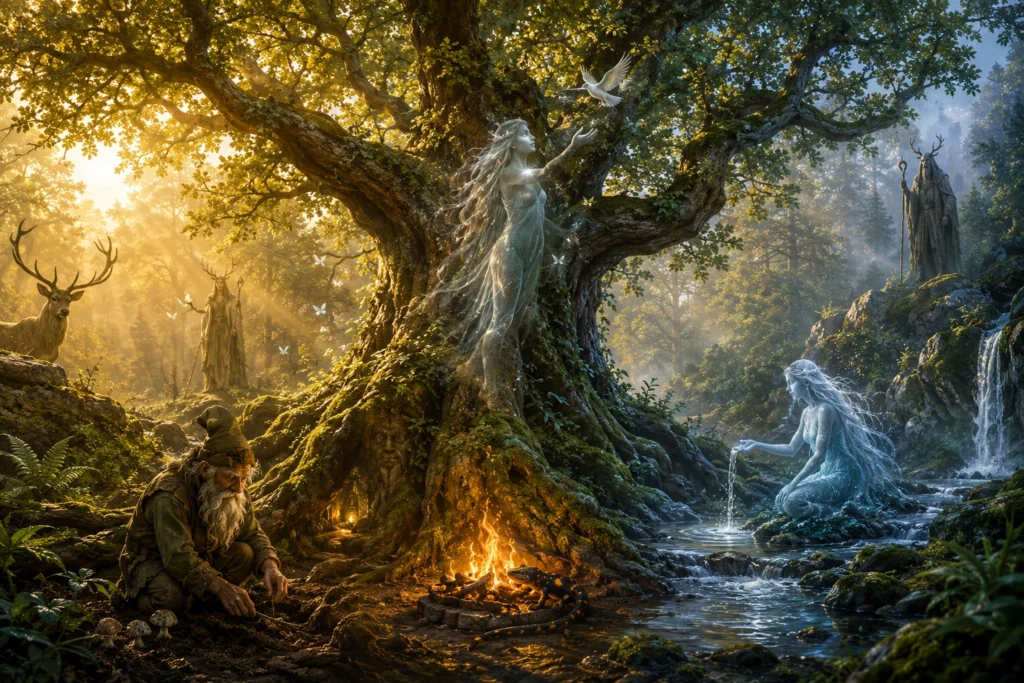
Across the Celtic lands the world was never seen as empty. Forests, rivers, hills and springs were understood to carry presences that moved within the same breath of life that sustains mankind, animals and trees. These presences were remembered as totems, guardians, spirits and deities. Some were vast and ancient, known across entire regions. Others were local companions tied to a spring, a grove, or a standing stone.
Within this living landscape, the powers of direction and element were also recognised. The East carried the quickening breath of air and the whisper of unseen thought. The South held the transforming fire of courage, passion and will. The West belonged to waters of memory, healing and the deep soul tides. The North stood with earth, stone, endurance and ancestral strength. Through these quarters moved the elemental presences later named as sylphs of air, salamanders of fire, undines of water, and the earth beings of root, hill and meadow. They were not separate from the land, but expressions of how the land lives.
Within this tradition the trees of the Ogham were not simply plants rooted in soil. Each tree existed within a wider field of consciousness that included animals, spirits, elementals, and the unseen intelligences of land and water. These presences do not replace the trees. Rather, they move alongside them, shaping the stories, symbols and spiritual relationships that have grown around each tree for centuries.
In the language of The Spiritual Centre, all of these presences participate in the same current of Bnwyfre, the breath of life and life force energy that animates all living things.
Totems, Spirits and Sacred Presences
Some entities remembered in Celtic tradition are clearly divine, such as Sulis of the sacred waters or Rosmerta who embodies provision and abundance. Others appear in folklore as teachers, protectors or threshold figures who guide the human imagination toward deeper understanding.
These presences should not be approached as rigid dogma. Celtic tradition rarely worked that way. Instead they act as symbolic companions to the trees. When a person approaches a tree for reflection, healing, or spiritual insight, the totems and entities associated with that tree help illuminate the deeper qualities held within its nature.
In this way the trees remain the centre of the teaching, while the totems and entities help reveal the personality, mythology and wisdom that surrounds them. They remind us that the world is not mute matter, but a living relationship of land, life, direction, element and presence.
Totems and Entities Index of the Ogham Trees
Within Celtic tradition many presences appear in stories, ritual memory and folklore. Some are gods, others guardians of place, while some exist in the shadowed borderlands between myth and spirit.
This list has been alphabetised purely for ease of use and to avoid ambiguity with season, direction or element.
A – D
Angels
Aoife
Arawn
Archangel Gabriel
Archangel Michael
Archangel Raphael
Archangel Uriel x 2
Arianrhod
Ben Nighe x 3
Bicne
Cernunni x 3
Crone x 3
Cwn Annwn x 2
Daoine-Sìthe x 2
Druantia x 6
Dryads x 3
Dumnorix
E – J
Elementals x 4
Ellyllon
Ethelreda
Fairies – Fae – Sidhe x 4
Fagus
Faunus
Finfolk
Gnomi x 2
Green Man x 3
Hazel
Hedgewitch x 3
Hesperides x 2
Hildegard of Bingen x 5
Holly Queen x 3
Huginn and Muninn x 2
Joseph of Arimathea x 2
K – O
Leuce
Magdalene x 2
Maidens x 2
Maponos
Meliae x 3
Merlin
Mermaids
Moirai x 2
Naiads x 4
Nereids
Nodens
Nymphs x 2
Oceanids x 2
Old Hag x 2
Celtic Totems and Entities Gateway to the Ogham Trees
1st Aicme –
(Beith)
2nd Aicme – (Huathe)
3rd Aicme –
(Muin)
4th Aicme –
(Ailim)
5th Aicme – (Forfeda)
This section is a work in progress check back soon to see latest updates: Last updated 27-09-2026
Celtic Totems and Entities
Angels ~ angelic realms ~
Origin: Celestial Intelligence ~ (earliest dated recognition) 3rd Millenium BCE
Tradition: Ancient Near East ~ Hebrew / Jewish Tradition
Nature: Celestial / Spiritual Beings
Realm: Celestial ~ Earthly
Role: Messengers ~ Guardians ~ Guides
Associated beings: ArchAngels ~ Angels ~ Incarnate
Angels do not begin with Christianity. Their story belongs to a much older human recognition of Celestial Intelligence, evidenced in the ancient world long before the Christian era. Angels have always walked beside us, lived within us and inherited our souls, and adopted our bodies for healing. The fact that we cannot recognise them is a part of the angelic disciplines. Human will never become angel, Angel however can become angel incarnate and recognise each other.
An angelic celestial energy can only assist when asked and under the correct circumstances, they will move you forward for the greater good of all. To make a request to an angel is good, for them to grant requests enhances all life, caution should always be exercised when making requests. The union between you and your Guardian Angel is personal to you, the relationship can only grow if allowed… nurture if allowed…
All celestial entities are able to travel through the orders but they do retain their identity within their own order, the entities closest to mankind include the ArchAngels, angels and the incarnates. They can move between the orders with dedicated intent, and with the intention of the purpose being for the greater good.
Sea / Angel
There are places where the boundaries of the physical world seem less certain. Stand beside open Water at sunrise or sunset and the elements gather around you: Earth beneath your feet, Water before you, Wind upon your face, Fire within the Sun, and Spirit moving through them all. Day and night briefly share the same world as light moves across the Water and the horizon becomes a threshold between what can be seen and what may only be felt.
It is here that the elementals gather within their elements and Celestial Intelligence draws close. We call these celestial beings Angels, although they belong neither to the Sea nor to any particular religion; they belong to Spirit. No ritual is required. Their presence may be experienced as tranquillity, an unexpected thought, an awareness of something greater, or that peculiar moment when solitude no longer feels like being alone.
At the water’s edge, Earth, Water, Wind, Fire and Spirit can, for a brief moment, be experienced together.
Aoife
1) Origin: Irish Celtic Tradition, The Ulster Cycle → warrior woman of Alba, Cú Chulainn and Connla.
2) Origin: Irish Celtic Tradition, The Crane-Bag, preserving the mythological tradition of Manannán mac Lir and the Tuatha Dé Danann.
3) Origin: Irish Celtic Tradition, Oidhe Chloinne Lir, preserving the mythological tradition of the Tuatha Dé Danann.
1) Aoife of the Ulster Cycle
Origin: Irish Celtic Tradition, The Ulster Cycle → warrior woman of Alba, Cú Chulainn and Connla.
Aoife is a warrior woman and ruler associated with Alba, appearing in the Ulster Cycle tradition surrounding Cú Chulainn and Scáthach. She commands her own warriors and is renowned for her courage and extraordinary skill in battle.
While Cú Chulainn is training with the warrior teacher Scáthach, conflict brings him face to face with Aoife. The two meet in single combat and Aoife proves a formidable opponent. Cú Chulainn eventually overcomes her, but their encounter develops into a relationship, and before he returns to Ireland Aoife conceives his son, Connla.
Cú Chulainn leaves Aoife with instructions for the child. When Connla is old enough, he is to travel to Ireland to find his father, carrying a golden thumb-ring by which Cú Chulainn will recognise him.
Aoife raises Connla in Alba and has him trained in the warrior arts. In time, the young man crosses the sea for Ireland, carrying with him both his mother’s upbringing and the legacy of his father.
Aoife therefore enters the Ulster tradition as a ruler, warrior, lover and mother, a woman whose story crosses the sea between Alba and Ireland and becomes woven into the early life and legend of Cú Chulainn.
2) Aoife of the Crane Bag
Origin: Irish Celtic Tradition, The Crane-Bag, preserving the mythological tradition of Manannán mac Lir and the Tuatha Dé Danann.
Aoife, daughter of Dealbhaeth, belongs to the Irish tradition surrounding Manannán mac Lir. She is loved by Ilbhreac, one of Manannán’s sons, and their story becomes entwined with Iuchra, who uses her magic to transform Aoife into a crane.
Aoife remains in the form of the crane for two hundred years, living upon the lands of Manannán. Her human life has been transformed, but her story continues through the long years she spends in the shape of the bird.
At the end of those two hundred years Aoife dies. Manannán takes the skin of the crane and fashions from it the Crane Bag, a magical container in which precious and mysterious treasures are kept. The bag subsequently passes into Irish legendary tradition, associated with objects of power and with some of its greatest figures.
Aoife’s transformation therefore carries her story far beyond her human lifetime. Woman becomes crane, crane becomes the vessel, and the vessel carries its treasures onwards into legend.
3) Aoife – The Children of Lir
Origin: Irish Celtic Tradition, Oidhe Chloinne Lir, preserving the mythological tradition of the Tuatha Dé Danann.
Aoife is a woman of the Tuatha Dé Danann, one of three sisters and a foster-daughter of Bodb Derg. Her sister Aobh marries Lir and bears him four children, Fionnuala, Aodh, Fiachra and Conn. When Aobh dies, Aoife becomes Lir’s second wife, entering a household still carrying the memory of her sister.
Aoife loves the children and cares for them, but as the years pass she becomes troubled by the depth of Lir’s devotion to them. Affection gives way to jealousy, and during a journey to the home of Bodb Derg, Aoife takes the four children to the waters of Loch Dairbhreach.
There she uses her magic and transforms them into four white swans.
The enchantment is powerful, but it does not take everything from them. Fionnuala, Aodh, Fiachra and Conn retain their human minds, their voices and the beautiful music of their song. They are destined to spend nine hundred years upon the waters of Ireland, moving through lakes, seas and generations while the world they once knew changes around them.
When Bodb Derg learns what has happened, Aoife is brought before him. He asks her what form she fears above all others, and upon hearing her answer, uses his own magic to transform her into an elemental of the air, (Sylph) sending her away upon the wind.
Spindle Tree / Aoife
Aoife wanders through Irish legend as warrior and ruler, lover and mother, enchantress and enchanted. Follow her stories and feathers begin to appear: children become white Swans, another Aoife becomes the Crane whose story continues within Manannán’s mysterious Crane Bag, while swan feathers find their place within the magnificent Tugen of the Bard. Somewhere amongst them waits Oir, the Spindle, quietly gathering loose fibres and turning them into thread. Aoife becomes Swan. Aoife becomes Crane. Feather becomes cloak. Fibre becomes thread. Nothing remains quite what it was, yet something of the beginning travels onwards.
Arawn
Origin: Welsh Celtic Tradition, The Mabinogi, preserving a much older Brittonic Otherworld tradition.
Arawn is the mysterious King of Annwn, the spiritual Otherworld of Welsh Celtic tradition. He is neither a demon nor a ruler of a Celtic hell, as later interpretations sometimes suggest. Annwn is portrayed as a beautiful and abundant realm of feasting, hunting and supernatural wonder, existing alongside the physical world rather than simply beneath it. Arawn therefore stands as a sovereign of another realm, a figure whose presence marks the place where the familiar world gives way to the spiritual.
His best-known story survives in the First Branch of the Mabinogi, Pwyll, Prince of Dyfed. While hunting at Glyn Cuch, Pwyll encounters an extraordinary pack of hounds, brilliant white with red ears, hunting a stag. They belong to Arawn. After Pwyll dishonours the hunt by driving the strange hounds from their quarry, Arawn appears and demands recompense. What follows becomes one of the great stories of transformation within Welsh mythology.
Arawn proposes that the two exchange appearances and kingdoms for a year and a day. Pwyll takes Arawn’s form and crosses into Annwn, while Arawn assumes the appearance of Pwyll and rules Dyfed. Pwyll’s task is to confront Hafgan, Arawn’s rival, whom he defeats with a single blow. When the appointed year is complete, Arawn and Pwyll meet again, return to their true forms and discover that each has governed the other’s kingdom honourably. Their friendship thereafter becomes an enduring bond between the mortal world and Annwn.
Arawn’s white, red-eared hounds are particularly important. They belong to the supernatural hunting tradition that later Welsh folklore remembers as the Cŵn Annwn, the Hounds of Annwn, whose cries were said to be heard travelling through the night. The hounds make Arawn more than a distant king. He is a hunter who moves close to the boundary of the human world, encountered in the forest where one landscape can unexpectedly become another.
Although Arawn’s surviving stories were written down during the Christian medieval period, the world surrounding him belongs to an older Celtic inheritance. Annwn, shape-changing, supernatural animals, sacred kingship and journeys between physical and spiritual realms all belong to the deeper mythological landscape preserved within Welsh tradition. There is no surviving evidence allowing Arawn himself to be securely dated to the Iron Age, yet the mythology in which he appears carries unmistakably pre-Christian Celtic elements.
Arawn represents Otherworld Sovereignty, Transformation, Honour, Guardianship and the Crossing of Realms. His story does not present the spiritual world as something opposed to the physical world. Instead, Annwn exists beside it, accessible when an ordinary hunt, a woodland path or an unexpected meeting crosses an unseen boundary. Arawn reminds us of an ancient Celtic understanding that different realms may remain distinct while still existing in relationship with one another, and that harmony between them depends upon respect, honour and right relationship.
White Poplar Tree / Arawn
Arawn, ruler of Annwn, belongs to the Welsh Celtic Otherworld, crossing between spiritual and physical realms and exchanging form with Pwyll for a year and a day. His supernatural hounds further connect him with the Cŵn Annwn, guardians of the Otherworld. White Poplar reflects this same mystery through its trembling leaves, continually turning from green to brilliant silver-white as though revealing two worlds within one tree. Together, Arawn and White Poplar embody Otherworld Passage, Transformation, Guardianship and the Crossing of Thresholds, where the familiar woodland gives way to Annwn.
ArchAngel Gabriel
Key Words:
Messenger ~ Prophecy ~ Reflection
What is the spiritual meaning of ArchAngel Gabriel?
Gabriel is a messenger.
Why does the ArchAngel Gabriel appear now?
Gabriel she/he is delivering a message to you personally.
How do I call upon ArchAngel Gabriel?
Using your minds eye ask for her/him to come forward with the message.
ArchAngel Gabriel
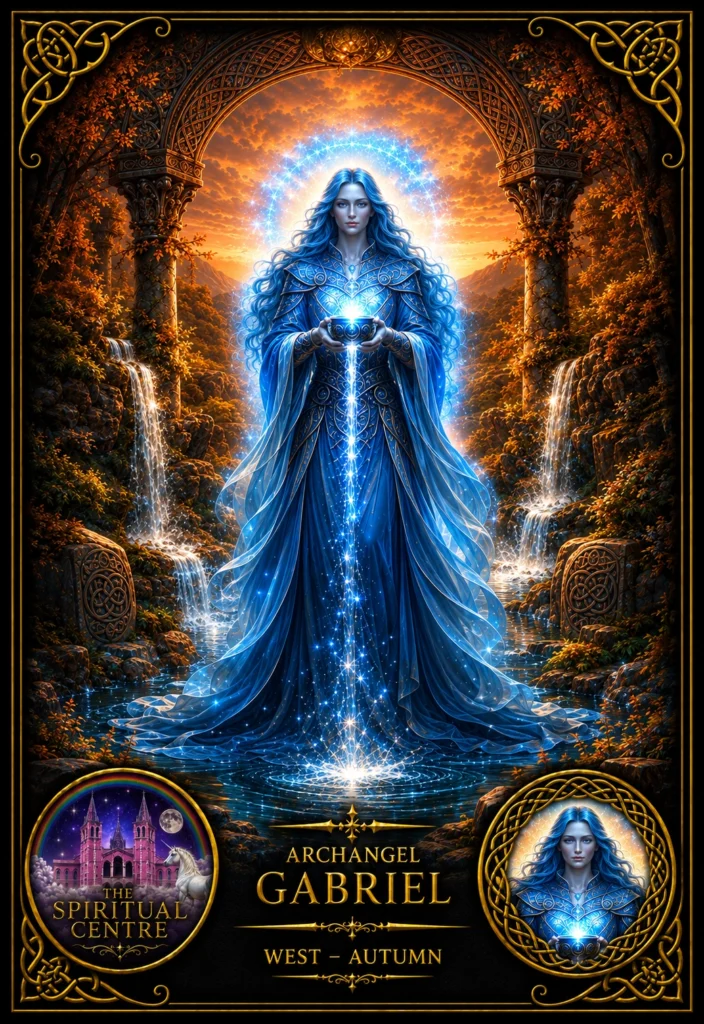
Gabriel may be understood in older spiritual memory as far more ancient than scripture alone. Before the name was written into biblical tradition, Gabriel can be seen as a western messenger presence, known in the elder world of forest, river, and mist, in the same deep age that remembers the Cernunni and the old powers of land and season. In this telling, Gabriel was not created by religion, but adopted by it, given new language while retaining an older essence.
She belongs to the West, the quarter of Water, Autumn, intuition, endings, and soul-depth. Where the East brings first light, the West receives the sun and gathers what has been learned. Gabriel stands there as keeper of messages carried through feeling, dream, omen, and inner knowing. She governs the truths that rise not through argument, but through recognition.
For this reason Gabriel is linked with messages, dreams, intuition, prophecy, pregnancy, new beginnings, and the awakening of destiny. Where something hidden must be spoken, Gabriel belongs. She announces birth, but also warns of endings. She blesses beginnings, but also sounds when an age has run its course. In this sense she is not only comforter, but herald of necessary change, even the closing of worlds.
In the older Celtic stream, echoes of her passage may be heard in Gabriel’s Hounds, and beside the spectral guardians known as the Cŵn Annwn. These are not merely dogs of fear, but guides through threshold places, protectors in darkness, and escorts when the veil grows thin. Their cry across hill and storm is the sound that something unseen is moving near.
Later faiths named her an Archangel, and rightly so within their own sacred language. Yet names change more easily than presences do. Whether called spirit of the West, ancient messenger, dream-bearer, herald, or archangel, Gabriel remains the one who comes when destiny must be heard.
She earns a place within The Spiritual Centre because many lives are changed not by force, but by a message received at the right time.
Ash Tree / Totems and Entities
The Ash Tree stands as a bridge between worlds, making it a natural companion to Gabriel, the sacred messenger who carries truth, guidance, endings, and new beginnings between realms. In older spiritual memory Gabriel may be understood as more ancient than scripture, later adopted into biblical tradition as an archangel. Standing in the West, aligned with Water, Autumn, intuition, and inner wisdom, Gabriel harmonises with Ash as a tree of connection, prophecy, and spiritual passage. Together they teach that messages still arrive through dreams, sudden clarity, instinct, and quiet knowing. Ash offers the pathway between worlds, while Gabriel gives voice to what the soul is ready to hear.
Beech Tree / Totems and Entities
Archangel Gabriel and the Beech share intuition, prophecy, transition and the wisdom carried between generations. In Gabriel’s season of Autumn, the Beech releases its mast, beautifully reflecting how every ending already carries the possibility of new life. Alongside Diana, Gabriel shares a connection with fertility, childbirth and protection: Diana listens to the instinctive language of nature, while Gabriel gives voice to what has been heard. Through them flows Bnwyfre, carrying memory, revelation and new beginnings through the living woodland.
ArchAngel Michael
Key Words:
Fecundity ~Purity ~ Light
What is the spiritual meaning of ArchAngel Michael?
ArchAngel Michael represents the strength of divine light, bringing courage, clarity and purpose through the transforming power of Fire.
Why does the ArchAngel Michael appear now?
Michael will help you face your fear.
How do I call upon ArchAngel Michael?
Look South to face him, use your minds eye to summon him.
ArchAngel Michael
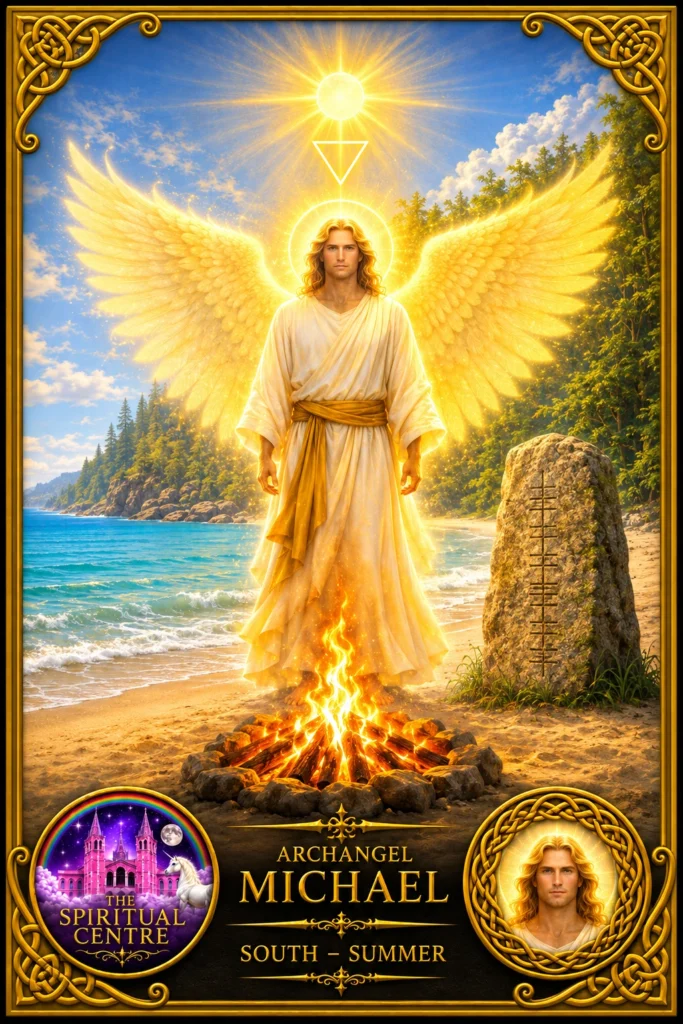
ArchAngel Michael is of the South, the Summer, the Fire and the Salamander.
Michael stands at the height of the turning wheel, when Summer has reached its fullness and the sun holds dominion over the longest days. He belongs to the South, to warmth and ripening, to the strength that moves through field, forest and every living thing when the year is abundant with life. His is not the first spark of spring, but the mature fire of Summer, established, powerful and sustaining, Bnwyfre – Life Force Energy
Within the Celtic world, the turning year was understood through the changing relationship between land, season, sun and spirit. Summer brought growth towards fulfilment: crops strengthened, fruits began to swell, animals raised their young and communities worked beneath the long hours of daylight. Fire represented the life force moving through this abundance, and Michael carries that same correspondence of vitality, courage, strength and purpose.
He stands within the South facing North, completing the balance of the four directions. Beside him are the Salamanders, the elemental spirits of Fire, carrying transformation through flame, sunlight and heat. Michael’s sword reflects this same nature. It can divide and distinguish, but it can also illuminate. Like the sudden brilliance of sunlight upon metal, it represents the moment when uncertainty gives way to clarity and purpose becomes known.
At the height of Summer there is also responsibility. What has grown must be tended if it is eventually to become harvest. The strength of Michael is therefore not simply that of the warrior. It is the strength of the guardian, the keeper and the one who maintains order while life reaches towards fulfilment. Fire can warm the hearth or consume it; strength becomes meaningful through the wisdom with which it is carried.
Michael’s familiar name was preserved within later religious traditions, but the spiritual principles he represents are considerably older than any single faith. Solar guardians, sacred warriors and keepers of divine fire appear throughout the ancient world. Within the Celtic landscape these same qualities were recognised through sacred flame, the power of the sun, the honour of the warrior and the seasonal rites that accompanied the turning wheel.
As Summer begins its slow journey towards harvest, Michael remains at the southern quarter, holding the fire at its fullest strength. Nothing within the wheel remains still forever. The sun that climbs must eventually descend, the flower becomes fruit, and abundance gives way to gathering. Michael belongs to that magnificent moment of fullness, when the year has become everything that Spring promised it might become.
Within The Spiritual Centre, ArchAngel Michael represents South, Summer and Fire: courage strengthened by responsibility, passion given purpose, and ‘Bnwyfre – Life Force Energy‘ at the height of its expression. He stands within the eternal turning of the wheel, not belonging to one religion or tradition, but as one expression of a spiritual presence humanity has recognised beneath many names.
Gorse / ArchAngel Michael
Gorse and ArchAngel Michael share the correspondence of Fire, Summer and the fullness of life. Gorse carries the colour of sunlight across the heath and burns fiercely as fuel, while Michael stands in the South with Fire as light, courage and transformation. Together they represent vitality, fecundity and Bnwyfre, the Life Force Energy reaching its fullness as the turning wheel moves towards harvest.
ArchAngel Raphael
Key Words:
Healing ~ Innocence ~ Companion
What is the spiritual meaning of ArchAngel Raphael?
Archangel Raphael represents healing, renewal and the restoration of the Self.
Why does the ArchAngel Raphael appear now?
Raphael appears when healing is needed.
How do I call upon ArchAngel Raphael?
Face East and call her in with the breath, appreciate all that she is and she will come quietly, respectfully.
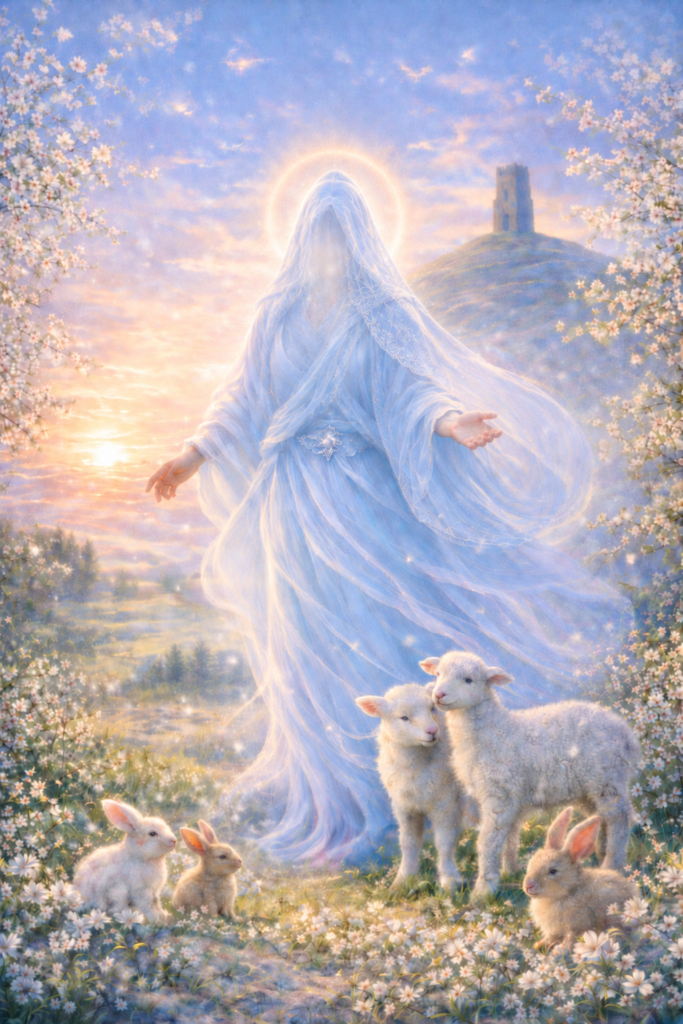
ArchAngel Raphael
ArchAngel Raphael is of the East, the Spring, the Air/Wind and the Sylph.
Archangel Raphael is known as the healing angel, a presence associated with restoration, protection and companionship. The name Raphael is traditionally understood as “God heals”, yet the presence behind the name may be far older than the religious traditions that came to recognise and preserve it. Within The Spiritual Centre, the Archangels are understood not simply as figures belonging to Christianity or any single faith, but as ancient spiritual presences that humanity has encountered, named and interpreted through different cultures and different ages.
Raphael appears within religious tradition as male, yet spirit need not conform to human ideas of gender. Raphael occasionally presents as female. She is heavenly without being distant; luminous without being overpowering. Her presence seems to envelop the energy around her, rather than standing apart from it. There is an innocence to Raphael, but not naivety — it is the innocence of something untouched, a healing light that asks nothing before offering itself.
The ancient story of Raphael tells of a companion. In the Book of Tobit, Raphael walks beside Tobias disguised as an ordinary traveller. She guides, protects and heals, yet for much of the journey Tobias does not know that an angel walks beside him. Perhaps this is one of the most beautiful ways of understanding Raphael: healing does not always arrive with thunder, revelation or miracle. Sometimes it simply walks beside us until we are ready to recognise its presence.
Raphael belongs to the East, to Spring and to Air. She arrives with awakening: the first warmth carried upon the breeze, the opening flower, the returning light and that first deep breath which tells us that something within us is beginning to live again. The East also represents the Self, and Raphael’s healing therefore begins within — restoring what has become tired, wounded or disconnected before allowing that renewal to move outwards into the world.
Raphael lives upon the breeze and within the breath. Her presence belongs naturally to Bnwyfre ~ Breath of Life ~ Life Force Energy, moving unseen around and through us. Like the fragrance of Honeysuckle carried upon the evening air, we may experience her before we understand where she has come from. We do not necessarily see the breeze, yet we feel it against our skin; we do not see the breath once it leaves us, yet it continues into the world.
Perhaps this is Raphael’s greatest gift. She does not need to announce herself as an Archangel. She can simply be the companion beside us, the warmth surrounding us, the breath within us and the quiet presence that helps us heal.
Honeysuckle Tree / ArchAngel Raphael
Raphael arrives upon the East wind, carried by the first gentle breaths of Spring. She shares the nature of the Sylphs, the elemental spirits of Air, traditionally associated with the breeze, atmosphere and unseen movement of the air around us. As Honeysuckle awakens and reaches towards the returning light, Raphael’s presence brings healing, renewal and the quiet encouragement to grow.
ArchAngel Uriel
Key Words:
Finality ~ New Beginnings ~ Grounding
What is the spiritual meaning of ArchAngel Uriel?
Uriel brings a conclusion to an episode.
Why does the ArchAngel Uriel appear now?
Uriel will help conclude one episode and introduce a new beginning.
How do I call upon ArchAngel Uriel?
Look North to face him, use your minds eye to summon him.
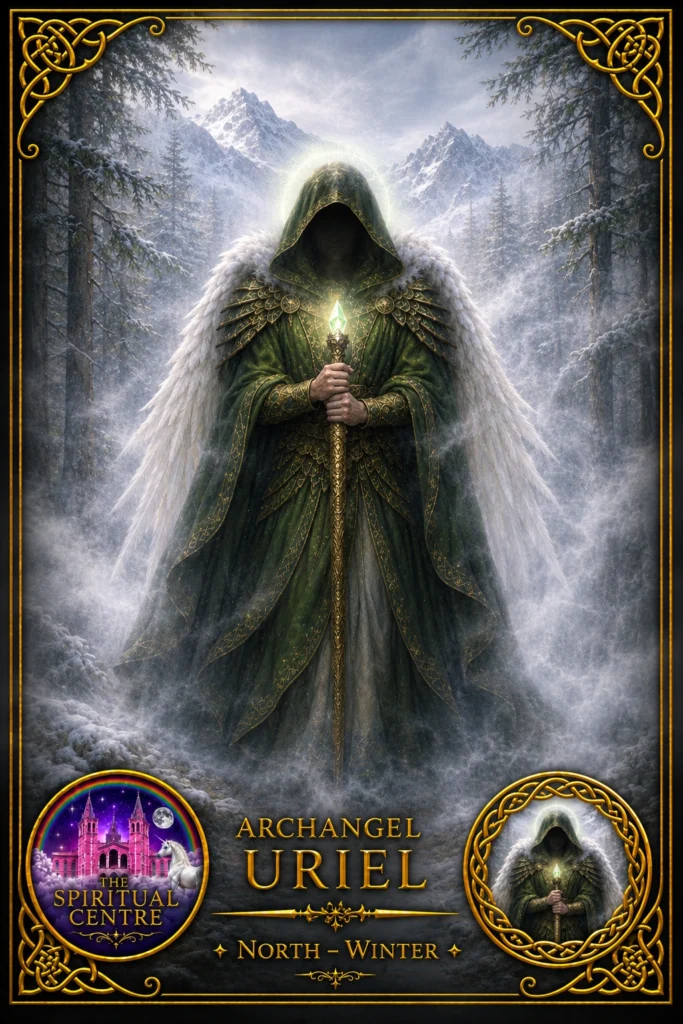
ArchAngel Uriel
ArchAngel Uriel is of the North, the Winter, the Earth and the Gnomi.
Archangel Uriel brings poetry, rhyme and reason to the forefront. He provides support, spreads divine light before us and brings understanding where once there was uncertainty. Known as the Earth Angel, Uriel stands in the North between the gates of Eden and Tartarus. Through the power of empathy, he sees all life, while his acceptance of representative thought allows him to promote life in all its forms.
Uriel stands in the North facing South, grasping a sword embedded within the Earth in his right hand and holding the disc of knowledge to his breast with his left. Within Celtic and Nordic traditions he is known across many incarnations, appearing in fables, spiritual teachings and ancient lore, and welcomed as a deity.
In robes of citrine, russet, olive and black, Uriel has appeared throughout the ages and to people of many cultures, from the caves of Siberia to the tombs of Egypt, from the gardens of Babylon to the Sacred Stones of the Druids, and within drawings of Uriel found in the most unlikely of places. Through Hermes Trismegistus and the Hermetic principles, from ancient Greece to Egypt and onward through Rome, Uriel has been recognised. Sacred places, ancient rituals associated with the Earth, the harvest, prosperity with land, food and farmers all carry his presence.
Thunder, lightning, storm and terror are quelled and calmed by Uriel. The colours of his robes reflect the changing storm: citrine within the cloak matches the light of the sun, russet echoes the reds of his shirt, while the gold of his disc accompanies the sword driven into the Earth. As the energy of the storm disperses and a new beginning unfolds, where once there was terror there is now empathy, judgement and temperance.
Uriel is recognised within the folds of the Hermetic Qabalah. From nothing came a thought, from thought came movement, and from movement came manifestation. Uriel is recognised as one of many, and as such many polytheistic religions and non-religious traditions accept him as deity or idol.
Within Tarot, the 22 Major Arcana are associated with the 22 paths of the Hermetic Qabalah walked by the Fool, the Zero or 22nd card. Divine light follows the path within the Tree of Life. Uriel, the Fool, spreads this divine light and the journey towards enlightenment, divinity and God. The flashes of light as he quells the storm are ten in number, forming the Qabalistic Tree of Life, while lightning striking the Earth becomes the manifestation of movement originating from thought.
The Celtic Druids of Britain accepted Uriel as their leader of bards, the poet laureate and inspirer of lore. An Earth Angel who ensured that all Earth-tied sentients were equal, the dryads, elves, fairies, nymphs and sylphs were no more or less important than each other. All sentient life forms are equal in the eyes of the lore. The lunar cycle and the power of night against day remain forever equal.
The Ancient Egyptians, of the same era and of an age long before, accepted Thoth or Ma’at as God of writing, magic, wisdom and the Moon. Divine balance lies at the heart of their belief system. Thoth forever in their thoughts and as the upholder of truth, creator of the Tarot, the Book of Thoth. Both Thoth and Ma’at carry a gold disc and a book and were self-created from thought.
Uriel transcends the density of physical reality, with self, all relatives to self and all elements of reality as is known.
Uriel, in his many guises, has appeared throughout cultures and has been idolised by more traditions than may ever be known. He has been acknowledged as Angel, Angel Incarnate, Archangel, Ascended Master, Bard, Creator, Deity, Face of God, God and Idol. These identities are not separate from one another, but expressions of the many ways humanity has encountered, understood and remembered his presence.
Uriel favours the role of Archangel, with the ability to appear as all things to all life-force streams, assisting and influencing when asked, speaking and being heard. As an Ascended Master, Archangel Uriel has shared many lifetimes and many experiences, carrying their wisdom through the ages.
Fir Tree / Archangel Uriel
Archangel Uriel walks with the fir through the stillness of winter, when the forest rests beneath snow and the strength of the evergreen becomes most apparent. Uriel is of the North, Winter and Earth, while the fir rises from that frozen Earth and reaches towards the heavens, remaining green when much of the surrounding woodland has fallen dormant.
Yew Tree / Archangel Uriel
Archangel Uriel walks with the yew where the boundaries between life, death and eternity grow thin. The ancient tree carries the memory of generations within its living wood, while Uriel becomes the keeper of the light that survives time. At Samhain, the yew stands with its roots among the ancestors and its evergreen branches among the living, creating a meeting place between the physical and spiritual worlds. Here Uriel’s light does not banish darkness but illuminates the mystery within it, carrying wisdom and memory from one existence into another. With the fir, his light accompanies renewal through winter; with the yew, his light accompanies eternity.
Arianrhod
Origin: Welsh Tradition, The Mabinogion, c. 11th–13th Century CE manuscripts preserving much older Celtic oral tradition.
Arianrhod is remembered as the Keeper of the Silver Wheel, the great celestial turning that carries the Moon, the stars and the eternal cycles of the heavens. Her presence is gentle rather than commanding, revealing harmony instead of hierarchy and order without force. She reminds us that the universe moves through natural rhythm, where every season, every tide and every phase of the Moon arrives in its own perfect time. Those who patiently observe the heavens begin to recognise that life itself follows these same quiet patterns.
The old Welsh traditions place Arianrhod among the mysteries of the sky, yet her influence is never separate from the earth below. The sea answers the Moon. Rivers answer the tides. Trees answer the seasons. Within the Bnwyfre Spiritual Order, she represents the living relationship between heaven and earth, where the movement of the stars is reflected in the landscape, the forests and the soul itself. She teaches that everything belongs within the same living harmony.
Her Silver Wheel turns beyond the passing of a single year, reflecting the greater celestial cycles that govern existence. Within The Spiritual Centre, she naturally aligns with the Metonic cycle and the rare Thirteenth Moon, reminding us that some wisdom cannot be measured by ordinary calendars. Like the heavens themselves, understanding matures through observation, patience and the willingness to see beyond the obvious.
Across many cultures, women are remembered as keepers of destiny. The Greek Moirai spin, measure and cut the thread of life, while Arianrhod turns the celestial wheel upon which those threads journey through time. Though their traditions differ, both recognise that life unfolds through relationship, continuity and sacred rhythm rather than chance alone. The pattern already exists; wisdom comes through learning to recognise it.
As evening twilight settles across the western sea and Venus appears beside the first stars, the heavens seem to pause between one day and the next. It is here that Arianrhod is most easily recognised, not as a distant goddess demanding devotion, but as a quiet presence inviting us to live in harmony with the Moon, the land, the turning heavens and the Breath of Life. Her wheel has neither beginning nor end, reminding us that every ending becomes a beginning, every season prepares the next, and every soul moves within the same eternal harmony of Bnwyfre.
Elder Tree / Arianrhod
Arianrhod is remembered as the Keeper of the Silver Wheel, whose endless turning brings the heavens, the seasons and the Moon into harmony. The ancient Druids understood that the Metonic cycle was more than a way of measuring time. It revealed the greater rhythm through which the Moon returns, the Elder appears, and the wheel begins another sacred revolution. Gwennefoedd breathes warmth and harmony through this celestial order, reminding us that every turning carries both continuity and renewal.
Like the ancient Moirai, Arianrhod does not determine destiny but preserves the eternal rhythm of life, death and rebirth. Through her Silver Wheel we are reminded that nothing stands alone. The heavens, the seasons, the land and the soul all move together in the quiet harmony of Bnwyfre.
Bean Nighe
(Ben-nee-yeh) Keeper of the Crossing
The Bean Nighe, the Washer at the Ford, belongs to the threshold places where one state gives way to another. She is a Scottish Gaelic spirit of fate, found at the edges of rivers and crossings, where movement cannot be avoided and direction must be taken. Within the field of The Spiritual Centre, she is recognised not as something to be feared, but as a presence of inevitability, the moment where what has been set in motion can no longer be turned back.
She is seen washing the garments of those whose time or circumstance is approaching its conclusion. This is not an act of harm, nor is it a cause. It is a revelation of what already exists, a quiet acknowledgement that a path has reached its point of outcome. In this way, the Bean Nighe does not interfere with life. She marks the transition, holding the space between what is known and what is about to unfold.
Within practice, the Bean Nighe is approached as a teacher of acceptance, clarity, and consequence. She is not called upon lightly, nor for comfort. Her presence is recognised when a situation has moved beyond negotiation, when decision has already taken root and must now be lived. To work with her is to acknowledge truth without resistance, to stand at the crossing and see clearly what lies ahead.
Blackthorn Tree / Bean Nighe
Bean Nighe finds her place alongside Blackthorn, where strife, boundary, and decision are held. Together they reflect the same principle. That there are moments in life where the path is no longer shaped by choice, but by what has already been chosen. In her presence, clarity is not softened. It is revealed, and through that revelation, understanding is found.
Heather / Bean Nighe
The Bean Nighe belongs naturally amongst Heather, where heathland meets burns, streams and ancient crossings. As Washer at the Ford, she represents transition and the revelation of what has already been set in motion, while Heather brings endurance, continuity and renewal beyond the crossing. Together they embody time, place and circumstance, where water moves onwards, the Bean Nighe marks the transition, and Heather reminds that beyond every crossing, the living land continues.
Sea / Bean Nighe
The Bean Nighe knows what is coming. Beside the Water she washes the bloodstained clothes of someone who has not yet died — a person who may still be at home, aboard a ship or laughing amongst those they love.
At the Sea, her warning becomes painfully familiar. Fishing communities have always known that someone who leaves with the morning tide may never return. The Sea can take a husband, son, brother or lover without returning a body to bury.
Find the Bean Nighe washing a familiar shirt before the boat has even left the harbour and she leaves us with a terrible question: are we being warned because fate can be changed, or told because it cannot?
The Bean Nighe continues washing, while the tide continues coming in and the moonlight cleanses all that it touches.
Bicne
Origin: Irish Celtic Tradition, Dindshenchas Érerus, preserving the medieval place-lore tradition of Ireland.
Bicne appears briefly within Irish legend as a Rhyming Druid, a cheerful and well-loved man called upon when the knowledge of others had failed.
For three hundred and fifty nights, almost a year Cairpre Lifechair had been troubled by four mysterious birds whose mournful song followed him from the bright sunrise in the east. They started at dawn and continued til dusk pestering Cairpre to the point of despair.
Once Bicne was summoned, he listened to Cairpre’s story and began searching the woods for an answer. One tree after another was brought before him. Over each Bicne spoke the verse of the Bard, and one after another they failed to answer, and yet still the Druid persisted.
Eventually a tree was brought from the fruiting thickets of Fid Frosmuine, the Spindle a weaver of fortune, of fate and of circumstance. Bicne spoke over it as he had spoken over the others, but this time the birds were silenced and Cairpre’s long anguish came to an end. The spell that had been cast for the greater good of all had served the purpose of personal intent and everyone involved prospered from the experience.
Little more is told of Bicne. He enters the story when he is needed and disappears when his work is done. Yet within that brief appearance we glimpse the Bard within the Druid, the poet whose words carried intention, and the learned man who understood that casting a spell involved Synchronicity – Time, Place and Circumstance and must serve the greater good of all, before it serves personal gain.
Spindle Tree / Bicne
The Rhyming Druid and Oir share an understanding of Correspondence and Harmony. Bicne gathered poetry, knowledge, nature and intention; the Spindle gathered separate fibres and turned them into thread. Its season is Autumn, its direction the West, towards which the mysterious birds travelled. Here Synchronicity becomes Time, Place and Circumstance, bringing Druid, tree and intention into harmony. Oir gathers the threads. Bicne understands why they belong together.
Cernunni
The Cernunni are the antlered folk of the old forests, a tribe of beings said to carry the intelligence of the stag, the gentle demure of the doe, the innocence of the fawn, and the cunning beauty of humankind. In this tradition they are not animals made human, nor humans made animal, but a bridge between the two, shaped from the living harmony of woodland life.
With Cernunnos as their elder and crowned guide, they belong to an age before kingdoms, before roads, before Britain stood apart as an island. They are remembered as among the first guardians of the deep woods, dwelling where mist, root, and birdsong formed the earliest temples.
The Cernunni watched the rise of mankind and did not always hide from it. To those who came with greed they were elusive as shadow. To those who came with reverence they became teachers of the land: how to move with the season, how to take without desecration, how to listen before speaking, and how to live without severing oneself from nature.
Their story belongs in The Spiritual Centre because they embody what many now seek to recover: a noble relationship between instinct and wisdom, wildness and kindness, body and spirit. They remind us that civilisation is not the opposite of nature unless we make it so.
In sacred art such as the Gundestrup Cauldron, the memory of that antlered presence survives. Whether as god, tribe, or symbol, the message remains the same: the forest was never empty, and humanity was never meant to walk alone.
Birch Tree / Cernunni
The Birch Tree is the first light of the woodland year, making it a natural companion to the Cernunni, whose mysteries are bound to fertility, renewal, kinship, and the continuation of life through the turning seasons. Among the old antlered folk, Birch was a tree of preparation, marking the return of movement, courtship, and new beginnings after winter hardship. They understood that life cannot be forced before its season, and that many sacred things begin quietly in darkness before appearing in the fullness of light. Together, Birch and the Cernunni speak to those rebuilding, seeking love, restoring hope, or stepping into a new chapter. Birch opens the way, while the Cernunni understand the sacred ancient secrets of Bnwyfre, the life force energy that encourages us to walk it.
(See Birch Tree / Totems and Entities)
Alder Tree / Cernunni
The Alder Tree stands where land meets water, making it a natural ally of the Cernunni, the antlered guardians of nature who uphold balance, harmony, and right relationship. Remembered as noble peacemakers with the strength of the stag and the wisdom of humankind, they stand beside Alder as winter turns to spring and life begins to stir again. Together they represent leadership through service, prosperity through fairness, and fertility through natural timing. As Gaia rises from winter sleep, Alder and the Cernunni remind us that peace, renewal, and abundance are living forces that must be nurtured.
(See Alder Tree / Totems and Entities)
Holly Tree / Cernunni
The Holly Tree stands strong at the heart of winter, making it a natural companion to the Cernunni, the antlered guardians who understand that life in the dark season is not lost, but protected and gathering strength. With the nobility of the stag and the awareness of humankind, they stand beside Holly as keepers of thresholds between life and death, instinct and sovereignty, endurance and renewal. Together they teach that true power is watchful, patient, and quietly resilient. In times of hardship or inner winter, Holly and the Cernunni remind us that unseen growth is still growth, and the promise of spring is already forming beneath the frost.
Crone (Hylde-Moer)
The Crone is one of the oldest feminine presences in myth, not a symbol of decline but of wisdom, sovereignty, protection, endings, healing, and truths earned through lived experience. In the sacred triad of Maiden, Mother, and Crone, she is the keeper of what comes after innocence and after duty: the stage of clear sight, deep knowing, and freedom from illusion. She has buried what needed burying, survived what needed surviving, and no longer speaks to please others.
Across Europe she appears under many names: wise woman, hedge mother, seer, herb keeper, winter queen, old wife of the woods. In Northern tradition she is remembered as Hylde Moer, the protective spirit of the Elder tree. To take from Elder without permission was said to invite misfortune, not because she is cruel, but because sacred medicine requires respect. The warning teaches relationship with nature, not ownership over it.
She is often attached to the Elder Tree because Elder itself carries her qualities. It is a tree of remedies, thresholds, endings, rebirth, funerary rites, protection, and hidden medicines. Elder flowers open in brightness, while darker berries ripen later in the year, mirroring the journey from youthful bloom to mature depth. Beneath this symbolism, the Crone stands as guardian of what ripens with time.
In folklore, children may fear her and the shallow may avoid her, because truth can be unsettling when one seeks only comfort. Yet to the sick, the grieving, the lost, the ageing, and the sincere seeker, she is often the most generous of guides. She does not flatter. She heals. She does not chase admiration. She offers what is needed.
She belongs within The Spiritual Centre because modern culture often worships youth while neglecting depth. The Crone restores honour to elderhood, intuition, menopause, grief wisdom, boundaries, ancestral knowledge, and the fierce compassion that comes from having truly lived. She reminds us that the final feminine stage is not disappearance, but power refined.
Hawthorn Tree / Crone
The Hawthorn Tree stands in the threshold places of the land, making it a natural companion to the Crone, the unseen guardian of wisdom, boundaries, sacred timing, and right relationship. She watches where worlds meet, guiding the fae, blessing those who approach with respect, and teaching that true beauty must be matched with discernment. Hawthorn blossom carries her gifts of love, handfasting, fertility, and good fortune, while its thorns remind us that protection is also sacred. Together, Hawthorn and the Crone speak to those moving through love, loss, healing, menopause, and renewal, showing that maturity holds its own deep power and grace.
(See: Hawthorn Tree / Totems and Entities)
Hazel Tree / Crone
The Hazel Tree is a tree of wisdom, sacred perception, divination, and hidden knowledge, making it a natural companion to the Crone, whose gifts come through lived experience and clear discernment. Together they teach that true insight is quiet, grounded, and earned with time. Hazel refines the senses so what was once faint becomes recognisable, while the Crone reminds us that not every feeling is truth and not every vision is wisdom. Linked with holy wells, dreaming, divining, and the subtle thresholds between worlds, they guide seekers toward understanding shaped by patience, humility, and right timing.
(See: Hazel Tree / Totems and Entities)
Elder Tree / Crone
The Crone is the eternal grandmother of the grove, the keeper of memory and the guardian of wisdom gathered through countless seasons. Known throughout Europe as the Wise Woman, the Hedge Mother, the Herb Keeper and Hylde-Moer, she teaches that healing begins with respect for the living world. Within the Bnwyfre Spiritual Order, she watches over the Elder Tree and the rare Thirteenth Moon of the Metonic cycle, reminding us that every ending becomes a beginning, nothing in nature is wasted, and wisdom is life’s greatest harvest.
Cŵn Annwn
The Cŵn Annwn are the legendary hounds of the Welsh Otherworld, the spectral pack who move between realms when the veil grows thin and the old pathways open. In Celtic memory they are most strongly felt around Samhain, when autumn closes, stores are gathered, and the living world turns toward winter. At this threshold of the year, their cry across hill, forest, and night air signals that one season has ended and another has begun. They are not merely omens of fear, but heralds of sacred transition.
Their home is Annwn, the ancient Welsh Otherworld: not a place of punishment, but a hidden realm of mystery, ancestors, wisdom, abundance, and powers beyond ordinary sight. The Cŵn Annwn are its escorts and guardians. They accompany souls across the boundary of death, guide travellers through unseen passages, and maintain order where worlds meet. To hear them is to be reminded that life extends beyond the visible field.
They belong also to the ancient forests, where root and mist hold older memories than stone. Before roads and walls, the woodland was temple, refuge, danger, and teacher. In such places the hounds were imagined as guardians of sacred routes through both land and spirit. Their presence within forest lore speaks of instinct, protection, and the intelligence that moves silently through darkness.
In later folk tradition, echoes of these older beings became known as Gabriel’s Hounds, where Christian language met Celtic memory. The archangel Gabriel, herald of endings and new beginnings, became associated with the soul’s passage and the comforting guidance once attributed to the Otherworld pack. The names differ, yet the role remains familiar: protection in transition, companionship at the threshold, and safe passage when the path is unknown.
Some traditions speak of nine hounds, surrounding the soul as spiritual guardians. Their stations form a sacred compass of presence: 1) Heart, 2) North, 3) East, 4) South, 5) West, 6) Above 7) Below 8) left shoulder, 9) right shoulder. Whether taken literally or symbolically, this expresses an ancient truth that guidance is not distant, but all around and within us.
White Poplar Tree / Cŵn Annwn
The Cŵn Annwn, the great white Hounds of the Welsh Otherworld, belong naturally beneath the trembling leaves of the White Poplar. Guardians and companions of Annwn, their white coats and red ears mark them as creatures moving between physical and spiritual realms. Their mysterious cries are said to grow softer as they approach, echoing the Poplar whose hidden silver is revealed by the slightest unseen breath upon its leaves.
As Samhain turns towards winter, tree and Hounds share the threshold, carrying Otherworld Guardianship, Spiritual Passage, Loyalty and Threshold Awareness. Perhaps the Cŵn Annwn need never be seen beneath the White Poplar; sometimes the trembling of its silver leaves is enough to know that something has passed.
Daoine Sìthe
Pronounced ~ Do nee yah Shay ~ Doo neeya See
Daoine Sìthe, the People of Peace, belong to the spiritual landscape of the Scottish Gaelic world. Their name describes not a single being, but a people, a collective spiritual presence remembered in the hills, glens, islands and wild places of Scotland. Although frequently translated into English as the fairy folk, this simple translation can diminish something far older and considerably more profound.
The Daoine Sìthe were not traditionally imagined as the tiny winged fairies of later children’s stories. They were Otherworld beings, often described in human form and understood to inhabit a world existing alongside our own. Hills and ancient mounds could belong to them; music might be heard where no musicians could be seen; and stories told of encounters in lonely places where the boundary between the human and spiritual worlds seemed remarkably thin.
The word Sìthe carries the meaning of peace, and respectful names were important within Gaelic tradition. The People of Peace were treated with consideration because humanity was not regarded as the sole inhabitant of the landscape. The land was shared. Certain places possessed their own spiritual presence, their own customs and their own inhabitants, whether or not they could ordinarily be seen.
This understanding sits naturally within The Spiritual Centre. Here, spirit does not always need to become an individual personality with a name, history and human appearance. Spiritual presence can also be collective. Na Daoine Sìthe preserve this older understanding beautifully: not one spirit representing the hill, but a spiritual people belonging within the living landscape itself.
Within the Bnwyfre Spiritual Order, the People of Peace share qualities with the Gnomi, the Sylphs and the density of physical reality. Each is an equal expression of spirit, for no individual being, entity, totem or density holds greater importance than another.
Stories describe encounters with the Daoine Sìthe in many different ways. They could offer assistance, share knowledge, dance, make music or interact with human communities, while other traditions warned against intrusion and disrespect. They were neither simply benevolent nor malevolent. Their world possessed its own order and boundaries, and harmony depended upon recognising that those boundaries mattered.
Within The Spiritual Centre, Na Daoine Sìthe are therefore recognised as the People of Peace, a collective presence of the Scottish Otherworld and part of the continuing spiritual memory of the Celtic landscape. They remind us of an older relationship with the land, where mountain, hill, water and wild place were never assumed to belong to humanity alone, and where the spiritual world could exist beside the physical as naturally as one valley lies beside another.
Gorse / Daoine Sìthe
Gorse creates a natural meeting place for Na Daoine Sìthe, the People of Peace, its thorns forming boundaries while its dense branches provide shelter. Yet this is no sombre boundary; its yellow and gold flowers carry the happiness, warmth and buoyancy of Summer, echoing the music and celebration found within stories of the People of Peace. Here, Gorse does not divide physical and spiritual reality, but gives their meeting place a shape, allowing both to exist as equal expressions within the living landscape.
White Poplar Tree / Daoine Sìthe
The Daoine Sìthe, the People of Peace, belong to the spiritual landscape of Scotland, dwelling alongside the physical world within the hills, woodlands and ancient places. The White Poplar becomes a natural meeting place between these realms, its restless leaves trembling and turning from green to silver-white as though responding to a presence moving quietly through the landscape.
Their correspondence is one of Otherworld Presence, Spiritual Kinship, Respect for the Land and Threshold Awareness, becoming especially strong around Samhain and Beltane, when the Celtic seasons turn and boundaries between realms draw close. Beneath the White Poplar, the Daoine Sìthe need not announce themselves. When its silver leaves suddenly tremble while the woodland remains still, perhaps the People of Peace are simply passing beneath the tree.
Yew Tree / Daoine Sìthe
The ancient Yew shares with the Daoine Sìthe, the People of Peace, a relationship with time that reaches beyond individual human lives. Its hollowing trunk, enduring evergreen foliage and continual renewal make it both ancestor and descendant, a living witness shared between the physical and spiritual worlds.
At Samhain, its roots reach through the earth of generations while its branches remain among the living, bringing Ancient Presence, Ancestral Landscape, Timelessness and Continuity into one sacred place. The Yew does not simply suggest that the Daoine Sìthe are passing through our landscape; perhaps beneath its ancient branches, it is humanity that briefly passes through theirs.
Druantia
Druantia is the sovereign lady of the woodland realm, remembered as Queen of the Dryads and guardian of the earth-bound intelligences that dwell within trees, root systems, groves, and the wider body of Gaia. If a dryad belongs to one tree, Druantia belongs to the living forest as a whole. She is both spirit of the tree and ruler of the many who serve within it.
Her throne is often placed within the Fir and most especially the ancient Scots Pine, where the stark beauty of the Highlands, mountain wind, and northern silence reflect her majesty. In the austere lands of stone, heather, mist, and winter endurance, she is felt as a regal presence: steady, watchful, and impossible to dismiss. Yet she is not confined to one species. Where great trees stand in dignity, whether Oak, Pine, Cedar, or the towering Sequoia, her current may also be sensed.
Druantia’s presence is woven into the very processes of nature. She moves with the seasons, turning with the winds of each direction before returning again to the North, the quarter of earth, memory, endurance, and ancestral strength. In spring she stirs growth. In summer she shelters abundance. In autumn she gathers wisdom. In winter she preserves what must survive. She does not resist change. She governs through it.
Spiritually, Druantia represents guardianship, balance, fertility, boundaries, and right relationship with the living world. She teaches that flourishing requires rhythm, that growth without restraint becomes excess, and that power without care becomes destruction. Under her watch, forests are not resources to be consumed, but relationships to be honoured.
She is also a mother of cycles. She witnesses the feminine journey from Maiden to Mother to Crone, seeing innocence ripen into wisdom and beauty deepen into authority. Hidden within the folds of Hawthorn, present in Elder, alive in every sacred grove, she is the quiet hand guiding maturation without force.
Why she belongs within The Spiritual Centre is clear. She is rooted in tree lore, Bnwyfre, seasonal consciousness, elementals, healing, and the unseen intelligence of nature. Druantia gives mythic form to all of these. She is the noble face of woodland sovereignty, the protector of tree spirits, and a reminder that the earth is alive with presence.
Rowan Tree / Druantia
The Rowan Tree is a tree of protection, clear sight, courage, and sacred boundary, making it a natural companion to Druantia, Queen of the Dryads and guardian of the living forest. Through Rowan, her wisdom becomes personal and protective, guarding homes, pathways, and the inner life from confusion and wandering harm. Together they teach that true strength is quiet, discernment is a form of power, and even the gentlest soul can stand watch with unwavering presence.
(See: Rowan Tree / Totems and Entities)
Ash Tree / Druantia
The Ash Tree is a world tree, living axis, and sanctuary between realms, making it a natural companion to Druantia, Queen of the Dryads and guardian of woodland harmony. Through Ash, her sovereignty becomes a living refuge where tree spirits, elementals, ancestral presences, and the currents of Bnwyfre may gather in balance. Together they teach that true power protects, true leadership unites, and life flourishes where many worlds meet in peace.
(See: Ash Tree / Totems and Entities)
Hawthorn Tree / Druantia
The Hawthorn Tree stands in the threshold places of the land, making it a natural companion to Druantia, Queen of the Dryads and guardian of woodland law, sacred boundaries, and unseen harmony. Through Hawthorn she watches over the fae, fairies, and sidhe, ensuring that reverence is rewarded and carelessness meets its lesson. Together they teach that love must be protected, power must be guided by wisdom, and blessing flows where respect is kept.
(See: Hawthorn Tree / Totems and Entities)
Elder Tree / Druantia
Druantia walks beside the Elder as the Druid’s year approaches Samhain, where the old year yields to the new and the veil between worlds grows thin. Guardian of the sacred grove, she preserves the wisdom of the passing seasons, reminding us that the rare Thirteenth Moon and the Metonic cycle reveal time as an eternal turning rather than a straight path. Standing with the Crone, surrounded by the Dryads and the ancestors, Druantia teaches that nothing truly lived is ever lost, only transformed, and that every ending naturally becomes a beginning.
(See: Elder Tree / Totems and Entities)
Fir Tree / Druantia
Among the ancient Fir forests, Druantia walks as Queen of the Dryads, her presence flowing through root, branch and the hidden pathways beneath the earth. The evergreen Fir reflects her sovereignty, endurance and guardianship, carrying life through the darkness of winter and standing green at the Winter Solstice when the woodland falls silent. Here Bnwyfre, the Breath of Life, continues to move through the forest, joining the Dryads, Gnomi, Fae and the unseen intelligence of root and mycelium into one living community. Beneath Druantia’s watch, the Fir teaches that no tree truly stands alone, for the forest is not simply a collection of trees, but one living presence breathing through many forms.
(See: Fir Tree / Totems and Entities)
Beech Tree / Druantia
Beneath the ancient Beech, Druantia carries the memory and living spirit of the forest. Bnwyfre flows through root, leaf, Dryad, Silvani and animal alike — the same vital force Hildegard recognised through viriditas. Druantia and Beech share quiet sovereignty, old knowledge and enduring wisdom, reminding us that a forest is not simply a collection of trees, but a living community whose memory reaches far beyond our own.
Dryads
The Dryads are primordial spirits and among the eldest presences of the woodland world, older than human memory, they are the guardians of ancient forest, woodland realms, groves, trees and woven into the first life of the trees. Remembered as earth-tied spirits, guardians of groves, and the living intelligence within the woodland world. More than figures of folklore, they represent the subtle life moving through root, bark, leaf, and branch. Where a tree is honoured as more than timber, the idea of the Dryad is never far away.
Their earliest associations are strongly linked with the Oak Tree, whose stature, endurance, and sacred reputation made it a natural first home for tree spirits. In classical tradition the name Dryad is often tied to oak, yet over time the meaning widened. What began with one tree became a language for many. Dryads came to represent the spirit-presence of forests, orchards, hedgerows, and individual trees across the living landscape.
There is wisdom in the way children imagine them. Ask a child to draw a tree spirit and they may sketch a figure of twigs, branches, eyes, and limbs emerging from bark and leaf. Such images carry an instinctive truth: that the human mind naturally recognises kinship between person and tree. We see ourselves in the upright trunk, the reaching arms, the rooted stability, and the seasonal cycle of growth, rest, and renewal.
In your wider tradition, Dryads are also understood as elementals of earth, sometimes called the Gnomi, though never limited to one rigid form. They may appear as twig-like figures in shadow, subtle presences near trunks and roots, or as beautiful human forms shaped to meet the perceiver in harmony. Their purpose is not spectacle, but relationship. They respond to atmosphere, intention, and the quality of presence brought beneath the tree.
To approach a Dryad, is to come in good spirit: calm, respectful, unforced, and receptive. Communication, if it comes, comes in their way first. Through feeling, atmosphere, intuition, symbolism, or the sudden sense that the woodland itself has become aware of you. Such encounters are less about seeing something external and more about entering a state of living connection.
Though earth-aligned, Dryads need not stand apart from other elemental currents. In some trees they mingle with the qualities of Sylphs of Air, Salamanders of Fire, and Undines of Water, reflecting the deeper character of each species and place. Thus orchard lore may attract twilight maidens and the Hesperides, Ash may welcome the Meliae, Holly may burn bright with fiery presences, and the wider forest remains under the care of Druantia, their sovereign queen.
Yet the Dryads should never be reduced to one task or one narrow meaning. Their true objective is harmony: to steady a place, enrich an atmosphere, complement the human aura, and remind us that nature is not empty matter but living relationship.
They belong within The Spiritual Centre because they restore wonder without abandoning the land. They invite us to meet trees not as objects, but as companions in the great breathing life of the world.
Oak Tree / Dryads
The Oak Tree is a tree of strength, kingship, protection, shelter, and ancestral continuity, making it the natural home of the Dryads, the primordial guardians of the woodland world. Older than human memory, they are deeply woven into the life of ancient forests, groves, and sacred trees. Through Oak they offer harmony, safety, resilience, and grounded wisdom, teaching that true power protects, true strength endures, and the oldest presence is often the quietest.
(See: Oak Tree / Totems and Entities)
Ivy / Dryads
Where Ivy climbs, the forest becomes layered with quiet life, binding trunk to branch in living green threads. In such places the Dryads, the ancient spirits of the trees, are said to dwell, moving with the sap and breath of the woodland itself. Ivy does not steal from the tree, but shares its shelter, creating refuge for birds, insects, and small creatures. The Dryad becomes the quiet keeper of this living sanctuary. Together, Ivy and the Dryads remind us that growth happens through relationship, patience, and harmony, and that some of the deepest life is hidden in stillness.
(See: Ivy / Totems and Entities)
Beech Tree / Dryads
Within the ancient Beech woodland, tree, animal and spirit become part of the same living presence. Dryads and Silvani move amongst the trees while Crow watches from the canopy, Mouse and Squirrel gather the mast and Stag walks quietly through the shadows. Together they share the viriditas — the living energy flowing through root, leaf, animal and spirit — reminding us that the spirit of the Beech does not end at its bark, but reaches into the entire woodland community.
Dumnorix
Origin: Gaulish Tradition, The Aedui, c. 1st Century BC preserved within the classical accounts of a much older British Celtic Tradition.
Dumnorix belongs to the Celtic world of Gaul, amongst the Aedui whose homeland lay within what is now Burgundy in France. He lived during the 1st century BC, at a time when the independent Celtic nations and varying factions were confronting Caesar and the expanding domination of Rome.
Dumnorix stood within the Aeduan world, amongst a people whose spiritual and cultural traditions belonged to the wider Druidic influence of Briton. He was a figure of significant importance with powerful allies, extensive wealth and recognised nationally as a leader who commands one of the larger military forces of the time. His allegiance to his people justified the recognition and loyalty demonstrated towards him from his followers. His skills in augury, druidry and predictions for the future matched his skills as leader and warrior. His claim to sovereignty and refusal to betray his heritage was ultimately tested in 54 BC. at the hands of Caesars cavalry. It is Caesars own account that respectfully acknowledges the spirit of Dumnorix and records his last words as: “Him being a free man and belonged to a free people.”
Dumnorix belonged to the same wider Celtic tradition that later produced Boudicea in Britain, their leadership drawing upon an ancient culture in which courage, sovereignty, spiritual knowledge and loyalty to one’s people were closely intertwined. Separated by little more than a century and the waters between Gaul and Britain, both commanded considerable followings and both emerged as formidable opponents of Roman domination. Dumnorix stood against Caesar; Boudica would later stand against Rome in Britain. Their resistance arose from the same fundamental claim: that a Celtic people possessed the right to remain free, governed according to their own traditions rather than those imposed upon them by Rome.
Dumnorix’s knowledge of augury helps explain why the Druid was such a respected and influential figure within Celtic society. The Druid possessed knowledge beyond that of the ordinary man, learning to observe the natural world and recognise meaning within its patterns. The flight and behaviour of birds, the sudden gathering of clouds, the direction taken by a released hare and other unusual happenances could be interpreted according to synchronicity which equals: time, place and circumstance. For a leader such as Dumnorix, augury became more than prediction; it brought together observation, experience, intuition and spiritual knowledge, helping determine when to travel, when to wait, when circumstances were favourable and when another path should be considered.
Central to this knowledge was encouraging synchronicity with the act of innocent intent. The skilled augur could deliberately create one part of the circumstance, perhaps releasing the hare at a chosen place and moment, while allowing nature to determine the answer through the direction it chose to run. The purpose was not personal gain, but the greater good of the people, requiring the Druid to observe without corrupting the message through personal desire. Such knowledge helps explain the authority surrounding figures such as Dumnorix: warrior and leader, but also a man able to read the correspondence between the spiritual world, the natural world and the circumstances unfolding around his people.
Mistletoe / Dumnorix
For Dumnorix, Mistletoe belonged to the language of Druidry, growing between Earth and Heaven and bringing together tree, Moon, season, spirit and mankind. Pliny describes the Druids gathering Mistletoe from the sacred Oak on the sixth day following the New Moon, using a golden sickle and catching the plant upon a white cloth. Through augury and synchronicity, time, place and circumstance, the Druid recognised the spiritual correspondence within the happenance, guided by innocent intent and the greater good. Mistletoe became a point of interaction between Mankind, Gnomi, Sylphs, Fae and spiritual presence, with Dumnorix standing amongst them as the Druid capable of recognising when the elemental worlds had come together.
Elementals
Elementals, including mankind, may be understood through personal experience as belonging to three great species: Terrestrial (of the Earth), Celestial (of the Heavens), and Extra-Terrestrial (not of the Earth).
The Terrestrial species may be further recognised in six expressions:
- Mankind = Human
- Gnomi = Earth
- Sylphs = Air
- Salamanders = Fire
- Undines = Water
- Spiritual Incarnates = beings conscious of other elemental life
Mankind are terrestrial beings living within the density of physical reality, embodied within matter and bound to time, growth, labour, relationship, and choice. Terrestrial elementals that live within the density of physical reality.
Gnomi are earth elementals who dwell within the body of the land. As humans rely upon air, they are sustained by earth in its solid and fertile state. They are guardians of stone, root, soil, and hidden treasures of the ground.
Sylphs are air elementals recognised in clouds, morning mist, drifting vapours, and rising warm currents. Their presence echoes through tales of the fae, fairy folk, and angelic forms. Often described as transparent beings glimpsed at the edge of sight, frequently seen in the peripheral vision, they move through wind and atmosphere with grace and swiftness.
Salamanders are fire elementals perceived within flame, ember, and storm-lit skies. They are drawn to living fire and may appear as shifting forms within candlelight or burning coals. Their role is transformative: to burn incompatible energy and restore calm, clarity, and peace to a space. In the past, the dance of these elementals mesmerised people as they gazed into the heart of a fire. A single candle in a room can encourage the ‘fire elementals’ to do their work. A common description today is of yellow wisps that turn orange when seen, then turn blue and disappear. Modern terminology for this ancient therapy is fire-gazing.
Undines are water elementals dwelling in seas, rivers, streams, fountains, and pools. Oceanic beings are often sensed as larger, deeper, and more powerful, while inland water spirits are gentler and more intimate in nature. The mermaid remains the most familiar image, though many forms are possible. Where water flows with the harmonic sounds the mermaids and nymphs presence is often strongest. The essence and romance of a babbling brook, a water fountain, and the gentle sound of rippling water will contribute to the elementals making themselves known. Believers and beings who possess a sense of spiritual acceptance are more likely to see them than those without a sense of spirituality.
Spiritual Incarnates are beings made in the divine image who live consciously among the wider elemental world. Their role is one of balance, awareness, harmony, and integration, recognising kinship between many forms of life. These beings live in harmony with all other elementals and can be socially aware of one or more of them. This quality resonates strongly with many Trees of the Ogham, which stand at the threshold between worlds and supports connection, gestation, and relational awareness.
Extra-Terrestrial beings are intelligences not originating from Earth. Though often assumed to come from other planets, their true origins may be far wider than modern imagination allows.
Alder Tree / Elementals
The Alder Tree stands where land meets water, making it a natural gathering place for the elementals and all beings drawn to harmony between worlds. Linked with connection, fertility, gestation, and awakening life, Alder marks the turning from the North to the East, from winter into spring. At Imbolc on 1st February, its current calls many presences: the antlered Cernunni, Huginn and Muninn, Paracelsus, Raven, Pike, Salmon, and the wider elemental hosts. Together they remind us that life returns through relationship, movement, and the reawakening of hidden forces.
(See: Alder Tree / Totems and Entities)
Oak Tree / Elementals
The Oak Tree is the king of the forest, a tree of strength, shelter, sovereignty, protection, and sacred continuity, making it a natural home for the elementals. Known as Home within the spiritual realm, Oak is a refuge where Dryads, Gnomi, Sylphs, Salamanders, Undines, and Spiritual Incarnates may gather in harmony. Through Oak, many forces become one living field, teaching that true power protects, true leadership unites, and life flourishes where all beings are given space to belong.
(See: Oak Tree / Totems and Entities)
Mistletoe / Elementals
Mistletoe forms a meeting place between the elemental worlds, growing upon the tree between Earth and Air without rooting directly into the ground. Mankind, represented through the Druids, meets the Gnomi of Earth, the Sylphs and Fae of Air, and the Spiritual Incarnates through its unusual spiritual correspondence. Mistletoe becomes the magical ingredient that encourages interaction between different elemental beings, softening their boundaries without changing their individual nature. Through Mistletoe, interaction becomes correspondence, correspondence becomes relationship, and separate elemental lives become part of one greater living spirit.
Honeysuckle / Elementals
Honeysuckle creates a living world within a world. Its roots disappear beneath the earth, twisting stems climb through neighbouring trees, flowers open to sunlight and rain, and their perfume drifts into the evening air. Within this small tangle of life, the Elementals find everything they need.
They are the unseen spirits of nature, present wherever the forces of Earth, Air, Fire and Water come together to create and sustain life. Honeysuckle gives them an especially rich meeting place: constantly growing, climbing, flowering, sheltering and feeding the creatures around it. What appears to us as a single plant becomes an entire community when viewed through their eyes.
Within Bnwyfre, the Breath of Life, the Elementals remind us that Honeysuckle never grows alone. Everything around it participates in its existence, and everything that visits becomes part of its story.
Sea / Elementals
The Undines are the Elementals of Water, a family whose many forms appear throughout human tradition. Naiads inhabit springs and rivers, Nereids ride the Sea, while Nymphs and Mermaids give Water forms we can recognise.
At the Sea, their world becomes immense. Water gathers without boundaries, carrying rivers from the land, answering the Moon and disappearing into depths beyond our sight.
Here the Elementals meet: Gnomi within the Land, Sylphs upon the Air, Fire travelling from the Sun and Undines within the Water. Different forms, different names, yet each belongs to the living elemental world surrounding us.
Ellyllon
Origin: Welsh Folklore ~ Ellyllon
Pronunciation: eth-LUHL-on
Singular: Ellyll
The Ellyllon belong to the old fairy traditions of Wales, where they are described as elusive beings of the groves, wooded valleys, hollows and secluded places of the landscape. Their name is the plural of the Welsh ellyll, meaning an elf, sprite or otherworldly spirit, and they are often associated with the wider family of beings known as the Tylwyth Teg — the Fair Folk.
Unlike the grand gods and goddesses of mythology, the Ellyllon belong closer to the earth. They inhabit those quieter places where the natural and spiritual worlds seem to overlap: beneath trees, amongst wildflowers, beside woodland paths and within sheltered hollows. Welsh tradition even preserves their relationship with plants in the name menyg ellyllon — “the gloves of the Ellyllon” — for foxgloves, suggesting a people imagined not merely alongside nature, but living intimately within it.
Bnwyfre ~ Breath of Life ~ Life Force Energy
The first breath of morning, the sharp intake of life that comes with the frost, the breath that lingers upon the air — this is the attraction of the Ellyll.
They look, listen and walk in your footsteps as you walk in theirs. Rarely announcing their presence, they remain the silent partner within the landscape: watching from the grove, moving through the hollow and following those quiet pathways where our world and theirs seem to meet.
The Ellyll do not need to be seen to be present. Within Bnwyfre, the Breath of Life, they belong to that moment when the woodland seems to breathe with you — when something causes you to stop, listen and wonder whether, for just a moment, you were walking alone.
The Ellyllon represent our awareness of the unseen life within the landscape. They encourage us to become quieter, more observant and more respectful of places that seem to possess an atmosphere of their own. A movement amongst the leaves, an unexpected fragrance, a woodland clearing that makes us instinctively lower our voice — these are the moments in which the boundary between the ordinary and the Otherworld can feel remarkably thin.
To encounter the Ellyllon is not necessarily to see a fairy. It is to recognise that a grove can be more than a collection of trees, that an ancient hollow can carry a presence, and that sometimes the smallest and most secluded places hold the greatest enchantment.
Honeysuckle Tree / Ellyllon
Honeysuckle creates the hidden places where the Ellyllon might choose to linger. As evening approaches, its fragrance strengthens, moths emerge and the woodland edge begins to change. Drawn by Bnwyfre, the Breath of Life, the Ellyllon move silently amongst its tangled stems and flowers, following pathways we may never notice and footsteps we cannot hear. Walk slowly through Honeysuckle, listen carefully and you may find yourself wondering whether the movement beside you was simply the breeze — or whether, for a little while, something unseen chose to walk with you.
Etheldreda
Æthelthryth is one of the great sacred women of early Britain, a queen who became an abbess, a ruler who chose devotion over power, and a figure whose presence still lingers in the mists of the eastern fenlands. Known also as Etheldreda and later St Audrey, she stands at the meeting place of sovereignty and spirituality, where worldly authority yields to a deeper calling.
Born into the royal house of East Anglia in the seventh century, she lived in an age when kingdoms were still forming and the spiritual shape of Britain was being rewritten. Dynastic marriages, shifting loyalties, and the rise of Christianity formed the outward world around her. Yet within that world, Æthelthryth became known for an inward strength that refused to be defined only by politics or expectation.
Though twice married, tradition remembers her as choosing a life of chastity, sacred independence, and service to God. In this she became more than a historical noblewoman. She became a symbol of a woman claiming ownership of her own destiny in a time when such freedom was rare. Her refusals were not weakness. They were acts of sovereignty.
Her greatest earthly legacy was the founding of the religious community at Ely, set amid waters, marshes, reeds, and shifting skies. This landscape matters. The fen is a threshold realm, neither firm land nor open sea, a place of mist, reflection, silence, and hidden paths. It suits her memory well. She belongs to those liminal places where transformation happens quietly and where spirit is felt close to the surface of life.
After her death, devotion to her spread widely. Ely became a place of pilgrimage, and her name endured through centuries of change. Even when language altered her to “St Audrey,” the current of reverence remained. Such survival suggests more than history alone. It suggests that some lives continue to speak because the truth within them remains needed.
Within The Spiritual Centre, Æthelthryth deserves a place as a British sacred woman of sovereignty, integrity, devotion, and inner freedom. She reminds us that power can be renounced without being lost, that purity can mean faithfulness to one’s calling rather than denial of life, and that the quiet soul may shape history more deeply than the loud one.
Ash Tree / Etheldreda
The Ash Tree is a tree of connection, passage, resilience, and the bridge between worlds, making it a fitting companion to Æthelthryth, the fenland queen who chose spiritual purpose over earthly power. Like Ash, she stands between realms: sovereignty and service, land and spirit, solitude and strength. Together they speak to those seeking integrity, sacred independence, and calm guidance through times of change, reminding us that the deepest authority often rises from within.
Faeries – Fae – Sidhe
The fairies, fae, and sidhe are among the most enduring presences of the unseen world, remembered through many names: fairies, faerie folk, sidhe, the good people, hidden ones, and the shining ones. They are not one single race or simple category, but a wide community of subtle intelligences whose stories have lived across Celtic lands and far beyond. Wherever people sensed that nature was alive with awareness, the Fae were never far away.
Within your wider understanding, the Fae may be recognised among the families of Sylphs and Gnomi, moving through both air and earth according to their nature. Some are woodland and root-bound, dwelling in mound, grove, stone ring, and old tree. Others are lighter, quicker, and more atmospheric, felt in mist, breeze, twilight shimmer, birdsong, and the edge of sight. Their realms are many because nature itself is many.
They belong to places where worlds meet: hawthorn trees, ancient paths, wells, streams, standing stones, crossroads, old hills, orchards, and forgotten clearings. Such places are not portals in the theatrical sense, but thresholds of perception where the visible world grows thin and awareness becomes more subtle. The Hawthorn is especially honoured in this regard, long remembered as a tree through which the faerie current may be felt.
Children are often linked with the Fae because children naturally perceive with imagination, openness, and less resistance than adults. In many traditions, when a child names a fairy, a relationship begins. The name becomes a thread of recognition, a path through which presence may return when called with sincerity. If neglected, that path may fade. Yet it is rarely lost forever. Through memory, wonder, and genuine intent, old connections may awaken again even after many years.
The Fae are not merely decorative beings of sweetness and glitter. They carry a fuller nature than that. They may bless, mislead, protect, test, inspire, conceal, or reveal. Like wind, water, and weather, they respond to the quality of relationship brought to them. Respect matters. Humility matters. A grasping heart seldom sees clearly.
They are often spoken of beside gnomes, elves, angels, dryads, and other elemental orders, not because all are identical, but because many traditions recognised layers of life beyond ordinary sight. Different cultures gave different names to neighbouring mysteries.
Within The Spiritual Centre, the Fae belong because they restore a forgotten truth: the world is more alive, more relational, and more enchanted than material habit allows. They remind us that wonder is not childish, that nature contains intelligence, and that belief is sometimes less about fantasy than about learning how to perceive again.
Hawthorn Tree / Fairies – Fae – Sidhe
The Hawthorn Tree has long been honoured as a tree of the faerie realms, growing in boundary places where the visible world meets the unseen. Fairies are said to thrive in its harmony, dancing between realms, guarding sacred gateways, and bringing blessing to those who approach with wonder and respect. At Beltane, Hawthorn petals were gathered and scattered to invite joy, fertility, prosperity, and good fortune. Together, Hawthorn and the fairy folk remind us that enchantment lives where reverence, openness, and nature meet.
(See: Hawthorn Tree / Totems and Entities)
Oak Tree / Fairies – Fae – Sidhe
The Oak Tree is a tree of strength, kingship, shelter, and ancient continuity, making it a natural gathering place for the fairies and the wider faerie folk. Where Oak stands, unseen life is said to flourish, for the Fae are drawn to places of vitality, protection, and deep-rooted presence. Beneath its ancient boughs they become guardians of hidden pathways, sacred places, and woodland harmony. Together, Oak and the fairies remind us that true enchantment can be strong, enduring, and deeply rooted.
(See: Oak Tree / Totems and Entities)
Hazel Tree / Fairies – Fae – Sidhe
The Hazel Tree grows in the liminal places of wells, streams, woodland edges, and quiet thresholds, making it a natural companion to the fairies and subtle faery intelligences. Unlike trees that open dramatic gateways, Hazel is a tree of heightened perception, intuition, and hidden wisdom, refining awareness so the unseen may be recognised rather than summoned. Linked with the clair-abilities, insight, and the quiet merriment of faery gatherings, Hazel and the fairy folk remind us that the deepest magic often appears through sharpened awareness and a receptive heart.
(See: Hazel Tree / Totems and Entities)
White Poplar Tree / Fairies – Fae – Sidhe
The Fairies, Fae and Sidhe belong naturally beneath the trembling silver leaves of the White Poplar, where the physical and spiritual landscapes seem to meet. Highland tradition associates the Poplar leaf with Faerie inspiration and eloquence, while British folklore remembers Poplar catkins being left overnight as offerings for the Fair Folk.
The tree creates its own enchantment as green leaves flash silver-white and soft white seeds drift through the air like Faerie snow. Within the White Poplar, the Fae carry Inspiration, Enchantment, Hospitality and Otherworld Communication. Sometimes their doorway needs no hidden entrance; it is simply a trembling silver leaf, a whispered word and an offering left quietly beneath the tree.
Honeysuckle Tree / Fairies – Fae – Sidhe
Honeysuckle creates a secret world of twisting pathways, leafy chambers and fragrant flowers where Fairies might easily make their home. As evening falls, its perfume strengthens and shadows gather amongst the leaves, bringing that familiar sense that the boundary between our world and the Otherworld has grown a little thinner. Within Bnwyfre, the Breath of Life, Honeysuckle reminds us that enchantment may be much closer than we imagine.
Fagus
Long before books carried the wisdom of the Beech, people living beneath the Pyrenees had already recognised something sacred within the tree. They gave that presence a name: Fagus.
Fagus is an ancient God of the Beech, remembered through stone rather than story. Votive altars discovered amongst the wooded valleys of the central Pyrenees preserve dedications to him, simple offerings left by people whose beliefs have otherwise almost disappeared from history. His name survives while his mythology has been lost.
There is something beautifully appropriate about that.
Fagus does not arrive accompanied by great battles, heroic legends or elaborate mythology. He remains amongst the trees: an ancient presence whose worshippers knew considerably more about him than they were able to leave behind. They approached his sacred places, carved his name into stone and entrusted their prayers to him. The forest has kept the rest.
His name itself speaks directly of the tree. Fagus is Beech. Whether the people of these valleys understood him as the spirit within a particular sacred tree, the divine presence of the Beech itself, or a God who watched over the surrounding woodland, the surviving stones preserve an intimate relationship between tree, landscape and divinity.
The Pyrenean forests also remember the Six Arbores, six sacred trees standing together within their woodland sanctuary. Alongside the Silvani and the other unseen presences of the forest, Fagus adds another layer to an ancient landscape in which trees were never simply timber or scenery. They could be meeting places between mankind, nature and the divine.
Fagus therefore asks for something unusual from us: to listen to what has survived without demanding to know everything that has been lost.
Within the Totems and Entities Oracle, Fagus stands amongst the ancient deities as the Divine Beech of the Pyrenees, carrying old knowledge, sacred memory, endurance and the quiet presence of the ancient forest.
His temples may have disappeared and his stories may have fallen silent, but his name remains.
Fagus. The Beech. The God remembered by the tree.
Beech / Fagus
Fagus and the Beech are inseparable: the ancient deity and the living tree carrying the same name. Fagus brings sacred memory, longevity, old knowledge and enduring wisdom, reminding us that the Beech does not simply represent the ancient forest; it remembers it.
Faunus
Ancient Guardian of the Italian Woodlands
Faunus is one of the oldest nature deities of ancient Italy, honoured by the early Latin peoples long before the rise of the Roman Empire. He belongs to the rural religions of central Italy, where farmers and shepherds recognised him as protector of forests, grazing lands, flocks, and the wild countryside. In these early traditions, Faunus guarded the natural rhythms of the land itself, encouraging fertility, abundance, and harmony between people, animals, and place.
As Roman culture expanded, Faunus became known throughout the wider Roman world and was sometimes compared with Pan, as both shared strong connections with woodland life, animals, and pastoral freedom. Yet Faunus remained fundamentally an Italic deity, rooted in the ancient countryside of Italy and closely tied to sacred groves, wooded hills, and rural valleys rather than cities or formal temples.
Within this quiet exchange between nature and awareness lies a form of natural healing long recognised in older traditions. Just as the temples of Asclepius welcomed seekers into restorative sleep, the groves of Faunus were places where the mind softened and the body returned to balance through stillness, listening, and presence. The whisper of wind through willow and reed, the gentle movement of water, and the distant tones carried through hollow stems recall the music of Pan, whose reed pipes turned breath and landscape into healing sound. In such places, the subtle current of Bnwyfre, the breath of life and life force energy, is felt moving freely through body, mind, and spirit.
During the Roman presence across Europe, including Celtic territories, Roman and local traditions often met and influenced one another. In some regions, figures such as Faunus were recognised alongside native spirits of forest and animal life, and their qualities sometimes overlapped with those of Celtic guardians of the wild. For this reason he may appear within broader nature traditions beyond Italy, not as a Celtic god in origin, but as a kindred presence whose symbolism resonates across cultures.
Within the living tradition of nature spirits and totems, Faunus represents the vital awareness of woodland and untamed countryside. He reminds us that forests, animals, and open land are not empty scenery, but living presences through which Bnwyfre continues to flow, sustaining the harmony between earth, creature, and spirit alike.
Reed / Faunus
Faunus, the ancient woodland spirit of early Italy, belongs naturally to the quiet boundary landscapes where Reed grows along rivers, marshes and wetlands. Although Roman in origin, his symbolism of wild nature, animals and pastoral life resonates in these gentle places where water, wind and wildlife move in harmony. Within the Reed landscape creatures such as the Salmon, travelling the river with ancient purpose, and the Frog, moving easily between water and land, reflect the same living vitality that Faunus represents. Ancient traditions also linked him with dreams, intuition and the subtle voice of nature, believed to be heard in the wind moving through trees and reeds. In this way the reed beds become places of quiet restoration and reflection, where the rhythms of the landscape encourage balance and renewal through Bnwyfre, the breath of life and life force energy flowing through all living things.
Finfolk
The Finfolk are the hidden people of the Sea, belonging particularly to the folklore of Orkney. Unlike the solitary Mermaid or shapeshifting Selkie, the Finfolk exist as a community: men and women with homes, relationships, knowledge, magic and a society beyond ordinary human sight.
They move between Sea and Land, appearing human when they walk amongst us while remaining entirely at home within the Water. Finn Men are remembered as extraordinary seafarers, travelling impossible distances across the waves, while Finn Women carry traditions of healing, herbs and magic. They may encounter humans, form relationships and even marry into the human world, allowing the boundary between their people and ours to become remarkably thin.
Their home is Finfolkaheem, a realm beneath the Sea, while the mysterious Hildaland belongs to their world above the Water. Hidden by distance, mist and enchantment, these places introduce something unusual to the Spiritual Centre: the possibility that another realm does not need to exist somewhere beyond our world. It can exist alongside it, separated only by our inability to perceive it.
The Finfolk are neither wholly benevolent nor malevolent. They have their own loyalties, their own interests and their own understanding of what belongs to them. They can heal and share knowledge, yet they can also deceive, protect their territory and respond when humans intrude upon their waters.
The Finfolk ask us to look beyond the individual spirit or magical being and consider something larger: another people, with another way of living, occupying the same world as ourselves. We may call their world folklore. The Finfolk simply call it home.
Sea / Finfolk
The Finfolk belong to the Sea as a people, their hidden world existing alongside our own. Beneath the Water lies Finfolkaheem, while Hildaland waits somewhere beyond ordinary sight, concealed by Sea and mist.
To the Finfolk, the Sea has pathways, territories and places known only to them. Finn Men cross its waters, Finn Women move between their world and ours, and fishermen enter their realm as visitors.
From the shore we see only the surface. The Finfolk remind us that life does not end where our vision does.
Gnomi
The Gnomi arise from the deep places of Earth: from stone, root, cavern, mineral seam, and the long patience of soil. They are among the oldest of the terrestrial elementals, belonging to the hidden foundations upon which visible life depends. Where roots anchor, mountains endure, and seeds wait in darkness for their season, the Gnomi are never far away.
They belong to the North, the quarter of the compass associated with Earth, foundation, memory, endurance, and stability. In this direction the land is not merely ground beneath our feet, but living presence, the ancient body of Gaia, recognised in Greek tradition and honoured in many forms across cultures since time beyond record. North is the realm of winter wisdom, ancestral strength, and what remains when illusion falls away.
Within Celtic land-awareness, this same living Earth has long been known through the sovereignty of place: the spirit of mountain, valley, stone, forest, and soil that sustains tribe and creature alike. The Gnomi dwell close to this land-consciousness. They move beneath roots, within rock, through fertile loam and hidden passage, shaping the quiet processes through which life is supported from below.
Their work is rarely dramatic, yet it is constant. They are guardians of germination, structure, boundaries, minerals, hidden wealth, and the unseen architecture of landscape. They steady slopes, enrich soil, guide the first push of root through darkness, and hold balance beneath the visible world. What appears still on the surface may be alive with their labour below.
In appearance they have been imagined in many ways: small earth folk, stone-faced elders, moss-covered guardians, twig-like beings, subterranean craftsmen, or compact forms of great strength. Such images matter less than the qualities they carry. The Gnomi represent patience, resilience, craftsmanship, grounded intelligence, and devotion to what lasts.
Moving through Bnwyfre, the breath of life and life force energy, the Gnomi participate in the enduring rhythm of the Earth itself. They do not rush. They do not seek applause. Like ancient hills and slow-growing forests, their power is formed through time, pressure, continuity, and faithful presence.
They also teach a human lesson. In an age drawn toward speed, surface, and constant movement, the Gnomi remind us of the value of rootedness, practical work, stewardship, and inner steadiness. Not all growth is visible. Not all progress is loud. Much of what sustains life happens quietly, below the level of attention.
Within The Spiritual Centre, the Gnomi deserve their place because they restore reverence for the living Earth. They remind us that beneath every forest, field, garden, and mountain lies a deeper intelligence still at work, supporting life through ages beyond memory.
Ivy / Gnomi
Where Ivy grows, the hidden orders of nature quietly meet. Its roots reach the deep places of earth where the Gnomi tend the unseen foundations of woodland life, while its climbing stems reveal growth through relationship, patience, and shared strength. Evergreen through winter and sheltering many small creatures, Ivy reflects the enduring nature of the Gnomi, who teach that true stability is built below the surface. Within the Bnwyfre Spiritual Order, Ivy shows that life is one continuous current, rising from hidden roots into living form.
Heather / Gnomi
The Gnomi belong naturally amongst Heather, dwelling within the Earth beneath its roots, amongst stone, peat and the hidden life of the heath. As Earth elementals, they represent the living spirit of the land, while Heather carries its Bnwyfre from root to blossom. Together, Gnomi and Heather embody grounding, endurance, fertility and belonging, creating a meeting place where mankind may interact with the elemental life of Earth and recognise that what flourishes above begins within the living spirit below.
Green Man
The Green Man is one of the great enduring figures of the northern world, recognised in many forms across Britain, Gaul, the Balkans, Greece, Rome, and the wider forests of Europe. He is older than any single name given to him, appearing wherever people understood that the land itself renews, dies back, and rises again. Faces formed of leaves, antlered guardians, thunder gods, woodland kings, carved church masks, and wild men of the forest all carry something of his presence. He is less one person than a recurring truth clothed in many cultures.
He is also the Oak King, the personification of the Oak Tree and the sovereign force of the waxing year. As the winter solstice turns and the days begin to lengthen, the Green Man takes the crown. He governs the season of rising sap, returning light, growth, courage, and outward life. At the summer solstice, when the sun stands highest, he yields in wisdom to the Holly Queen, who carries the darker half of the year until the crown returns again at midwinter. This is not a battle, but sacred stewardship.
Traces of this current appear in many names. He may be felt through the antlered mystery of Cernunnos, the storm force of Perkūnas, or the wheel-thunder of Taranis. These are not identical figures, yet each reflects aspects of woodland sovereignty, sky power, fertility, protection, and the charged vitality of nature awake.
He is linked naturally with the Oak because Oak embodies his qualities. It may live for centuries, withstand storm, host whole ecosystems, and continue growing even when hollowed by age. Lightning may strike it, yet it stands. Roots hold firm while branches reach upward into the sky. In this way the Oak becomes a living image of resilience, kingship, endurance, and connection between earth and heaven.
Folk memory also preserved him in humbler forms: carved faces in beams and stonework, figures set in fields, scarecrows guarding crops, and the sense that a watching intelligence stands within the land itself. Even when theology changed, people continued carving leaves around human faces in churches and halls, as if the older truth refused to disappear.
Within the understanding of the Bnwyfre Spiritual Order, the Green Man is not merely a mythic character but a symbol of the life force moving visibly through creation. He is the moment seed becomes leaf, winter becomes spring, hesitation becomes courage, and hidden vitality steps into form. He represents the rising current of Bnwyfre, the breath of life and life force energy expressed through woodland, season, and soul.
Within The Spiritual Centre, the Green Man deserves his place as guardian of renewal, masculine vitality, seasonal wisdom, protection, endurance, and the sacred relationship between humanity and the living land. He reminds us that life returns, that strength can be benevolent, and that what appears dormant may already be preparing to rise.
Oak Tree / Green Man
The Oak Tree is a tree of strength, sovereignty, endurance, and living continuity, making it a natural companion to the Green Man, the awakening life within woodland growth. Among his many forms, he is often known as the Oak King, ruling the waxing year from winter solstice to summer solstice before yielding to the Holly Queen. Together they reveal the turning seasons, the return of vitality, and the wisdom that true power protects, shelters, and renews life. Within the Bnwyfre Spiritual Order, they embody the visible movement of Bnwyfre, the breath of life and life force energy through tree, season, and soul.
(See: Oak Tree / Totems and Entities)
Holly Tree / Green Man
The Holly Tree is a tree of endurance, guardianship, resilience, and sacred preservation, making it a powerful companion to the Green Man in his winter mystery. Where Oak expresses his outward growth, Holly carries his hidden strength through the darker half of the year, preserving life in evergreen leaf, bright berry, and patient stillness. Within the Bnwyfre Spiritual Order, they reveal that the breath of life moves not only through expansion, but also through protection, preparation, and unseen renewal.
(See: Holly Tree / Totems and Entities)
Ivy / Green Man
Ivy is a teacher of continuity, resilience, devotion, and living connection, making it a natural companion to the Green Man, the renewing life within nature. Evergreen through every season, Ivy shows that growth is not only sudden expansion, but also patient endurance, quiet return, and the healing power of relationship. Within the Bnwyfre Spiritual Order, Ivy and the Green Man reveal the breath of life as an unbroken current joining root, tree, stone, and soul.
Hedgewitch
The hedgewitch belongs to the margins where one world meets another, the hedgerow, the woodland edge, the line between cultivated land and wild growth. She is not set apart from the land. She is woven into it. These boundary places are her domain, where plants gather in diversity and where movement between states becomes possible. Here, she observes, gathers, and works with what the land provides.
Historically, the hedgewitch is a folk practitioner, grounded in direct relationship with the natural world. She works with herbs, roots, bark, and flower, not as separate remedies, but as part of a wider understanding of balance within the body and the land. Her knowledge is not written in books. It is learned through season, repetition, and lived experience, passed quietly through practice rather than proclamation.
The hedge is more than a physical divide. It is a threshold, a place of transition where the known gives way to the unknown. To walk the hedge is to move between these states, to understand both without becoming lost in either. The Hedgewitch carries this ability, working at the edge of seen and unseen, physical and subtle, holding awareness in both.
The Hedgewitch is not abstract or distant. She is applied knowledge in motion, grounded, observant, and responsive to the needs of the moment. Within The Spiritual Centre, she represents the ability to work with the land as it is, to recognise that healing, protection, and transformation often occur at the edges. In her presence, the boundary is not a barrier. It is a place of understanding, where the path forward becomes clear through experience.
Blackthorn Tree / Hedgewitch
Within the field of Blackthorn, the Hedgewitch finds her natural place. Blackthorn forms the very hedges she walks, dense, protective, and uncompromising. She does not avoid its thorns. She understands them. She knows how to move through them, when to gather from them, and when to leave them untouched. Where Blackthorn enforces boundary and decision, the Hedgewitch brings the knowledge of how to live within those boundaries, working with the difficulty rather than resisting it.
Gorse / Hedgewitch
The Hedgewitch and Gorse belong naturally to the boundaries between cultivated land and the wild, where knowledge comes through observation and experience. Gorse offers flower, seed, root and woody growth for different purposes, while its thorns provide both boundary and shelter. Together they share an understanding of remedies, fire, seasonal change and the spirit within the land, grounded in the practical knowledge of living alongside nature.
Spindle Tree / Hedgewitch
The Hedgewitch, Crone and Druid share the old knowledge of the land, where herbs and roots, season and circumstance, intuition and experience become knowledge in motion. Oir grows quietly within their world until Autumn reveals it in crimson, pink and orange, as the year turns towards the West. Spindle gathers loose fibres into thread; they gather nature, knowledge and intention into understanding. All belong to the Earthly, recognise Correspondence, seek Harmony, and understand Synchronicity, when Time, Place and Circumstance offer exactly what is needed.
Hesperides
The Hesperides are the radiant keepers of the golden orchard, remembered in ancient tradition as maidens of the far western horizon where daylight softens into twilight and mortal sight gives way to mystery. Often described as golden-haired, golden-skinned, and luminous, they belong to that sacred hour between day and night when the world feels gentler, wider, and touched by another realm.
Their most famous charge is the tending of the golden apples, fruits long associated with renewal, blessing, love, and immortality. In myth, these apples do not merely preserve endless existence. They symbolise the deeper truth that life becomes enduring when touched by harmony, wisdom, and awakened love. The bridge between this life and eternal life is not built through conquest, but through the secret of the heart.
The Hesperides are therefore more than guardians of treasure. They are dancers of transition, encouraging the movement of life force energies into life, love, beauty, and right relationship. Where obstacles harden the human path, their presence is said to soften the way. Where sorrow closes the heart, they remind the soul that evening can hold joy as surely as dawn holds promise.
They belong to the West, the quarter of sunset, water, emotion, memory, and the journey toward the unseen. In many spiritual traditions, westward movement is linked with reflection, completion, and passage into deeper realms. The Hesperides stand at that threshold not as grim wardens, but as gracious hosts of the soul’s next horizon.
Your vision places them beautifully within the mists of Avalon, where from the height of the Tor one may gaze across river, marsh, and sunset light and imagine them dancing into the night. There the unicorns attend, the Holly Queen oversees the autumn revel, and the boundaries between myth, land, and spirit grow thin. Such imagery belongs naturally to the language of sacred landscape.
No orchard of power stands unguarded. In older myth the dragon Ladon watches this domain, reminding us that immortality, wisdom, and true blessing are not seized carelessly. They must be approached with worthiness, patience, and transformed understanding.
Within the understanding of the Bnwyfre Spiritual Order, the Hesperides represent the breath of life ripened into beauty, love, and spiritual continuity. They remind us that death and sunset are not merely endings, but gateways through which deeper life may be discovered.
Within The Spiritual Centre, the Hesperides deserve their place as guardians of twilight wisdom, sacred femininity, love, blessing, the western mysteries, and the promise that joy may still be found at the edge of night.
Holly Tree / Hesperides
The Holly Tree is a tree of winter strength, guardianship, preservation, and hidden vitality, making it a natural companion to the Hesperides, keepers of the golden fruit of the western orchard. Both guard sacred treasure through the darker season, reminding us that winter is not emptiness but gestation, renewal, and life held safely in waiting. Within the Bnwyfre Spiritual Order, Holly and the Hesperides reveal that the breath of life continues its quiet work beneath frost, silence, and the long night.
(See: Holly Tree / Totems and Entities)
Apple Tree / Hesperides
The Apple Tree is a tree of love, beauty, fertility, abundance, ripened wisdom, and renewal, making it the natural companion to the Hesperides, keepers of the golden apples of the western orchard. Together they unite blossom and harvest, joy and sacred reward, desire and deeper nourishment. Within the Bnwyfre Spiritual Order, Apple and the Hesperides reveal the breath of life ripened into beauty, generosity, and spiritual abundance, reminding us that the finest gifts arrive in their rightful season.
Hildegard of Bingen (1098 – 1179)
Hildegard of Bingen was one of the great visionary minds of the medieval world: a Benedictine abbess, mystic, composer, healer, writer, and natural philosopher whose life joined spiritual devotion with fearless inquiry. Born in 1098 in Germany, she lived within the Christian monastic tradition, yet her thought reached far beyond narrow boundaries, embracing cosmology, medicine, ethics, music, language, and the living intelligence of nature.
She is best known for her powerful visions, later gathered into theological works that explored the relationship between heaven, humanity, virtue, illness, and creation itself. Yet Hildegard was never only a visionary. She observed plants, health, temperament, and the human condition with unusual depth, leaving writings on herbal medicine, healing practice, and the harmony between body and soul. In 2012 she was formally recognised as a Doctor of the Church, affirming the enduring significance of her wisdom.
At the heart of her worldview was viriditas, the greening life-force moving through all creation. This was not merely botanical growth, but the inner vitality by which life renews, heals, flowers, and becomes fruitful. Where many traditions speak of a sacred current animating the world, Hildegard named and contemplated that greening power with extraordinary clarity. In this sense, viriditas stands in natural kinship with Bnwyfre, the breath of life and life force energy flowing through all living things.
In 1150, when she founded her independent convent at Rupertsberg, she entered her most fertile period of work. There she composed music, wrote her great visionary texts, and developed the Lingua Ignota, an “unknown language” of hundreds of sacred terms with its own alphabet. This language was not intended for ordinary conversation, but for naming realities she believed lay beyond common speech: heavenly orders, virtues, spiritual forces, and unseen structures of existence.
In this, her work quietly mirrors Ogham, the tree-script of the Celtic world. Both may be understood as threshold languages: one rooted in woodland signs, tree lore, and landscape intelligence, the other in cloistered revelation and visionary order. One rises from forest inscription, the other from sacred contemplation, yet both seek to bridge the visible and invisible worlds through symbol, structure, and encoded harmony.
Her spirit also resonates deeply with the Hazel Tree, long associated with wisdom, insight, and cultivated discernment. Hazel does not signify sudden spectacle, but knowledge ripened through reflection and offered with care. Where Hazel holds the nut of understanding, Hildegard held vision refined through prayer, disciplined thought, and attentive observation.
Within the understanding of the Bnwyfre Spiritual Order, Hildegard represents the union of spirit, intellect, healing, music, language, and living nature. She reminds us that wisdom need not choose between devotion and reason, that the world is alive with meaning, and that true knowledge becomes medicine when guided by love.
Within The Spiritual Centre, Hildegard of Bingen deserves her place as a guardian of healing insight, sacred creativity, feminine wisdom, natural philosophy, and the greening vitality of life itself.
Hazel Tree / Hildegard of Bingen
The Hazel Tree is a tree of wisdom, discernment, balanced insight, and knowledge ripened in season, making it a natural companion to Hildegard of Bingen. Drawn to Hazel’s quiet order, she reflects the same truth she called viriditas, the greening life-force moving through creation in harmony and measure. Together they unite healing, refined perception, spiritual intelligence, and gentle clarity, reminding us that the highest wisdom is not spectacle, but the kind that restores balance to mind, body, and soul.
(See: Hazel Tree / Totems and Entities)
Ivy / Hildegard of Bingen
Ivy is a living symbol of renewal, resilience, continuity, and the quiet return of life, making it a natural companion to Hildegard of Bingen. Through her vision of viriditas, the sacred greening power within creation, Ivy becomes more than a vine. It is the visible sign that healing and vitality continue to rise through root, bark, leaf, and soul. Within the Bnwyfre Spiritual Order, Ivy and Hildegard remind us that life is always seeking to flourish where it is given room to grow.
(See: Ivy / Totems and Entities)
Fir / Hildegard of Bingen
The Fir Tree beautifully embodies Hildegard of Bingen’s vision of viriditas, the greening life force, remaining green and alive through winter when much of the woodland has fallen silent. For Hildegard, greenness was more than colour; it was the visible expression of the invisible vitality flowing through all creation, resonating naturally with Bnwyfre, the Breath of Life and Life Force Energy. When ordinary language proved insufficient to express the extraordinary realities she perceived, Hildegard created her own Lingua Ignota, the “Unknown Language”, developing hundreds of unique words and an accompanying alphabet through which she could reach beyond the limitations of familiar speech. Beneath the evergreen Fir, these ideas come together: viriditas becomes the living green of winter, Bnwyfre the unseen breath moving through the forest, and Lingua Ignota the human desire to find words for a living presence that can be felt more easily than it can ever be spoken.
(See: Fir Tree / Totems and Entities)
Beech Tree / Hildegard of Bingen
Hildegard of Bingen and the Beech are quiet teachers, sharing wisdom through observation, intuition and the living world. Visionary, healer, herbalist and scholar, Hildegard understood nature as alive with viriditas — the greening power of life. Together, Hildegard and Beech represent healing, old knowledge and the wisdom discovered when we become still enough to listen.
Sea / Hildegard of Bingen
Nearly a thousand years ago (1098–1179), Hildegard of Bingen perceived creation as something alive and interconnected. She called its living greenness Viriditas. Earth, air, water, fire and aether existed in relationship with one another, and through their coming together arose fecundity — the living potential of creation.
At the water’s edge this relationship can still be experienced. Earth beneath the feet, water upon the horizon, wind against the skin and the fire of the rising or setting Sun awaken the senses, while aether surrounds them all. What Hildegard recognised as Viriditas, the Spiritual Centre encounters through Bnwyfre — the living presence within and around creation.
Hildegard arrives at the Sea through Hazel. The ancient Eamhancholl — Twin Coll, Twin Hazel — connects the fifth Forfid with Coll, while the modern Tree Lore places Mór, the Sea, within that same position.
At the water’s edge those ancient threads meet: the elements gather, the senses awaken, and the unseen becomes a little easier to feel.
Holly Queen
The Holly Queen is no mere title laid upon a season. She is an enduring presence, an intelligence of the living world, the sovereign spirit of holly itself. Evergreen through frost and storm, holly does not surrender its colour when the land grows bare. It keeps its leaf through hardship, holds form through winter, and stands watch when softer growth has fallen away. So too does the Queen. She is not simply ruler of the darker half of the year. She is the keeper of endurance, dignity, and hidden vitality when light is scarce.
At the Summer Solstice, when the sun reaches its height and the Oak King stands in splendour, the turning begins. The longest day already carries the first whisper of shortening light. It is there, at the very summit of brightness, that the Holly Queen receives the crown. This is her mystery: she is born not from darkness, but from light fulfilled. As the days slowly draw inward, her realm expands through late summer, autumn flame, and the deep chambers of winter. She governs the season of roots, hearths, ancestors, memory, and truths that can only be heard when the outer world grows still.
She is often misunderstood by those who fear the dark. Yet her darkness is not evil, nor barren. It is the fertile dark of seed beneath soil, the night in which stars become visible, the silence in which wisdom can speak. The Oak King opens the road outward. The Holly Queen opens the road within.
When winter hardens the earth and frost pearls upon the hedgerow, her berries burn like embers among polished leaves. Scarlet, crimson, almost purple in certain light, they are the jewels of her reign. Cold does not diminish them. It ripens them. Snow does not bury her beauty. It frames it. In this she teaches one of her oldest truths: adversity can deepen colour, refine character, and reveal what was hidden in easier seasons.
The medieval mystic Hildegard of Bingen spoke of viriditas, the sacred greening force that moves through all living things. The Holly Queen is one of its winter faces. While fields sleep and branches stand bare, she remains green, carrying the sign that life has not departed the world. Beneath apparent stillness, the current continues. Beneath grief, renewal waits. Beneath winter, spring is already preparing itself.
She has personality, and those who meet her feel it. She is regal but not vain, watchful but not cold, protective yet demanding of sincerity. She does not flatter. She does not rush. She values composure, loyalty, and inner truth. To the false-hearted she is thorn and boundary. To the genuine she is shelter and wise counsel. Many sense her as a noble woman of the woodland threshold, robed in dark green, crowned with red berries, eyes bright with age-old knowing.
Her creatures are not chosen at random. The unicorn appears where purity of purpose has been regained. The white eilidh, the sacred deer, moves where gentleness and right timing are needed. They do not merely accompany her; they express her ways of guidance: strength without cruelty, grace without weakness, movement without noise.
To seek the Holly Queen is not to command an apparition. It is to become worthy of encounter. Stand near holly in winter. Breathe the cold air. Be still enough to hear what cannot be spoken loudly. Let pride fall away. Let the mind quieten. In such moments her presence may gather around you, not always seen, but unmistakably known.
And when she is known, she leaves a gift: the understanding that true sovereignty is not dominance, but steadfastness; not noise, but depth; not display, but the power to remain living and green when the whole world seems asleep.
Rowan Tree / Holly Queen
The Rowan Tree guards the Winter Solstice, the second moon of the year in Ogham lore, and stands witness to one of the great sacred turnings. Here the Holly Queen relinquishes her crown to the Oak King, whose reign begins with the slow return of longer days. This is not loss, but the fulfilment of season, each power yielding in harmony when its work is complete. Rowan, long honoured for protection, vision, and threshold wisdom, is the fitting host to this passage. Its red berries mirror the scarlet jewels of the Holly Queen, while its ancient spirit watches over the exchange of dark and light. Around this solstice gather Gaia, Druantia, the Cailleach, Cernunnos, and the Cernunni, all bearing witness as winter softens and renewal begins. In the hush of the longest night, the Rowan keeps the gate between what has ended and what is about to awaken.
(See: Rowan Tree / Totems and Entities)
Ivy / Holly Queen
The Ivy is a natural companion of the Holly Queen, for both embody endurance, steadfast growth, and the green life that remains when colder seasons arrive. Where softer plants fade, ivy continues to climb, clothing stone, tree, and old wall in living leaf. It mirrors the Queen’s quiet strength and patient wisdom, growing by persistence rather than force. In winter woodland it becomes a sign that the current of life still moves beneath stillness. Long linked with protection, fidelity, and resilience, ivy teaches that true bonds endure through hardship and time. Under the Holly Queen’s gaze, it reminds us that some of nature’s deepest beauty appears when the world seems bare.
(See: Ivy / Totems and Entities)
Fir Tree / Holly Queen
The Fir Tree is a natural companion to the Holly Queen, both carrying evergreen life through the darker half of the year. As the woodland withdraws and the Winter Solstice approaches, the Fir remains green beneath her gaze, reminding us that darkness is not emptiness but a time when renewal is quietly prepared. Within root, bark and needle, Bnwyfre, the Breath of Life, continues to flow as the Holly Queen reaches the fullness of her seasonal reign and prepares for the returning light. Together they embody evergreen sovereignty, endurance and renewal, teaching that even within the longest night, life remains present and the journey towards spring has already begun.
Huginn and Muninn
Huginn and Muninn are the two ravens of Odin, companions of wisdom, memory, and far-seeing thought. Their names are often understood as Thought and Memory, though they carry meanings deeper than simple words. They are the twin movements of consciousness itself: one that reaches outward to gather what is new, and one that returns inward to preserve what has been learned.
Each day they fly across the worlds, passing over mountain, forest, sea, and hall, witnessing the deeds of gods and mortals alike. At evening they return to their lord and whisper all they have seen. Through them, nothing is entirely hidden. They are not merely messengers, but symbols of the mind’s sacred powers: to observe, to remember, to reflect, and to know.
Huginn is the wing of inquiry, curiosity, vision, and living intelligence. He is the restless mind that seeks horizons yet unseen. Muninn is the keeper of remembrance, ancestry, instinct, and the wisdom carried through time. He is the inward treasury where experience becomes understanding. Together they remind us that insight requires both movement and stillness, discovery and recollection.
The raven itself has long stood at the threshold between worlds, feeding where death has been and flying where life continues. Because of this, Huginn and Muninn are often linked with prophecy, battle wisdom, fate, and the hidden knowledge that comes from standing between endings and beginnings.
To walk with Huginn and Muninn is to cultivate a balanced mind: to seek truth bravely, yet also to honour what the soul already knows. One teaches us to look outward with clear eyes. The other teaches us to look inward with equal honesty. When both wings move together, wisdom takes flight.
Alder Tree / Huginn and Muninn
Huginn and Muninn, the ravens of Odin, find a natural kinship with the Alder Tree, for alder is a tree of crossings, waterways, and guidance through uncertainty. Though often linked with the ash in Norse lore, their wisdom also suits the mast of the alder ship, where the crow’s nest once watched for the first bird from land, signalling that shore was near before it could be seen. In this way, Huginn becomes the wing of foresight, while Muninn carries memory and the wisdom of past journeys. Their symbolism also echoes through Celtic tradition, where ravens were royal emblems of Bran the Blessed and Beli Mawr, signs of sovereignty, protection, and noble vision. Together with alder, they teach that true guidance often arrives before the path is fully visible.
(See: Alder Tree / Totems and Entities)
Ash Tree / Huginn and Muninn
Huginn and Muninn, the ravens of Odin, belong naturally with the Ash Tree, long honoured as the World Tree that links heaven, earth, and the unseen realms. As sacred messengers, they travel between worlds gathering knowledge and returning with truth. Huginn carries thought, vision, and inquiry, while Muninn guards memory, ancestry, and wisdom. The ash reflects the same balance through its deep roots and far-reaching branches, teaching that true understanding comes when one is both grounded and open to higher sight. Together they symbolise clear perception, inner strength, and the union of what is learned with what is remembered.
Joseph of Arimathea
Joseph of Arimathea stands within The Spiritual Centre as a figure of passage, guardianship, continuity, and sacred responsibility. Known in the biblical tradition as the man who sought permission from Pontius Pilate to take the body of Jesus from the cross, he is remembered not only for this act of courage, but for ensuring that what was precious was treated with dignity and not abandoned to disorder. He becomes, therefore, a keeper of transitions, one who protects what must continue when an age appears to close.
Within the tradition held here, Joseph is also the one who brought Jesus to Britain in youth and later helped secure safe passage after the crucifixion. These journeys are more than movement across land and sea. They speak of teaching carried through adversity, lineage preserved through danger, and wisdom planted in new soil. In this way Joseph becomes a bridge between the traditions of the East and the spiritual inheritance of the Celtic West.
His connection with the Druids of Britain is understood here as a meeting of traditions rather than the conquest of one by another. The old wisdom schools of the land, rooted in season, star, healing herb, sacred grove, and oral teaching, would naturally recognise depth where depth was present. Joseph, in turn, is remembered as one able to honour local knowledge rather than dismiss it. In this telling he is not a foreign intruder, but a respected elder among elders, participating in the exchange and preservation of wisdom.
At Wearyall Hill, Joseph is said to have planted his staff into the earth, where it rooted and flowered as the Glastonbury Thorn. This enduring legend carries powerful symbolism. The traveller’s staff, emblem of pilgrimage, authority, endurance, and sacred purpose, becomes a living tree. Wood becomes root. Journey becomes settlement. Memory becomes landscape. That it flowers outside the expected season reflects an older truth, that sacred life does not always obey ordinary timing.
The Glastonbury Thorn deepens this mystery still further through its winter blossoming. A flowering sprig of the Thorn is traditionally presented on Christmas morning to the head of the Church of England, carrying the old sign of life appearing in the heart of winter, hope flowering in darkness, and continuity preserved through the sacred seasons of Britain. In this way the Thorn stands not only as a legend of Joseph, but as a living emblem of renewal, kingship, and enduring spiritual memory.
Joseph also represents a quieter masculine principle often overlooked: steadfast service without the need for spectacle. He does not dominate the story, yet appears at decisive moments. He protects, carries, arranges, buries, guides, and ensures continuity. Such figures often hold civilisation together while louder names receive the credit.
Within the understanding of the Bnwyfre Spiritual Order, Joseph of Arimathea embodies the breath of life expressed through faithful action, wise stewardship, cross-cultural respect, and the carrying forward of what serves future generations. He reminds us that sacred work is often practical work done with integrity.
Within The Spiritual Centre, Joseph deserves his place as guardian of sacred passage, Britain’s Christ tradition, elder wisdom, protection, pilgrimage, continuity, and the meeting of spiritual paths in mutual respect.
Hawthorn Tree / Joseph of Arimathea
The Hawthorn Tree is a tree of thresholds, protection, sacred beginnings, blessing, and lineage, making it a natural companion to Joseph of Arimathea. Through the mystery of the Glastonbury Thorn, winter blossom presented at Christmas to the head of the Church of England becomes a sign of hope in darkness and continuity carried through Britain’s sacred seasons. Beside the waters of the Wattle Church, Hawthorn also stands in tradition as witness to the baptism of James, son of Jesus and Mary, joining sacred bloodline, renewal, and the meeting of Britain’s old wisdom with the Christ story. Within the Bnwyfre Spiritual Order, Joseph and Hawthorn reveal the breath of life moving through memory, blessing, and the flowering of time.
(See: Hawthorn Tree / Totems and Entities)
Blackthorn Tree / Joseph of Arimathea
The Blackthorn Tree is a tree of endurance, sacrifice, protection, resilience, and strength forged through hardship, making it a fitting companion to Joseph of Arimathea. Through the mystery of the Glastonbury Thorn, Joseph’s staff becomes a living sign of legacy, rooted purpose, and hope that flowers beyond ordinary seasons. Though the legend may stand outside academic proof, it remains a living historical truth preserved in tradition, ceremony, and the continuing memory of Britain. As the Druids were said to pass wisdom through the spoken word, so some truths endure in the faithful keeping of a cultural identity across centuries. In the season of Blackthorn, the baptism of Boudicca’s army stands as a rite of courage, unity, and spiritual resolve before trial, showing that even in defeat the deeper story may endure. Within the Bnwyfre Spiritual Order, Joseph and Blackthorn reveal the breath of life moving through ordeal, loyalty, and unwavering strength.
Leuce
Origin: Ancient Greek and Greco-Roman Tradition
Leuce, also known as Leuke, (Luka) is an ancient nymph whose story carries the mystery of love, mortality and the continuation of spirit beyond physical form. Her name comes from the Greek leukē, meaning white, and she is remembered as one of the Oceanids, the daughters of Oceanus, the great divine river believed to encircle the world. From the beginning, Leuce therefore belongs to water, nature and the spiritual forces moving through the living landscape.
Her legend tells that Hades fell in love with Leuce and carried her into his realm. There she remained until the natural span of her life came to its end. Yet death did not bring the end of Leuce. Hades transformed her into the White Poplar of Elysium, allowing her presence to continue within a living tree. She became rooted within the earth while reaching towards the spiritual realm, remembered not through a monument of stone but through something that continued to grow, breathe and renew itself.
Leuce’s story became entwined with that of Heracles, one of the greatest heroes of the ancient world. Following his journey into the Underworld, Heracles became associated with the White Poplar and wore its leaves upon his return. The tree also entered sacred ceremony at Olympia, where White Poplar wood became connected with sacrifices made to Zeus. Through these traditions, Leuce’s tree came to represent not simply death, but descent, transformation and return.
Her story survives from the ancient Mediterranean world, but the tree carrying her name and symbolism travelled far beyond Greece. Poplars became familiar throughout Europe, including Britain and the Celtic nations, where the trembling Poplar developed its own traditions of spirit, Otherworld communication and the meeting of realms. Leuce herself is Greek rather than Celtic, but within a living spiritual tradition her story can sit comfortably beside Celtic understandings of transformation and the continuing spirit. Different cultures may give the mystery different names, yet the recognition that spirit can continue beyond a change of form is shared far beyond the landscape in which her legend began.
This is what gives Leuce her enduring place within The Spiritual Centre. She is not remembered for conquest, power or earthly rule. Her fame comes from something quieter and perhaps more profound: she changes form and continues. Nymph becomes tree, mortality becomes renewal, and what appears to have ended becomes another beginning.
Leuce therefore carries the qualities of Transformation, Continuing Spirit, Love, Renewal and Passage Between Realms. Her legend begins in ancient Greece, but its meaning is not confined there. Wherever the Poplar trembles its leaves and reveals their pale underside to the wind, the story of Leuce can still be understood: form may change, but spirit continues its journey.
White Poplar Tree / Leuce
Leuce, daughter of Oceanus, becomes the White Poplar of Elysium when her mortal life ends, her spirit continuing within the living tree. Its trembling leaves, turning from green to silver-white, reflect her mystery: form changes, but spirit continues.
Through Heracles and his return from the Underworld, White Poplar also carries passage, return and renewal. Leuce therefore embodies Transformation, Continuing Spirit, Love, Renewal and Passage Between Realms, her presence remaining within every trembling silver leaf of the White Poplar.
Magdalene
Mary Magdalene stands within The Spiritual Centre as a figure of feminine wisdom, sacred devotion, intuitive knowing, continuity, healing love, and the quiet strength of the soul. Though often remembered beside greater institutional names, her presence has never depended on rank or title. She belongs to the enduring stream of those whose power is recognised not through dominance, but through depth, loyalty, compassion, and spiritual perception.
What may be called Magdalene energy is the feminine essence that arises from the soul of the divine. It is not limited to one person, though Mary Magdalene is its clearest and most beloved expression. It carries the qualities of maternal intelligence, receptivity, grace, inner steadiness, devotion, and the ability to nurture life in seen and unseen ways. Once recognised, it is never entirely forgotten. It becomes a companion presence through the seasons of a life.
Yet this energy is often subtle. In a world shaped by noise, urgency, and distraction, the quieter virtues can be overlooked. Mary Magdalene is therefore easily overshadowed by louder narratives, by institutions, and by figures given greater prominence in formal tradition. But subtle does not mean weak. Some of the deepest truths arrive softly and are perceived only by those willing to become still enough to feel them.
She is remembered in sacred tradition as witness where others fled, faithful where others faltered, and present at the threshold between death and resurrection. For this reason she becomes a guardian of transitions: one who stands beside grief, loss, rebirth, and the hidden turning points of the soul. She teaches that love can remain steady even when certainty has fallen away.
Within the tradition held here, Mary Magdalene also belongs to the sacred story of Britain, journey, lineage, and continuity after the crucifixion. In this telling she is not a marginal figure, but a bearer of inheritance, carrying wisdom, bloodline, and spiritual memory into new lands. She becomes a bridge between sorrow and renewal, between the old world and what is yet to be born.
Within the wider language of the sacred feminine, Venus shines beside her as morning star and evening star, a light of spring awakening and autumn reflection, beauty, attraction, and illuminated love. Venus does not replace Magdalene, but offers an older celestial mirror through which the same mysteries of devotion, grace, fertility, and feminine radiance may be understood.
To the western horizon belong the Hesperides, keepers of the orchard of golden fruit, guardians of love, blessing, ripened wisdom, and the rewards of a life brought into harmony. Their presence enriches the Magdalene current, for where Magdalene carries compassion and fidelity, the Hesperides remind us that love also matures into joy, abundance, and spiritual harvest.
The utterance of OM, or the simple act of clasping the hands in reverent stillness, may be used as gestures through which Magdalene energy is invited or remembered. These acts do not compel presence. They create receptivity. In contemplative imagination she may appear as a veiled woman of quiet majesty, clothed with humility, grace, and noble restraint. Her grandeur is felt not through display, but through atmosphere.
Within the understanding of the Bnwyfre Spiritual Order, Mary Magdalene embodies the breath of life expressed through sacred femininity, intuitive wisdom, healing love, loyalty, beauty, fertility, and the power to carry light through dark passages. She reminds us that tenderness and strength are not opposites, but companions.
Within The Spiritual Centre, Mary Magdalene deserves her place as guardian of sacred femininity, womanhood, maternal presence, spiritual courage, devotion, inner knowing, sacred lineage, and the quiet authority of the awakened sisterhood.
Willow Tree / Magdalene
The Willow Tree is a tree of healing, feminine wisdom, emotion, intuition, and renewal, making it a natural companion to Mary Magdalene. As Willow forms its catkins and spring rises from winter, Magdalene is felt in the return of hope, motherhood, and the soft strength that follows sorrow. Beside these waters, Venus shines as morning and evening star, bringing the light of spring awakening and autumn reflection, while the distant joy of the Hesperides reminds the soul that healing and love are sisters. Alongside the Birch Tree, bright sister of new beginnings, Willow and Magdalene reveal the breath of life moving through compassion, resilience, and the quiet rebirth of the heart.
(See: Willow Tree / Totems and Entities)
Vine / Magdalene
The Vine is a symbol of love, sacred union, abundance, transformation, devotion, and fruit ripened through time, making it a natural companion to Mary Magdalene. As grapes gather sunlight and are refined into wine, Magdalene reveals the same mystery of sorrow transformed into wisdom, desire deepened into devotion, and hidden growth becoming grace. Alongside the radiance of Venus and the joyful blessing of the Hesperides, she completes the sacred feminine pattern through fidelity, compassion, and enduring love. Within the Bnwyfre Spiritual Order, Magdalene and Vine reveal the breath of life moving through healing, abundance, and the quiet gifts matured in unseen places.
Maiden (Sacred Energy)
Maiden (Sacred Energy) stands within The Spiritual Centre as the timeless current of grace, wonder, sovereign beauty, renewal, spiritual freshness, and feminine presence held in its own power. It is not confined to age, status, or one realm of existence. It appears wherever life shines in elegance, hope, dignity, enchantment, and the mysterious promise of new beginnings. Maidenhood is not something lesser awaiting fulfilment. It is a complete and sacred quality in its own right.
This current moves across the whole spectrum of being. It may be recognised in the humble vision of Bernadette Soubirous, in the radiant intellect and healing wisdom of Hildegard of Bingen, in the fen-born dignity of Æthelthryth, and in the holy presence of Mary, mother of Jesus. In each, maidenhood is expressed differently: through vision, wisdom, consecration, devotion, and inner sovereignty.
It lives also within the mythic and elemental worlds. In Mermaids it appears as beauty and mystery rising from the waters. In Nymphs it becomes the living joy of river, grove, and spring. In Fairies it is delight, subtle enchantment, and the invitation to wonder. In Branwen it carries nobility, sorrow, and sacred queenship. In Gwennefoedd it becomes the luminous feminine of the blessed realm and the heavenly sphere.
In the language of the elements, maidenhood belongs naturally to Air in the East and to the quickening of Spring. Dawn light, birdsong, blossom, fresh wind, and the first green stirring of the year all carry the same current of emergence. Yet it may also be found in water’s reflective grace, in the hidden beauty of earth, and in the bright spark of fire when life first awakens. It is not bound to one element, but moves through all.
Among the trees, this energy gathers beautifully in the Ash Tree, where many realms meet and subtle beings are said to gather in twilight harmony. It stands nobly within the Oak Tree, where beauty is joined with dignity and strength. It sings through the Willow, where emotional wisdom and feminine healing flow beside the waters. It blossoms in the Apple Tree, where love, attraction, and joy ripen into sweetness. Each tree reveals a different face of the same mystery.
Within the wider field of Maidens (Sacred Energy), Maponos enters as the radiant companion of youthful life, bringing the bright current of joy, vitality, music, healing, noble promise, and the beauty of beginnings. Where the Maidens carry grace, wonder, enchantment, and sovereign feminine presence, Maponos answers with movement, song, courage, and the golden confidence of life rising to meet the day. Together they reveal that renewal is not divided between masculine and feminine, but flows through both as one living harmony of spring, hope, and awakening.
Some carry this current for a season. Others embody it throughout a lifetime. It can return after grief, rise again after hardship, or remain untouched in spirit even through age and change. Whenever hope is renewed, whenever beauty remains undefended, whenever the soul opens again to life, the presence of maidenhood is near.
Within the understanding of the Bnwyfre Spiritual Order, Maidens (Sacred Energy) reveal the breath of life in one of its clearest forms: the world forever renewing itself through grace, beauty, wonder, and the courage to begin again.
Within The Spiritual Centre, Maidens deserve their place as guardians of feminine sovereignty, inspiration, enchantment, sacred beauty, hope after darkness, renewal, and the living promise of new life.
Ash Tree / Maiden (Sacred Energy)
The Ash Tree is a tree of connection, harmony, inspired thought, and the meeting of many realms, making it a natural companion to Maidens (Sacred Energy). In twilight lore it is a gathering tree where fae, nymphs, Meliae, mermaids, celestial beings, and human souls may meet in subtle harmony. With its kinship to Air in the East and the awakening of Spring, Ash reveals maidenhood as the first light of becoming: grace, wonder, fresh hope, and beauty moving freely between worlds. Within the Bnwyfre Spiritual Order, Ash and Maidens reveal the breath of life as renewal, feminine sovereignty, and the joyful courage to begin again.
(See: Ash Tree / Totems and Entities)
Oak Tree / Maiden (Sacred Energy)
The Oak Tree is a tree of strength, dignity, sovereignty, and ancient wisdom, yet around its roots and beyond its outer branches lie the signs of youth: acorns and young saplings rising toward the light. In sacred lore, for every oak sapling there is a Dryad awakening with it, carrying the bright energy of beginnings, renewal, and graceful becoming. Though tender and vulnerable, each sapling already holds the pattern of the great oak within it, the mystery of an old soul in young form. Within the Bnwyfre Spiritual Order, Oak and Maidens reveal the breath of life moving through lineage, youthful promise, inherited wisdom, and the eternal return of new life around ancient roots.
Maponos
Maponos stands within The Spiritual Centre as a figure of youthful radiance, renewal, gifted potential, healing joy, noble promise, and the bright life-force that rises after darkness. His name is commonly understood to mean Great Son or Divine Youth, and through that title he carries the mystery of life in its flourishing strength, not as immaturity, but as vitality at its most luminous and creative point.
He belongs to the ancient Celtic world of Britain and Gaul, where his presence was honoured in inscriptions and sacred places long before modern categories divided myth, religion, and psychology. In him we meet an older understanding that youth is not merely an age of the body, but a spiritual current of freshness, courage, beauty, and possibility. He is the returning spring within the soul.
Maponos is often linked with music, poetry, healing waters, inspiration, and solar brightness. These are not random associations. Music lifts the spirit. Poetry gives voice to what reason alone cannot hold. Healing waters restore what has become burdened or dry. Light reveals what was hidden. Together they form a pattern of renewal, and renewal is the heart of his nature.
Within the wider field of sacred symbolism, Maponos may be understood as the companion of Maidens (Sacred Energy), for both carry the powers of awakening, attraction, joy, and the beauty of beginnings. Yet where the Maidens often express grace, wonder, and sovereign feminine presence, Maponos brings movement, courage, youthful confidence, and the golden spark of action. Together they reveal that life renews itself through balanced harmonies rather than divided opposites.
He belongs naturally among the trees. In the Birch, he appears as fresh beginnings and the first breath of spring. In the Ash, he is vitality, movement, and inspired connection between worlds. In the Oak sapling, he is noble promise already alive within young strength. In the Apple, he becomes beauty, attraction, and joyful abundance. Each tree shows a different face of the same bright current.
The old people of the coast used to say that Maponus walks the Durham cliffs before anyone sees him. They said he comes in on the wind at Seaham, long before spring shows its face, when the sea is still iron-grey and the gulls lean hard against the air. He does not arrive in thunder or temple light, but in the salt breath that lifts the chest and refuses to let it sleep. Those who stand long enough on the limestone edge begin to feel him, not as a figure, but as a brightness pressing quietly forward.
One winter evening, when the northern sky shimmered with a faint aurora, a trembling veil of green beyond ordinary sight, the light seemed to move like breath across the dark. An old fisherman, watching from the harbour wall, whispered that the colour carried Bnwyfre — breath of life, life force energy — woven into the cold air. It was not spectacle, not performance. It was a living current, youthful and unextinguished, running through sea wind and bone alike. He said that was Maponus, not carved in stone, but alive in the north.
When the east wind finally turned in early spring, it came softer, carrying thaw and the scent of waking grass. Along the coastal path, where cliff meets field, something shifted. The mare in the pasture lifted her head, strong and watchful, a quiet echo of Epona in the damp earth. A warmth moved through the air like a promise, golden, open-hearted, reminiscent of Freyja in her northern grace. And somewhere in the sheltered cottages, a small flame was coaxed back to life, recalling Brigid and her early-spring fire.
So the story of Maponus in Seaham is not written in altars or inscriptions, but in endurance that chooses to open again. In sea wind that hardens and then softens. In youth that survives winter and steps forward regardless. Walk the cliffs when the east wind rises, and you may feel it… the quiet, radiant insistence beneath the sky — not demanding belief, only inviting you to continue.
Within the understanding of the Bnwyfre Spiritual Order, Maponos reveals the breath of life in its ascending form: the quickened heart, the inspired mind, the returning light, the energy that says life is still possible and beauty still worth serving.
Within The Spiritual Centre, Maponos deserves his place as guardian of renewal, youthful spirit, creativity, healing joy, sacred beauty, noble promise, and the living springtime of the heart.
Apple Tree / Maponos
The Apple Tree is a tree of love, beauty, kinship, renewal, and the returning sweetness of life, making it a natural companion to Maponos. Around the blossom there is often a quiet brightness, not of childhood or naivety, but of the strength of becoming. Maponos moves within this field as the Divine Son, carrying youthful radiance, continuity, healing joy, and the promise that life can begin again after hardship. Like blossom returning after winter, he reminds the heart that hope is one of the oldest strengths in the world.
Meliae
The Meliae are ancient ash-tree nymphs of Greek tradition, among the oldest feminine presences associated with sacred trees. Their name is linked to the Ash Tree, and they are understood as maidens or spirits who dwell within ash groves, arise from ash, or guard the life-force moving through the tree itself. They are not merely decorative woodland figures. They belong to a much older stratum of myth where tree, land, water, and spirit were experienced as alive and conscious.
In classical mythology, the Meliae were sometimes said to have been born when the blood of Uranus fell upon the earth. Because of this, they carry a symbolic union of heaven and earth, sky-force rooted in soil, spirit entering matter. Their origin places them among primordial beings rather than later fairy-tale inventions.
The Ash itself is a fitting home for them. Across many cultures, ash is linked with movement between worlds, pathways, healing, inspiration, and living connection. It rises cleanly toward the sky while rooting deeply in the ground, making it a natural bridge tree. The Meliae embody this same principle: graceful yet strong, subtle yet enduring, feminine yet elemental.
They were also associated with springs, streams, fertility, growth, and guardianship of young life. In this sense they are not separate from the landscape, but expressions of its vitality. Where fresh water runs near ash woodland, where wind moves through branches at twilight, or where the atmosphere of a place feels quietly alive, the old imagination would say the Meliae are near.
The Meliae belong naturally within Maidens (Sacred Energy). They are not “maidens” in the shallow modern sense, but expressions of timeless feminine presence, freshness of life, beauty joined with mystery, and the power of becoming held in grace.
Within the understanding of the Bnwyfre Spiritual Order, the Meliae reveal the breath of life moving through tree, water, wind, and spirit together. They remind us that the world is not built only of objects, but of relationships, presences, and subtle intelligences woven through living nature.
Within The Spiritual Centre, the Meliae deserve their place as guardians of the Ash Tree, sacred femininity, woodland mystery, elemental harmony, renewal, and the hidden beauty that lives where worlds meet.
Ash Tree / Meliae
The Ash Tree is a tree of connection, vitality, healing, and the meeting of many realms, making it a natural companion to the Meliae. In Greek tradition, the Meliae are ancient ash-tree nymphs, born from the blood that fell upon Gaia, and in some tellings they helped nurture the young Zeus with the milk of Amalthea. Within wider sacred lore they also appear as water maidens of rivers and streams who make their home in the Ash, joining flow and rootedness in one living harmony. Within the Bnwyfre Spiritual Order, the Meliae and Ash reveal the breath of life moving through tree, water, myth, and renewal together.
(See: Ash Tree / Totems and Entities)
Oak Tree / Meliae
The Oak Tree is a tree of strength, sovereignty, protection, and ancient wisdom, making it a noble companion to the Meliae. Though known in Greek tradition as ash-tree nymphs, the Meliae in Oak take on a deeper and more regal presence, where feminine grace stands beside endurance and old roots shelter new life. Among acorns and rising saplings, they become symbols of renewal gathered around ancestral strength, revealing that beauty and power may grow from the same earth. Within the Bnwyfre Spiritual Order, the Meliae and Oak speak of lineage, resilience, feminine sovereignty, and the breath of life renewing itself through ancient roots.
(See: Oak Tree / Totems and Entities)
Sea / Meliae
The Meliae begin far from the Sea, where fresh Water rises from the Earth and gathers into springs and streams. The Water flows through the landscape, streams join rivers and Bnwyfre travels with them — the breath of life moving through the land.
At the coast, freshwater meets salt and river becomes Sea, carrying with it everything gathered along the journey. Yet the flow continues: Sea becomes cloud, cloud returns as rain, and Water enters the Earth once more.
The Meliae carry us through that eternal movement: spring to stream, stream to river, river to Sea — and home again.
Merlin
Few names have travelled through the forests of Britain for as long as Merlin. Magician, prophet, warrior, Druid, hermit and adviser to kings, he seems to belong everywhere and nowhere. Search for the man and he disappears amongst the trees; follow the legend and his footprints cross centuries.
Long before the familiar stories of King Arthur, an older figure wandered through the northern forests. In Scotland and the old Brittonic kingdoms he was remembered as Lailoken, the wild prophet. Welsh tradition remembers Myrddin Wyllt, Myrddin the Wild, a mysterious man of the ancient northern world who withdrew into the great Caledonian Forest and emerged from its solitude carrying prophecy, poetry and an extraordinary understanding of the world around him.
The names change, the landscape moves and the centuries pass, but the character remains strangely familiar.
Merlin is a man of the forest.
He belongs amongst ancient trees and forgotten pathways, where civilisation thins and the older voice of the land becomes easier to hear. His knowledge feels rooted rather than learned and his magic instinctive rather than performed. He understands animals, trees, stars and the movement of the seasons. He can advise a king, stand beside warriors and then abandon the affairs of mankind altogether, disappearing once again beneath the woodland canopy.
There is something of the Druid, bard, seer, warrior and shaman within him. These identities gather naturally around a man who seems able to stand with one foot in the human world and another somewhere considerably older.
By the twelfth century, Geoffrey of Monmouth gathered fragments of prophecy, folklore and older British tradition and brought Merlin dramatically into written history. The wild prophet stepped from the forest into the courts of kings. Myrddin became Merlin, and Merlin eventually took his familiar place beside Arthur.
Yet Geoffrey did not contain him.
Merlin refuses to remain within a single century.
His shadow reaches backwards into the old forests and forwards into Arthurian Britain. He wanders through Welsh and Scottish tradition and eventually enters the enchanted landscapes surrounding Avalon and Glastonbury. One generation remembers the prophet, another the magician, another the Druid, another the counsellor of kings. Each encounters the same mysterious presence and gives him another name.
Even five hundred years need not trouble Merlin.
Ancient traditions throughout the world tell of extraordinary men and women whose lives exceed ordinary human measure. Merlin can be understood in the same way: an impossibly long-lived wanderer moving through generations while kingdoms, religions and cultures change around him.
There is another possibility requiring no long mortal life at all.
Merlin is an old soul.
Lailoken, Myrddin and Merlin become different expressions of the same enduring spirit, returning through different lives, names and centuries. The body changes. The language changes. The people telling the story change. Something within the man remains recognisable.
That would explain one of Merlin’s greatest mysteries: nobody has ever successfully confined him to a single identity. Christianity could not entirely make him Christian. Arthurian romance could not entirely make him a court magician. History could not entirely make him a mortal man, and mythology could not quite turn him into a God.
He remains somewhere between them all.
The historical man is concealed beneath poetry, Pagan memory, Christianity, folklore and centuries of storytelling. Every generation that encountered Merlin added something to him, but beneath those layers remains the ancient woodland figure: the man who knows.
Within the Totems and Entities Oracle, Merlin stands as an Entity, rather than a God or deity. He is the ancient wise man, woodland prophet and wandering keeper of knowledge, carrying old wisdom, intuition, prophecy, transformation and mystery.
Merlin never needed to disappear.
Like the ancient forests themselves, he simply learned how to survive by changing his name.
Beech Tree / Merlin
Merlin and the Beech share a relationship with time, old knowledge and enduring wisdom. As the ancient Beech carries memory through generations, Merlin crosses the centuries as prophet, bard and woodland sage, preserving knowledge that might otherwise be forgotten. Together they remind us that true wisdom is gathered slowly, through experience, observation and everything we have witnessed.
Mermaid
The Mermaid is the human face of the Sea. She gives the Water a form we recognise: a face, a voice, emotion and intelligence, while her tail reminds us that however familiar she appears, her world is not ours.
For thousands of years, humanity looks towards the Water and finds beings resembling ourselves looking back. The names and forms change between cultures, but the Mermaid endures as something neither wholly human nor wholly of the creatures beneath the waves. She carries both worlds within a single form.
There is beauty in her, but also mystery. She may rise beside a ship, rest upon a rock, disappear beneath a wave or watch unseen from below the surface. Some traditions allow her to cross the boundary completely and take human form; others keep her forever within the Water. She can enchant, warn, protect, love or lead the unwary towards danger. The Mermaid is not one simple character, and neither is the Sea she represents.
Unlike the Selkie, she does not need to shed one identity to reveal another. The Mermaid allows us to see both at once. The human within her invites recognition; the aquatic form keeps something forever beyond our reach.
We look into the Sea and wonder what lives beneath its surface. Through the Mermaid, the Sea is given the opportunity to wonder about us.
Sea / Mermaid
The Mermaid is the human face of the Sea, appearing in stories across cultures for thousands of years. Beautiful, intelligent and unpredictable, she reflects the Water she inhabits.
To the sailor she can become protector, warning of rocks, storms and danger; to the pirate or invader, the same voice can lure a ship towards destruction. Dolphins share her waters, bringing their own intelligence, empathy and ancient relationship with those who travel the Sea.
Modern sightings may be quieter — Mermaids, it seems, do not particularly like cameras — but the stories remain. A dolphin breaks the surface, a distant figure rests upon a rock, and the Sea gives us just enough to wonder.
Moirai
Origin: Mycenaean Greece (c. 1600–1100 BCE)
The Moirai, often known as the Three Fates, are remembered as the weavers of life’s eternal thread. Rather than deciding who is worthy or unworthy, they reveal that every life follows its own unique journey, woven through birth, experience and renewal. Their ancient story reminds us that existence unfolds through rhythm, relationship and continuity, where every thread contributes to the greater tapestry of life.
Within the Bnwyfre Spiritual Order, the Moirai are recognised as symbolic keepers of life’s unfolding pattern. They do not stand apart from the natural world but reflect the same harmony found in the turning seasons, the waxing and waning Moon, the changing tides and the continual renewal of the forest. Their weaving reminds us that no moment exists in isolation. Every choice, every meeting and every experience becomes part of a greater design that stretches far beyond a single lifetime.
The Moirai share a natural relationship with Arianrhod, who turns the Silver Wheel, and Gwennefoedd, whose gentle harmony flows through every cycle of creation. Together they reveal different expressions of the same eternal mystery: the Wheel turns, harmony sustains it, and each individual life is woven into its endless movement. Seen in this way, the Moirai are not distant figures from ancient Greece but timeless symbols of continuity, balance and the interconnectedness of all living things, reflecting the universal flow of Bnwyfre.
Clotho (“The Spinner”)
Spins the thread of life
Represents birth, beginnings and potential.
Her spindle begins every human life.
Lachesis (“The Allotter”)
Measures the thread.
Represents the life that is lived.
Determines the portion or path allotted to each person.
Atropos (“The Inflexible”)
Cuts the thread.
Represents completion, not punishment.
Her action allows life to pass into its next mystery.
The Moirai, traditionally known as the Three Fates, are better understood within the Bnwyfre Spiritual Order as the Three Weavers of Life. Rather than controlling destiny, they reveal the eternal rhythm through which every life unfolds. Clotho weaves the thread of every beginning, Lachesis measures the living journey as it grows through experience, and Atropos completes the thread, not as an ending to be feared, but as the fulfilment of one cycle before another begins. Together they remind us that life is not governed by rigid fate, but woven through birth, growth, completion and renewal, where every soul contributes its own unique thread to the ever-changing tapestry of existence.
Elder Tree / Moirai
The Moirai, traditionally known as the Three Fates, are recognised within the Bnwyfre Spiritual Order as the Three Weavers of Life, revealing the eternal rhythm through which every beginning carries an ending and every ending prepares another beginning. Clotho begins the thread, Lachesis measures life’s journey and Atropos completes the weaving, allowing renewal to follow. Together with Arianrhod’s Silver Wheel and the gentle harmony of Gwennefoedd, they remind us that no thread is ever truly broken. Every soul, every season and every experience becomes part of the endless tapestry of life, woven together through the living harmony of Bnwyfre.
Spindle Tree / Moirai
The ancient Greeks placed a spindle into the hand of Clotho, where her gentle turning brought the thread of life into being. With Lachesis and Atropos, the three Moirai accompanied life’s journey from first breath to completion, finding a distant harmony with the Celtic Maiden, Mother and Crone. Within their rhythm grows Oir, rooted in the Earthly world and turning with the seasons. Here Correspondence, Harmony and Synchronicity meet, while Clotho continues her gentle turning and another life takes its first breath.
Naiads
Naiads
Naiads are the freshwater nymphs of the ancient Greek world, spirits belonging to springs, wells, streams, rivers, fountains and other places where fresh Water gathers and flows. Their lives are entwined with the waters they inhabit, giving presence and personality to the hidden springs, running streams and sacred waters that nourish the land.
They are not spirits of the open Sea. Their realm is the fresh Water moving through the Earth — emerging from springs, travelling through rivers and valleys, feeding plants, animals and communities before eventually finding its way towards greater waters.
Within the Spiritual Centre, the Naiads are recognised as Elemental Intelligences of Water, related to the wider family of Nymphs and to the Undines of the elemental tradition. Wherever freshwater rises, gathers or begins to flow, the Naiads belong to its living presence.
Sia — Queen of the Naiads of Seaham
Before harbour stone and wedding halls, before coal seam and cliff path, freshwater moved quietly through this land. From Hawthorn Dene in the south, where limestone folds cradle a running stream, to the grass above the cliffs near Byron Avenue in the north, unseen currents still travel beneath root and soil. It is within that hidden movement that Sia reigns.
Sia is not ocean. She is not storm. She is freshwater, the living thread that runs beneath Seaham. The molehills rising near the cliff-top car park are her small signatures, earth lifted from below by creatures who know the ground is alive. The hawthorn blossom in spring marks her season, white against salt wind, delicate yet guarded. She is queen not through dominion, but through continuity. Every trickle that finds its way to sea passes through her keeping.
When Lord Byron stood at Seaham Hall in the early nineteenth century, watching the same restless horizon that poets are drawn to, he may not have named her, yet the Romantic spirit that seeks longing in wind and tide belongs naturally within her field. For Sia governs not only water, but inspiration born of water, the subtle stirring that rises where freshwater meets open sea.
She does not rise from fountains in marble cities. She does not demand temple or offering. She moves beneath limestone and hawthorn root, beneath coal and garden wall, beneath mole-worked earth and cliff grass. She gathers the streams, carries them silently northward, and releases them into the vastness of the North Sea.
Sia, Queen of the Naiads of this coast, is presence rather than spectacle. She is the keeper of flow.
And Seaham, from dene to cliff edge, breathes with her.
Bnwyfre – Life Force Energy
Apple Tree / Naiads
Naiads are the freshwater spirits of springs, wells and quiet streams, guardians of the waters that nourish orchards and fertile valleys where the Apple tree thrives. In Celtic symbolism the Apple carries themes of love, beauty and fertility, and the Naiads reflect this same gentle current of renewal flowing through the landscape. Associated with the western direction, where reflection and the Otherworld meet, these freshwater nymphs embody the living vitality that sustains blossom and fruit. Animals such as the Horse, long linked with fertility and the flowing strength of the land, echo this same life-giving rhythm, reminding us that the sweetness of the Apple and the vitality of the orchard arise from the quiet movement of Bnwyfre, the breath of life and life force energy flowing through all living things.
(See: Apple Tree / Totems and Entities)
Reed / Naiads
Naiads are the spirits of freshwater springs, rivers and quiet streams, guardians of the living waters that nourish the land. Where Reed grows along riverbanks, marshes and wetlands, these freshwater spirits are believed to dwell nearby, protecting the purity and vitality of the waters. In this way Naiads reflect the deeper nature of Reed itself, a plant rooted in the meeting place of earth and water, where renewal, balance and gentle restoration move through Bnwyfre, the breath of life and life force energy flowing through all living things.
Sea / Naiads
The Naiads belong to freshwater: springs, wells, streams and rivers. Yet Water seldom remains where it begins. Springs become streams, streams become rivers, and rivers journey towards the Sea.
At the river mouth, the Naiads reach a threshold where freshwater meets saltwater, joining the realms of the Nereids, Oceanids and Undines. They carry with them the waters of the land—rain, springs and rivers gathered from across the landscape and released into the greater waters.
For Sia, Queen of the Naiads of Seaham, this journey follows the hidden waters and streams of the Durham coast until they meet the North Sea.
The Sea does not begin at the shore; its waters have been travelling towards it all along.
Nerieds
Origin: Ancient Greek Tradition
Nature: Sea Nymphs ~ Divine Water Spirits
Element: Water
Realm: Sea ~ Waves ~ Shores ~ Caves
Role: Guardians ~ Protectors of Sailors ~ Spirits of the Sea
Associated Beings: Nereus ~ Doris ~ Thetis ~ Amphitrite ~ Nymphs
The Nereids are the sea nymphs of ancient Greek tradition, traditionally the fifty daughters of Nereus, the Old Man of the Sea, and Doris, herself an Oceanid. They appear in some of the oldest surviving Greek poetry: Homer gathers them around Thetis in the depths of the Sea, while Hesiod names fifty daughters of Nereus and Doris. Theoi
Unlike the Naiads, whose realm is freshwater, the Nereids belong to the saltwater world. They inhabit the Sea itself—its waves and currents, foam and shores, rocky places and hidden depths. Individual Nereids came to embody different expressions of the Sea; Galene, for example, carries the calmness of tranquil waters. Theoi
They were also known as benevolent beings who protected sailors and those travelling upon the water. Ancient traditions placed sanctuaries to them near shores and harbours, where people whose lives depended upon the Sea recognised their presence and sought their favour. Theoi
The Nereids can be understood as living intelligences of the Sea. Where the Naiad travels with the freshwater towards the coast, the Nereid is already waiting beyond it—in the movement of the tide, the breaking wave, the quiet cove and the great saltwater realm stretching towards the horizon.
Sea / Nerieds
The Nereids belong within the Sea, but their stories form part of something much wider. Across the world, coastal peoples recognised the great waters as alive and inhabited, giving different names to the beings they encountered there. When Pytheas of Massalia travelled the Atlantic seaways around 325–320 BC, reaching Britain and journeying into the far north, the Mediterranean world encountered the cultures and traditions of the North Atlantic. The natural correspondence that was already there was being discovered.
That correspondence reaches into Ogham Tree Lore. The fifth Forfid was historically Eamhancholl — Twin Coll, Twin Hazel, while within modern Tree Lore that position becomes Mór — the Sea. Hazel carries perception and the awakening of the senses; through the Nereids, that perception passes beyond the familiar shore and into the living mystery of the Sea.
Nodens
Nodens is remembered in the Celtic lands as a guardian of healing waters and dream-born guidance. His sanctuary stood at Lydney on the edge of the River Severn, a place where river, tide and forest meet. People travelled there seeking restoration, leaving offerings and resting within the temple in the hope that the god would visit them in dreams and reveal the path to healing.
His influence moves through the places where water gathers and renews itself. Springs, rivers and tidal margins were long believed to carry restorative power, and Nodens was honoured as a protector of sacred waters and natural healing. Images of dogs appear frequently beside his name, symbols of loyalty, guardianship and instinctive healing. In ancient traditions dogs were believed to sense illness and guide recovery, making them fitting companions for a deity concerned with restoration.
Within Celtic tradition Nodens represents the quiet intelligence that works beneath the surface of life. Healing does not always arrive through force or intervention. Often it emerges through stillness, sleep, reflection and the subtle movement of water. Dreams, insight and patient awareness all belong to his influence, gently guiding the body and mind back toward balance.
Among the totems and entities of Celtic wisdom, Nodens stands as a guardian of renewal and sacred healing places. Where rivers flow, springs rise and the mind becomes quiet enough to listen, his presence reminds us that restoration often begins in silence, when Bnwyfre, the breath of life and life force energy, moves freely once more through all living things.
Reed / Nodens
Nodens is remembered as a guardian of healing waters, a presence naturally at home in the quiet landscapes where Reed grows along riverbanks, marshes and wetlands. These places of still water and soft wind have long been associated with purification, emotional balance and gentle restoration, qualities reflected in the Reed itself. In ancient tradition Nodens guided healing through rest, dreams and the calming influence of sacred waters, a rhythm echoed in the slow movement of rivers where animals such as the Salmon and Otter travel among the reeds. Within this living environment Nodens represents the restorative intelligence flowing through water and land, reminding us that the harmony of river, reed and wildlife is sustained by Bnwyfre, the breath of life and life force energy moving through all living things.
Nymphs
Nymphs are the living spirits of water, appearing wherever the breath of life moves through springs, rivers, lakes and oceans. In classical language they are known as Naiads of the freshwater and Oceanids or sea nymphs of the greater waters, yet across Celtic landscapes the same presence is recognised simply as the spirit within the water itself. Within the understanding of the Bnwyfre Spiritual Order, these beings belong to the wider family of water elementals, sharing kinship with the Undines who inhabit the deeper seas and oceans.
The waters of the oceans and seas hold the greater Undines, often perceived in myth as mermaids or oceanic guardians. These beings are powerful, expansive and strongly attuned to the vast movements of tide and current. By contrast the freshwater nymphs, often recognised as Naiads, dwell within springs, streams, rivers and wells, where their presence is gentler and more intimate. These inland spirits protect the purity of the water and nurture the delicate ecosystems that gather around reeds, banks and woodland streams.
Across the landscapes of rivers and wetlands these freshwater spirits are often felt rather than seen. The romance of a babbling brook, the quiet pool beneath overhanging trees, or the soft sound of water moving through reeds all reflect their presence. In Celtic tradition such places were honoured as sacred, for water was understood to carry the vitality that nourishes land, plant and animal alike.
Within the wider spiritual landscape explored by The Spiritual Centre, nymphs represent the living consciousness of water, a family of spirits that includes the Undines of the sea, the Naiads of rivers and springs, and the guardians of sacred wells often associated with deities such as Nodens. All belong to the same elemental current, moving quietly through the waters of the world.
Through these waters flows Bnwyfre, the breath of life and life force energy, the subtle vitality that sustains every river, every spring and every ocean tide. Nymphs therefore remind us that water is never merely substance, but a living presence that carries renewal, inspiration and the gentle rhythm of life itself.
Reed / Nymphs
Nymphs are the living spirits of freshwater springs, rivers and quiet marshlands, and their presence is naturally felt where Reed grows along the edges of water. In these calm landscapes of wetlands and riverbanks the gentle flow of water nourishes both the reeds and the life that gathers among them. Freshwater nymphs, often known as Naiads, are seen as guardians of these waters, protecting the purity and balance that allows the landscape to flourish. Creatures such as the Salmon, keeper of river wisdom, and the Frog, moving easily between water and land, share this living environment, reflecting the harmony that the nymphs sustain. Within the spiritual landscape of the Reed they represent renewal, emotional balance and quiet restoration, reminding us that the vitality of rivers, reeds and wetland life flows through Bnwyfre, the breath of life and life force energy moving through all living things.
Sea / Nymphs
The Nymph belongs to the Water, and the Sea gives her a world without boundaries. She rides the waves, rests upon the rocks and sometimes rises from the Water to walk upon the Land.
Here we meet the Nereids, Nymphs of the Sea, and the Oceanids of the greater waters. Foam, sunlight and moving Water create forms that appear and disappear before our eyes.
At the shoreline our worlds touch. The Nymph may reveal herself for only a moment before returning to the waves, leaving the Sea to close around her and keep her secret.
Oceanids
Origin: Ancient Greek Tradition ~ c. 700 BC
Nature: Divine Water Nymphs ~ Daughters of Oceanus
Element: Water
Realm: Waters ~ Rivers ~ Springs ~ Clouds ~ Sea
Role: Water Spirits ~ Guardians ~ Divine Presences
Associated Beings: Oceanus ~ Tethys ~ Potamoi ~ Nereids ~ Naiads
The Oceanids are the divine daughters of Oceanus and Tethys, born from the great waters that surrounded the world in ancient Greek cosmology. Hesiod described three thousand Oceanids, an immense sisterhood whose number suggests something of the abundance and diversity of Water itself.
Although their name inevitably draws the modern imagination towards the ocean, the Oceanids were not simply sea nymphs. Their presence extended throughout the watery world: springs and rivers, rain and clouds, freshwater and the distant waters surrounding the Earth. Some became associated with particular places or qualities, while others entered the stories of Gods and humanity in their own right. Among the better-known Oceanids are Styx, Metis, Eurynome, Doris, Electra and Clymene.
This separates them naturally from the Naiads, whose presence belongs particularly to freshwater, and the Nereids, daughters of Nereus who belong more intimately to the Sea. The Oceanids occupy something larger. They arise from an ancient vision in which the waters of the world are connected, flowing from and ultimately belonging to a greater whole.
Through the Oceanids, Water becomes a vast family rather than a single element. Spring, river, rain, cloud and Sea may appear separate to human eyes, yet each participates in the same living world of Water.
And that last idea gives us somewhere genuinely new to go when we later write Oceanids / Sea. We won’t need to explain them again. We can explore what happens when that enormous family of waters reaches the Sea—and then Oceanus / Sea can go deeper still, into the ancient idea of the great Water surrounding the known world.
Sea / Oceanids
The Oceanids belong to waters spread throughout the world, and the Sea is where those waters gather. Rain, springs and rivers journey across the Earth before joining the greater waters, while mist and cloud carry Water back towards the Sky.
Unlike the Nereids who inhabit the Sea itself, the Oceanids reveal its wider connections. Within Mór, river, rain, cloud and ocean become expressions of the same living Water, moving between Earth, Sea and Sky.
Old Hag
The Old Hag appears in folklore as a figure who walks the threshold between the known and the unseen. She is remembered in night tales and fireside warnings, often associated with the strange weight of sleep when the body lies still and the mind remains awake. Across Britain and Ireland this experience became known as the Old Hag’s visit, a reminder that the boundary between waking life and the deeper world of spirit is thinner than it appears.
Her arrival is not without purpose. The Old Hag is felt in moments where something has been left unresolved, denied, or avoided, pressing upon the stillness of the night until it is recognised. This state is not random disturbance, but a call to awareness, where the individual is brought face to face with what lies beneath the surface. She does not create fear. She reveals what is already present.
Yet the Old Hag is not only a figure of unease. In older village memory she is also the wise woman, the keeper of remedies, plant knowledge, and ancestral understanding. Age in this sense is not decline but accumulation, the gathering of experience through seasons, births, losses, and the quiet study of land and herb. Her presence represents knowledge that has endured, carried forward through generations.
Within Celtic land-awareness, the Old Hag reflects the deeper archetype of the crone, the guardian of endings, transformation, and difficult truths. She stands at the edge of life’s cycles, where illusion falls away and clarity emerges. To meet the Old Hag is not always comfortable, but it is often necessary, for she reminds us that wisdom is not always gentle, but it is always true.
In this way, the Old Hag becomes the elder voice of the land itself, ancient, uncompromising, and profoundly aware. She appears where old knowledge waits to be remembered and where the courage to listen remains. Within The Spiritual Centre, she is recognised not as something to be feared, but as a presence of truth, transformation, and enduring wisdom, guiding those who are ready to see beyond what is comfortable and into what is real.
Blackthorn Tree / Old Hag
Within the field of Blackthorn, the Old Hag is the living presence of the thorns, the dryad who reveals what has been avoided. Known through Old Hag syndrome, her night visit brings sleeplessness and paralysis, holding the body still while the mind remains aware, not as harm, but as a call to recognise unresolved tension or denied truth. The ailment is understood as a message, where imbalance must be faced, and within Blackthorn the remedy lies in the sloes and the settling presence of the tree itself, calming the nervous system and restoring balance. When the truth is acknowledged and the path through the thorns accepted, her hold releases, and sleep returns in stillness.
(See: Blackthorn Tree / Totems and Entities)
Ivy / Old Hag
The Ivy is a plant of endurance, protection, hidden wisdom, and life that persists through winter, making it a natural companion to the Old Hag. In folklore she walks the boundary between fear and wisdom: remembered both as a night visitor of unsettling dreams and as the village wise woman who knows herbs, remedies, and difficult truths. Like Ivy, which carries both healing potential and toxicity, she teaches that the line between poison and medicine lies in the wisdom of the one who uses it. Within the Bnwyfre Spiritual Order, Ivy and the Old Hag reveal the breath of life through resilience, elder knowledge, discernment, and the power that survives in shadow.
Pan
Pan is the ancient Greek spirit of wild nature, pastoral landscapes and the untamed vitality of the countryside. Known for his horns and goat-like form, he was understood as a guardian of forests, hills and remote valleys where animals and shepherds lived close to the rhythms of the land. Unlike the ordered gods of cities and temples, Pan belonged to the living wilderness, moving freely through woodland clearings, mountain slopes and quiet riverbanks where the natural world spoke most clearly.
One of Pan’s most enduring symbols is the reed pipe, also called the pan flute. According to myth the instrument was created from hollow reeds beside a river, and when breath passed through them the landscape itself seemed to sing. This connection gives Pan a natural relationship with places where reeds grow along rivers and wetlands, for the sound of wind moving through reed beds echoes the same gentle music that inspired the creation of his pipes.
Pan’s influence was not only physical but emotional and spiritual. Ancient traditions believed that those who wandered through wild landscapes might feel a sudden rush of instinct, inspiration or overwhelming presence, a sensation once called “panic,” originally understood as the powerful nearness of Pan in the wilderness. In quieter moments he was also associated with dreams, reflection and the subtle voice of nature, where wind, water and animal life seemed to carry meaning for those willing to listen.
Although Pan belongs to the mythology of Greece, his character resonates strongly with the nature traditions of the Celtic lands, where forests, animals and sacred landscapes were also understood to carry living spirit. For this reason he is often seen as a symbolic companion to the horned guardians of nature found in Celtic lore, reflecting the same vitality and instinctive life-force moving through the land.
Pan’s influence continues into the modern world through cultural imagination. The figure of Peter Pan, the eternal youth who lives close to nature and resists the confines of adulthood, carries echoes of this ancient woodland spirit. In both forms the character represents freedom, youthful vitality and the untamed creativity of the natural world, reminding us that inspiration, joy and instinct arise most easily where the human spirit reconnects with the living landscape sustained by Bnwyfre, the breath of life and life force energy flowing through all living things.
Reed / Pan
Pan, the ancient spirit of wild nature and pastoral landscapes, holds a natural connection with the Reed through the myth of the reed pipes, instruments formed from hollow reeds whose breath-filled tones echo the music of wind moving across wetlands and riverbanks. In reed beds the landscape itself seems to whisper, the wind passing through the stems creating the same gentle sound that Pan was said to shape into music. Creatures of the river such as the Salmon and the Frog, moving between water and land among the reeds, reflect the instinctive vitality that Pan represents. Within the world of the Reed he embodies inspiration, instinct and the living breath of the landscape, reminding us that the quiet harmony of river, wind and wildlife is sustained by Bnwyfre, the breath of life and life force energy flowing through all living things.
Paracelsus
Paracelsus stands as one of the most unusual and influential figures of the Renaissance, a physician, alchemist, philosopher, and reformer who challenged the accepted medicine of his age. Born in 1493 and dying in 1541, he refused to treat healing as a matter of rote authority or inherited status. For him, medicine required observation, experience, courage, and an understanding that the human being was more than flesh alone.
He is remembered for opposing rigid academic systems that valued old books above living results. While many physicians of his time relied heavily on inherited doctrine, Paracelsus argued that nature itself was the true teacher. He valued what might be called learned wisdom and received wisdom together: study joined with insight, knowledge joined with direct encounter. This made him admired by some and condemned by others.
Paracelsus drew from many streams of thought, including Hippocrates, alchemical traditions, Hermetic philosophy associated with Hermes Trismegistus, and his own practical experience treating the sick. He openly criticised medical authorities when he believed they had become detached from reality, and this brought him frequent conflict with established institutions.
One of the reasons he remains important in spiritual and esoteric traditions is his language of the elementals. Earlier cultures had already recognised the powers of earth, air, fire, and water in different ways, but Paracelsus gave enduring names to the beings or intelligences associated with these realms. In later tradition these became widely known as:
- Gnomi / Gnomes – Earth – North
- Sylphs – Air – East
- Salamanders – Fire – South
- Undines – Water – West
Whether understood literally, symbolically, psychologically, or spiritually, these names gave form to the idea that nature contains distinct modes of life and consciousness beyond the narrow materialism of later ages. His language endured because it spoke to something people continued to sense in the living world.
Paracelsus also helped move medicine toward chemistry and dosage, insisting that substances could heal or harm depending on quantity and preparation. His famous principle, often paraphrased as the dose makes the poison, remains foundational in toxicology. In this sense he belongs both to mystical history and practical science.
Why does he belong in The Spiritual Centre? Because he stands at the meeting point of healing, spiritual awareness, nature wisdom, courage to question authority, and the search for hidden harmony within creation. He reminds us that medicine need not be soulless, and spirituality need not be detached from the body.
Within the understanding of the Bnwyfre Spiritual Order, Paracelsus reveals the breath of life moving through earth, air, fire, water, body, soul, and the intelligence woven through nature itself.
Within The Spiritual Centre, Paracelsus deserves his place as guardian of holistic healing, elemental wisdom, reforming courage, living knowledge, and the union of spirit with medicine.
Alder / Paracelsus
The Alder Tree is a tree of healing, resilience, transformation, and threshold wisdom, making it a natural companion to Paracelsus. Like Alder, which thrives where land meets water, Paracelsus stood between medicine and mysticism, body and soul, refusing stale systems when they no longer served life. This same spirit of necessary renewal may also be recognised in Bran the Blessed, whose path speaks of crossing boundaries and setting new precedent when old forms must change. Rooted in earth, touched by water, answering air, and feeding fire, Alder reflects the four elemental harmony that Paracelsus named through Gnomi, Sylphs, Salamanders, and Undines. Within the Bnwyfre Spiritual Order, Alder and Paracelsus reveal the breath of life through healing intelligence, sacred reform, and wisdom found where worlds meet.
(See: Alder Tree / Totems and Entities)
Ash Tree / Paracelsus
The Ash Tree is a tree of connection, healing, inspired thought, movement between worlds, and the meeting of many realms, making it a natural companion to Paracelsus. Bold and controversial in his own age, Paracelsus challenged stale religious and medical systems, insisting that a true physician should possess spiritual knowledge as well as practical skill. Like the Ash, which bridges root and crown, earth and sky, he refused to divide body from spirit. Through his naming of Gnomi, Sylphs, Salamanders, and Undines, he gave lasting form to the elemental powers long sensed within nature. Within the Bnwyfre Spiritual Order, Ash and Paracelsus reveal the breath of life through healing wisdom, courageous reform, and truth kept living rather than left to decay.
Pechs
The Pechs belong to the old folklore of Scotland, remembered as a mysterious race of small but extraordinarily powerful beings whose story lies somewhere between ancient people, ancestral memory and the spiritual world. Known as remarkable builders, they became associated with ancient stone structures, underground dwellings and places whose origins had already been forgotten, their extraordinary strength giving them an almost elemental relationship with stone and Earth.
Whether the Pechs began as memories of the Picts or an even older people remains uncertain, but Scottish tradition gradually carried them beyond ordinary humanity. They became the Little People of an earlier landscape, immensely strong, secretive and possessed of knowledge that belonged to their own kind. Old ruins became Pech houses, ancient structures became their workmanship, and unexplained remnants of the past became evidence that they had once shared the land with mankind.
Amongst their most treasured knowledge was the secret of Heather Ale, brewed from the flowering Heather of the Scottish landscape and guarded from outsiders. Tradition tells that when conquest finally reduced the Pechs to a father and son, their captors demanded the secret. Rather than surrender the knowledge of his people, the father allowed the secret to disappear with him, choosing its loss over its betrayal.
The Pechs therefore stand upon an intriguing threshold. Human memory may lie behind them, while folklore remembers them as something more than human. Ancestor, builder, Little Person and keeper of hidden knowledge meet within the same being, leaving the Pechs as an enduring presence from an older Scotland whose greatest secret remained entwined with the Heather growing upon its hills.
Heather / Pechs
The Pechs belong naturally amongst Heather, their ancient story woven into the Scottish hills and the secret of Heather Ale they guarded from outsiders. Remembered somewhere between ancestral people and spiritual beings, they became associated with extraordinary strength, ancient knowledge and belonging to the land. Together, Heather and the Pechs represent guardianship, endurance and ancestral wisdom, leaving the living plant as keeper of a secret mankind has forgotten.
Queen Mab
Queen Mab of the Twilight Hour is perhaps all things to all people. She has been remembered as a tiny fairy travelling through the night, a bringer of dreams, a mischievous spirit, a beautiful golden woman and the regal Queen of the Little People. Her history refuses to settle comfortably into one story, and perhaps that is exactly where Mab belongs.
Her best-known written appearance comes through Shakespeare, who describes her as “the fairies’ midwife”, so small that her chariot travels across the bodies of sleeping mortals. Yet Shakespeare does not provide a beginning for Mab, and the origins of her name remain uncertain. She has been linked with older Celtic traditions, with the Irish Queen Medb, with Welsh language and folklore, and with names and expressions circulating through Elizabethan England. None provides a complete answer.
What followed is perhaps more important. Mab escaped the pages in which she appeared. Poets, storytellers, artists and spiritual traditions continued to reshape her, until the tiny nocturnal fairy could also become a life-sized Fairy Queen, sometimes described with golden hair and a radiant presence. Mab became larger than any single account of her.
Within The Spiritual Centre, she is Queen Mab of the Twilight Hour.
Twilight suits her because twilight belongs to neither day nor night. Shapes change, colours deepen and familiar things briefly appear different. It is the hour of transition, when certainty softens and the boundary between the physical and spiritual worlds seems less absolute. Mab belongs naturally within this space, just as she belongs upon the boundary between waking and dreaming, imagination and experience, folklore and spiritual presence.
Her association with dreams is particularly important. Dreams allow the impossible to become ordinary. Size, place and time lose their familiar meaning, while people and landscapes transform without explanation. The tiny Mab and the golden Fairy Queen can therefore exist together without contradiction. She changes according to the world in which she is encountered.
Perhaps this is why attempts to define Queen Mab have never entirely succeeded. She has become all things to all people because transformation is part of her story. Every generation has inherited something of Mab and imagined her anew, yet the twilight presence remains: mysterious, playful, beautiful and never completely within reach.
The Spiritual Centre does not need to decide which Queen Mab is the true Queen Mab. Each belongs to her story. She is the tiny traveller across the sleeping world and the radiant Queen standing at the edge of the Otherworld. She belongs to poetry and folklore, to imagination and spirit, carrying dreams between worlds during that fleeting hour when daylight fades and the possibilities of night begin.
Gorse / Queen Mab
Queen Mab and Gorse meet at the edge of things, where the golden light of day gives way to the Twilight Hour. Gorse creates natural boundaries across heath and hillside, while Mab belongs between waking and dreaming, physical and spiritual reality. Its brilliant flowers carry the last warmth of sunlight into evening, creating a natural correspondence with a Queen of dreams, imagination and transformation who has never belonged entirely to one world or another.
Rosmerta
Rosmerta stands within the ancient Celtic world as a goddess of abundance, provision, generosity, right exchange, and the blessing that flows when life is shared well. Known through inscriptions and images across Gaul and the Romano-Celtic lands, she remains one of the clearest remembered presences of sacred nourishment and prosperity. Her name is often understood in the spirit of the Great Giver or Great Provider, and everything associated with her returns to that central current.
Rosmerta may be known through several ages at once. In the academic record, she belongs to the Romano-Celtic world of the first centuries of the Common Era, where her name was carved into stone across Gaul and neighbouring lands. Yet stone is only the late echo of an older devotion. Before inscription comes memory, before monuments come hearths, fields, harvests, and the felt gratitude of a people who knew that life depends not only on what is grown, but on what is shared. In that deeper sense, Rosmerta belongs to an immemorial age, older than record, where the table was sacred because all were fed.
In the language of the Greeks, her spirit would sit naturally within the Golden Age, the remembered harmony when abundance was enough, wealth was rightly distributed, and fear had not yet hardened the human heart. For this reason Rosmerta is not confined to one tribe or century. She returns wherever generosity overcomes hoarding, wherever communities thrive through reciprocity, and wherever nourishment is offered with open hands. She lives wherever abundance, harmony, sharing, and the quiet wealth of belonging are still honoured.
Yet Rosmerta is not spectacle, and she is not conquest. She is generous continuity, provision made visible. She is the quiet moment when harvest is enough, when the table is laid without anxiety, when those gathered know there will be more. Her abundance is not dramatic. It is steady. Not excess, but balance. Not greed, but sufficiency that allows life to breathe.
She is feminine without confinement. Not only mother, not only wife, not only nurturer. She is the sustaining intelligence that ensures what is grown is shared, what is earned is circulated, and what is received is passed onward. In one hand she holds abundance, in the other the act of offering. She does not hoard. She moves.
For this reason Rosmerta often appears with symbols such as the cornucopia, the offering bowl, fruit, or vessels of nourishment. These are not merely signs of wealth. They represent the sacred circulation of blessing. Food must be eaten, seed must be sown, gifts must be given, and prosperity must move through a people if it is to remain alive.
She also appears in partnership with Mercury in several ancient dedications. This pairing is deeply fitting. Where Mercury governs movement, trade, and exchange, Rosmerta governs the trust, sufficiency, and blessing that make exchange meaningful. Together they suggest that prosperity is not only accumulation, but relationship rightly held.
In the surviving monuments of the Romano-Celtic world, Rosmerta is at times shown beside Sucellus, and their pairing speaks with quiet clarity. Where Rosmerta offers the cornucopia, vessel, fruit, and flowing generosity of provision, Sucellus stands with the hammer, barrel, and guardianship that preserves what has been gained. Together they reveal a sacred balance: abundance and stewardship, blessing and protection, generosity and continuity. One ensures the table is filled, the other ensures it endures through winter. In their union, prosperity is not excess, but something cultivated, safeguarded, and shared across generations.
Rosmerta stands where exchange becomes trust, where provision becomes relationship, and where reciprocity is honoured. Her presence is felt when systems are working, when communities are fed, when households are steady, and when fear of scarcity loosens its grip. She reminds the settlement and the hearth alike that sufficiency is sacred when it is shared.
Around her moves Bnwyfre, the breath of life and life force energy, not as something abstract but as something living and distributive. She portions it as she portions bread, ladles it as she would stew, and sets it upon the long table without ceremony. Through her hands the current moves into field, hearth, and heart alike. She feeds more than body. She feeds continuity itself.
Within the understanding of the Bnwyfre Spiritual Order, Rosmerta reveals the breath of life as generosity, nourishment, circulation, community wellbeing, and the sacred trust that there can be enough when life is rightly shared.
Within The Spiritual Centre, Rosmerta deserves her place as guardian of abundance, prosperity, reciprocity, household blessing, community harmony, sacred generosity, and the wisdom that true wealth must continue to flow.
Apple Tree / Rosmerta
The Apple Tree is a tree of abundance, nourishment, renewal, kinship, and sweetness ripened through time, making it a natural companion to Rosmerta. Known as the Great Provider, she belongs to the Celtic world of measured prosperity, steady giving, and wealth rooted in land, harvest, and continuity of kin. Beside the orchard she aligns not with excess, but with the full basket, the shared table, and the blessing that comes when gifts are circulated rather than hoarded. Within the Bnwyfre Spiritual Order, Rosmerta and Apple reveal the breath of life through generosity, family wellbeing, fertile abundance, and the quiet wealth that grows when life is tended with care.
(See: Apple Tree / Totems and Entities)
Vine / Rosmerta
The Vine is a symbol of abundance, hospitality, fertility, transformation, and sweetness ripened through care, making it a natural companion to Rosmerta, the Great Provider. Beside the vineyard she represents measured plenty, shared blessing, and prosperity cultivated through patience rather than excess. Within the vines may also be felt the gentle current of Mary Magdalene, whose purity is one of devotion, healing love, and wisdom refined through trial. Together they reveal that true abundance must nourish both household and heart. Within the Bnwyfre Spiritual Order, Rosmerta and Vine express the breath of life through generosity, sacred sharing, emotional healing, and blessings matured slowly in unseen places.
Selkie
The Selkie is a shapeshifter of the Sea, known particularly through the folklore of Scotland, Orkney and Shetland. Within the Water she takes the form of a seal; upon the shore she sheds her sealskin and takes human form.
The Selkie crosses that boundary by choice. She chooses to experience human life and may choose to remain within it, living, loving and forming relationships while always retaining the ability to return to the Sea. Her sealskin is more than the means of transformation; it preserves her freedom to decide which world she wishes to inhabit.
If a Selkie chooses a mate, she also chooses to reveal herself. There is vulnerability in allowing another person to know where her sealskin lies, because whoever possesses it holds the means to prevent her return. Her trust therefore depends upon her freedom remaining intact. Hide the skin and the relationship becomes captivity; leave it with her and she remains because she chooses to remain.
This gives the Selkie an unusual strength. She does not need to surrender one existence in order to experience another. She can belong to the human world without ceasing to belong to the Sea, and she can love without surrendering the right to leave.
Perhaps this is where the romance of the Selkie truly lies: she is free to return to the Sea, yet chooses to stay.
Sea / Selkie
The Selkie stands between two lives. She may take human form, choose her mate and make the Land her home, while her sealskin preserves her freedom to return to the Sea.
When she reveals herself to her mate, she places a sacred trust in them. Her skin must remain hers: hide it and love becomes captivity; leave it within her reach and she remains because she chooses to stay.
The Sea therefore holds everything the Selkie has surrendered for the life she has chosen. She may always return — but while she remains among us, her choice is Love.
Silvani and Six Arbores
Silvani
The Silvani are ancient spirits of the woodland, belonging to the deep forests, wild trees and forgotten pathways where the presence of mankind becomes quieter and the older voice of the land can be heard. Their name rises from the Latin silva, the woodland or forest, and shares its ancestry with Silvanus, the Roman god who watched over forests, wild-growing trees, shepherds and the boundaries where cultivated land surrendered itself to the wilderness. Ancient tradition did not always imagine this presence as one being alone; the Silvani were also spoken of in the plural, allowing the spirit of the woodland to become many.
They belong comfortably amongst the greater family of nature spirits already recognised. The Dryads breathe with the trees; the Meliae remember the Ash; Druantia walks as sovereign guardian of the forest; the Gnomi inhabit root, stone and earth; Sylphs move upon the air; while Fairies, Fae and Sidhe gather where the natural and spiritual landscapes overlap. The Silvani add another voice to this ancient gathering: spirits of the woodland itself, shaped by the forests and mountain valleys in which their presence was recognised.
The Silvani, the Dryads, Druantia and the Green Man reside within the living forest; it has room for them all. Just as mankind forms families, villages and nations without becoming one indistinguishable spirit, so the unseen woodland may contain many communities and many orders of being. One may belong intimately to a tree, another to its roots, another to the wind moving through its canopy, while the Silvani belong to the greater woodland presence that surrounds them.
The Silvani remind us that a forest does not begin when mankind enters it. Long before a pathway is named, a boundary marked or a sacred place adopted, the woodland already possesses its own life, relationships and memory. We are not always the discoverers of sacred places. Sometimes we are simply the last to arrive.
Six Arbores
Among the wooded foothills of the central Pyrenees, within the ancient landscape surrounding the Arbas valley, stood a sacred place remembered as the Six Arbores — the Six Trees. Their memory survived into the Gallo-Roman world strongly enough for local people to raise votive altars in their honour. Three such dedications have been associated with the small area around Arbas, Castelbiague and Montespan, suggesting a deeply local sacred tradition belonging to the communities of that valley.
Here stood six ancient Beech trees, gathered into a natural horseshoe within the woodland. Their great trunks formed the walls of a sanctuary without stone, while the open side of the horseshoe offered its entrance. There was no need for mankind to build a temple: root, branch, earth and canopy had already created one.
But mankind was not the first to recognise the grove.
The Silvani were already there.
They gathered amongst the Six Arbores as the woodland spirits of the surrounding forests, drawn to the presence of the ancient trees and becoming their companions and guardians. The grove belonged first to the woodland itself: to tree, animal, root, spirit and the unseen life moving between them. The Silvani did not require mankind to declare the place sacred. They already knew.
In time, people from the surrounding communities began to sense the same presence. Hunters became quieter when approaching the trees. Travellers rested beneath them and felt reluctant to disturb the stillness. Shepherds, families and generations of villagers simply recognised that this particular place felt different. Whatever first drew mankind towards the grove, reverence followed recognition. The place already honoured by the Silvani became honoured by humanity.
The Six Arbores therefore represent something greater than six individual trees. They become a meeting place between mankind and the older spiritual community of the woodland. Humans did not create their sanctity; they recognised it, adopted it and eventually gave physical expression to their reverence.
The Silvani remain the guardians of this living sanctuary, while the Six Arbores stand at its heart. Together they remind us of something already woven. The natural world does not wait for mankind to give it meaning. Sometimes we walk into an ancient place and discover that something else has been keeping it sacred all along.
Beech Tree / Silvani
The Silvani were guardians of the sacred Six Arbores, six ancient Beech trees standing together in a horseshoe within the Pyrenean woodland. Their presence was recognised by surrounding communities, who adopted the grove as sacred, reflecting the Beech’s old knowledge, quiet strength and enduring wisdom.
Sucellus
Sucellus is one of the documented gods of the Gaulish and Romano-Celtic world, known not through a surviving myth book, but through inscriptions, carved reliefs, statues, and dedicatory monuments left across continental Europe. Most evidence places his worship in the Roman Imperial period, especially between the 1st and 3rd centuries CE, when local Celtic traditions continued alongside Roman rule. Rather than being remembered through one grand epic, Sucellus survives through stone, image, and the scattered devotion of many communities.
His presence is strongest in regions that are now France, Luxembourg, Germany, Switzerland, and parts of eastern Europe. Important finds come from ancient Gaul, particularly the Rhine, Moselle, Burgundy, and central French regions, where Romano-Celtic religious life blended native gods with Roman artistic styles. This means Sucellus belongs to a real historical landscape of towns, villas, shrines, trade routes, vineyards, farms, and frontier settlements.
He is usually shown as a mature, bearded figure carrying a long-handled hammer or mallet and often a pot, cup, barrel, or jar. These repeated symbols are the strongest clues to his character. The hammer suggests authority, protection, craftsmanship, or the power to shape and secure. The vessel suggests nourishment, drink, prosperity, storage, or provision. Taken together, they point less to war and more to guarded abundance, practical strength, stewardship, and continuity.
Several monuments and reliefs connect Sucellus with Rosmerta, one of the great provider goddesses of the Celtic world. On these paired depictions, Rosmerta may carry symbols such as a cornucopia, patera, fruit, or offering vessel, while Sucellus bears the hammer and container. Their partnership appears to express a sacred balance: provision and protection, generosity and guardianship, blessing and structure. Though scholars debate precise meanings, the repeated pairing strongly suggests they were honoured together in some communities.
Unlike deities preserved through detailed mythology, Sucellus must be understood through archaeology. We do not possess a full ancient story telling us his deeds, family, or adventures. What remains instead is often more intimate: evidence that ordinary people invoked him, carved him, dedicated altars to him, and considered his presence worth preserving in stone. That alone tells us he mattered.
Because many of his monuments come from agricultural and wine-producing regions, scholars often connect him with fertility, woodland wealth, farming, vineyards, household wellbeing, and the keeping of stores through winter. Some also see chthonic or afterlife associations, especially where symbols imply continuity beyond death. These interpretations remain scholarly reconstructions rather than certainties, but they are grounded in the surviving material evidence.
Historically, then, Sucellus belongs to the lived world of Roman-era Celtic Europe: farms, roads, shrines, markets, storehouses, vineyards, and local temples where native memory endured beneath imperial power. He is not a fantasy invention of modern times, but a genuinely attested deity whose image crossed regions and generations.
Within The Spiritual Centre, Sucellus deserves his place as a guardian of grounded strength, wise provision, continuity, stewardship, and the enduring truth that abundance must be protected if it is to nourish future generations.
Sulis
Sulis is one of the most clearly attested goddesses of ancient Britain, known above all through the sacred hot springs at Bath, the Roman town of Aquae Sullis. Her name lived so strongly in that place that the Romans did not erase it. Instead, they joined their own goddess Minerva to hers, creating the blended title Sullis Minerva. That alone tells us she was a presence of real power and importance.
She belongs to the world of healing waters, sacred springs, wisdom, justice, sight, and divine presence arising from the land itself. The hot waters of Bath emerge from deep beneath the earth, naturally warmed and rich with minerals. To ancient people this was no ordinary occurrence. It was a place where the unseen world touched the visible one, where earth gave forth living medicine. Sulis was the intelligence and sovereignty felt within that gift.
Archaeology gives us an unusually vivid picture of her worship. Thousands of offerings were made at Bath, including coins, jewellery, altars, and the famous curse tablets in which visitors asked the goddess to right wrongs, expose thieves, or restore what had been taken. This suggests Sulis was not only healer, but also a goddess of truth, justice, and moral order. People trusted her to see what was hidden.
Because the Romans identified her with Minerva, Sulis also carries associations of wisdom, intelligence, protection, and skilled healing. Yet she remains distinctively British in character. The spring itself was older than Rome, and the reverence offered there rose first from the land.
Within the elemental imagination later expressed through Celtic and European tradition, Sulis may also be understood through the living powers gathered at the spring. Water in the West belongs to healing, intuition, emotion, and the flowing mysteries of life, where the Naiads, freshwater spirits, and Undines are felt as guardians of stream, pool, and well. Earth in the North belongs to stability, endurance, mineral wisdom, and the deep body of the land, where the Gnomi hold root, stone, and hidden treasure. At Bath, these two currents meet as sacred waters rise through ancient ground.
Yet Sulis is not water alone. The spring is warm, and so the hidden presence of Fire is there also, carried in the heat from below. In later elemental language this would be the realm of the Salamanders, the transforming power that quickens, purifies, and restores vitality. Thus the sanctuary of Sulis becomes a meeting place of Water, Earth, and Fire: flow, foundation, and renewal joined in one living source. In such a place, healing is more than remedy. It is harmony restored between the elements within the human being and the world around them.
Sulis is therefore more than a deity of water alone. She is the meeting of fire and water, of earth and spirit, and of body and soul, where transformation becomes possible. She is a threshold goddess, where elements meet and hidden forces rise into blessing.
Historically, Sulis belongs to the Iron Age and Roman Britain of the first centuries CE, yet like many great goddesses she also feels older than the inscriptions that name her. Springs were sacred long before stone temples were built around them. Her recorded age is ancient Britain. Her deeper age may be the timeless human recognition that healing flows from the living earth.
Within the understanding of the Bnwyfre Spiritual Order, Sulis reveals the breath of life as healing intelligence, restorative waters, truth brought to light, and the warmth that rises from hidden depths to renew what has grown weary.
Within The Spiritual Centre, Sulis deserves her place as guardian of healing springs, justice, sacred waters, wisdom, renewal, elemental harmony, and the enduring power of the land to restore both body and spirit.
Apple Tree / Sulis
Sulis, the ancient goddess of healing springs and sacred waters, belongs naturally to the fertile landscapes where the Apple tree thrives. Orchards often flourish where springs and gentle waters nourish the soil, and these living waters were long believed to carry restorative power. Honoured in ancient Britain at the warm springs of Bath, Sulis reflects the qualities of renewal, balance and fertility that also surround the Apple tree, where blossom, fruit and fertile land grow in quiet harmony. Animals such as the Horse, long associated with vitality and the flowing strength of the land, echo this life-giving rhythm, reminding us that the sweetness of the orchard arises from the same living waters sustained by Bnwyfre, the breath of life and life force energy flowing through all living things.
(See: Apple Tree / Totems and Entities)
Reed / Sulis
Sulis, the ancient goddess of sacred springs and healing waters, is naturally at home in the quiet landscapes where Reed grows beside rivers, wetlands and mineral springs. Honoured in ancient Britain at the warm waters of Bath, her deeper symbolism belongs to the living springs that rise from the earth and nourish the land. In reed-filled waters the presence of Sulis reflects purification, renewal and gentle restoration, where creatures such as the Salmon moving through the river and the Frog among the reeds share the same living harmony. Within the world of the Reed she represents the calm intelligence of healing waters, reminding us that restoration often unfolds through stillness and immersion in the natural rhythms sustained by Bnwyfre, the breath of life and life force energy flowing through all living things.
Sylphs
Sylphs belong to Air. They are the unseen spirits of the atmosphere: the breeze moving through the trees, the clouds travelling across the sky, the morning mist, the drifting wisp and the invisible currents that carry fragrance, pollen, birds and seeds across the landscape. We rarely see Air itself; we recognise it by the movement it creates. Sylphs belong to that same elusive world.
The name Sylph is comparatively recent. It was introduced into European esoteric tradition by the sixteenth-century physician and alchemist Paracelsus, who described a living spirit associated with each of the four elements: Gnomes with Earth, Undines with Water, Salamanders with Fire and Sylphs with Air. Yet the idea behind the Sylph is much older. Long before Paracelsus gave these spirits a name, people looked towards the sky, listened to the wind and imagined spiritual beings inhabiting the invisible world above and around them.
Sylph therefore describes more than a single kind of fairy-like creature. It is a family of spiritual presences whose nature belongs to Air. At its gentlest it may be experienced as a tiny fairy moving amongst flowers or a playful presence carried upon the breeze. Elsewhere it may become the wisp within the mist, the spirit amongst the clouds, the unseen companion walking beside us or the angelic presence that seems to descend from the heavens. At its highest expression we find the Archangels of Air, immense spiritual presences whose energy surrounds rather than simply stands before us.
They need not all look alike because Air has no single form. A Sylph may be imagined with wings, surrounded by light, hidden within cloud or possessing no visible form whatsoever. Fairies, nature spirits, angels and Archangels belong to different traditions and should not historically be confused with one another, but within our spiritual understanding they can share the Sylphic quality: beings whose presence is expressed through Air, movement, breath and the space between things.
Perhaps this is why the idea of the Sylph has survived. Air has surrounded life from its beginning. It existed before humanity gave its spirits names, before temples were built and before religions attempted to explain the heavens. If Sylphs are the spiritual expression of Air, then their story begins not with Paracelsus but with the first breath of life itself.
Bnwyfre ~ Breath of Life ~ Life Force Energy
This is where the Sylph comes into its own. Every breath draws the outside world in and returns something of ourselves to it. The breeze that touches the leaves may moments later touch our skin; the fragrance released by a flower can travel unseen until suddenly we become aware of its presence. Air connects without needing to be seen.
The Sylphs inhabit that connection. From the smallest fairy dancing upon the breeze to the Archangel whose presence seems to fill the sky, they remind us that the invisible does not have to be absent. Sometimes it is simply moving around us, waiting for a breath of wind, a shifting cloud or an unexpected fragrance to reveal that it was there all along.
Honeysuckle Tree / Sylph
Honeysuckle speaks the language of the Sylphs. Its flowers remain rooted to the woodland edge while their fragrance travels upon the evening air, carried unseen to moths and other night visitors.
Within Bnwyfre ~ Breath of Life ~ Life Force Energy, the Sylphs give Honeysuckle wings without asking it to leave the earth. Through breeze, breath and fragrance, they remind us that something does not need to be seen for its presence to be felt.
Sea / Sylph
At the Sea, Sylph moves between Air and Water, dancing across the waves until mist rises and the boundary between Sea and Sky disappears.
Within a thick sea fog, even Sylph may become something more. A figure appears where moments before there was nothing: perhaps the mist has taken form, perhaps a Sylph has allowed herself to be seen, or perhaps a nymph has risen from the Water.
Here Air becomes Water and Water becomes Air, and neither is quite willing to tell us which one we have seen.
Tylwyth Teg
The Tylwyth Teg, translated as the Fair Kindred, Fair Family or Fair Folk, belong to the spiritual landscape and folklore of Wales. They are not one individual spirit but a people, remembered through generations of storytelling as inhabitants of an Otherworld existing alongside our own.
The modern image of the tiny winged fairy does little justice to them. Welsh traditions describe the Tylwyth Teg in many forms, sometimes small and sometimes remarkably human in appearance. Even their clothing changes between regions, with stories describing them dressed in white, green, blue or scarlet. There is no single appearance by which the Fair Kindred can be recognised.
Music, dancing and celebration are woven throughout their stories. They gather upon hillsides, beside lakes and waterfalls, within woodland and around fairy rings. Harp music may be heard where no musician can be seen, while those who stumble upon their dancing sometimes discover that time within their company does not pass in quite the same way as time in the human world.
The Tylwyth Teg could also enter human lives. Stories tell of gifts given and received, marriages between the Fair Kindred and mortals, assistance offered, promises made and agreements broken. Their relationships with humanity were rarely simple. Courtesy and respect mattered, as did recognising when one had crossed into a place belonging to another.
Perhaps this is what makes the Tylwyth Teg so enduring within Welsh tradition. They were not distant gods looking down upon the landscape, but neighbours within it, encountered beside familiar hills, waters and pathways. Their stories allowed the ordinary Welsh countryside to contain another possibility: beyond the path that everyone knew might lie another people, another gathering and another way of experiencing the same land.
Gorse / Tylwyth Teg
Welsh folklore gives Gorse and the Tylwyth Teg an unusually direct connection, with its thorny branches once used to mark a boundary the Fair Kindred were believed unwilling or unable to cross. Yet Gorse is more than a barrier. Beneath its thorns come brilliant yellow flowers, reflecting the music, colour and celebration of the Tylwyth Teg themselves. Together they represent two worlds recognising one another while allowing each its own place within the landscape.
White Poplar Tree / Tylwyth Teg
The Tylwyth Teg, the Fair Family of Welsh tradition, belong to places where the spiritual and physical worlds meet: hills, caves, woodlands, rivers and lakes. Welsh folklore even preserves the Fairy Oak of Flintshire, where the great tree itself became a meeting place between the human world and the Fair Folk.
The White Poplar carries this correspondence through its restless leaves, changing from green to silver-white as though another tree is momentarily revealed within the first. Growing naturally beside water, where its reflection creates another world beneath its branches, it becomes a fitting tree for beings whose stories are filled with hidden realms, altered time and passage between worlds.
Within the White Poplar, the Tylwyth Teg embody Otherworld Passage, Enchantment, Hidden Knowledge, Spiritual Presence and Revelation, reminding us of the ancient Celtic understanding that the spiritual world does not necessarily lie somewhere distant, but may exist alongside the physical world, separated only by the thinnest of thresholds.
Undines
Origin: Paracelsian Tradition ~ 16th Century
Nature: Elemental ~ Water Spirit
Element: Water
Realm: Rivers ~ Lakes ~ Springs ~ Sea
Role: Guardians ~ Elementals ~ Spirits of Water
Associated Beings: Nymphs ~ Naiads ~ Nereids
Undines are the elemental beings of Water, given their most enduring form within the writings of the sixteenth-century physician, philosopher and alchemist Paracelsus (1493–1541). He understood the natural world as inhabited by beings belonging to its elements: Gnomes within Earth, Sylphs within Air, Salamanders within Fire and the Undines within Water.
Yet the Undine is more than a creature placed into an elemental category. She belongs to the movement and character of Water itself: the spring emerging from the Earth, the river finding its way towards the Sea, the stillness of the lake, the falling rain and the great waters moving beneath the Moon.
Older stories had long populated waters with nymphs, spirits and other beings; Paracelsus gave another language to that ancient recognition. Within the Spiritual Centre, the Undines can therefore be understood as Elemental Intelligences of Water — beings whose presence may be encountered wherever Water gathers, moves and gives life.
Water receives, carries and changes. It can be tranquil or irresistible, transparent upon its surface while concealing an unseen world beneath. The Undine carries something of that same mystery.
She reminds us that Water is never merely scenery.
Where Water becomes alive to the senses, the Undines are already there.
Sea / Undines
At the Sea, the world of the Undines becomes almost without boundary. Rivers and rain enter the great waters; tides move beneath the Moon; mist rises towards the Sky and returns again as rain.
Within this realm gather Nymphs and Naiads, Nereids and Oceanids, mermaids and Selkies, the Whale Maiden and Sia, alongside the Gods, Goddesses and spiritual beings associated with Water. Each carries something of its nature: movement, intuition, reflection, transformation and life.
Even Water refuses to remain within its own element. It rises as mist and vapour, where the Undines meet the Sylphs of Air. Cloud becomes rain, rain becomes river, river becomes Sea, and Sea rises once more towards the Sky.
At the water’s edge we see only the surface.
Well Maiden
Guardians of Sacred Springs
Well Maidens are remembered in Celtic tradition as the spirits who dwell within sacred wells and living springs, quiet guardians of the places where fresh water rises from the earth. Across Britain and Ireland such wells were approached with reverence, for their waters were believed to cleanse, restore and bring clarity to those who entered their presence. The Well Maiden represents the living consciousness of the spring itself, watching over the purity of the water and the delicate balance between land, water and life.
In other traditions these freshwater spirits appear under different names. The Greeks spoke of Naiads, the nymphs who inhabit springs, rivers and fountains, while broader folklore remembers them simply as water nymphs, the gentle presences of streams, pools and quiet waters. Though the names differ, the essence remains the same: the belief that freshwater carries awareness, and that certain springs hold a spirit who protects and nourishes the life around it.
Within Celtic lands these waters were also linked to healing deities such as Nodens, guardian of restorative springs and sacred waters, whose presence was honoured where people sought renewal through immersion and reflection. In this way the Well Maidens stand within a wider family of water spirits, companions to Naiads, nymphs and the guardians of sacred wells who watch over the quiet places where water gathers and life is renewed.
In the stillness of such places the atmosphere itself feels different. Water rises slowly from the earth, reeds soften the edges of pools and streams, and the mind settles into reflection. Here the Well Maiden keeps watch, a gentle presence of purity, renewal and quiet guidance, reminding us that the living waters of the land carry the subtle movement of Bnwyfre, the breath of life and life force energy flowing through all living things.
Reed / Well Maiden
Well Maidens are remembered in Celtic tradition as the spirits who guard sacred wells and freshwater springs, gentle presences believed to dwell where clear water rises from the earth. In landscapes where Reed grows beside marshes, rivers and quiet pools, these living springs nourish the land and create places of calm reflection and renewal. Creatures such as the Salmon, travelling the river with ancient purpose, and the Frog, moving easily between water and land among the reeds, share this same environment sustained by the purity of freshwater. Within the world of the Reed, the Well Maiden represents the guardian spirit of the spring, reminding us that the harmony of water, reed and wetland life flows from the quiet vitality of Bnwyfre, the breath of life and life force energy moving through all living things.
White Lady of the Woods
The White Lady of the Woods is the quiet radiance often felt near the Birch, where forest edge meets open path and the ordinary world begins to soften into something older. She is not merely seen with the eyes, but sensed through atmosphere, stillness, and the sudden feeling that one is no longer alone. Her beauty belongs to light itself: pale as birch bark, graceful as mist, and gentle as first dawn moving through branches.
She is often understood as a guardian of thresholds, appearing where a soul is about to enter new ground inwardly or outwardly. For this reason she stands naturally beside the Birch Tree, long honoured as a tree of beginnings, purification, and renewal. Where Birch clears the way, the White Lady blesses the crossing. Where Birch invites courage, she offers calm.
Some know her as kin to the Cernunni, the elder woodland beings who understand the sacred laws of season, fertility, and balance. If the Cernunni are the strength and instinct of the forest, she is its grace, tenderness, and silent welcome. Others may know her as a messenger of Gwennefoedd, carrying the softer light of the Blessed Realm into earthly woods. In her, the woodland and the heavenly need not be separate things.
She asks for no worship and demands no offering. Her gifts are quieter than that. A burden suddenly lightened. Fear eased without explanation. A path inwardly recognised. The right thought arriving at the right moment. The sense of being held by life when words cannot explain why.
Within The Spiritual Centre, the White Lady of the Woods reminds us that not every guide arrives with thunder. Some come as peace, some as presence, and some as a pale stillness beside the Birch, waiting only to be noticed.
Birch Tree / White Lady of the Woods
The White Lady of the Woods is deeply at home with the Birch Tree, for both belong to beginnings, renewal, cleansing, and gentle guidance. Where Birch stands at thresholds and woodland edges, she is felt as a calm presence accompanying times of change, easing old burdens and restoring hope after difficult seasons. Her nature reflects the pale grace of Birch itself: quiet, protective, and full of subtle healing. Some know her as a messenger of Gwennefoedd, others as the softer woodland counterpart to the ancient Cernunni. Together, Birch and the White Lady remind us that the greatest transformations often begin in silence.
AB
BA
Key Words:
What is the spiritual meaning of ?
Why does the ? appear now?
How do I call upon ?
B
Tree / B
(See: Tree / Totems and Entities)