Secrets of the Grove
The Grove
Volume 21 of 31
Bruce Clifton
Grove ~ Koad
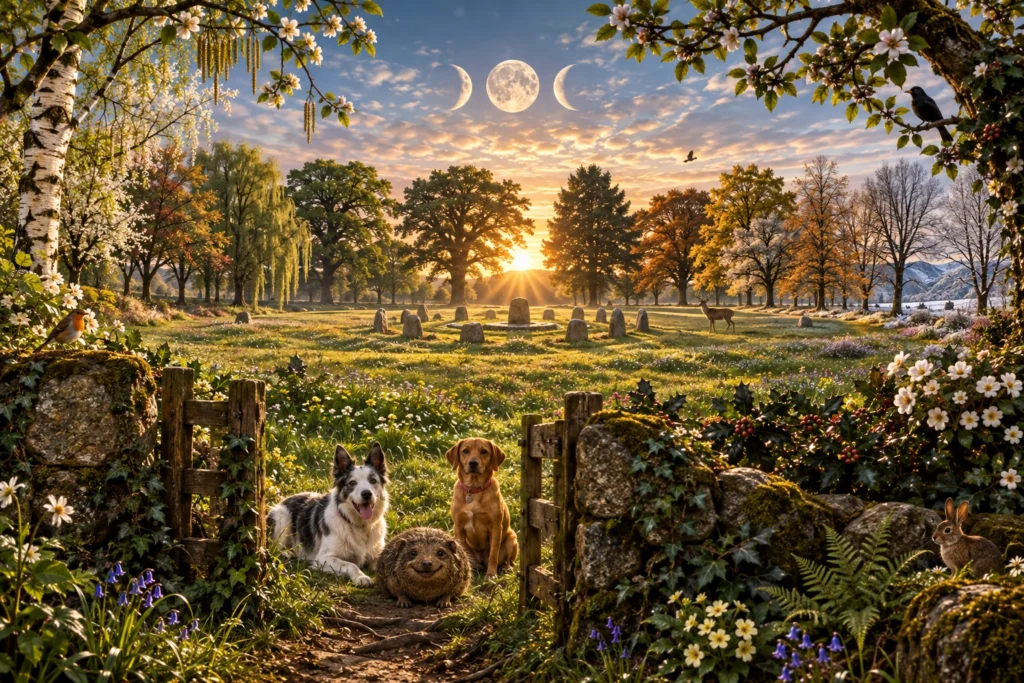
The Grove, known as Koad within the later Ogham tradition, is unlike any individual tree within the Ogham Tree Lore. It is a living sanctuary: a gathering place of trees, plants, animals, people and spirit, shaped by the relationships that grow between them.
Within Celtic Tree Lore, the Grove carries associations with community, learning, healing and sacred tradition. Yet its meaning reaches beyond any single practice or belief. It can be home and sanctuary, a place of belonging and continuity, where knowledge is shared, stories are remembered and generations leave something of themselves for those who follow.
The Grove invites us to discover what happens when life gathers together.
Grove – Ogham Tree Profile
Bruce Clifton
Name: Grove
Ogham: Koad >> cod ~ quot ~ kwod
Letter: Ea
Lunar: 13 houses
Season: Winter ~ Spring ~ Summer ~ Autumn
Element: Earth ~ Wind ~ Fire ~ Water ~ Spirit
Direction: North ~ East ~ South ~ West ~ Centre
Moon Phase: Variable
Moon Name: Variable
Influence: Unified
Title: Community
Age: Eternal
Aura: Variable
Healing: Evidenced
Animal Spirit: Evidenced
Totems – Entities: Evidenced
Gods – Deities: Evidenced
Secret Harmonies: Evidenced
Festival: (coming soon)
Cosmos: (coming soon)
Key Words: Belonging ~ Community ~ Continuity ~ Home ~ Sanctuary
Essence of the Grove
Bruce Clifton
There is a moment when a collection of trees becomes a Grove.
No single tree creates it. The Oak does not cease to be Oak, nor the Hazel surrender its character to the Hawthorn. Each grows according to its own nature, drawing from the same earth, reaching into the same sky and making room, somehow, for the lives growing beside it.
This is the essence of the Grove: belonging.
To belong is not to become the same. The tallest tree still reaches beyond the canopy; the smallest flower still opens close to the earth. Roots cross beneath paths. Branches meet above them. Birds arrive and depart, animals make their homes, seedlings appear where old trees have fallen, and generation after generation inherits a place already shaped by everything that lived there before.
Humanity enters the Grove in much the same way.
We arrive carrying different knowledge, different experiences and different ways of seeing. The healer does not need to become the teacher, nor the teacher the storyteller. The child does not possess the wisdom of the elder, but neither does the elder possess the wonder of the child. Each brings something that would be absent without them.
Perhaps this is why the Grove became a place of learning. Knowledge grows differently when it is shared. One person knows the tree, another the herb beneath it, another the animal that feeds upon its fruit, another the season in which it flowers. What begins as individual experience becomes relationship, and relationship allows understanding to grow beyond the limits of any single life.
The same is true of spirit. What is seen and what is unseen need not compete for the same ground. The crow can remain a crow and still carry meaning. The ancient tree can be timber, shelter, memory and sacred presence without one truth diminishing another. The Grove has room for all of them.
And this is its greatest teaching.
We spend so much of life deciding where one thing ends and another begins: self and other, human and nature, life and death, knowledge and mystery, earth and spirit. Yet beneath the branches those boundaries become less certain. Fallen leaves become earth. Earth becomes root. Root becomes tree. Tree becomes blossom, fruit and seed, and the seed begins again.
Nothing has lost its individuality.
Nothing stands alone.
The Grove is where difference discovers that it belongs.
Healing Lore of the Grove
Bruce Clifton
The healing lore of the Grove begins with the Druid.
A newly established Grove may have possessed little more than the knowledge and experience carried by the Druid who founded it. The plants, trees and natural resources available would have depended upon the land in which the Grove was established, while the Druid brought knowledge accumulated through learning, observation and travel. From these beginnings, the healing tradition of each Grove could develop its own character.
As the Grove became established, it attracted people. Some came seeking knowledge, some seeking healing and others carrying knowledge of their own. If the Grove developed into a place of learning, the Bard and Ovate might become part of its community. A Wise Woman, Midwife, Herbalist or other experienced healer might contribute knowledge gathered over a lifetime. A traveller arriving from another region could bring a remedy, technique or understanding previously unknown within that Grove.
These roles were not necessarily exclusive. A Bard might also understand herbs, assist at childbirth or know how to set a broken bone. A Midwife might be an accomplished Herbalist. The Druid or Ovate might possess considerable knowledge of healing alongside their other responsibilities. Individual people developed particular abilities and reputations, but practical knowledge did not have to remain confined within the boundaries of a title.
Nor should we imagine every Grove containing every kind of healer. One Grove might have only its Druid; another, established over generations, might become home to a substantial community of knowledge. Its strength lay not in possessing a prescribed number of practitioners, but in the experience that had accumulated there and continued to be shared.
The land contributed as much to this development as the people. A coastal Grove did not possess precisely the same resources as a woodland Grove, nor would a Grove in the mountains encounter exactly the same plants, conditions or needs as one established within a fertile valley. As Druids and other healers travelled between them, knowledge could travel too. What was learned in one landscape could become valuable in another.
The Grove therefore became more than a place where remedies were found. It became a place where healing knowledge could gather, develop and survive. Plants could be recognised, remedies prepared, injuries treated, children delivered and experience passed from one generation to another.
No single healer needed to know everything.
The Grove knew more than any one of them.
Grove – Healing Practitioners Oracle
We have alphabetised this list of healers of the Grove solely for ease of reference; no sense of hierarchy or entitlement is intended or implied, they include but are not limited to:
1) Bard
2) Crone
3) Druid
4) Hedgewitch
5) Herbalist
6) Medicine Man
7) Midwife
8) Monk
9) Old Hag
10) Ovate
11) Shaman
12) Wise Woman
13) Witch
14) Yogi
Bard
Bard / Grove
Who is the Bard?
The Bard is the memory of the Grove. The keeper of its stories, histories, genealogies, experiences and accumulated knowledge, preserving through memory and teaching that which might otherwise disappear with the passing of a generation.
A Bard may be young or old, student or teacher, newly admitted or experienced enough to teach a Bardic school of his own. Bardry is not simply a stage that must be abandoned in order to become an Ovate or Druid. A person may devote a lifetime to the Bardic path, developing from student to teacher and eventually becoming recognised for the depth of knowledge they carry. Greater knowledge brings greater responsibility, but not greater human worth.
What is the Bard?
The Bard is a practitioner of memory and transmission. In an oral tradition, remembering is not passive. Memory must be exercised, disciplined and taught. Story, poetry, song, rhythm, repetition and recitation provide ways by which substantial amounts of knowledge can be retained and accurately passed from one person to another.
Within the healing community this gives the Bard an important purpose. The Bard need not be exclusively a healer, yet may also be a Herbalist, Bonesetter, Midwife or possess other practical knowledge. More importantly, the Bard helps preserve what the Grove has learned. Which plants were traditionally used, how remedies were prepared, what techniques were taught, what was learned from experience and what knowledge was brought home by travellers can survive because somebody remembers and passes it onwards.
A remedy known only to one healer may die with that healer. The Bard helps prevent that death.
Where does the Bard come from?
The Bard comes from the tradition of oral learning. Before knowledge could be stored conveniently in books, libraries or electronic records, much of the knowledge of a community survived verbally from person to person. The Bard became one of those living repositories.
Within the Grove, a Bard may emerge from its own school or arrive carrying knowledge learned elsewhere. A visiting Bard brings more than stories: they bring the memory of another community, another landscape and another body of experience. In return, they may carry something learned within this Grove onwards to the next.
The Bard therefore belongs to no fixed age and need not occupy a fixed position beneath another practitioner. A Chief Bard may possess knowledge accumulated across an entire lifetime, while still remaining a Bard. The Druid may possess knowledge the Bard does not; equally, the Bard may know things the Druid does not.
Within the Grove, that difference is not a weakness.
It is the reason they need one another.
Crone
Crone / Grove
Who is the Crone?
The Crone is the elder woman of experience. Her knowledge has been accumulated through living: through observing birth and death, childhood and ageing, health and illness, abundance and hardship. She has watched generations grow around her and carries knowledge inherited from those who came before, strengthened by everything she has witnessed for herself.
The Crone does not require a formal position within the Grove. She may never have been an Initiate, Bard, Ovate or Druid. Her authority comes from experience, observation and the knowledge entrusted to her by others.
Within healing, this can make her particularly valuable. She may understand childbirth and women’s health, recognise familiar illnesses, prepare herbs and simple remedies, dress wounds, tend the dying or simply recognise when something is wrong. She may also know when her own knowledge is insufficient and another healer is needed.
What is the Crone?
The Crone is a keeper of lived knowledge.
Where the Bard preserves knowledge through memory and transmission, the Crone carries knowledge acquired through experience. She remembers the remedy her grandmother prepared, the plant used by a travelling healer, what happened during a difficult birth, which treatment failed and which succeeded, and the signs that preceded an illness encountered many years before.
Her healing may therefore extend beyond the remedy itself. A frightened mother may need reassurance as much as assistance. Someone approaching death may require companionship rather than medicine. A young healer may possess learning but lack experience. The Crone has lived through many of the experiences that others are encountering for the first time.
She may be Herbalist, Midwife, Wise Woman or something of all three. These identities need not compete. Within the Grove, knowledge overlaps.
Where does the Crone come from?
The Crone comes from the community itself.
She may have been born within it or arrived from somewhere else. She may have travelled widely or spent an entire lifetime upon the same land. What defines her is not where she was born, but the accumulation of experience she carries and her willingness to pass that experience onwards.
Every community ages. Children become adults; adults become elders; knowledge passes from one generation to another. The Crone represents that continuity. She reminds the Grove that not everything worth knowing is learned through formal teaching. Some knowledge can only be acquired by living long enough to encounter it.
Age does not place the Crone above the Bard, Ovate, Druid, Midwife or Herbalist, nor does the absence of formal Druidic learning place her beneath them. She possesses knowledge that others may not, just as they possess knowledge that she may not.
Within the healing community of the Grove, her experience is her contribution.
And when that experience is shared, it becomes part of the knowledge of the Grove.
Druid
Druid / Grove
Who is the Druid?
The Druid is the founder, practitioner and teacher of the Grove, but perhaps most importantly, the Druid is the person who first chooses to make the Grove home.
In much the same way that a person may choose a house and gradually make it a home, the Druid chooses a place within the landscape and begins to establish a relationship with it. The trees, plants, water, animals, seasons and character of the land are not merely resources to be used; they become part of the life that develops there. The Druid learns from the land while bringing knowledge gathered through learning, experience and travel.
A newly established Grove may contain little more than the Druid and that relationship with place. It becomes something greater through hospitality. Travellers are welcomed, the sick may seek help, knowledge is exchanged and people begin to return. Some may eventually choose to remain. What began as one person’s home gradually becomes a home shared by others.
As the Grove develops, so does its healing knowledge. A Bard or Ovate may join its community. A Crone, Herbalist, Midwife, Bonesetter or other practitioner may contribute experience gathered elsewhere. Students may arrive to learn, while travelling healers bring remedies, techniques and observations from other landscapes.
The successful Grove therefore grows not through possession, but through participation.
What is the Druid?
The Druid is a practitioner of comprehensive knowledge and its application. Within healing, this may include knowledge of plants and remedies, recognition of illness and injury, care of the sick and an understanding of the relationship between the individual, the community and the land.
The Druid may also be a Herbalist, Bonesetter, Midwife or healer, but being a Druid does not imply mastery of every healing practice. A Midwife may understand childbirth more deeply; a Bonesetter may possess greater experience of injury; a Crone may recognise through a lifetime of experience something the Druid has never encountered.
The wisdom of the Druid lies partly in recognising whose knowledge is needed and creating a Grove in which that knowledge can be shared.
There is no loss of status in asking another for help. Knowledge may distinguish one practitioner from another, but within the Grove it need not divide them. Each contributes something to the whole.
Where does the Druid come from?
The Druid comes from learning, experience and the journey between Groves.
Knowledge may have been acquired from teachers, Bards and Ovates; through observation and practice; through encounters with healers outside the Druidic tradition; and through travelling from one landscape to another. A coastal Grove teaches different lessons from a woodland Grove. Mountain, valley, river and plain each provide different plants, animals, conditions and experiences.
Eventually a travelling Druid may encounter somewhere that feels right and choose to remain.
That decision is the beginning of another Grove.
The Druid brings what has been learned elsewhere, but does not attempt simply to reproduce the Grove that has been left behind. The new land has its own character and therefore its own lessons. A relationship begins between Druid and place, and through hospitality that relationship is opened to others.
In time, the Grove may become somewhere people seek for healing, learning, companionship and sanctuary. The Druid who established it may become teacher, healer and host, while those who gather there add knowledge and experience of their own.
The Grove may eventually know far more than its founder.
And perhaps this is one of the simplest expressions of the Druid’s relationship with the Grove:
The Druid finds a place within the land, makes it home, and leaves the door open for others.
Hedgewitch
Hedgewitch / Grove
Who is the Hedgewitch?
The Hedgewitch is the keeper of the boundary.
The hedge itself tells us something about the practitioner who takes its name. It grows where one place becomes another: between field and woodland, settlement and wilderness, cultivated ground and the land beyond. It shelters birds and animals, carries berries, flowers and medicinal plants, provides food and protection, and creates pathways through which wildlife moves almost unseen.
The Hedgewitch learns to live within that boundary.
They may be Herbalist, healer, diviner and spellcaster, yet none of those practices alone defines them. Their knowledge comes primarily through an intimate relationship with place. They know what grows around them because they have watched it emerge, flower, fruit, die back and return.
The Hedgewitch does not necessarily require the enormous collection of ingredients available to the Witch.
Much of what they need may already be growing outside the door.
What is the Hedgewitch?
The Hedgewitch is a practitioner of local knowledge and the spaces between worlds.
They know the plants of the hedgerow: which can feed, which can heal, which can harm and which should simply be left alone. They recognise the changing seasons through blossom, berry, leaf and seed. They know where animals travel, where water gathers after rain and where particular plants return year after year.
Their healing can therefore be practical.
A cut requires cleaning. A sting needs soothing. A cough may be eased. A plant can be gathered and prepared. An animal may require tending. Sometimes the person arriving at the door needs nothing more mysterious than warmth, food, rest and somebody prepared to listen.
But the hedge represents another boundary as well.
It stands between the familiar and the unknown.
For the Hedgewitch, that boundary can extend beyond the physical landscape. Dreams, intuition, divination, spirit and encounters with the unseen can belong alongside herbs, animals and remedies. Later magical traditions speak of hedge-riding as travelling beyond ordinary consciousness or between worlds.
Here the Hedgewitch can correspond closely with the Shaman and Ovate.
Yet their identity remains distinct.
The Shaman may journey between realities through the practices of their own tradition. The Ovate may develop profound knowledge of physical and metaphysical correspondence.
The Hedgewitch begins with something wonderfully simple:
the hedge outside the door.
Through knowing one boundary intimately, they begin to understand the nature of boundaries themselves.
Where does the Hedgewitch come from?
The Hedgewitch comes from the edge of the community.
Not necessarily because they have been rejected by it.
They may simply prefer it there.
The centre of the settlement contains people, conversation, commerce and activity. The boundary offers something different. There are fewer voices and more opportunities to hear the wind, birds and animals. The cultivated world remains close enough to participate in, while the wild world is close enough to enter.
This gives the Hedgewitch something the travelling practitioners of the Grove may never possess.
Intimacy with one small piece of land.
A travelling Druid may have crossed mountains and encountered distant Groves. A Shaman may carry traditions developed across generations. A Herbalist may recognise hundreds of plants.
The Hedgewitch may know every few yards of the path between their home and the woodland.
They know where the Blackthorn thickens.
They know where Hawthorn flowers first.
They know which Elder produces the best berries, where the Hazel overhangs the stream and where mushrooms appear after Autumn rain. They notice when a familiar bird fails to return and when an unfamiliar plant suddenly establishes itself.
This is knowledge created through presence.
The Hedgewitch also reminds us that healing knowledge does not always come from schools, temples or formal traditions. Sometimes it develops because somebody has spent decades paying attention to the same land.
And because they live upon the boundary, people can find them.
The Midwife may call when another pair of knowledgeable hands is needed. The Herbalist may exchange plants. The Wise Woman may share an observation. The Witch may require an ingredient that grows along the hedge. A Druid passing through may discover knowledge of the local landscape that no amount of travelling could have provided.
The Hedgewitch can learn from all of them.
And all of them can learn from the Hedgewitch.
There is another correspondence hidden within the name.
A hedge divides, but it also connects.
Follow an old hedgerow and it leads from one field to another, from farm to woodland, from settlement into countryside. For wildlife it becomes a road. For plants it becomes habitat. For people it marks the place where one territory becomes another.
The Hedgewitch occupies that same position.
Neither entirely wild nor entirely domesticated.
Neither entirely solitary nor separated from community.
Neither exclusively healer nor magician.
Neither confined to the physical nor lost within the metaphysical.
They belong somewhere between.
And perhaps that is why the Hedgewitch understands thresholds so well.
The Witch gathers correspondence and gives it intention. The Hedgewitch lives among correspondence until the boundary itself becomes the teacher.
Herbalist
Herbalist / Grove
Who is the Herbalist?
The Herbalist is the keeper and practitioner of the healing properties of plants. Their knowledge begins with the ability to recognise what grows upon the land, but extends far beyond simply knowing the names of herbs, trees, roots and fungi. They learn which parts are traditionally used, when they should be gathered, how they may be prepared and, equally importantly, when they should not be used.
Within the Grove, the Herbalist may be Druid, Ovate, Crone, Midwife, Wise Woman or Man, or someone whose particular knowledge of plants has earned recognition in its own right. The title describes an area of knowledge rather than a position within a hierarchy.
The Herbalist learns from the land immediately surrounding the Grove, but their knowledge need not end at its boundaries. Travellers bring plants, remedies and traditions from other places. A Herbalist may travel themselves, exchanging knowledge with other practitioners and returning with an understanding that can be shared with the community.
What is the Herbalist?
The Herbalist is the meeting place between plant and practitioner.
Knowing that a plant possesses healing properties is only the beginning. The Herbalist must recognise the plant correctly, understand the part traditionally used and know how it is gathered, preserved and prepared. Leaves, flowers, berries, bark and roots may possess very different properties. Preparation may involve an infusion, decoction, poultice, salve or other remedy, and experience teaches that the quantity and method can matter as much as the plant itself.
The Herbalist also learns through observation. What helped? What failed? What caused an unexpected reaction? What did another healer do differently? Knowledge grows through experience and is strengthened when it is shared.
This makes herbalism particularly suited to the Grove. No single landscape contains every healing plant and no single Herbalist possesses every tradition. A coastal Grove, mountain Grove and woodland Grove each provide different resources. Knowledge carried between them enlarges the understanding of them all.
The Herbalist therefore does not simply take from the land. They must first know the land: recognising its seasons, respecting what can be gathered and understanding that the continued availability of a plant depends upon allowing it to continue growing.
Where does the Herbalist come from?
The Herbalist belongs to no single culture.
Wherever human beings have lived closely with plants, knowledge of their uses has developed. Some of that knowledge became formal systems of medicine; some remained within families and communities; some was carried by midwives, monks, physicians, wise women, Indigenous healers and countless unnamed practitioners whose experience was passed from one generation to another.
The Chinese herbalist Li Ching-Yuen provides an extraordinary example of the way the Herbalist can become inseparable from the knowledge they represent. Remembered as a herbal practitioner and collector of medicinal plants, Chin became famous through remarkable stories concerning his longevity. Accounts differed enormously over his age, and the extraordinary lifespan attributed to him ranging from 80 to 256. (b.1677 – 1933) Yet the legend surrounding him is itself revealing: his reputation connected herbs, longevity, lifestyle and tranquillity rather than presenting healing as the taking of a single remedy.
For the Grove, that is important.
Knowledge does not become less valuable because it originated beyond the Grove, nor does wisdom cease at the boundaries of one country or tradition. A Druid travelling through another land may encounter a Herbalist who understands plants and practices previously unknown to them. The appropriate response is not superiority, but curiosity:
You know something I do not. Teach me.
The knowledge can then travel onwards. The Herbalist teaches the Bard; the Bard remembers. The Midwife contributes experience; the Herbalist learns. The Druid encounters another tradition and brings something home. In time, knowledge that once belonged to one person or one place becomes part of the accumulated understanding of the Grove.
The Herbalist therefore represents something greater than a collection of remedies.
The Herbalist listens to what the land can provide, learns from those who came before, and shares that knowledge with those who come after.
Medicine Man
Medicine Man / Grove
Who is the Medicine Man?
The Medicine Man is a healer, spiritual practitioner and keeper of knowledge within the Indigenous cultures of North America.
The English title encompasses many different traditions and should not suggest that every Native American nation understood medicine in precisely the same way. Each people possessed their own language, ceremonies, teachings and practitioners. Medicine Women also held these responsibilities, and the knowledge carried by them could include healing, plants, ceremony, divination, spiritual perception and the relationship between the individual, the community and the land.
These traditions are considerably older than European settlement of the Americas. Their beginnings cannot be reduced to a single date because knowledge was transmitted between generations long before Europeans attempted to record it.
The Medicine Man therefore comes to the Grove carrying something we have encountered before:
knowledge inherited, practised, developed and passed onwards.
What is the Medicine Man?
The Medicine Man understands healing as something greater than the treatment of a physical symptom.
Plants and physical remedies may form part of the practice, but so may prayer, ceremony, divination, altered states of consciousness and communication with spiritual reality. The wellbeing of the individual can be understood through relationships with family, community, ancestors, animals, landscape and the unseen world.
Here the correspondence with the Shaman and experienced Ovate becomes particularly interesting.
All three may enter states of consciousness through which ordinary physical perception is no longer considered the boundary of experience. They may seek information, healing or understanding beyond what can immediately be seen. Their cultures, methods and explanations differ, but the territory they describe can overlap.
The Grove does not need to make them identical in order to recognise the correspondence.
Among the Apache, Geronimo provides a particularly powerful example. Remembered principally today as a warrior and leader of resistance, he was also recognised as a Medicine Man and attributed spiritual abilities to himself. His extraordinary ability to evade vastly greater pursuing forces contributed to stories and traditions surrounding his powers. He eventually surrendered in 1886 and died at Fort Sill in 1909, still a prisoner of war.
Alongside him stands Lozen, the sister of the Chihenne Apache leader Victorio. She was warrior, healer and spiritual practitioner, remembered particularly for an ability to determine the whereabouts and movement of enemies through prayer and spiritual practice. After Victorio’s death, she eventually joined Geronimo’s group.
Geronimo and Lozen therefore allow the Medicine Man and Medicine Woman to enter the Grove together.
Their importance here is not that every extraordinary story surrounding them must be accepted as literal history. Their importance is that their people remembered them as possessing abilities that extended beyond warfare and physical survival. Healing, spiritual perception, divination, landscape and survival belonged to the knowledge they carried.
Where does the Medicine Man come from?
The Medicine Man comes from an Indigenous American tradition whose roots extend far beyond the arrival of Europeans and Christianity in North America.
For countless generations, knowledge had to survive through people.
One generation taught another. Plants had to be remembered. Ceremonies had to be repeated. Stories preserved experience. Spiritual practices had to be learned rather than merely described. The knowledgeable practitioner consequently became part of the means by which the community preserved itself.
And here another correspondence with the Grove emerges.
Across an ocean, the Druid, Bard and Ovate belonged to entirely different peoples and traditions. Across northern Eurasia, the Shaman developed within another cultural world again. There is no need to claim that one copied another before recognising something remarkable within them all:
human communities repeatedly created ways of ensuring that important knowledge survived the individual who possessed it.
In North America that process continued into the historical period. The Cherokee silversmith Sequoyah, also known as George Gist or Guess, created the Cherokee syllabary, which was adopted in the early nineteenth century and enabled the Cherokee language to be recorded and read with extraordinary effectiveness. Medicine practitioners were among those who subsequently used Cherokee writing to preserve knowledge concerning healing and ceremony.
The method had changed.
The purpose had not.
Knowledge that had travelled from person to person could now also travel through signs.
For the Grove, this matters enormously. A Medicine Man arriving from another land does not arrive merely carrying remedies. They bring the accumulated experience of their people: knowledge of plants, animals, landscape, ceremony, healing and spiritual practice acquired through generations.
The Druid need not call it Druidry.
The Shaman need not call it Shamanism.
The Medicine Man need not surrender the tradition from which that knowledge came.
They can recognise something within one another because each understands that knowledge survives only when somebody carries it forward.
Geronimo and Lozen stand close enough to our own historical world for their names and experiences to have been recorded. Behind them stand generations whose names have disappeared but whose knowledge did not.
That is what the Medicine Man ultimately brings into the Grove:
The knowledge of those who came before, carried by the living, for the benefit of those who will come after.
Midwife
Midwife / Grove
Who is the Midwife?
The Midwife is the woman who waits at the entrance to life.
She knows pregnancy, labour and birth through experience passed from woman to woman and generation to generation. She understands the rhythms of the body, recognises when nature should be allowed to follow its course and knows when mother or child needs her intervention.
Her work can be exhausting, painful, frightening and sometimes heartbreaking.
Yet she repeatedly witnesses something extraordinary.
A life that has existed unseen suddenly enters the world.
What is the Midwife?
The Midwife is the keeper of the first threshold.
She attends two people who have yet to meet. She cares for the mother while waiting for the child, listening, watching and feeling for the moment when one existence becomes two.
The correspondences of birth are remarkable.
Darkness becomes light.
Water becomes air.
The unseen becomes seen.
The first breath is taken.
The first cry is heard.
And another human being enters the Grove.
There may be herbs, remedies, prayers and traditions surrounding the birth, but the greatest magic needs no embellishment.
The child is here.
Where does the Midwife come from?
She comes from humanity’s oldest necessity.
Long before her role possessed the name we use today, experienced hands helped women give birth. Knowledge accumulated with every labour: what helped, what endangered, when to wait and when to act.
Within the Grove, she may learn from the Herbalist, Crone, Wise Woman or Druid, and they may learn from her. Yet when the moment arrives, this is her knowledge and her responsibility.
The Grove may contain teachers, healers, travellers and practitioners carrying wisdom gathered across generations.
But every new generation must first arrive.
The Midwife stands at the entrance, receives the child from the darkness, and introduces them to the light of their new world.
Monk
Monk / Grove
Who is the Monk?
The Monk is the person who chooses to make learning, discipline and spiritual understanding a way of life.
They withdraw from many of the distractions and obligations of ordinary existence, not necessarily because they reject the world, but because they wish to understand it differently. Their monastery becomes home, school and sanctuary: somewhere knowledge can be acquired, practised, contemplated, preserved and eventually taught.
The Monk does not study simply to complete an education.
Learning is the life they have chosen.
Years may be spent with teachers before the Monk becomes a teacher themselves, yet there need be no moment at which learning is considered complete. Meditation deepens through practice. Knowledge develops through experience. Questions that appeared simple to the student may become considerably more complicated with age.
In this, the Monk finds an immediate correspondence with the Druid.
What is the Monk?
The Monk is a practitioner of disciplined knowledge.
Study alone is insufficient. Knowledge must become practice.
The Monk may meditate, contemplate, pray, work with breath and consciousness, study philosophy, learn healing traditions and understand the relationship between body, mind and spirit. Daily repetition is not necessarily restriction; it provides the discipline through which understanding can deepen.
The monastery consequently becomes more than somewhere to live.
It becomes a community of accumulated knowledge.
One practitioner knows something another does not. The experienced teach the inexperienced. Students eventually become teachers, while teachers remain students of something greater than themselves. Knowledge survives because each generation accepts responsibility for carrying it onwards.
Here the Monk and Druid can recognise one another.
The Grove is also home, school and sanctuary. The Druid creates a place where people can gather, learn, heal and develop. What has sometimes been described as twenty years of Druidic education need not represent twenty years followed by graduation and completion.
Twenty years may merely teach someone how much remains to be learned.
Where does the Monk come from?
The Monk comes from the human desire to step away from distraction in order to seek understanding.
Ancient monastic and ascetic traditions developed across Asia in different forms, particularly within India and throughout different cultures including Tibet and China. Their religions and philosophies were not identical, yet monasteries repeatedly became places of disciplined spiritual practice, teaching, contemplation and preservation of knowledge.
The Monk who enters the Grove therefore need not abandon the monastery from which they came.
Nor must the Druid become a Monk.
They can simply recognise the correspondence.
Both understand that knowledge requires time.
Both understand that discipline develops understanding.
Both understand the responsibility of teacher to student.
Both understand hospitality.
And both understand that a place of learning becomes greater when its knowledge is shared.
Neither possesses the final lesson.
The Monk may spend an entire lifetime seeking understanding and still approach tomorrow as another opportunity to learn.
The Druid can do exactly the same.
The Monk does not enter the Grove because their learning is complete. They enter because they understand that it never will be.
Old Hag
Old Hag / Grove
Who is the Old Hag?
The Old Hag is the woman who waits at the threshold.
She belongs to the darker part of the year, to evening becoming night and to the moment when consciousness begins to surrender itself to sleep. Within the Grove she is associated with Blackthorn, whose correspondences carry her towards Autumn and Winter, Water and Earth, West and North.
Everything is moving towards darkness.
And the Old Hag is already there.
Unlike the Crone, whose wisdom comes through the accumulated experience of a long life, the Old Hag carries something less comfortable. She is not necessarily the woman who reassures us that everything will be well. She may be the figure who confronts us with something that cannot be avoided.
Her association with sleep paralysis expresses this particularly well. Across different traditions, people have described awakening in darkness unable to move, sometimes sensing a presence or weight upon the body. In the folklore of the Old Hag, that presence became the Hag herself.
The sleeper cannot run from her.
Perhaps that is precisely the point.
What is the Old Hag?
The Old Hag is both affliction and confrontation.
Her relationship with Blackthorn expresses the same contradiction. Blackthorn can wound through its thorns and protect through the barrier those thorns create. It produces delicate white blossom upon dark wood and fruit as the year descends towards Winter.
The Old Hag similarly occupies the uncomfortable boundary between danger and protection.
She may induce the nightmare, but traditions also preserve knowledge of how the Hag may be resisted or defeated. The figure that represents the affliction consequently becomes inseparable from the knowledge required to overcome it.
Within healing, this gives the Old Hag a role unlike most of the other practitioners of the Grove.
The Herbalist may prepare the remedy.
The Crone may recognise the illness.
The Shaman may journey in search of understanding.
The Medicine Man or Woman may seek restoration through inherited spiritual practice.
The Old Hag makes us confront what has arrived.
There are experiences from which we cannot simply walk away. Pain, fear, illness, ageing and eventually death become unavoidable parts of life. Healing does not always mean removing them. Sometimes it means developing the knowledge, courage or understanding necessary to pass through them.
The Old Hag waits at precisely such places.
Where does the Old Hag come from?
Her ancestry reaches far beyond any single story.
The supernatural explanation of sleep paralysis is ancient. European traditions contain the mara or night-being that presses upon the sleeper, while later British and North Atlantic folklore preserves the image of the Hag who comes during the night. The English word nightmare itself retains something of that older relationship between sleep and the supernatural visitor.
Within Celtic and later folklore, the old woman also repeatedly appears at boundaries: between youth and age, fertility and barrenness, Summer and Winter, the familiar world and the Otherworld. She may frighten, challenge, test, advise or reveal. She cannot easily be reduced to either benevolent healer or malevolent witch.
That ambiguity is important.
Within the Grove, the Old Hag belongs naturally beside Blackthorn.
Autumn moves towards Winter.
West turns towards North.
Light becomes twilight.
Twilight becomes darkness.
Wakefulness becomes sleep.
Her arrival is therefore not unexpected.
It is inevitable.
Sooner or later everyone enters her territory. The year grows dark. The body grows old. Sleep overtakes consciousness. Difficulty arrives. Something beyond our control forces us to stop.
Yet Winter is not the end of the Grove.
Blackthorn survives it.
And perhaps this is where the Old Hag finally reveals her place among the healers. She does not promise that we can avoid darkness. She possesses something considerably older and harder:
the knowledge that darkness can be entered, endured and passed through.
The Old Hag waits where the light begins to fail.
She is not necessarily there to prevent us from entering the darkness. She may be there to teach us how to come out again.
Ovate
Ovate / Grove
Who is the Ovate?
The Ovate is the observer and interpreter of nature. Within the Grove, they seek to understand life not simply as a collection of separate things, but through the relationships connecting the physical, natural and metaphysical worlds.
Their learning may include the trees and plants of the Grove, animals and their behaviour, the changing seasons, weather, the human body, illness, healing, birth and death. Yet the Ovate also looks beyond what can immediately be touched or measured, exploring intuition, divination, dreams, spiritual experience and the correspondences through which one thing may reveal something about another.
This gives the Ovate a natural place within healing. Illness presents a physical condition, but the person experiencing it remains part of a family, community, landscape and spiritual life. The Ovate seeks to understand the whole rather than isolating one part from everything surrounding it.
What is the Ovate?
The Ovate is a practitioner of physical and metaphysical understanding.
Within the Grove, this may make the Ovate Herbalist, healer, diviner or observer of the natural world. They may study the properties of plants while also observing the season in which those plants emerge; recognise the behaviour of animals; understand the cycles of the Moon; explore dreams and intuition; and seek correspondence between the condition of the individual and the world surrounding them.
The Ovate does not have to choose between the physical and metaphysical. Both belong to the investigation.
A wound can be cleaned and dressed. A fever can be observed. A medicinal plant can be prepared. These belong to the physical world. But the Ovate may also ask questions that extend beyond the remedy: What preceded the illness? What has changed within the person’s life? What does intuition suggest? What can be learned from the land, the season or the behaviour of the natural world?
Not every Ovate will reach the same conclusion, nor will every Ovate possess the same abilities. One may become particularly knowledgeable in herbalism, another in divination, another in healing, animals, trees or spiritual practice.
The Ovate develops through observation, experience and enquiry.
Where does the Ovate come from?
The Ovate emerges from the ancient association between Druidry and the interpretation of nature.
Within the Grove, an Ovate may have begun through Bardic learning or arrived from another Grove carrying experience already acquired elsewhere. Some may continue their studies towards becoming a Druid; others may discover that the work of the Ovate is their vocation and remain within it for life.
There is no requirement for the accomplished Ovate to abandon one identity simply to acquire another.
An experienced Ovate may teach students, exchange knowledge with other practitioners and develop particular areas of understanding over an entire lifetime. A Druid may possess broader knowledge, while an Ovate may possess considerably greater knowledge within a particular field. Neither diminishes the other.
For healing, this becomes especially important. The Herbalist may know the plant. The Bonesetter may understand the injury. The Midwife may recognise the progress of birth. The Crone may remember having encountered the condition before.
The Ovate asks how these things relate.
They observe, listen, compare and interpret. Their contribution to the Grove is not simply possessing answers, but developing the ability to recognise connections that another practitioner may have overlooked.
The Bard helps the Grove to remember.
The Druid helps the Grove to apply.
The Ovate helps the Grove to understand.
Shaman
Shaman / Grove
Who is the Shaman?
The Shaman is a healer, spiritual practitioner and traveller between worlds.
The name originates among the Tungusic peoples of Siberia, although practices that modern writers describe as shamanic occur among many different peoples. Within those traditions the names, beliefs and methods differ, and they should not be regarded as a single universal religion. What they frequently share is the presence of a practitioner able to work between the ordinary human world and a spiritual reality understood to exist alongside it.
Within the Grove, the Shaman therefore arrives with a tradition that is not Druidic, yet may possess striking correspondences with Druidic understanding.
The Shaman recognises the land as inhabited by more than humanity. Animals, ancestors, spirits and forces of nature may participate within the spiritual landscape. Healing can consequently involve more than treating the physical symptoms of illness. The relationship between the person, their community, the natural world and the unseen may also require attention.
The Shaman brings this knowledge to the Grove.
What is the Shaman?
The Shaman is an intermediary.
Through ritual, trance, rhythm, drumming, movement, chanting, meditation or other practices belonging to their particular tradition, the Shaman may enter an altered state of consciousness through which communication with the spiritual world becomes possible.
Within healing traditions, the purpose may be to discover what has become disturbed, seek guidance, restore balance, provide protection or assist someone through illness, trauma, transition or death.
Plants may also form part of Shamanic healing, but the Shaman is not simply another Herbalist. Nor are they merely a diviner. Their particular knowledge concerns the ability to cross a boundary and return with something useful to the community.
That boundary might be understood as the division between human and spirit, living and ancestral, conscious and unconscious, physical and metaphysical.
This creates an interesting correspondence with the Ovate. Both may explore realities beyond immediate physical perception, working with the relationship between the physical and metaphysical worlds. An experienced Ovate, through considerable learning and practice, may journey deeply into these realities in ways that correspond closely with Shamanic practice. Their traditions and methods may differ, but the territory they explore can overlap.
Within the Grove, this similarity does not require us to decide that one tradition borrowed from the other, nor that they are different names for exactly the same practice. Instead, it provides an opportunity for recognition: two practitioners, arriving through different traditions, may discover that each has learned how to travel paths the other recognises.
The Grove allows those experiences to meet.
The Grove does not require one understanding to replace the other.
It allows them to meet.
Where does the Shaman come from?
The historical roots of Shamanic practice reach deeply into Siberia and northern Eurasia. Archaeological interpretations suggest possible Shamanic traditions extending thousands of years into prehistory, while later evidence allows increasingly recognisable comparisons with the practices eventually recorded among Siberian peoples.
The word Shaman itself entered European languages much later. The lateness of the written word should not be confused with the age of the practices it describes.
Beyond Siberia, peoples throughout Asia, the Americas and other parts of the world developed their own healers, spirit-workers and ritual specialists. Modern usage has frequently gathered these very different practitioners beneath the word Shaman, although their own cultures may use entirely different names.
For the Grove, their differences matter.
A Siberian Shaman does not need to become a Druid. A Druid does not need to become a Shaman. Neither must surrender their understanding before knowledge can be exchanged.
A travelling Druid encountering a Shaman may discover unfamiliar ways of understanding illness, animals, ancestors, spirits, altered consciousness and the relationship between humanity and the land. Equally, the Shaman entering the Grove encounters knowledge accumulated by its Druids, Ovates, Herbalists, Crones and other practitioners.
Each may possess something the other has never encountered.
And so the Shaman represents another important principle within the healing community of the Grove:
Knowledge may travel further than the culture in which it was born.
The Shaman crosses boundaries between worlds, but within the Grove another boundary can also be crossed — the boundary between one tradition and another.
Neither needs to disappear.
Both can learn.
Wise Woman
Wise Woman / Grove
Who is the Wise Woman?
The Wise Woman is the person people have learned to ask.
She does not necessarily hold an office within the Grove, nor must she have passed through a formal school of learning. She may never have called herself a healer, diviner, Herbalist or teacher. Her authority develops more quietly than that.
People come to her because, over time, she has demonstrated an ability to notice what others overlook.
She watches. She listens. She remembers.
Perhaps she recognises an illness because she has encountered it before. She knows which plant soothed the fever, which preparation eased the cough and which remedy failed completely. She remembers the difficult birth, the wound that would not close, the child whose symptoms looked insignificant until they suddenly became serious.
But her observation need not end with physical healing.
She notices the behaviour of animals, changes in the weather, recurring dreams and patterns within the natural world. She may read cards, cast stones, throw runes or examine the leaves remaining in the bottom of a cup.
Where another person sees chance, the Wise Woman may see correspondence.
What is the Wise Woman?
The Wise Woman is a practitioner of recognition developed through experience.
She may inherit knowledge from a mother, grandmother, healer or teacher, but inherited knowledge is only part of what she possesses. Much of her wisdom develops because she continues to compare what she has been taught with what she actually encounters.
She notices repetition.
A particular sign appears and something follows. Years later it happens again. Then again.
Observation becomes memory. Memory recognises pattern. Pattern reveals correspondence.
This is how something as ordinary as tea leaves can become a means of divination. The leaves themselves need not change. What changes is the ability of the person looking at them to recognise relationships within what they see.
The same principle can be applied to runes, Ogham staves, stones, cards, dreams, fire, water, birds or the movement of animals. Some systems come with established meanings handed down by others. Some understanding develops through the practitioner’s own experience.
The Wise Woman can work with both.
She inherits correspondence and discovers correspondence.
This distinguishes her without separating her from the other practitioners of the Grove. The Ovate may have devoted years to the deliberate study of nature and metaphysical relationship. The Herbalist may possess considerably greater knowledge of medicinal plants. The Midwife may understand childbirth more deeply. The Crone may carry the experience of a much longer life.
The Wise Woman does not need to know more than all of them.
Wisdom also means recognising who knows what you do not.
Where does the Wise Woman come from?
She comes from the community.
Every culture has produced people whose knowledge was recognised long before it was formally recorded. In Britain and Europe, surviving records eventually speak of wise women, cunning folk, herb women and other community practitioners who might be consulted for illness, remedies, divination, lost possessions, troublesome circumstances or problems believed to have a supernatural cause.
But the written record does not create the Wise Woman.
It merely catches sight of her.
Her knowledge belongs to the much older human practice of observing the world, remembering what happens and passing useful understanding from one person to another.
Within the Grove, she might have lived in the same place throughout her life. Unlike the travelling Druid, Shaman or healer who arrives carrying knowledge from distant landscapes, the Wise Woman may know one landscape extraordinarily well.
She knows where the first herbs appear in spring.
She knows which stream floods after prolonged rain.
She knows where particular birds nest, when certain berries ripen and which plants disappear during a hard winter.
And she knows the people.
She remembers their births, illnesses, marriages, disagreements, losses and recoveries. People speak to her because generations before them spoke to her, or to someone who taught her.
Her reputation becomes her qualification.
That makes the Wise Woman particularly important to the Grove. Travellers can bring knowledge from across the world, but somebody must recognise how that knowledge corresponds with this place, these people and this land.
She can learn from the Druid and teach the Druid.
She can exchange remedies with the Herbalist, observations with the Ovate and memories with the Crone. She can learn an unfamiliar practice brought by a traveller and, through years of experience, discover how it works within her own community.
Eventually something she discovered for herself may be taught to another.
And at that moment, individual observation becomes part of the knowledge of the Grove.
The Wise Woman does not become wise because somebody gives her the name.
She watches until she recognises the pattern, listens until she understands the correspondence, and shares what she has learned when somebody comes to ask.
Witch
Witch / Grove
Who is the Witch?
The Witch is the caster of spells.
She understands correspondence, but she does more than recognise it. She gathers it, combines it and gives it direction. Plant, tree, stone, animal, season, Moon, element, direction, colour, word and symbol may each possess their own nature, but the Witch understands how their correspondences can be brought together in pursuit of a particular intention.
This is the foundation of her spellcraft.
A spell need not begin with darkness, wickedness or harm. At its simplest, a spell is intention given form through correspondence. The greater the knowledge behind the correspondences, the greater the concentration placed upon the intention and the clearer its purpose, the more complete the spell becomes.
The Witch therefore requires an extraordinary breadth of knowledge.
She must know her ingredients, but knowing their names is not enough. She needs to understand why they belong together. She knows what should be gathered, where it might be found and when it should be collected. She understands that the same plant gathered beneath a different Moon, during another season or for another purpose may carry a different correspondence within the spell she is creating.
Nothing need be accidental.
The Witch creates synchronicity.
What is the Witch?
The Witch is a practitioner of intentional magic.
This places the Witch surprisingly close to the Druid.
A Druid who selects the wood of the Spindle, understands its correspondence, performs the appropriate action and deliberately seeks to remove an obstruction for the greater good is doing something immediately recognisable to the Witch. The tradition may be different. The language may be different. The practitioner may be different.
The principle is familiar.
Both understand that knowledge can be applied.
The Witch may therefore possess knowledge of herbs comparable with the Herbalist, recognise correspondence like the Wise Woman, understand metaphysical relationships familiar to the Ovate and communicate with spiritual realities encountered by the Shaman.
Yet none of these things alone makes the Witch.
Her particular knowledge lies in knowing how to bring them together.
The herbs upon her table, the flame of a candle, the direction she faces, the words she speaks and the time at which she performs the work can become parts of the same deliberate act. Individually they possess correspondence. Through knowledge they are assembled. Through concentration they are focused.
Through intention, they become the spell.
And intention matters.
The Witch may cast for healing, protection, fertility, reconciliation, courage, prosperity or the removal of an obstacle. The morality of the spell does not reside in the candle, herb, stone or incantation. These things have no human ego with which to hate, envy or seek revenge.
The intention belongs to the practitioner.
Knowledge provides possibility.
Intent gives it direction.
Where does the Witch come from?
Perhaps this is partly why the Witch became mysterious.
She may live within the community without entirely belonging to it. She may prefer the woodland edge to the crowded settlement, the company of animals to unnecessary conversation, and the presence of spirit and elemental life to the expectations of other people.
Her independence makes her difficult to understand.
The cat beside her becomes her familiar. The broom becomes her emblem. Her knowledge becomes magic. Her solitude becomes suspicious.
And what is not understood can easily become feared.
The Witch consequently acquired another identity—one created as much by those who feared her as by the Witch herself. She became the explanation for the failed harvest, the sick animal, the unexpected death, the unwanted childlessness or the misfortune for which somebody desperately wanted a cause.
The historical witch hunts reveal how dangerous that transformation could become.
In seventeenth-century England, the self-appointed Witchfinder General Matthew Hopkins and his associates moved through East Anglia investigating accusations of witchcraft. Their activity lasted only a few years, yet it contributed to an extraordinary concentration of accusations, prosecutions and executions. Where professional witch-finding became active, witches seemed remarkably easy to find.
Perhaps the uncomfortable question is not whether Hopkins discovered evil.
It is how much evil human beings can create when fear, certainty and authority are given permission to search for it.
The Witch survived the Witchfinder.
So did the broomstick, the cauldron, the familiar and the spell.
Some of those images were created or exaggerated by people who feared witchcraft, yet the Witch eventually reclaimed them. The broomstick that once helped caricature her now identifies her. The black cat once offered as evidence of sinister companionship now sits quite comfortably beside her.
And the spell remains at the centre.
Although the Witch is so often portrayed as female, witchcraft itself need not be feminine. Men as well as women have practised magic, been described or accused as witches, and died during periods of witch persecution. The Witch may therefore be masculine or feminine, while the familiar image of her remains one of the most enduring archetypes within folklore.
Within the Grove, she need not surrender that mystery.
She may still disappear into the woodland alone. She may speak to her cat more readily than to the people passing her door. She may collect something apparently insignificant because she understands a correspondence nobody else has noticed. She may spend days preparing for something that takes only minutes to perform.
Those who do not understand her may call it superstition.
Those who fear her may call it evil.
The Witch calls it knowledge.
She knows what she needs.
She knows why she needs it.
She knows when to gather it.
She knows how to bring it together.
And, above all, she knows what she intends to do with it.
The Witch does not merely recognise correspondence. She gathers correspondence around an intention until intention itself becomes the spell.
Yogi
Yogi / Grove
Who is the Yogi?
The Yogi is the practitioner who discovers that the body, breath, mind and spirit are not separate instruments.
To many people today, Yoga means physical posture: stretching, balance, controlled movement and the extraordinary positions into which an experienced practitioner can place the body. Yet the physical practice is only one expression of something considerably deeper.
The Yogi seeks union.
For one practitioner, the journey may begin with the body. Posture becomes discipline. Movement becomes concentration. Breath becomes deliberate. Through control of the physical body, the Yogi begins to recognise and direct the energy moving through it.
For another, the journey begins within.
Stillness replaces movement. Meditation disciplines the mind. Attention becomes increasingly concentrated until thought itself becomes something that can be observed, quietened and directed.
One appears physical.
The other appears spiritual.
Yet each is approaching the same relationship from a different direction.
What is the Yogi?
The Yogi is a practitioner of directed energy through disciplined consciousness.
The physical Yogi works through the body. Posture, movement and breath are not performed merely for strength or flexibility. The body becomes the means through which energy is recognised, concentrated and directed.
The spiritual Yogi works principally through consciousness. Stillness, meditation, breath and concentration allow the practitioner to explore the internal landscape and develop an extraordinary awareness of thought, sensation, energy and self.
But the division is never absolute.
The physical Yogi requires concentration.
The meditating Yogi still inhabits a body and breathes.
Body influences mind.
Mind influences body.
Breath belongs to both.
Eventually the distinction begins to disappear.
Perhaps one of the most enduring images of spiritual practice demonstrates this beautifully.
The Buddha sits beneath a tree.
Siddhartha Gautama sought understanding through discipline, contemplation and meditation, eventually sitting beneath the Bodhi tree and attaining awakening.
Outwardly, very little appears to be happening.
There is no great physical journey. The tree remains where it has always stood. The body sits upon the earth.
Yet inwardly, an extraordinary journey is taking place.
This is the territory of the Yogi.
Buddhist traditions also speak of radiance accompanying profound spiritual attainment. Whether understood as spiritual energy, presence, illumination or symbol, the correspondence is powerful: something cultivated within the individual becomes perceptible beyond the individual.
Later Buddhist traditions developed many Buddhas, bodhisattvas and enlightened figures associated with different qualities, while popular traditions gave us figures such as Budai, the Laughing Buddha, associated with happiness, generosity, contentment and abundance.
The imagery gives us another expression of the same principle:
the condition cultivated within ourselves influences what we bring into the world around us.
This also creates an unexpected correspondence with the Witch.
The Witch gathers correspondences from the world around them and concentrates those correspondences upon an intention. Herbs, symbols, elements, directions, time and ritual may be brought together until intention is given form.
The Yogi begins with the correspondences already contained within themselves.
Body.
Breath.
Mind.
Consciousness.
Energy.
Intention.
The Witch constructs the spell.
The Yogi becomes the instrument.
This does not make Witchcraft and Yoga the same practice. Their traditions, language and methods are different. What they reveal is a correspondence: intention becomes more powerful when attention is disciplined and energy is given direction.
Where does the Yogi come from?
The Yogi emerges from the ancient spiritual traditions of India, where practices concerned with meditation, disciplined living, breath, consciousness and the relationship between the physical and spiritual self developed over many centuries.
Yoga therefore cannot be understood simply as exercise.
The familiar physical postures represent one expression of a much larger search concerned with consciousness, self-understanding and the relationship between the individual and something greater than the individual self.
Across different traditions, emphasis may change. One practitioner may approach understanding through movement and physical discipline; another through stillness, meditation and the disciplined mind. Yet neither body nor consciousness exists independently of the other.
This is why the Yogi belongs within the Grove.
The Druid understands relationship through the land.
The Witch understands correspondence and gives it intention.
The Monk understands that knowledge requires discipline and a lifetime of practice.
The Yogi brings another understanding:
before attempting to understand the energies surrounding us, we can learn to recognise those moving within us.
The Yogi may sit beneath a tree without moving.
They may breathe.
They may meditate.
They may place the body into a posture requiring years of discipline to accomplish.
To somebody passing through the Grove, apparently very little is happening.
To the Yogi, an entire landscape is being explored.
The body becomes landscape.
The breath becomes movement.
The mind becomes observer.
Energy becomes correspondence.
Intention gives it direction.
And beneath the tree, the correspondence becomes beautifully simple.
The tree does not move.
The Yogi does not move.
And yet an entire world can change.
Celtic Tree Lore of the Grove
Bruce Clifton
The Grove is unusual within the Ogham Tree Lore because it is not represented by a single tree. Its character comes from the trees standing together. Oak remains Oak, Hazel remains Hazel and Hawthorn remains Hawthorn; each retains its individual properties and traditions, while collectively they create something that none could create alone.
For Celtic communities, trees were also practical resources. They provided timber, fuel, food, medicines, tools, shelter and boundaries, while woodland supported animals, plants and human settlement. Knowledge of trees was therefore not separate from everyday life. To understand the tree was to understand something of the land upon which life depended.
The Grove adds another dimension to that relationship. Classical writers associated the Druids with sacred groves and described them as teachers, judges, religious authorities and custodians of an extensive oral tradition. These descriptions survive through Roman observers and therefore preserve Roman perspectives rather than a Druidic account of itself; nevertheless, they contribute to a much wider tradition in which the Grove becomes associated with learning, ceremony, counsel and the transmission of knowledge.
Within that tradition, education need not be understood simply as a period of study completed after a prescribed number of years. The Grove represents continuing learning: the child receives knowledge, the initiate learns its meaning, experience deepens understanding, and eventually the learner becomes the person from whom others learn. Knowledge survives because it is passed onwards.
This may be the particular importance of the Grove within Celtic Tree Lore. An individual tree can teach its own lesson, but the Grove contains many trees, many generations and many forms of knowledge. Difference is not removed by their gathering; it is made useful.
The tree carries its lore. The Grove carries the tradition.
Folklore of the Grove
Bruce Clifton
“A little piece of heaven on earth”
There are voices that do not travel through the ear, touches that never meet the skin, and moments of knowing that arrive before thought has found the words to contain them. The five senses carry us wonderfully through the daylight world, but the Grove does not end at the boundary of their perception.
Nor do we.
Perhaps this is why folklore gathers so easily beneath trees. The Grove is filled with life, but life has never been limited to what can be counted. Every generation leaves something behind: laughter, grief, promises, prayers, births, deaths, footsteps, memories and love. People pass through the Grove and the Grove remains, holding what has been given to it.
The Moon understands this.
She does not illuminate the world as the Sun does. Her light is gentler. She leaves shadows where shadows belong. Beneath her, the Grove is not exposed; it is revealed slowly. What daylight makes obvious, moonlight makes intimate.
Folklore carries that remembrance from one generation to another. Its stories change because storytellers change, but the wonder beneath them remains. Fairies still dance where the grass grows differently. Spirits still walk the old roads. The dead still visit those they love. Animals still bring messages. Dreams still open doors. Trees still keep secrets.
And somewhere in every generation a child still looks into the darkness beneath the trees and sees something the grown-ups have forgotten how to see. When the child matures to adult, there may come an evening when they walk beneath those same branches, hear the crow calling beyond the path, feel the air change around them and remember the child within themself.
The winter prepares for the spring and the spring introduces the summer that gives way to the autumn, as the autumn surrenders gracefully to winter it looks forward and beneath the shadows of the moonlit evening and the quiet of the twilight hour it remembers what was… and smiles.
Animal Spirit of the Grove
Bruce Clifton
The animal spirit of the Grove cannot be defined by a single creature. Unlike the individual trees, whose relationships with animals may be explored through their particular character, habitat and folklore, the Grove is a community. Its animals arise from the land upon which it stands, the people who settle there, the work that must be done and the creatures that choose to live alongside them.
Before an animal becomes a symbol, it is an animal.
Before it becomes a totem, a story or a spiritual presence, there must first be a relationship.
When people establish themselves upon the land, they must learn to live according to what that land permits. A Grove within deep woodland develops differently from one upon open farmland, beside a river or high amongst the hills. The soil is different. The weather is different. Food and water are different. Travel is different. Even danger is different.
The people adapt, and the animals living beside them adapt as well.
The dog offers perhaps the clearest example. Humanity’s relationship with the dog reaches deep into prehistory, long before the Grove we imagine here. Yet there has never been only one relationship between human and dog. A dog required to guard is valued for different qualities from one required to hunt. A herding dog develops another purpose; a companion another. In later ages these differences would become increasingly visible in the extraordinary variety of dogs familiar to us today, from small companion breeds to powerful guardians, hunting dogs and mountain rescue dogs.
They remain dogs, yet human need, environment and generations of selection have produced animals capable of remarkably different lives.
The horse tells much the same story.
The heavy horse required to work cultivated land is not the same animal required for speed, distance or difficult upland country. Where the landscape demands sure footing, endurance and economy, smaller and hardier horses and ponies have advantages that a great draught animal does not. Where heavy loads must be moved, strength becomes more valuable. Human beings do not simply change the horse to suit themselves; the landscape determines what humans need from the horse.
Sheep, goats and other domestic animals continue the pattern. Across generations, climate, terrain, available food, isolation and human selection favour different characteristics. The animal becomes increasingly suited to the place, while the people become increasingly knowledgeable about the animal.
Neither develops entirely independently of the other.
The Grove therefore does not arrive upon the landscape complete. It grows from the relationship between place, people and animals.
Nor are all its animals invited.
The woodland has inhabitants of its own. Boar, deer, fox, hare and countless smaller creatures may cross the boundaries that humans imagine around the Grove without recognising those boundaries themselves. Birds nest in its trees. Bees and other insects move between its flowers. Predators follow prey. Scavengers consume what is left behind. Some creatures are welcomed, some tolerated and some feared, while others may become competitors for the same food upon which the human community depends.
Through observation, people learn them.
They learn which bird announces a season, which animal warns of danger, which creature appears before changing weather, where the deer travel, where the predator hunts and when the wild fruits will draw animals into the woodland. What begins as practical knowledge becomes inherited knowledge. Children learn what their parents learned, but they also add observations of their own.
Eventually, experience becomes memory.
Memory becomes story.
Story becomes culture.
And within culture, the animal can become something more than the creature standing before us.
The dog that guards the settlement comes to represent vigilance, loyalty and protection because generations have experienced those qualities directly. The horse that carries people across difficult country becomes associated with endurance, freedom or journey because those ideas were first lived before they were symbolised. The boar encountered in the forest may acquire a very different character from the sheep protected within the settlement because the human relationship with each is different.
Spiritual meaning does not need to be imposed upon the animal. It can grow from relationship.
This is why there can be no universal Animal Spirit of the Grove.
A mountain Grove and a woodland Grove need not share the same animals. A pastoral community will develop relationships different from those of hunters, farmers or travellers. Even two Groves occupying similar landscapes may acquire different traditions because different people have lived within them and different experiences have entered their collective memory.
Each Grove grows into its own animal spirit.
This also offers a way of understanding the wider Ogham journey. The individual tree profiles allow us to explore established relationships between tree, animal, folklore and spiritual meaning. The Grove asks an earlier question: how might such relationships have arisen?
The Forfeda take us beyond the individual tree and allow us to look at the community in which meaning develops. Here the connection between nature and spirituality need not begin with doctrine. It can begin with something much simpler: people living upon the land and paying attention to what lives beside them.
The landscape shapes the people.
The people shape their relationship with the animals.
The animals influence the culture of the people.
And the culture gives language, story and meaning to the relationship.
Over generations, the practical and the spiritual become increasingly difficult to separate.
The Grove does not choose its Animal Spirit.
It grows into it.
Totems and Entities of the Grove
Bruce Clifton
Not everything within the Grove can be touched.
The trees can be seen. The animals leave tracks. The healer gathers plants that can be held in the hand, while the changing seasons can be watched and measured. These things belong readily to the physical senses.
Yet human experience has never been confined entirely to what can be seen, heard, touched, tasted or smelled.
Across cultures and generations, people have spoken of ancestors, spirits, guides, apparitions, unseen companions and presences associated with particular places. Some describe encounters with deceased relatives. Others experience an unfamiliar presence that appears to belong to the land itself. A person may feel an immediate connection with somewhere they have never knowingly visited, or experience images, emotions and memories interpreted as belonging to another life.
Modern language often places such experiences beyond the five recognised senses and calls them extrasensory.
The Grove asks a different question.
What if they are not extra?
Within the spiritual philosophy of the Grove, the five physical senses are those most immediately suited to navigating physical reality. They tell us where the tree stands, whether the fire is hot, where the river flows and whether danger is approaching. They are essential to physical life.
But they need not represent the limits of perception.
The Grove therefore does not necessarily understand intuition, psychic awareness, mediumship or spiritual sensitivity as new abilities added to a human being. They may instead be understood as a continuation of perception: subtler ways of sensing that have become less familiar as human attention has increasingly concentrated upon the physical world.
The sensitive person does not necessarily create the presence by sensing it.
They notice.
This distinction is important.
An ancestor is not a god because somebody remembers them. A deceased relative is not necessarily worshipped because their presence is felt. A guide need not become a deity, and an unexplained figure encountered within the Grove does not require a mythology before somebody can acknowledge the experience.
These are the Totems and Entities of the Grove: the unexplained companions at the edge of ordinary perception.
A Grove inhabited across generations would carry an extraordinary human history. Children were born. Elders died. Teachers passed their knowledge to students. Healers treated the sick. Travellers arrived and departed. Relationships formed, ceremonies were performed, stories were told and countless lives touched the same land.
The living community is therefore only the most recent chapter in a much longer story.
Within the philosophy of the Grove, some part of that story may still be perceived.
One person may sense an ancestor. Another may recognise someone they understand as a former teacher or guardian of the place. Another may encounter something for which they have no name at all. The psychic may interpret an impression differently from the Druid, the medium, the seer or the visiting stranger because each approaches the experience through a different body of knowledge and cultural language.
The experience may come first.
The explanation comes afterwards.
And that distinction allows different traditions to coexist within the Grove. One culture may call something an ancestor, another a spirit, another a guide, while another may possess a name for which there is no precise translation. Different names need not mean that the experiences themselves are identical, nor must different interpretations be forced into a single explanation.
The Grove listens before it names.
This is why its Totems and Entities cannot be reduced to a fixed list. They belong partly to the people, partly to the history of the place and partly to those experiences that remain unexplained. Just as every Grove develops a different relationship with its animals, every Grove accumulates a different history of human presence.
The physical community changes.
The remembered community grows.
And perhaps, for those who perceive beyond the familiar senses, another community continues beside them.
The Grove does not demand that every person perceive it. Nor does it require every unexplained experience to be given a name.
It simply leaves room for the possibility that what cannot be seen is not necessarily absent.
Gods and Deities of the Grove
Bruce Clifton
Before humanity gave the gods names, there was the world.
The Sun rose. The Moon crossed the night. Stars moved through the seasons. Storms broke across the land, rivers flooded, crops failed and returned, animals gave birth and winter followed summer.
Mountains stood beyond the memory of any living person, while ancient trees survived generations beneath their branches.
These things did not require belief in order to exist.
For the people of the Grove, the natural world was not something observed from a distance. It determined whether they were warm, whether they ate, whether their animals survived and whether there would be another harvest. The changing position of the Sun altered the length of the day. Rain could bring abundance or destruction. Fire could preserve life or consume it. The river that provided water could also overflow its banks.
Human beings learned because they had to.
They watched.
They remembered.
And they passed what they learned to those who followed.
Knowledge allowed people to recognise patterns, but knowledge did not necessarily diminish wonder. To understand that the Sun would return after the longest night did not make its return insignificant. To know the seasons did not remove dependence upon them. Familiarity with a mountain did not make the mountain smaller.
Some things remained greater than the individual human life.
It is here that the Grove begins its exploration of gods and deities.
A great tree can inspire awe without first requiring a theology. A mountain can dominate the landscape without being given a name. The Sun can provide warmth before anybody tells a story about it. The Moon can illuminate the darkness before anyone gives meaning to its changing face.
Experience comes before explanation.
As generations observe the same forces, practical knowledge gathers around them. Stories gather too. Human beings give names to what matters. They describe characteristics, relationships and intentions. One generation inherits the observations of another and adds something of its own.
What was experienced becomes remembered.
What is remembered can become story.
Story can become tradition.
And tradition can become sacred.
This does not mean that every god or deity arose in the same way, nor that the many religions of humanity can be reduced to a single origin. Cultures develop through different histories, landscapes, migrations and encounters. Their gods carry those differences.
But the Grove recognises something fundamental beneath them: human beings form spiritual relationships with the world they experience.
Place therefore matters.
A community living beside the sea develops a relationship with water that an inland community may never share. Those dependent upon cultivated land watch fertility, rainfall and harvest with particular attention. People living beneath mountains experience the permanence and danger of those mountains differently from people whose horizon stretches across an open plain.
The heavens are shared, but even they are viewed from different places.
The Grove does not therefore require every community to recognise the same gods.
Just as the land helps shape its animals, its healing traditions and its stories, so too can landscape help shape what a people considers sacred.
There is also another kind of power.
Birth and death cannot be placed upon an altar before they are experienced. Love cannot be gathered like a herb. Wisdom cannot be pointed towards in the sky. War, justice, fertility, healing, inspiration and transformation are not objects in the same sense as a mountain or tree.
Yet they profoundly affect human life.
Cultures have therefore given form not only to the powers of the natural world but also to the forces experienced within human existence. Through story and personification, something difficult to hold can be given a face, a name, a history and relationships of its own.
The deity makes the immense understandable.
It gives human language to something that may otherwise remain beyond easy description.
Within the Grove, this need not diminish either the deity or the person who approaches it. The name becomes a way of entering relationship with something larger than the individual self.
One person may stand beneath an ancient tree and see only a tree.
Another may recognise an ancestor.
Another may perceive a spirit.
Another may encounter the presence of a god.
The physical tree has not necessarily changed.
The relationship has.
This is where Gods and Deities differ from the Totems and Entities of the Grove.
Totems and Entities brought us towards experiences whose physical source may be uncertain or absent: the ancestor sensed nearby, the unexplained presence, the guide, the memory that appears not to belong to this life.
Gods and Deities return us to manifestation.
The Sun can be seen.
The mountain can be climbed.
The storm can be heard.
The tree can be touched.
The consequences of fertility, winter, fire, water and death are encountered within physical existence.
Yet physical experience does not prevent spiritual meaning. Within the Grove, it can become one of the paths towards it.
Perhaps this is why gods have travelled so successfully through human history. Their names change. Their stories merge, divide and evolve. One culture encounters another and recognises similarities while preserving differences. The deity becomes part observation, part inheritance, part story and part continuing spiritual relationship.
The Grove does not need to decide which name is correct.
It asks instead what humanity was trying to understand.
Behind the names remain the Sun and Moon, earth and water, birth and death, abundance and scarcity, creation and destruction, love and conflict, wisdom and mystery.
And behind all of them remains relationship.
The people of the Grove look outward upon a world vastly greater than themselves and attempt to understand their place within it.
They observe.
They name.
They remember.
They tell stories.
They give thanks.
And sometimes, they worship.
The gods and deities of the Grove therefore need not belong to a single pantheon. They arise wherever human beings recognise that existence contains powers greater than the individual and seek a language through which relationship with those powers can be understood.
The Grove gives those relationships somewhere to meet.
It does not ask that they become the same.
It asks whether, beneath their different names and different stories, they may already belong to the same world.
Secret Harmonies of the Grove
Bruce Clifton
The Grove began with trees.
Yet no Grove was ever only trees.
Beneath their branches came the healer and the teacher, the child and the elder, the traveller and the storyteller. Animals lived beside them. Ancestors were remembered. Unexplained presences were sensed. The Sun crossed above them, the Moon returned through the darkness, seasons changed and generations passed.
Each could be considered separately.
The Grove teaches us to consider them together.
This is the beginning of its Secret Harmonies.
Throughout the Grove we have encountered difference. The herbalist does not heal in the same way as the midwife. The Druid does not carry the same knowledge as the hedgewitch. The dog experiences the land differently from the horse. The ancestor is not the mountain, and the mountain is not the Sun.
Difference is real.
Separation is another question.
Human beings understand much of the world through comparison. We recognise light because we know darkness. We distinguish hot from cold, large from small, visible from invisible, physical from spiritual. Comparison allows us to describe experience, organise knowledge and communicate it to others.
But the description is not necessarily the reality.
Day does not fight with night. Summer has not defeated winter when the seasons turn. The roots of the tree are not opposed to its branches because one grows into darkness and the other towards light.
They belong to the same tree.
Perhaps many of the opposites recognised by human thought are better understood in the same way.
The Senses of the Grove
The five familiar senses are extraordinarily well suited to physical existence.
Through sight, hearing, touch, taste and smell we navigate the world of matter. We recognise food, danger, distance, warmth, movement and one another. They anchor human awareness within physical reality.
Modern language places certain experiences beyond those senses and calls them extrasensory.
The philosophy of the Grove asks whether extra is the right word.
What if intuition, psychic awareness and spiritual sensitivity are not additions to human perception, but continuations of it?
Within this philosophy, humanity did not necessarily need to develop another set of senses in order to perceive spirit. Rather, as human attention became increasingly occupied by the demands, possibilities and achievements of physical existence, the senses most useful to that existence became dominant.
We learned to manipulate matter.
We cultivated land, domesticated animals, built settlements, worked metals, travelled greater distances and increasingly changed the environment around us.
Humanity became extraordinarily successful within physical reality.
And perhaps, in becoming so attentive to what could be touched, measured, possessed and changed, we became less attentive to what could not.
The subtler senses did not necessarily disappear.
We may simply have stopped listening to them.
This is a spiritual proposition rather than a scientific history of human perception. The Grove does not offer it as something that must be believed. It offers it as something worth contemplating.
Because if perception extends beyond what physical reality requires, then the apparently separate worlds encountered throughout the Grove begin to move closer together.
The animal and its spiritual meaning need not be separate.
The ancestor and the memory of the ancestor need not occupy entirely different worlds.
The tree and the sacred tree can be the same tree.
The Sun can be a star and still be sacred.
One understanding does not have to destroy another.
The Harmony of the Seen and Unseen
This is why the Totems and Entities of the Grove and its Gods and Deities belong beside one another.
They appear to approach spirituality from different directions.
Totems and Entities lead towards what is sensed without necessarily possessing an obvious physical form: ancestors, guides, memories, presences and those experiences that remain difficult to explain through the familiar senses.
Gods and Deities lead towards manifestation: Sun and Moon, mountain and river, storm and fire, fertility and death—the immense realities humanity encounters through existence and gradually surrounds with story, personality, reverence and worship.
One moves towards what is hidden.
The other towards what is revealed.
It is tempting to make them opposites.
The Grove does not.
They are different expressions of relationship.
What humanity perceives inwardly and what humanity encounters outwardly need not belong to separate universes. The boundary exists partly because we have named one physical and the other spiritual.
Perhaps the Secret Harmony begins when the boundary becomes less important.
Unity Without Conformity
The lesson has been present throughout the Grove.
Every tree remains itself, yet together the trees become woodland.
Every healer retains their knowledge, yet the Grove knows more than any single practitioner.
Every animal follows its own nature, yet together animals, people and landscape create an ecosystem.
Different cultures give different names to spiritual experiences.
Different peoples tell different stories about the powers they encounter.
Different gods carry different faces.
Nothing needs to surrender its identity.
Unity does not require conformity.
Nor does unity require everything to become identical.
Harmony is not produced by making every note the same. It exists because different notes can belong within something larger than themselves.
The Grove is therefore not a place where differences disappear.
It is where their relationships become visible.
And perhaps this is what humanity once understood more naturally: that physical existence, spiritual perception, animals, plants, ancestors, gods, people and landscape were not separate subjects requiring separate rooms.
They were life.
The Grove and the Sea
There is, however, something the Grove cannot teach by itself.
The Grove grows from the Earth towards the Sun.
It manifests.
Roots become trunks. Buds become leaves. Flowers become fruit. Animals leave footprints. People build, cultivate, teach and create. Knowledge is spoken and written. The invisible becomes visible through action and form.
The Grove therefore carries something of the Sun.
Beyond it waits another expression.
The Sea does not root itself to the land.
Its surface reveals only a fraction of what it contains. It receives the rivers, reflects the heavens and moves beneath the influence of the Moon. What disappears beneath its surface has not necessarily ceased to exist simply because it can no longer be seen.
The Sea carries something of the Moon.
It would be easy to call them opposites.
Land and water.
Sun and Moon.
Manifest and hidden.
Physical and spiritual.
But that would return us to comparison. (Is comparison the theft of joy?)
The Grove needs water.
The Sea receives the rivers that have passed through the land.
The Moon shines with reflected sunlight.
The Sun is reflected upon the water.
Each relationship leads back into another.
There is no point at which one can finally say, this exists entirely alone.
And perhaps that is the deepest Secret Harmony of the Grove.
Not that everything is the same.
Not that differences are illusions.
Not that one tradition, one god, one healer, one sense or one understanding must replace another.
But that beneath the distinctions through which humanity understands existence there may be something more fundamental:
relationship.
The tree does not cease to be a tree because it belongs to the forest.
The individual does not cease to be an individual because they belong to a community.
The physical does not cease to be physical because it carries spiritual meaning.
And spirit does not become less spiritual because it manifests within the physical world.
They are not enemies.
They are not competing truths.
They are expressions within something larger.
The Grove has shown us what grows above the surface.
The journey must now continue towards what lies beneath it.
The Grove turns towards the Sea.